WhatTheyThink

Premium Commentary & Analysis

Observations from an Old Printer: For some, history will repeat itself.

Editor&

Friday, May 10, 2002

Editor’s Note: Steven Schnoll, principal partner of Schnoll Media Consulting, has been a strategic advisor to this site since our start in March of 2000. He also offers his takes by writing periodically on different topics. Last year, he covered Printcafe’s user conference in Orlando and also reviewed the SWOP compliant Xerox Docucolor 12 with the Matchprint Professional Server.

This article is in response to yesterday’s TrendWatch release which stated that commercial printers were not ready for variable data printing. Schnoll remembers when there was resistance to switching from letterpress to offset. He compares that era with a printer’s decision today to ignore digital opportunities.

Observations from an Old Printer: Will history repeat itself?

TrendWatch Graphic Arts has released a report called Variable Data Printing: Where Are We in 2002. It declares that at least 98% of the digital printers worldwide are not prepared to deliver complex variable data applications.

Speaking about the report, Vince Naselli, Director, TrendWatch Graphic Arts stated, “There are more than 50,000 digital presses worldwide capable of printing variable data. Yet, recent estimates place the total number of commercial printing companies capable of producing complex variable data applications at only 500 to 1000 worldwide [1% to 2%]. The need/demand is apparent to any qualified marketer. Yet our most recent research indicates that only 11% of the commercial printers view variable data as a sales opportunity. The good news is that this number rose from 4% in '2000."

When I started in this business in 1969, letterpress was still the preferred method of print and the computer was the tool that got men to the moon. No one could have predicted the technological developments that impacted our industry. I remember fondly going to our local PIA chapter in New York called PIMNY, Printing Industries of Metropolitan New York, and listening to the sagacious men of our trade pontificate about how this new offset will never catch on because the agencies and publishers demand the quality of letterpress.

Well, history has proven them wrong and most of the companies they represented no longer exist. Many of the successful companies of the latter part of the 20th century did not exist in the early part of that century or if they did, young family members came in with a new vision of the future that Grandpa or Dad listened to.

When I read that printers are not adopting the likes of digital printing or don’t understand the dynamics of variable data printing I fondly reminisced. History does repeat itself. As I travel around the country and talk with printers I derive two conclusions – 1) printers who are busy are generally organizations that have seen the value of digital print and have developed successful marketing strategies to bring the power of print and the Internet to their customer base in one unified fashion. And 2) the printers who are extremely busy are those that see the true value of variable data and have developed comprehensive IT departments to manage data and the associated content to better help their customers track success.

Many of the latter group, are new companies with no preconceived notions of what print was in the past. They are supremely rational individuals who have carefully weighed the choices of graphic media delivery mechanisms and have presented multiple content delivery options to their customers.

Printers are categorically extremely irrational. They have a tough time identifying good options even when presented to them on a silver platter. Many aren’t very good decision makers and tend to be followers rather than leaders. While many have been in the industry for decades, they posses two common traits - fear and greed and therefore are prone to make many mistakes in business.

It is clear that the winners in our industry are starting to manifest themselves. These winners will have a deep commitment to IT and a real understanding of the Internet and potentially wireless. They will be fulfillment service organizations and the equipment on their floor will have labels like Xerox, HP Indigo, IBM, Xeikon and to some extent old faithful Heidelberg.

Printers --- do not miscalculate your future. Develop a winning business and behavior formula by undertanding these technologies. Don’t let history repeat.


Continue reading your article
with a WhatTheyThink membership.

WhatTheyThink Annual Membership

Less than $4/week.

Get unlimited access to in-depth commentary and analysis covering the latest trends, emerging technologies, operational strategies, and key events across every segment of today's printing industry.

Stay informed. Stay competitive. Stay ahead.
WhatTheyThink Day Pass

$5 for 24 hours

Unlimited access to all of WhatTheyThink. Get your Day Pass

Already a member?
Sign In

About WhatTheyThink

WhatTheyThink is the global printing industry's go-to information source with both print and digital offerings, including WhatTheyThink.com, WhatTheyThink Email Newsletters, and the WhatTheyThink magazine. Our mission is to inform, educate, and inspire the industry. We provide cogent news and analysis about trends, technologies, operations, and events in all the markets that comprise today's printing and sign industries including commercial, in-plant, mailing, finishing, sign, display, textile, industrial, finishing, labels, packaging, marketing technology, software and workflow.

Recent Articles from WhatTheyThink

The Total Label Issue

The Total Label Issue

This issue of the WhatTheyThink Quarterly is all about labels, which are seen as a high-growth part of commercial printing, driven by e-commerce, food/beverage demand, and regulations. The market has surpassed 1.2 trillion square meters of label production volume per year, and is moving toward high-mix, low-waste production rather than only high-volume throughput. While flexo is still used for high-volume label production, digital label printing often complements it—or in some cases replaces it. But labels are about more than printing technology. Read More

The Unified Platform for Packaging Manufacturing Excellence

The Unified Platform for Packaging Manufacturing Excellence

Leverage 30+ years of plant-floor expertise. Trusted by 700+ packaging manufacturers globally to reduce waste, optimize scheduling, and drive digital transformation. One unified foundation. Eight packaging-native pillars. Zero fragmentation. Read More

Expand Your Opportunities with the Truepress JET 560HDX from SCREEN

Expand Your Opportunities with the Truepress JET 560HDX from SCREEN

Commercial, direct mail, and publishing printers accustomed to producing jobs over several weeks can now print them in days with the SCREEN Truepress JET 560HDX. The press can accommodate 120 lb. coated or uncoated paper up to 560 mm wide. Read More

Around the Web: Of Water and Winners

Around the Web: Of Water and Winners

A sign-writer created the visual style of music festivals. The “2026 Milky Way Photographer of the Year” winners. AI appears to be catching on among the Amish. Sony has upgraded its wearable air conditioner. How to easily reuse produce bags. A complex digital water clock. A Nobel Prize–winning technology is able to extract water from dry air. Yes, it is possible to be allergic to water. Laser-induced graphene on Kevlar enables multifunctional structural composites. The “most desired” place in each of the 50 states. “The rise in plastic surgeons asked to create ‘AI face.’” K-pop band BTS has teamed with Oreo to release limited edition OREO x BTS Cookies. Welcome to WhatTheyThink’s weekly miscellany. Read More
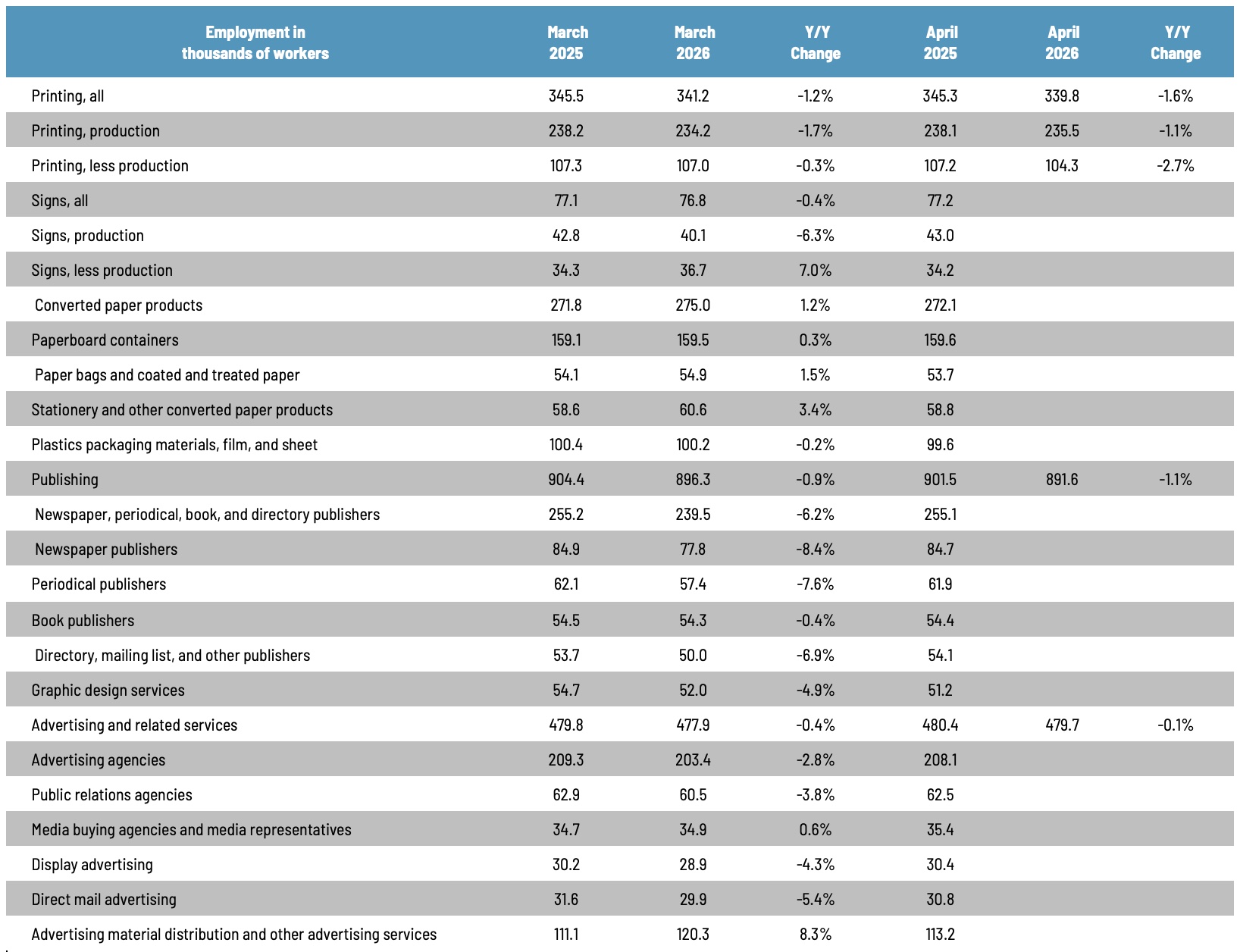
Graphic Arts Employment in April Down Overall—Substantially Among Non-Production

Graphic Arts Employment in April Down Overall—Substantially Among Non-Production

April 2026 saw printing industry employment overall generally flat, down 0.4% from March. And while production employment was up 0.6%, non-production employment was down by 2.5%—basically the reverse of what we saw in March. Read More

Recent Printing Industry News

Wednesday, June 03, 2026