WhatTheyThink

Premium Commentary & Analysis

Five Ways to Supercharge Industry Trade Associations

Industry trade associations as we know them today are hitting the wall.

Tuesday, June 04, 2002

Industry trade associations as we know them today are hitting the wall. And it’s not because they’re not full of well-meaning and tenured people truly working hard for their members. The chaos revolves around leadership. CEO’s for associations are under extreme pressure and, in my opinion, probably worse than the industries they serve. Trade show and conference revenues are in the tank and businesses continue to cost cut away their association fees. To survive, associations have to respond. Associations have no choice but to take dramatic steps to re-energize membership dues and service revenues that individuals and companies are willing to pay for today.

So how does an Association supercharge its’ charter and offer the right services to the right members at the right time?

Five Lessons Learned
Raine has helped several Associations work through these challenges to create new road maps. In addition, Raine is currently working with IDEAlliance (formerly Graphic Communications Association) to launch a new association called WGMT (Women in Graphic Media and Technology). Here are five lessons we’ve learned that we think Association leaders may want to take note:

Clean the slate, re-segment the market, and revise the ideal member profile.
Industry lines are blurring. The collision between content management and print production makes member profiles a moving target. Recent studies have found that the pendulum has swung from member companies paying for its employee memberships to the employees having to pay dues out of their own pockets. Subsequently, members join fewer associations and want immediate demonstrable value when they make their decisions.

Decide whether the Association is an "information clearing house" or a clearinghouse for business transactions between customers and printers.
The revenue models for each are very different and so is the competition. Investments in infrastructure and technology as well as liabilities grow exponentially when moving to commerce-type association models. More importantly, be sure it’s not conflicting with your ideal member profile.

Set goals for mind share versus market share (and how much to spend on each).
The cost to maintain a wide gamut of services for all dues-paying individuals is at an all-time high. Reduced resources will force a balancing act of events, membership drives, service offerings, and distribution channels both virtual and in-person delivery. Confusion still exists around E-Business and Digital Print as to whether these are in fact SIG’s (Special Interest Groups) or the reinvented association.

Hire scouts to find leading edge tools, methodologies, and research that will help members with their business problems.
The challenge is not to keep pace. The challenge is to be on the frontier with the new world of work and communications. The fastest way to the frontier is to get out of the not-invented-here syndrome and the fear of losing neutrality by aligning with private and public alliances/partnerships. The Associations’ biggest advantage is their ability to build and distribute industry support services that drives economies while going to scale.

Build a P3 for the future (i.e. Public Private Partnership)
In the Information Age, sustainable not-for-profit Associations will be built on a new business model; one we call P3 = Public Private Partnership. A simple model yet one that is full circle: create, distribute, and measure the social good between private and public businesses. For example, one of the largest P3’s in the world is the $60 billion alliance between the Bill and Melinda Gates Foundation and the fight against aids in South Africa. I know it’s unrealistic to expect industry associations to fix world hunger but understanding how to deliver both personal value and business value through one organization is powerful. By blending the best of both worlds, linking and interchanging value, and advancing knowledge to leadership sustainability is what it’s all about.


Continue reading your article
with a WhatTheyThink membership.

WhatTheyThink Annual Membership

Less than $4/week.

Get unlimited access to in-depth commentary and analysis covering the latest trends, emerging technologies, operational strategies, and key events across every segment of today's printing industry.

Stay informed. Stay competitive. Stay ahead.
WhatTheyThink Day Pass

$5 for 24 hours

Unlimited access to all of WhatTheyThink. Get your Day Pass

Already a member?
Sign In

About WhatTheyThink

WhatTheyThink is the global printing industry's go-to information source with both print and digital offerings, including WhatTheyThink.com, WhatTheyThink Email Newsletters, and the WhatTheyThink magazine. Our mission is to inform, educate, and inspire the industry. We provide cogent news and analysis about trends, technologies, operations, and events in all the markets that comprise today's printing and sign industries including commercial, in-plant, mailing, finishing, sign, display, textile, industrial, finishing, labels, packaging, marketing technology, software and workflow.

Recent Articles from WhatTheyThink

The Total Label Issue

The Total Label Issue

This issue of the WhatTheyThink Quarterly is all about labels, which are seen as a high-growth part of commercial printing, driven by e-commerce, food/beverage demand, and regulations. The market has surpassed 1.2 trillion square meters of label production volume per year, and is moving toward high-mix, low-waste production rather than only high-volume throughput. While flexo is still used for high-volume label production, digital label printing often complements it—or in some cases replaces it. But labels are about more than printing technology. Read More

The Unified Platform for Packaging Manufacturing Excellence

The Unified Platform for Packaging Manufacturing Excellence

Leverage 30+ years of plant-floor expertise. Trusted by 700+ packaging manufacturers globally to reduce waste, optimize scheduling, and drive digital transformation. One unified foundation. Eight packaging-native pillars. Zero fragmentation. Read More

Expand Your Opportunities with the Truepress JET 560HDX from SCREEN

Expand Your Opportunities with the Truepress JET 560HDX from SCREEN

Commercial, direct mail, and publishing printers accustomed to producing jobs over several weeks can now print them in days with the SCREEN Truepress JET 560HDX. The press can accommodate 120 lb. coated or uncoated paper up to 560 mm wide. Read More

Around the Web: Of Water and Winners

Around the Web: Of Water and Winners

A sign-writer created the visual style of music festivals. The “2026 Milky Way Photographer of the Year” winners. AI appears to be catching on among the Amish. Sony has upgraded its wearable air conditioner. How to easily reuse produce bags. A complex digital water clock. A Nobel Prize–winning technology is able to extract water from dry air. Yes, it is possible to be allergic to water. Laser-induced graphene on Kevlar enables multifunctional structural composites. The “most desired” place in each of the 50 states. “The rise in plastic surgeons asked to create ‘AI face.’” K-pop band BTS has teamed with Oreo to release limited edition OREO x BTS Cookies. Welcome to WhatTheyThink’s weekly miscellany. Read More
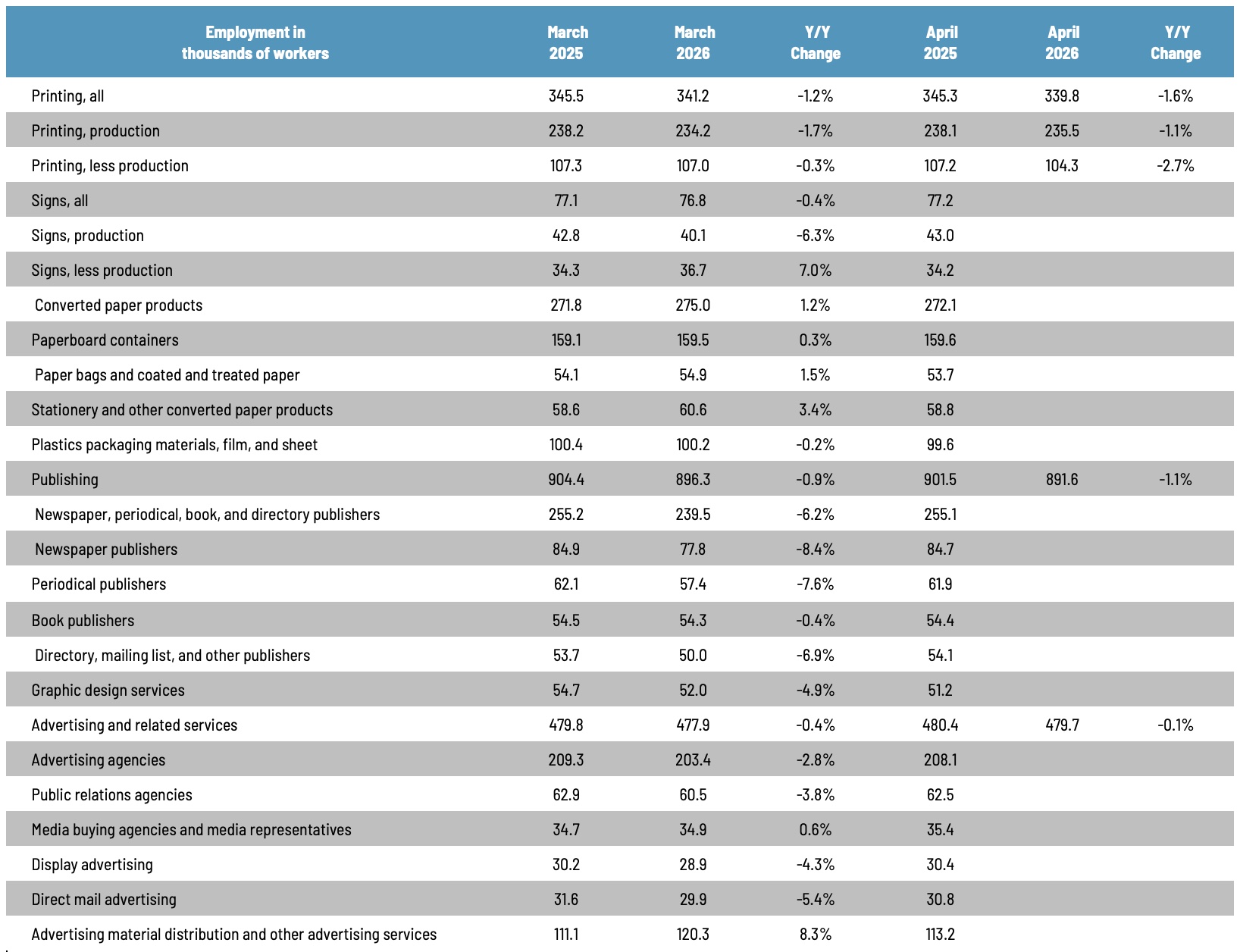
Graphic Arts Employment in April Down Overall—Substantially Among Non-Production

Graphic Arts Employment in April Down Overall—Substantially Among Non-Production

April 2026 saw printing industry employment overall generally flat, down 0.4% from March. And while production employment was up 0.6%, non-production employment was down by 2.5%—basically the reverse of what we saw in March. Read More

Recent Printing Industry News

Wednesday, June 03, 2026