WhatTheyThink

Premium Commentary & Analysis

Part 2: Who is Successful through Change?

The pundits and economists discussed in Part 1 aren&

Friday, February 07, 2003

The pundits and economists discussed in Part 1 aren’t the ones that make it happen; they can only tell us with surety what happened before. But when we talk to the marketplace, we also hear that print is declining, and/or no longer growing as fast as the increase in the GDP. Offset print supplies, the bellwether of the supply chain for many years, has been declining in use by 20% per year for the last two years. To some, this means that the printing business as they know it can no longer support the kind of job opportunities and growth that has been true for most of our careers. To others, the changes in technology and their impact on print have caused pain, but out of that pain has been born new and exciting opportunities.

In 1991 Frank Bruno (RIT) suggested that Flexographic printing would grow from 17% of the print market to 23% by 2005. According to the Flexographic Trade Association (FTA) it was already 24% of the North American market in 2002. By these numbers, "flexo" has grown faster than had been predicted just 10 years ago, while the traditional "offset" lithography market share has declined. This trend is caused by changes in technology and marketing models. Those who pioneered in the flexo world, or have migrated there, are seeing growth, not doom and gloom.

And, while the technology for digital printing really began in the early 80’s the quality, format, throughput and price necessary to compete against offset print for pay didn’t become available until very recently. Short runs, fewer than 3,000 impressions, which are the main stay of the digital world, now make up 66% of all color jobs. And printers are being asked more and more frequently to deliver product with turn around times less than 24 hours. Wide format in particular is in its infancy, however sales are expected to grow from 60,000 units in 2001 to over 125,000 units in 2006. Media sales for these units is expected to grow similarly, from 2.9 MM square feet in 2000 to 6.8 MM square feet in 2005, again a doubling over a five year period.

Between the two markets, flexo and digital, we see much growth still left and terrific opportunities for those who take advantage of it.

The Print Outlook2003 Conference ended with presentations and a panel discussion with three printers. These three printers, Digital Print Impressions (~$5 MM Sales), Metzgers Printing (~$14 MM Sales), and Consolidated Graphics represent a wide spectrum of the market from moderately small to the very largest.

It is important to note that they are all profitable and growing strongly.

The smaller two clearly showed that growth and profitability could be achieved through a focused business plan, taking on digital technologies and broadening their services while keeping a keen eye toward the bottom line. Some may not be able to achieve this measure of security with change; yet their successes indicate that the future is poor only if you let it be that way.

Consolidated Graphics has become successful because they have shunned the old consolidation model that focused upon central control and central purchasing, trying to profit by squeezing the suppliers, and moving business around the country to the most profitable presses for their own benefit. Instead, Consolidated gives its printing locations local P&L control and prefers an emphasis on close customer service to keep the accounts happy, while approving the large capital expenditures each plant needs to prosper. Their foray into national printing is yet to occur, and they see such an effort as a way to do a better job of providing print on demand, where needed, to/for the customer, rather than as a tool for their own advantage.

From small to large, each of these three companies has taken huge risks including expenditure of capital to make the changes that allow them to grow. Purchase of new kinds of presses and other capital equipment are what has fuelled Metzgers. Digital Print Impressions is now more than 80% of the total business of their parent company that for many years had been a typical offset printer. And, Consolidated, unlike most of the aggregators over the past years has suffered because of industry problems with valuations and growth, but has emerged as a strong competitor while most of its competitors are still challenged at best.

Print is Dead – Long Live Print

The future is still bright for those who innovate and change with the times.

See Part 1.


Continue reading your article
with a WhatTheyThink membership.

WhatTheyThink Annual Membership

Less than $4/week.

Get unlimited access to in-depth commentary and analysis covering the latest trends, emerging technologies, operational strategies, and key events across every segment of today's printing industry.

Stay informed. Stay competitive. Stay ahead.
WhatTheyThink Day Pass

$5 for 24 hours

Unlimited access to all of WhatTheyThink. Get your Day Pass

Already a member?
Sign In

About WhatTheyThink

WhatTheyThink is the global printing industry's go-to information source with both print and digital offerings, including WhatTheyThink.com, WhatTheyThink Email Newsletters, and the WhatTheyThink magazine. Our mission is to inform, educate, and inspire the industry. We provide cogent news and analysis about trends, technologies, operations, and events in all the markets that comprise today's printing and sign industries including commercial, in-plant, mailing, finishing, sign, display, textile, industrial, finishing, labels, packaging, marketing technology, software and workflow.

Recent Articles from WhatTheyThink

The Total Label Issue

The Total Label Issue

This issue of the WhatTheyThink Quarterly is all about labels, which are seen as a high-growth part of commercial printing, driven by e-commerce, food/beverage demand, and regulations. The market has surpassed 1.2 trillion square meters of label production volume per year, and is moving toward high-mix, low-waste production rather than only high-volume throughput. While flexo is still used for high-volume label production, digital label printing often complements it—or in some cases replaces it. But labels are about more than printing technology. Read More
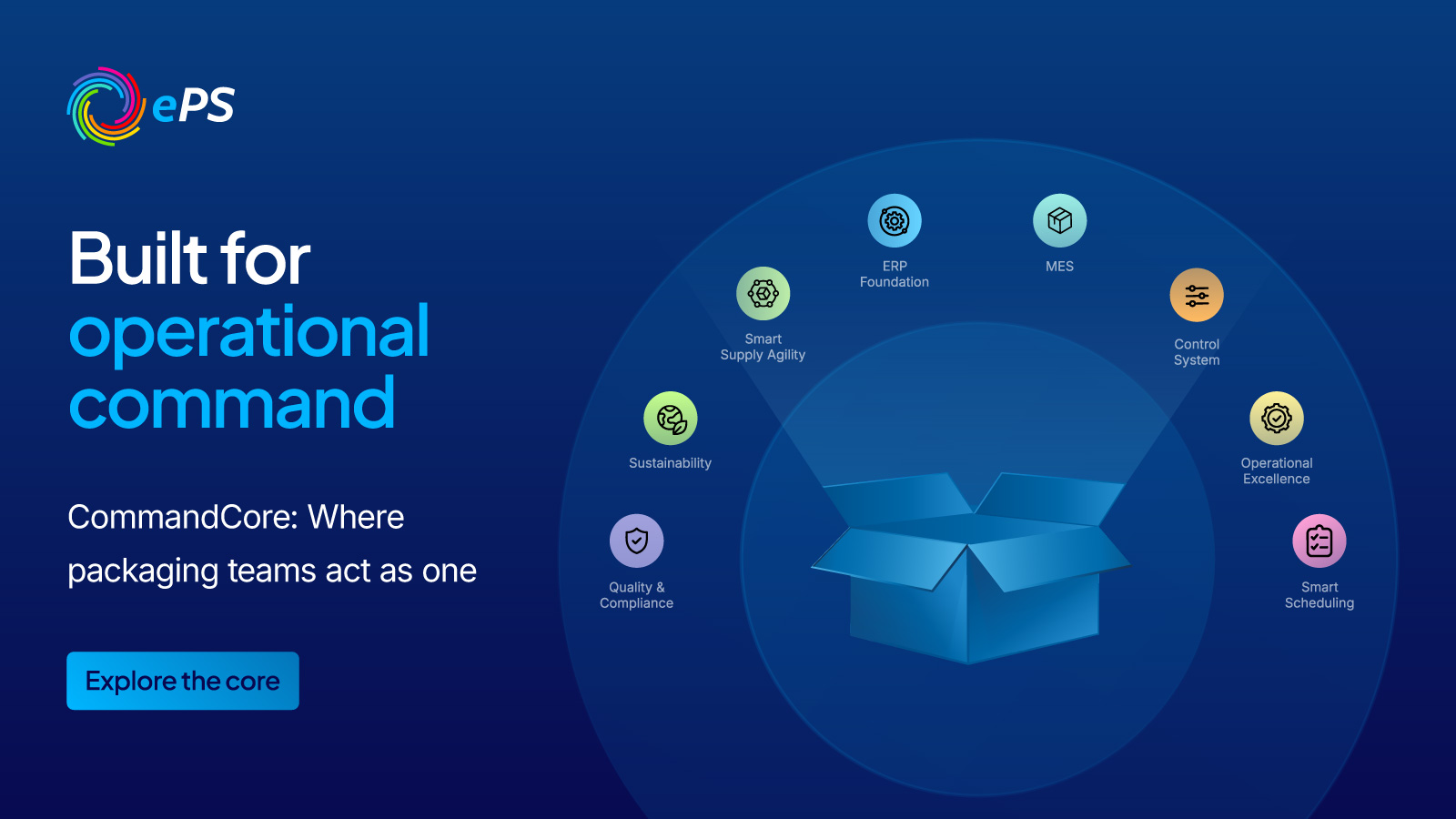
The Unified Platform for Packaging Manufacturing Excellence

The Unified Platform for Packaging Manufacturing Excellence

Leverage 30+ years of plant-floor expertise. Trusted by 700+ packaging manufacturers globally to reduce waste, optimize scheduling, and drive digital transformation. One unified foundation. Eight packaging-native pillars. Zero fragmentation. Read More

Expand Your Opportunities with the Truepress JET 560HDX from SCREEN

Expand Your Opportunities with the Truepress JET 560HDX from SCREEN

Commercial, direct mail, and publishing printers accustomed to producing jobs over several weeks can now print them in days with the SCREEN Truepress JET 560HDX. The press can accommodate 120 lb. coated or uncoated paper up to 560 mm wide. Read More

Around the Web: Of Water and Winners

Around the Web: Of Water and Winners

A sign-writer created the visual style of music festivals. The “2026 Milky Way Photographer of the Year” winners. AI appears to be catching on among the Amish. Sony has upgraded its wearable air conditioner. How to easily reuse produce bags. A complex digital water clock. A Nobel Prize–winning technology is able to extract water from dry air. Yes, it is possible to be allergic to water. Laser-induced graphene on Kevlar enables multifunctional structural composites. The “most desired” place in each of the 50 states. “The rise in plastic surgeons asked to create ‘AI face.’” K-pop band BTS has teamed with Oreo to release limited edition OREO x BTS Cookies. Welcome to WhatTheyThink’s weekly miscellany. Read More
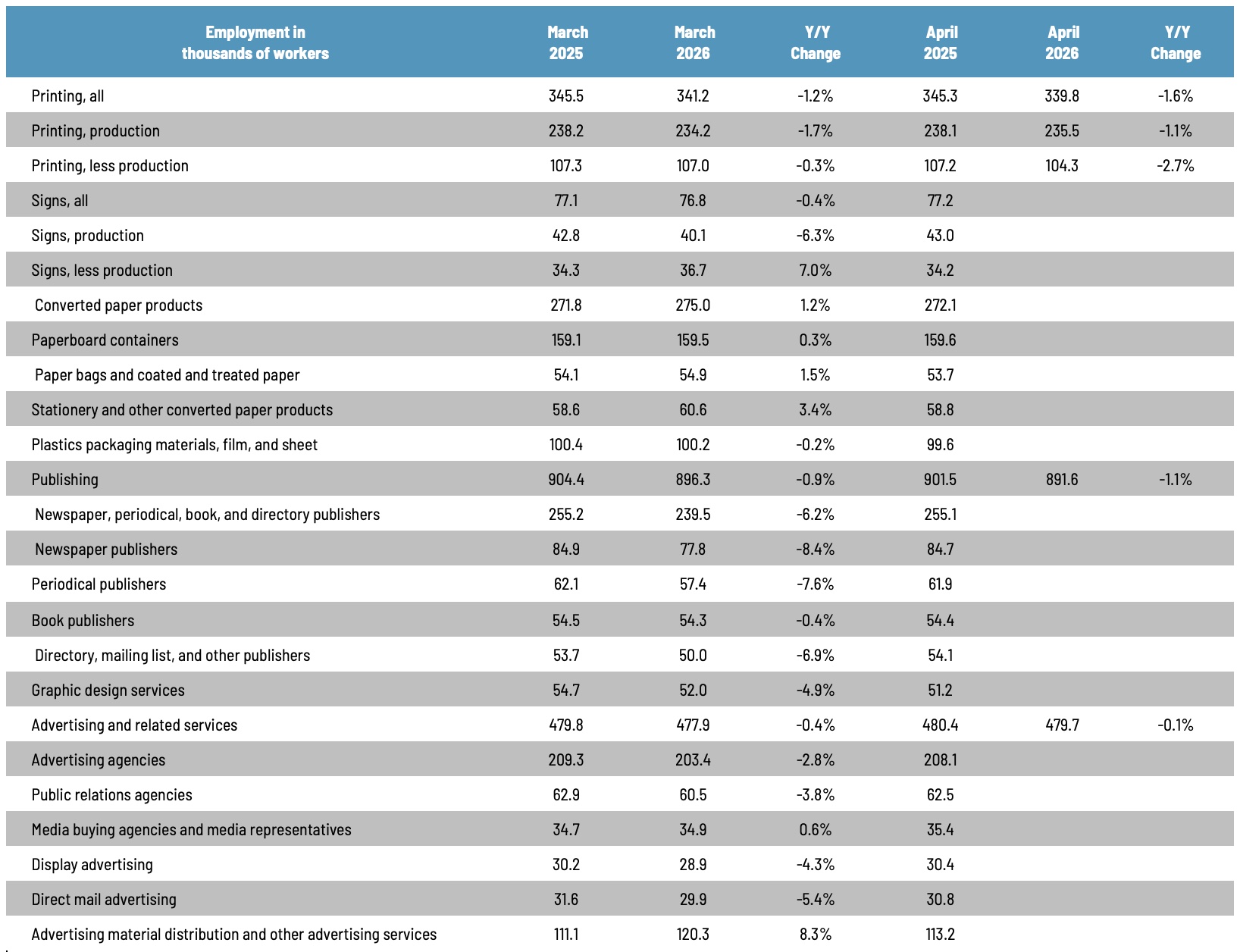
Graphic Arts Employment in April Down Overall—Substantially Among Non-Production

Graphic Arts Employment in April Down Overall—Substantially Among Non-Production

April 2026 saw printing industry employment overall generally flat, down 0.4% from March. And while production employment was up 0.6%, non-production employment was down by 2.5%—basically the reverse of what we saw in March. Read More

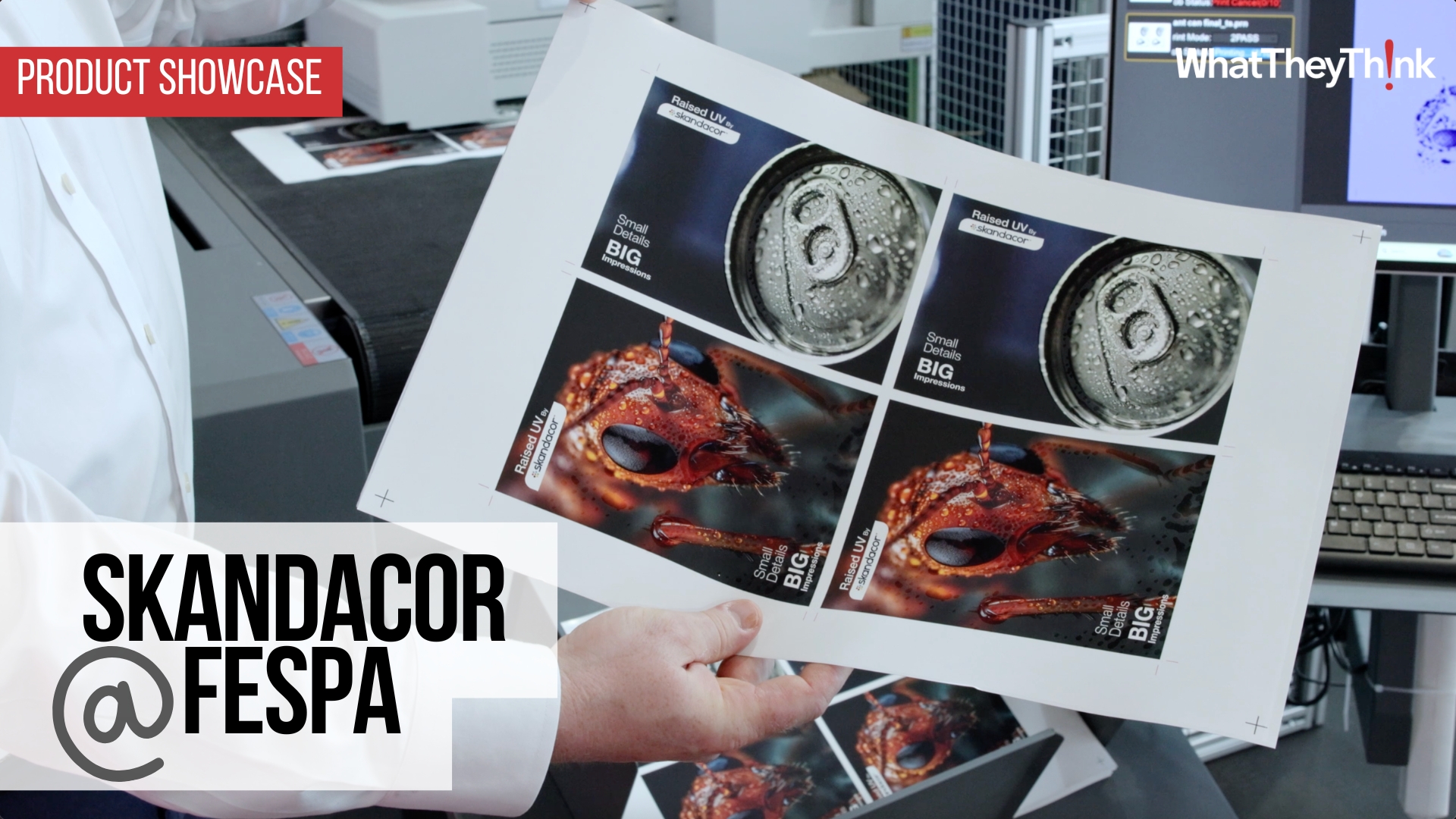
Recent Printing Industry News

Wednesday, June 03, 2026