WhatTheyThink

Premium Commentary & Analysis

Matching Prices with Your Competitors to Get Business? Match This!

If your quote is for $

Wednesday, March 20, 2002

If your quote is for $1,000 and the buyer says your competitor’s quote is $950, what will your salesperson most likely do? What will you do? What should you do?

Feedback from owners and print sales reps alike shows that in at least 8 of 10 cases you’ll offer to match it – period.

In these challenging times, with the PO temptingly close in the buyer’s hand and the recent months’ commission checks thinning out, it is easy to understand why the initial reaction of a sales rep would be to match the price. After all, what is a mere 5% when the whole job or project is in the balance? Better to get a squeezed margin on the project than no project at all - or is it?

Consider this. What does that same 5% add up to over multiple jobs or accounts? The money left on the table for a $1,000 job is $50, for a $50,000 account it means $2,500 of margin, a $1,000,000 in sales would account for a $50,000 loss and so on. How much are those "little concessions" costing you in a year? If there were a way to recover just half of what was left on the table, would it not be worth the effort to attempt to justify the difference?

And we are only talking about 5% here – what if the difference was 10% or even more?

Why was the 5% an issue in the mind of the buyer to begin with? And, if a sales rep genuinely believes that their organization is prepared in some unique way to assist their customers solve problems, achieve objectives or overcome hurdles, then why would they surrender margin and undercut your value proposition? It is likely that there are as many potential answers as there are buyers, but let’s focus on just a few of those over which the sales rep and management have some control.

Price becomes the only issue when the sales rep allows the negotiations to begin long before the selling is done. What would you expect a buyer to do? A key concern of buyers is that they are getting a "fair price", so their request for the 5% could be something as simple as an attempt to make sure that they are getting exactly that. In those cases, the exertion of even the most modest of "sales" efforts will likely suffice.

Yes, "sales" efforts. What is missing at the outset of these situations is the sales rep’s willingness and ability to convey why the price difference is justifiable. A common response from sales managers is that their "better reps justify the difference" – enough said.

When the value necessary to create differentiation between you and your competitors is not very apparent to the customer, the only issue left for negotiation is price. If your sales reps do not have the confidence in your company’s ability to produce or if their perception is that a competitors’ position is superior, then the only position they have left is "price".

If this is truly the case and you are competitively out of the ballpark, then it is clearly management’s role to identify the reality of the competitive concern and address it through the development of a course correction strategy to assist the rep. The cause of the problem may be something as simple as targeting the wrong type of account or looking for an opportunity to "get the foot in the door" by quoting on inappropriate work in the hopes of better things to come. Either way it is management’s role to offer assistance.

Most of the time though, your pricing structure is not the real issue. The real issue is a sales rep’s lack of skill, confidence or motivation to take the extra steps necessary to "sell" the project and your company (translate: build the case for your value and differentiate themselves from the competition), instead of just "taking the order" (translate: rely on the buyer’s benevolence to give the order to the "right" person).

A sales rep’s ability to defend price differences is a function of their ability to uncover the buyer’s, sometimes, discreet buying motivations, problems or opportunities and to communicate the sales rep’s organization’s differentiating factors and ability to address each. To be effective, they need an understanding of their customer’s business, which comes as a result of preparation, research and employment of sound discovery strategies. No tricks, no gimmicks, just asking the right question, at the right time, and in the right way to move the customer from being unaware of a problem to asking your sales rep to solve it for them.

Once again this is a management issue. Can this sales rep sell? Is he or she willing and able to learn new methods? Are they merely an order taker or can they do more? You, the sales manager, are paid to make the tough decisions and this may very well prove to be one of them.

Let’s discuss one more "management issue" affecting these situations. From a strategic point of view, your sales compensation plan is a key component in this process. Examine how much both your company and the sales rep are affected by discounting. If the amount is not proportionate, then this is likely a reason why the sales rep will not make the effort to fight for and protect your margins. This is an excellent case for value added or profitability based compensation.

To recap, when the most likely response to a price objection is to concede, you need to take a look at the sales rep and ask:

- Is the sales rep convinced that your company and the company’s product are worth the price you ask?

- If they are convinced, do they have the requisite skills and the willingness to communicate this to their customers?

And finally, take a look at what you, the manager, are doing that might be contributing to their behaviors.

- Is the compensation plan designed to discourage excessive discounting?

- Are you developing their selling and negotiating skills to properly handle such situations?

- Have you "really" considered whether those on the front line are capable of enduring the pressure associated with properly handling these situations?

Keep selling!


Continue reading your article
with a WhatTheyThink membership.

WhatTheyThink Annual Membership

Less than $4/week.

Get unlimited access to in-depth commentary and analysis covering the latest trends, emerging technologies, operational strategies, and key events across every segment of today's printing industry.

Stay informed. Stay competitive. Stay ahead.
WhatTheyThink Day Pass

$5 for 24 hours

Unlimited access to all of WhatTheyThink. Get your Day Pass

Already a member?
Sign In

About WhatTheyThink

WhatTheyThink is the global printing industry's go-to information source with both print and digital offerings, including WhatTheyThink.com, WhatTheyThink Email Newsletters, and the WhatTheyThink magazine. Our mission is to inform, educate, and inspire the industry. We provide cogent news and analysis about trends, technologies, operations, and events in all the markets that comprise today's printing and sign industries including commercial, in-plant, mailing, finishing, sign, display, textile, industrial, finishing, labels, packaging, marketing technology, software and workflow.

Recent Articles from WhatTheyThink

The Total Label Issue

The Total Label Issue

This issue of the WhatTheyThink Quarterly is all about labels, which are seen as a high-growth part of commercial printing, driven by e-commerce, food/beverage demand, and regulations. The market has surpassed 1.2 trillion square meters of label production volume per year, and is moving toward high-mix, low-waste production rather than only high-volume throughput. While flexo is still used for high-volume label production, digital label printing often complements it—or in some cases replaces it. But labels are about more than printing technology. Read More
The Unified Platform for Packaging Manufacturing Excellence

The Unified Platform for Packaging Manufacturing Excellence

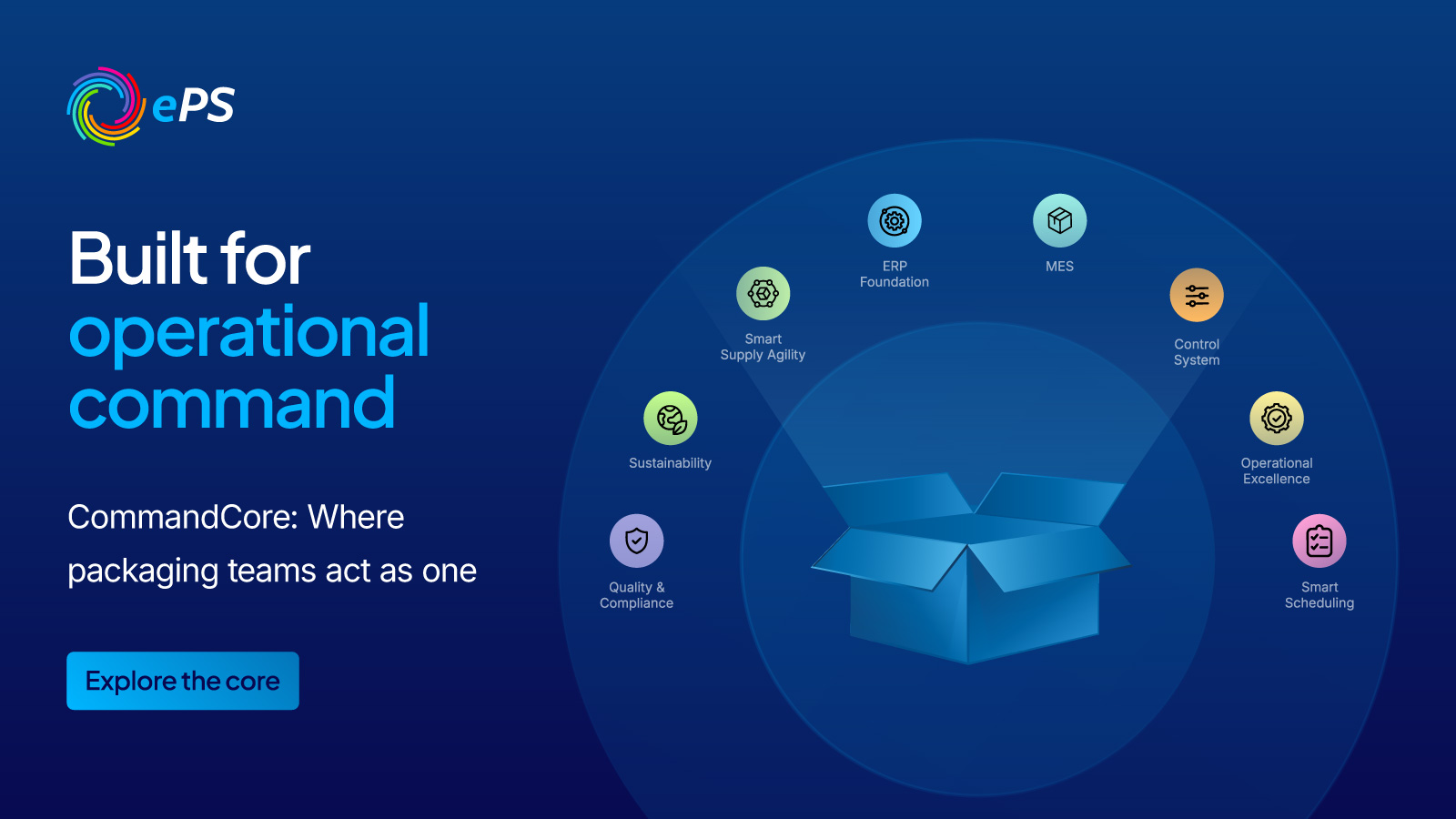
Leverage 30+ years of plant-floor expertise. Trusted by 700+ packaging manufacturers globally to reduce waste, optimize scheduling, and drive digital transformation. One unified foundation. Eight packaging-native pillars. Zero fragmentation. Read More

Expand Your Opportunities with the Truepress JET 560HDX from SCREEN

Expand Your Opportunities with the Truepress JET 560HDX from SCREEN

Commercial, direct mail, and publishing printers accustomed to producing jobs over several weeks can now print them in days with the SCREEN Truepress JET 560HDX. The press can accommodate 120 lb. coated or uncoated paper up to 560 mm wide. Read More

Around the Web: Of Water and Winners

Around the Web: Of Water and Winners

A sign-writer created the visual style of music festivals. The “2026 Milky Way Photographer of the Year” winners. AI appears to be catching on among the Amish. Sony has upgraded its wearable air conditioner. How to easily reuse produce bags. A complex digital water clock. A Nobel Prize–winning technology is able to extract water from dry air. Yes, it is possible to be allergic to water. Laser-induced graphene on Kevlar enables multifunctional structural composites. The “most desired” place in each of the 50 states. “The rise in plastic surgeons asked to create ‘AI face.’” K-pop band BTS has teamed with Oreo to release limited edition OREO x BTS Cookies. Welcome to WhatTheyThink’s weekly miscellany. Read More
Graphic Arts Employment in April Down Overall—Substantially Among Non-Production

Graphic Arts Employment in April Down Overall—Substantially Among Non-Production

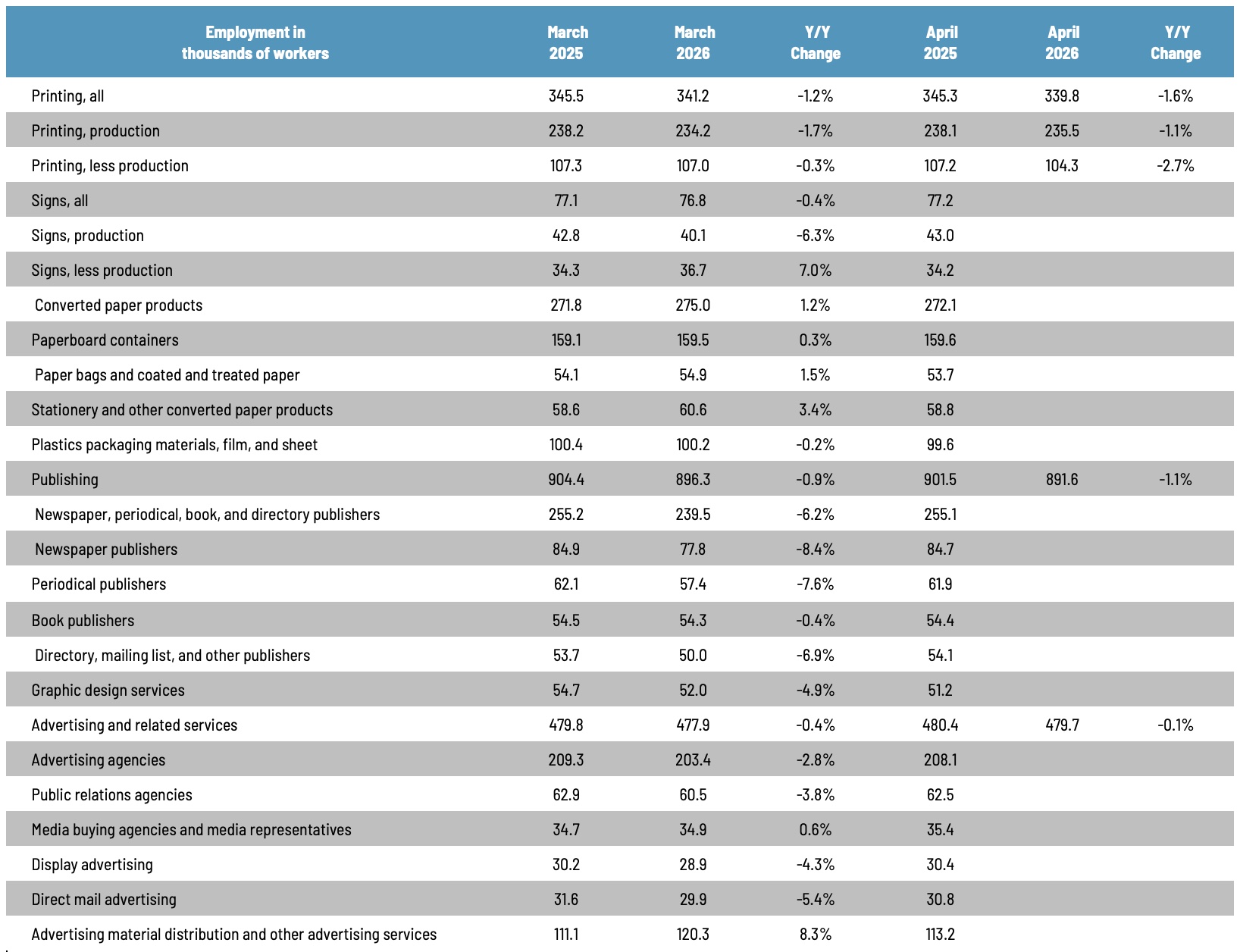
April 2026 saw printing industry employment overall generally flat, down 0.4% from March. And while production employment was up 0.6%, non-production employment was down by 2.5%—basically the reverse of what we saw in March. Read More


Recent Printing Industry News

Wednesday, June 03, 2026