Phoning it In
Last month marked a fairly significant anniversary: March 10, 2026, was the 150th anniversary of the invention of the telephone. Via BU Today, at the time, Alexander Graham Bell was a professor at Boston University.
Bell taught three courses as one of nine faculty members of the Boston University School of Oratory, helping people become more efficient in the use of vocal organs and the art of speaking. According to BU’s 1874 yearbook, his courses included The Culture of the Speaking Voice and Mechanism of Speech.
He was well-known for teaching deaf students, but his relationship with the hearing-impaired community was a bit sketchy.
But he is also criticized by the signing Deaf community for his involvement in the American eugenics movement. He first opposed intermarriage between deaf people, believing it would increase the deaf population, only to soften his position later in life by acknowledging people should marry whom they choose.
His invention of the telephone was mostly accidental.
He had been traveling from his home in Salem to his BU classroom building on Beacon Street, and began experimenting on the telegraph between lectures. He’d become convinced he could make electric currents vibrate through wires, and thus create sound. He decided to string wires from the attic to the basement in the nearby building at 109 Court Street and conduct experiments there.
And it was on March 10, 1876, that he made the famous phone call to his assistant, Thomas Watson, uttering the immortal phrase, “Mr. Watson, come here, I want to see you.” Watson very quickly invented the concept of “let it go to voicemail.”
The telephone is certainly one of the greatest inventions of humankind, although there are days when we wish Bell had never been born. But is it the greatest invention? Possibly, although our candidate for greatest invention is indoor plumbing, but that could just be the coffee talking.
Head Games
Ah, the password. The scourge of modern life. And how many years of our lives have we lost over the years retyping those stupid “dotted out” passwords? And password managers have proven to be the most annoying pieces of software ever developed. Our Mac uses fingerprint recognition, which is convenient but raises fears of dismemberment. There are also retinal scans, and other biometric ways of logging into various things, but via PopSci, you may—literally—be able to keep your password in your head.
The newly designed software program called VitalID uses the tiny vibrations generated by heartbeats and breathing that move through the skull. Like our fingerprints, these patterns are unique to an individual’s facial tissue and bone structure. VitalID is designed for use in extended reality settings and was presented at the 2025 ACM Conference on Computer and Communications Security.
Uh oh. “Extended Reality”? Don’t we have enough realities at this point?
Extended reality (XR) includes virtual reality, augmented reality, and mixed reality technologies that mix digital content with the physical world. XR systems including Viture, MetaQuest, and Oculus Rift are best known in the gaming world. However, this technology is expanding into finance, medicine, education, and remote work. As it increases its reach, security in XR systems has become increasingly urgent.
Great.
So, enter the skull.
Every breath and heartbeat creates tiny vibrations that travel through the neck and into the head. Once they reach the skull, they make our heads shake slightly. Since every skull has a different shape, thickness, and bone structure, the vibrations change in unique ways as they travel.
You can see someone holding a skull now: “Alas, poor password! I knew it, Horatio, a mnemonic of infinite jest, of most excellent fancy.”
We continue.
As a result, we all produce a distinct vibration pattern within our skulls. Motion sensors that already reside inside virtual reality headsets can detect these tiny patterns and determine who is wearing the device.
The researchers say that since these vibrations travel through a person’s bones and tissues, they’re potentially more difficult for someone to mimic. “While someone might imitate another person’s breathing rhythm, they can’t replicate the biomechanical properties of another person’s skull quite so easily.” And cutting off their head would likely be no help, either.
Be On Neon
We thought we had linked to this before, but it appears not. When we’re in Las Vegas later this year for PRINTING United, we are going to have to check out the Neon Museum. Says Atlas Obscura:
Many of the most recognizable neon displays from the golden age of Las Vegas casinos have been produced by Young Electric Sign Company (YESCO). This Salt Lake City-based company has maintained a storage yard in Las Vegas for decades. This three-acre plot has, over the years, become a veritable graveyard of disused neon signs.
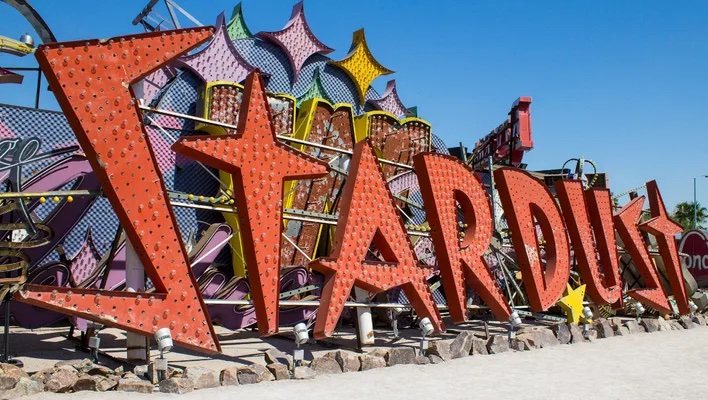
There are over 150 decommissioned, non-restored neon signs at this location. In 2005, the La Concha Hotel, a Paul Revere Williams design, was moved up the street to serve as the museum's visitor center.
We’re in!
Office Fur-niture
Do you work from home? Do you have a cat? If yes to both, you know how much cats like desks, and getting in the way of work or Zoom calls. Now, via Boing Boing, Japanese company Bibilab has designed the Neko House Desk, an office desk with cat compartments built right in. (By the way, “neko” means “cat” in Japanese, which entirely changes how we think about Neko Case.)

Of course, if you have cats you know perfectly well that the chances of them actually using their designated compartments is practically nil. Still, it’s the thought that counts.
The feature Bibilab is proudest of is the “Surprise Cat Hole”— a portal in the middle of the desk that lets your cat pop up through the surface from below, when it requires scritches. Cable routing and PC tower storage are built in too, though parking your tower in the cat shelves means evicting a tenant.
There is something faintly disturbing about the phrase “Surprise Cat Hole.”
According to the company, the shelves are rated for cats up to 44 lbs, in the event that you have a leopard.
A steal at ¥24,800 (about $160) via Amazon Japan.
Seeing Things
Here’s a cool idea. Via Good News Network, UK company CrossSense has integrated AI with smart glasses to develop a pair of glasses for people with dementia that projects visual prompts onto the lenses.
They can guide people living with early-stage dementia through daily activities by identifying common objects and providing audio commentary or answer questions while projecting visual prompts onto the lenses.
By asking gentle questions, the glasses’ AI companion, called ‘Wispy’, understands and learns a person’s unique way of doing things, with the AI adapting to each user’s needs as their dementia progresses.
Wispy will even talk the wearer through a particular task or process. And it seems to be a hit.
In test trials, three out of four patients reported a significant improvement to their quality of life.

The specs, which work with people’s prescription lens inserts and hearing aids, also capture the environment of the person living with dementia and the AI interprets that information to help the user to do the things that define independence.
They are set to be released in early 2027 in the UK.
Elemental
How did the elements—as in the periodic table of elements—get their names? Via Laughing Squid, linguist Patrick Foote of Name Explain traced the etymologies of the 118 names and abbreviations of the elements.
The names of chemical elements are super fascinating and come from all different kinds of origins. from elements with names linked to the ancient past, elements named after both mythical and real people, elements named after locations, and even a couple named after some freaky little goblins.
For example, “oxygen” comes from the Greek word “oxys,” meaning “acid,” after the mistaken belief that oxygen was involved in the production of acids, which it is not. Neon comes from the Greek “neos” meaning “new,” as when it was discovered it was the newest element, which it no longer is. Argon comes from the Greek “argos” meaning “lazy” or “inactive,” referring to the fact that it does not readily react with other elements. Titanium was named after the Titans of Greek mythology, possibly equating the metal’s strength with that of the Titans.
We could go on, but if you’re a fan of science and etymology, check out the video here.
Really Sum Thing
We’re not much into status symbols (we’re perfectly happy having absolutely no status) but we can see the point of buying and wearing, say, a high-end watch. Chances are it keeps pretty good time, it looks nice, and doesn’t need to be recharged every five seconds like, say, a Garmin Vivoactive smart watch.
But: a high-end luxury…calculator? Via Core77, such a thing does exist. So if you’re a high-powered CPA, be sure to snag Casio’s S100X Premium Luxury Calculator.
What makes it so high-end? Well, first off, it’s not made of plastic, but aluminum, the keys use the same kind of mechanism that laptop keys use, and, perhaps most importantly, the keys have the numbers molded into them not just imprinted on top of them, so they won’t wear out.

A steal at $350. (Crystal chess set sold separately.) And if your annual income matches the figures on those screens, there is an even more luxurious S100X Japanese Lacquer Edition that features frames that are hand-lacquered by a master craftsman. Do your taxes in style! An even bigger steal at ¥99,000 ($621).
Graphene Gets Foiled
Was it a good week for graphene news? It’s always a good week for graphene news! Graphene-coated aluminum foil. From (who else?) Graphene-News:
China's Jiangmen Xinhui Industrial Park (Fengshanhu New Energy Industrial Park) has announced the launch of trial production for its graphene-coated carbon aluminum foil project.
…The large facility is designed to produce up to 48,000 tons of graphene-coated carbon aluminum foil per year once fully operational. The project’s turnkey delivery and trial production ceremony marked a step toward commercial-scale production in the region’s rapidly growing graphene and new energy industries.
Dam Good
Via LiveScience, Swiss researchers have discovered an unlikely ally in the fight against climate change: beavers.
A new study in Switzerland finds that beaver-built wetlands can trap and store large amounts of carbon, offering a low-cost boost for restoration and climate resilience.
The researchers looked at a 0.5-mile stream in northern Switzerland, which, pre-beaver, had been a tree-filled flood plain. When the beavers were introduced, they chewed down many of the trees to build their dams, and the reduced canopy meant that smaller plants could get their share of sunlight. (Rush explained how this works.)
The scientists measured carbon in the water, escaping into the atmosphere and being stored in sediments, biomass and deadwood. They did this by collecting core samples from the sediment and surrounding forest, along with plant samples from the algae growing along the stream. The researchers also calculated water flow of the stream, which helped them determine water levels, salt content, and how much sediment moved through the area.
The results?
the wetland was a net sink that sequestered 108 to 146 tons (98 to 133 metric tons) of carbon per year. This amount of carbon saved is equivalent to 832 to 1,129 barrels of oil consumed.
This is important as there is an effort to reintroduce beavers into other suitable parts of Switzerland—which could offset 1.2% to 1.8% of Switzerland’s annual carbon emissions.
Ant-iques Roadshow
Would you pay $220 for an ant? No, nor would we, although we once paid Orkin about that much to get rid of ants. But then we are not big into wildlife trafficking, much less insect trafficking, which is apparently a thing. Via the BBC, there is such a thing as an “international ant collector” and giant African harvester ant queens are especially prized—and indeed can go for up to $220. This is an online black market, as such things are illegal, if not silly.
The scale of the illicit trade in Kenya became apparent last year when 5,000 giant harvester ant queens - mainly collected around Gilgil - were found alive at a guest house in Naivasha, a nearby lakeside town popular with tourists.
Well, it’s better than poaching elephant tusks or rhinoceros horns. And please tell us there is actually a store called Ants R Us.
UK-based retailer Ants R Us describes the giant African harvester ant as “many people’s dream species” – though the queens are currently out of stock, with the site explaining that it is very hard for retailers to source them.
It’s not entirely clear why this exists, but apparently the idea is to keep them as…pets?
"A colony of pet ants are often kept in a formicarium, which is basically a transparent plastic box so that keepers can observe colonies at work, digging tunnels, collecting food, and guarding their queen. I'd say it's quite charming and… can be a good way of educating people about insects and their behaviour.”
However:
"But then we realised, wait, isn't keeping invasive species incredibly dangerous?"
Monitoring online sales - of more than 58,000 colonies - in China over six months, the researchers found that more than a quarter of the traded species were not native to China - despite it being illegal to import them.
"If the trade volume of invasive ants continues to grow, it's only a matter of time before a few escape from their formicaria and become established in the wild," said Wang.
Ant trafficking. Who knew?
Going Up…and Up
(Optional musical accompaniment to this item.)
If you like escalators, be sure to head to China’s Chongqing municipality, where the world’s longest escalator—more than a half-mile—has recently been built. Via Futurism:
Called the “Goddess” escalator, it endeavors towards a suitably heavenly domain. The absurd architectural feat cuts through the center of the city in Wushan, starting from the bottom of a steep bank and rising straight into the sky, which it almost seems to touch; footage of the marvel, while impressive, struggles to capture its sheer scale.

From bottom to top, it takes just over 20 minutes to ascend. (Those who suffer from vertigo would be advised to avoid it.)
As Mitch Hedberg once said, an escalator can never be broken; it can only become stairs—but we would not want that to become stairs…
Eggstra Large
Here’s something would probably give the Easter Bunny a hernia, although it would make egg hunts quite a bit easier. Via PopSci, chocolatiers Claire Fielding, Dawn Jenks, and Donna Pitt have created the world’s largest Cadbury Mini Egg, aka The Mega Mini Egg.
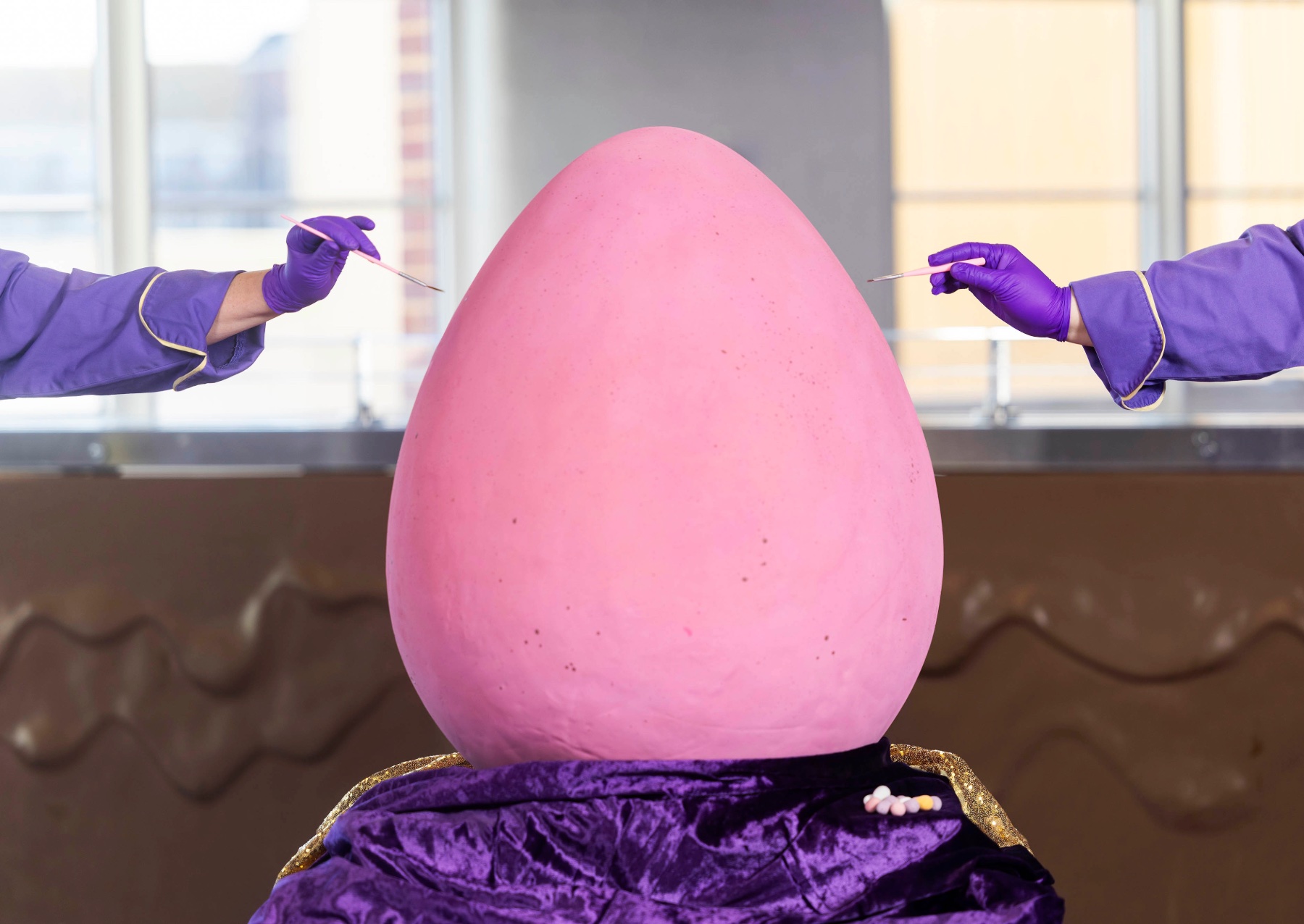
The headline says it “weighs as much as an emu,” which is helpful as that actually is our default weight analogy. (At the gym, we routinely ask, “How many emus can you bench?”)
Actually, though, it is 27.5 in. tall and weighs 121 pounds, and it took the chocolatiers two days to make it—entirely by hand. It is currently on display in the Chocolate Making area at Cadbury World in Bournville, England, about 100 miles northwest of London.
Last year, the trio had made the world’s largest Cadbury Creme Egg which was “about as tall as a USPS mailbox” (“How many mailboxes tall is your son now?”).
In a nice bit of Easter buzzkill, PopSci helpfully informs us how much chocolate it would take to kill a human.
The adult human weighing 165 pounds would need to eat 75,000 milligrams to be at a toxic level.
They estimate that that would entail eating:
- 711 regular-sized Hershey’s milk chocolate bars OR
- 7,084 Hershey chocolate kisses OR
- 332 standard-sized Hershey’s dark chocolate bars.
Well, OK: challenge accepted!
This Week in Printing, Publishing, and Media History
March 30
1853: Dutch-French painter and illustrator Vincent van Gogh born.
1880: Irish dramatist, playwright, and memoirist Seán O'Casey born.
1986: American poet and etymologist John Ciardi dies (b. 1916).
2004: English-American journalist and author Alistair Cooke dies (b. 1908).
March 31
1596: French mathematician and philosopher René Descartes born. (Apparently he thought.)
1631: English lawyer and poet John Donne dies (b. 1572).
1685: German organist and composer Johann Sebastian Bach born.
1732: Austrian pianist and composer Joseph Haydn born.
1809: Ukrainian-Russian short story writer, novelist, and playwright Nikolai Gogol born.
1855: English novelist and poet Charlotte Brontë dies (b. 1816).
1889: The Eiffel Tower is officially opened. (Not everyone in France was a fan; author Guy de Maupassant ate lunch every day at the tower’s base restaurant, because, he said, “inside the restaurant was one of the few places where I could sit and not actually see the Tower!”)
1906: The Intercollegiate Athletic Association of the United States (later the National Collegiate Athletic Association) is established to set rules for college sports in the United States. (Before that it was all just madness...)
1918: Daylight saving time goes into effect in the United States for the first time and, unfortunately, not the last.
1930: The Motion Picture Production Code is instituted, imposing strict guidelines on the treatment of sex, crime, religion and violence in film, in the U.S., for the next 38 years.
1951: Remington Rand delivers the first UNIVAC I computer to the United States Census Bureau. (And they’re still using it today.)
2016: Scottish comedian, actor and screenwriter Ronnie Corbett dies (b. 1930).
April 1
1854: Charles Dickens’ novel Hard Times begins serialization in his magazine Household Words.
1960: The TIROS-1 satellite transmits the first television picture from space.
1976: Apple Inc. is formed by Steve Jobs, Steve Wozniak, and Ronald Wayne in Cupertino, Calif.
2004: Google announces Gmail to the public.
April 2
1800: Ludwig van Beethoven leads the premiere of his First Symphony in Vienna.
1805: Danish novelist, short story writer, and poet Hans Christian Andersen born.
1840: French novelist, playwright, journalist Émile Zola born.
1872: American painter and academic, inventor of the telegraph and Morse code Samuel Morse dies (b. 1791).
1902: “Electric Theatre,” the first full-time movie theater in the United States, opens in Los Angeles.
1941: American radio host Dr. Demento born.
1956: As the World Turns and The Edge of Night premiere on CBS. The two soaps become the first daytime dramas to debut in the 30-minute format.
1973: Launch of the LexisNexis computerized legal research service.
April 3
1783: American short story writer, essayist, biographer, historian Washington Irving born.
1774: Irish novelist, playwright and poet Oliver Goldsmith dies (b. 1728).
1860: The first successful United States Pony Express run from St. Joseph, Mo., to Sacramento, Calif., begins.
1895: The trial in the libel case brought by Oscar Wilde begins, eventually resulting in his imprisonment on charges of homosexuality.
1898: American publisher, and co-founder of Time Magazine Henry Luce born.
1949: English singer-songwriter and guitarist Richard Thompson born.
1955: The American Civil Liberties Union announces it will defend Allen Ginsberg's book Howl against obscenity charges.
1973: Martin Cooper of Motorola makes the first handheld mobile phone call to Joel S. Engel of Bell Labs.
1981: The Osborne 1, the first successful portable computer, is unveiled at the West Coast Computer Faire in San Francisco.
2010: Apple Inc. released the first generation iPad, a tablet computer.
April 4
1581: Francis Drake is knighted for completing a circumnavigation of the world.
1768: In London, Philip Astley stages the first modern circus.
1818: The United States Congress, affirming the Second Continental Congress, adopts the flag of the United States with 13 red and white stripes and one star for each state (20 at that time).
1928: American memoirist and poet Maya Angelou born.
1975: Microsoft is founded as a partnership between Bill Gates and Paul Allen in Albuquerque, N.M.
April 5
1710: The Statute of Anne receives the royal assent establishing the Copyright law of the United Kingdom.
1908: American actress Bette Davis born.
1929: English songwriter and producer Joe Meek born.
1954: American singer-songwriter and guitarist Stan Ridgway born.