Off the Mark
Well, this sucks.
For almost three-quarters of a century, people have relied on the postmark to serve as evidence that a particular deadline was met: say, when a tax return was filed, a court document was submitted, etc. Well, alas, there was stealth change in postal regulations that has decoupled the postmark from when a piece of mail actually entered into the mailstream. Via Save the Post Office:
On December 24, 2025, a quiet change took effect in the Postal Service’s Domestic Mail Manual. The new section (DMM 608.11) now clarifies that a postmark will no longer indicate the date a piece of mail was deposited with U.S. Postal Service (USPS). The Postal Service notes this misalignment “has and will become more common” as it continues consolidating its processing network and standardizing transportation schedules under the Delivering for America (DFA) plan.
A report from the Brookings Institute looks at the consequences of this decoupling.
The DFA aims to strengthen USPS’ financial position, but it also disrupts an evidentiary tool that has long been woven into election law, tax administration, court procedure, and many other regulatory frameworks.
Which may be moot, as it’s possible the USPS will run out of money next year. (WhatTheyThink has a story in development that will take a close look at this as well as the implications for the printing industry.)
Sigh. We can’t have nice things.
Pearls Before Bind
If you find yourself in New York City, If you found yourself in New York City eight years ago, you’ll almost surely have wanted to stop by the Morgan Library and Museum and check out some of the “most luxurious medieval manuscripts in existence.” Says Atlas Obscura:
In the medieval period, monks usually produced books, but with treasure binding—as this practice is known—metalworkers were employed to emboss patterns of silver and gold and set precious stones. Either the very wealthy or the very pious (or both) commissioned the books
One example is the Lindau Gospels, which dates to ninth-century France.
The intricate metalwork on the back cover only hints at the extravagance of the front cover, which was made nearly a century later. Jewels line the edges and sit on raised clawed legs around a repoussé (metal worked on the reverse side to create an image in relief) figure of Christ. The elevation of the jewel clusters has a practical purpose as well as an aesthetic one; it protects the rest of the cover when the book is open.
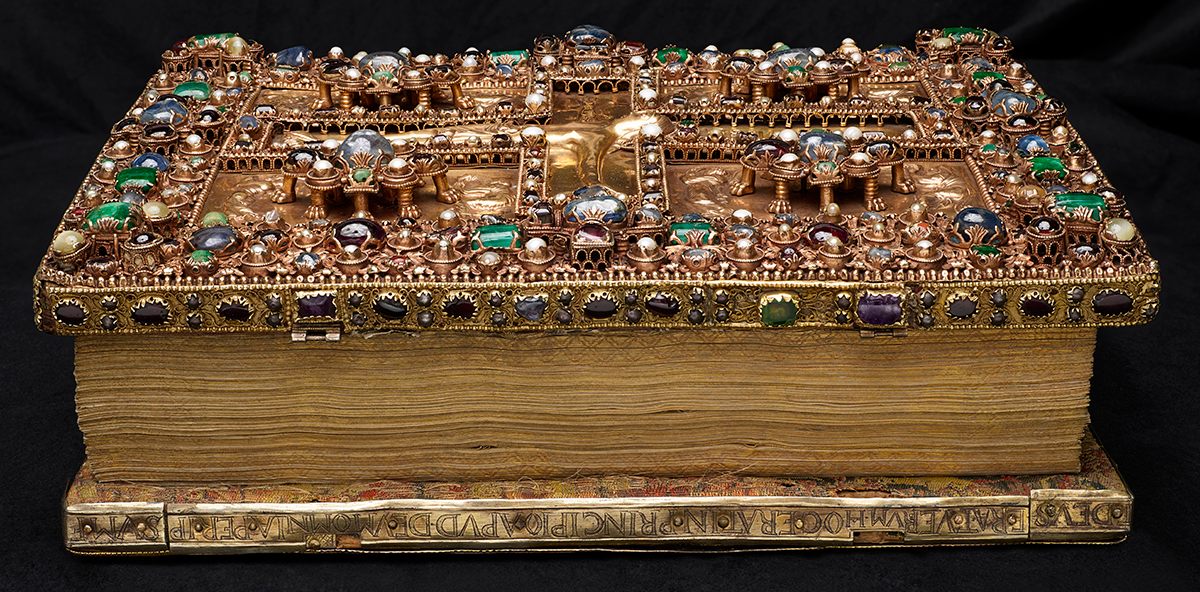
Try that with an ebook.
Magnificent Gems: Medieval Treasure Bindings runs through January 7, 2018. Doh!
Still, examples of treasure binding can be found in a few libraries around the world but, as you might expect, not too many of these books have survived the centuries.
AI-Yi-Yi, Part the Infinity: Given the Hachette
We’re not sure which is worse: being called out for having written something using AI or being accused of using AI when you didn’t. Author Mia Ballard can speak to both scenarios. Her horror novel Shy Girl, originally self-published and then reprinted by Hachette, was pulled from publication in the UK after a New York Timesinvestigation found that all or significant chunks of it were written using AI. Says Ars Technica:
Shy Girl was self-published in 2025 and quickly found an audience on social media. The novel follows a depressed, OCD woman named Gia who, down on her luck, encounters a “sugar daddy” who pays off her debts. All she has to do? Live as his literal pet. Eventually, of course, living like an animal makes her into an animal, and things apparently get nasty.
It did not get many good reviews to begin with, but then things went south.
Soon, the questions moved beyond the literary. Had the book really been “written” at all? Complaints started to surface that the prose sounded, at least in places, like chatbot writing.
Which raises an interesting critique we suspect we’ll be seeing more of.
“If it isn’t AI, she’s a terrible writer”
…Yesterday, The New York Times published its own investigation, in which it “analyzed passages from the novel using several AI detection tools and found recurring patterns characteristic of AI generated text, like gaps in logic, excessive use of melodramatic adjectives and an overreliance on the rule of three.”
Hmmm… Just like Around the Web which has never graced, and never shall grace, the inside of a chatbot (make of that what you will). But then could it just be a matter of taste?
In the case of Shy Girl, despite numerous claims that AI writing sucks and that it can be easily identified, plenty of readers enjoyed the book and even promoted it online. That may both terrify and horrify actual writers, but it remains a reality they’ll need to face.
Chacun AI son goût.
Of course, you don’t need to use AI to be a bad writer who publishes bestsellers. Back in 2015, in the halcyon days before AI, a massively compelling TV adaptation of Blake Crouch’s Wayward Pines led us to the bestselling book trilogy that was so badly written it was a struggle to get through them (yes, “them”—the plot was indeed compelling, the prose notwithstanding).
Good Grief
Writing coaches always encourage people to “write what you know,” and author Kouri Richins seems to have taken that a bit too much to heart. After the death of her husband, she wrote a bestselling children’s bookabout dealing with grief. However, via Boing Boing, she was eventually convicted of murdering her husband.
In addition to aggravated murder, a first-degree felony, she was found guilty of attempted aggravated murder, a first-degree felony; two counts of insurance fraud, a second-degree felony; and forgery, a third-degree felony. Richins, 35, was accused of fatally poisoning Eric Richins on March 4, 2022, and slipping drugs into his food, making him sick, a few weeks earlier in an attempt to kill him.
Even more damning, it later emerged that she didn’t even write the book herself, but hired a ghostwriter (as it were). Ah, well; at least it wasn’t written with AI.
Shelving It
Here’s a clever bookshelf design, via Core77. Brent Biglow, principal of Canadian company Biglow Woodworks, has developed the Book Stop, a wall-mounted bookshelf with an integrated, adjustable bookend.
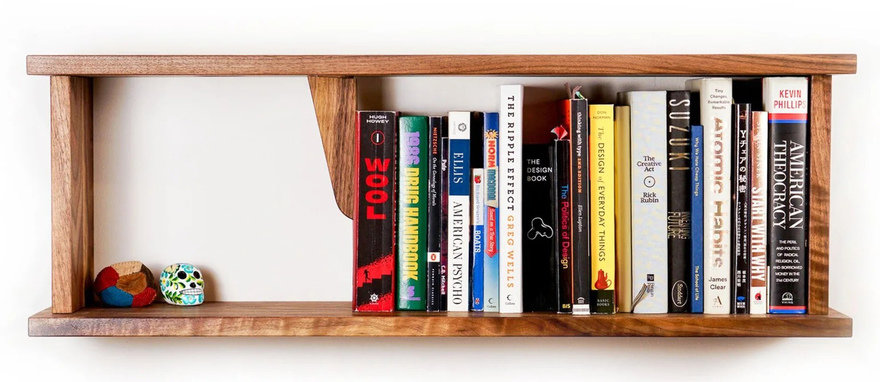
A steal at $180.
Signs of the Times, Part the Ongoing: Tales from the Cryptic
If you are in the San Francisco Bay Area, you may have been some cryptic billboards going up around the region.
Across San Francisco, a new crop of tech billboards seems designed to confuse almost everyone who isn't fluent in AI jargon. Slogans such as "Own Your Models," "Intelligent AF," and "Agents Don't Work Without Evals" now fill expensive city real estate once reserved for mainstream brands like Coca-Cola or Toyota. These messages aren't just unusual; they're coded statements from AI startups speaking directly to other engineers and industry insiders.
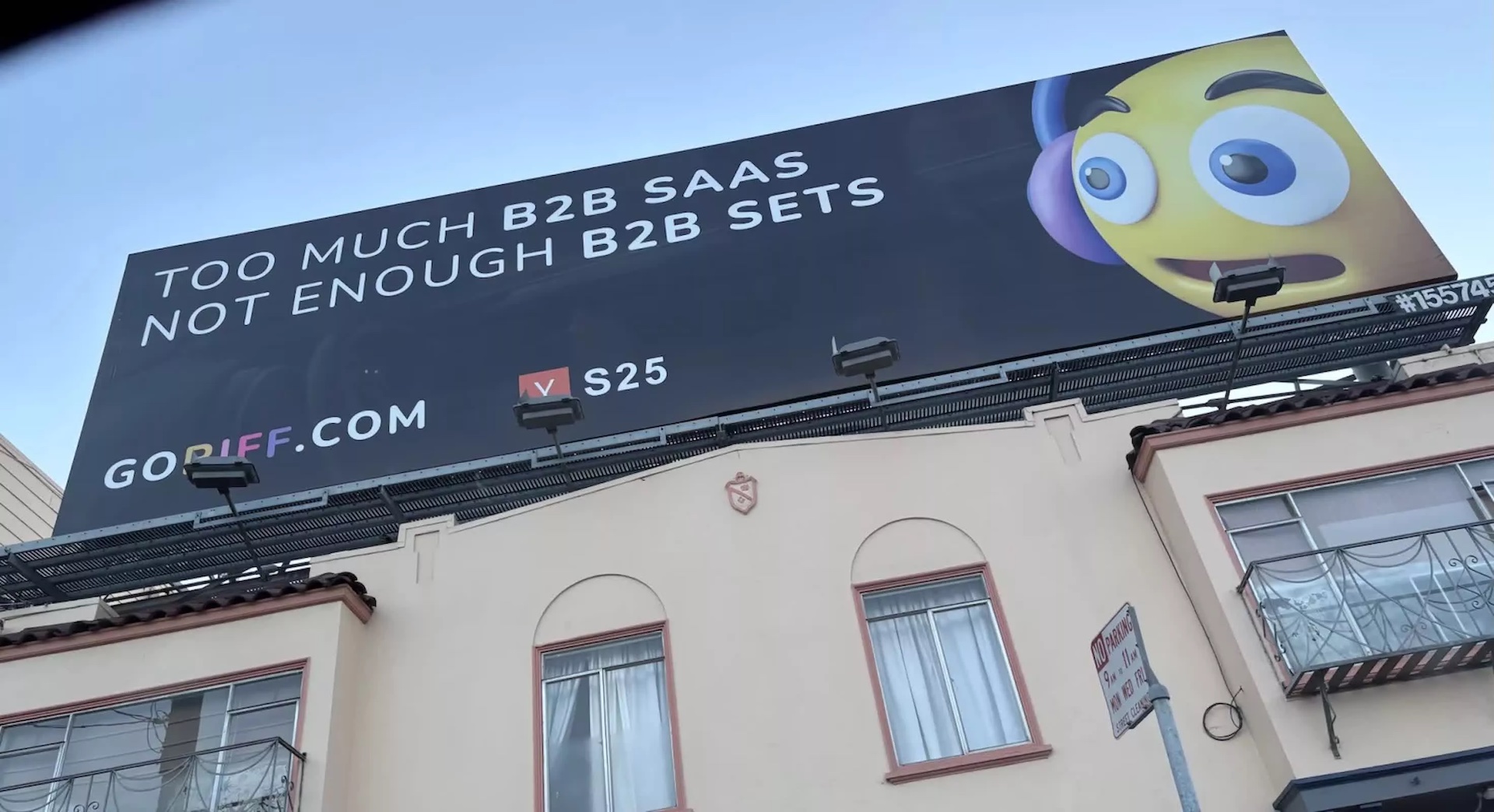
The idea is to eschew appealing to consumers and instead advertise directly to other tech bros.
These campaigns borrow a familiar playbook from other niche brands that deliberately lean into exclusion to make belonging feel more valuable. In tech, that can mean doubling down on acronyms, in-jokes, and opaque slogans so that recognizing the reference becomes a quiet signal of professional status, even if it leaves most drivers guessing at what is actually being sold.
It's only a matter of time before AI starts advertising to other AI.
The Turtle of the Baskerville?
Last winter, the turtle hospital at the New England Aquarium rehabilitated about 500 sea turtles that had washed up on the shore of Cape Cod Bay, suffering from hypothermia. Most were easily treated and moved to other facilities but those that required long-term care were given names, as is the tradition. And, via PopSci, the turtle vets chose to name them after typefaces.
The aquarium staff, volunteers, and interns have a tradition of naming the turtles receiving prolonged care. This year’s names honor the team’s favorite fonts. Two critically endangered Kemp’s ridleys turtles are called “Cavolini” and “Franklin,” a pair of loggerheads named “Pretty Princess” and “Helvetica,” while another pair of sea turtles dubbed “Verdana” and “Chunk.”
There is no truth to the rumor that one turtle was named “Comic Sans” and bit off an intern’s finger.
Let Us Spray
Those of us of a klutzy disposition are often inadvertently wounding ourselves (we once cut ourself on a sponge), running in search of Band Aids. So we were happy to hear about a new spray-on powder that immediately seals wounds. Vis TechSpot:
researchers at the Korea Advanced Institute of Science and Technology (KAIST) have created a powder-based hemostat that forms an impenetrable hydrogel barrier in just one second when applied to a wound.
The hemostatic technology was developed by a joint research team led by Professor Steve Park and Professor Sangyong Jon. The formulation's key capability lies in its instant transition into a solid hydrogel upon contact with blood, creating a strong physical and chemical seal that halts bleeding almost immediately.
KAIST described the advance as a potential lifesaving development for conditions as extreme as combat or natural disasters, where immediate medical intervention is rarely available.
True, various cyanoacrylate adhesives have been used for medical purposes for ages, and while you can use Super Glue on cuts, it is not recommended, as there are other medical grade adhesives available.
Heavy Lifting
You know how it is. You have to lift a heavy wall but you’re all by yourself, and you’re not Steve Austin. What to do? Well, via Core77, Virginia-based building contractor Mark Helmuth has developed the Wall-Lift, which allows a single person to raise a stud wall all by him- or herself.
One unit can handle a wall that’s 25 ft. in length; doubling up the units allows you to raise a 50-ft. wall.

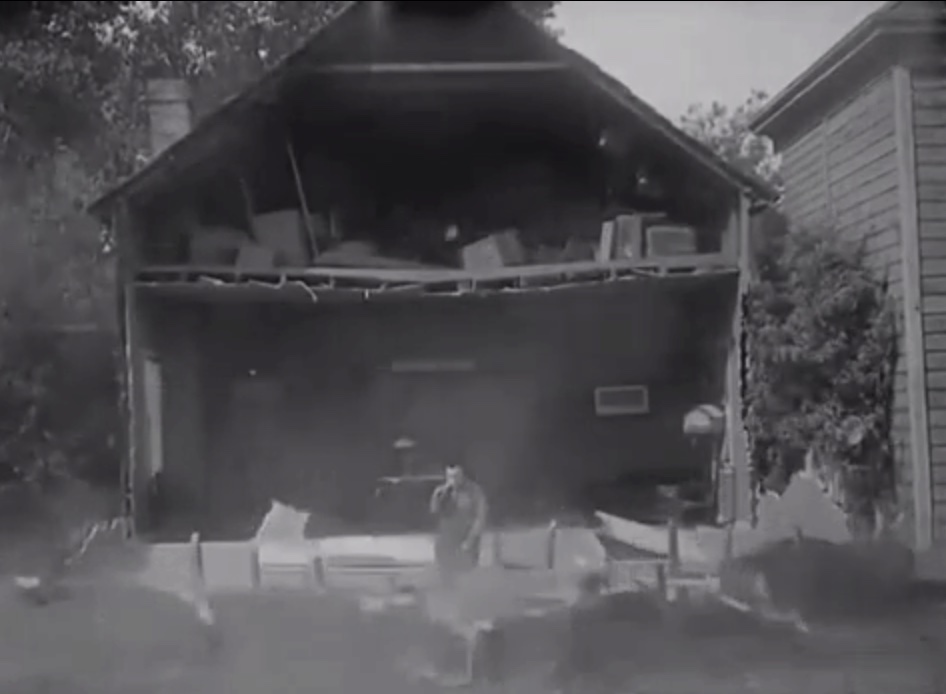
It comes in two configurations: a 440-lb and a 550-lb capacity model. A steal at $1,074 and $1,449, respectively. We do question whether doing construction work alone is advisable. Still, it would be perfect for Buster Keaton.
Shine a Little Light
Well, this is just hellish. Via Futurism:
The US Federal Communication Commission is reviewing an application to launch and deploy a massive mirror satellite in space that would reflect beams of sunlight onto darkened portions of the Earth.
Sure, it sounds good in theory; it could help power solar farms, provide ostensibly inexpensive lighting for 24-hour cities, or provide lighting during emergencies. It is the brainchild, if that’s the right word to use, of a startup called Reflect Orbital.
the prototype satellite, equipped with a 60-foot mirror, would just be the beginning. Reflect Orbital envisions deploying 50,000 mirror satellites in orbit around the Earth — over five times the size of the largest satellite constellation in the world, operated by SpaceX.
They anticipate charging about $5,000 per hour for the light of a single mirror. However, there would likely be some dire environmental consequences:
Experts fear that light from space mirrors could disrupt circadian rhythms in nature, posing a problem for flora and fauna alike. Animals might breed at the wrong time, and hibernating insects and migrating birds could be confused, Martha Hotz Vitaterna, a research professor of neurobiology at Northwestern University, told the NYT. And plants could bloom when pollinators aren’t active.
And astronomers worry that it would cause massive light pollution, interfering with efforts to make astronomical observations, which is already a big enough problem. Of course, these concerns are not the FCC’s—all the FCC is required to do is ensure that the satellites don’t interfere with other telecommunications signals. But then, it may all be moot, as it’s not entirely certain that it would even work.
Michael Brown, an astronomer at Australia’s Monash University, did the math and found that even with tens of thousands of satellites, Reflect Orbital’s efforts would barely make a dent. “Over 3,000 satellites would be required to produce the equivalent of just 20 percent of the midday Sun at a single site,” he wrote in a formal comment on the startup’s FCC application quoted by the NYT. With 87,000 satellites it could provide a fifth of the Sun’s midday illumination to 27 sites.
Rest Aria
Do you like economics? And opera? If yes to both, you will definitely have wanted to check out David Lang’s the wealth of nations, an opera based on Adam Smith’s seminal book on economics. Says the New York Philharmonic:
Drawing on texts from Smith, and also Franklin Roosevelt, Frederick Douglass, Ralph Waldo Emerson, Edith Wharton, Eugene Debs, and Maria W. Stewart, the work explores the roles and relationships of commerce and free markets. Inspired by Handel’s treatment of texts in Messiah, Lang has created an enjoyable and thought-provoking 21st-century oratorio that he hopes “encourages audiences to consider what we truly value.”
It would have been a great gimmick if it had been conducted using an invisible hand. Alas, the Philharmonic’s production just ended, but you’ll want to keep an eye out for any future performances. Or maybe not.
Pro-Tein?
Some of us, back in the day, had a PowerMac—but we’ve never had a PowerMac and cheese. Yes, there is such a thing. Via (who else?) Food & Wine:
America’s protein fixation has made its way into a classic side dish. In April, the Kraft Heinz Company will introduce Kraft Mac & Cheese PowerMac, a protein-packed version of its classic (and beloved) boxed mac and cheese.
Is it beloved? We only ever ate it because, in college, it was one of the few things we could afford.
When cooked, this new product — available in original and white cheddar — provides 18 grams of protein and six grams of fiber, helping people meet their macros while enjoying a longtime fan-favorite food. The extra nutrients are incorporated into special protein- and fiber-enriched noodles.
We’re not quite sure when protein became the big new questionable diet fad (isn’t keto still a thing?), but it seems to be everywhere these days (we’ve actually been to restaurants that have “Protein” as a menu heading). As you might expect, what health professionals recommend is not necessarily overdoing it on protein, but a wider variety of protein.
Diversify your protein sources and eat more fiber-rich foods—which many Americans don’t get enough of.
And if you’re into mac and cheese, we’re not sure that the PowerMac is the healthiest approach, but in moderation it couldn’t hurt.
This Week in Printing, Publishing, and Media History
March 23
1842: French novelist Stendhal (né Marie-Henri Beyle) dies (b. 1783).
1857: Elisha Otis’s first elevator is installed at 488 Broadway New York City.
1910: Japanese director, producer and screenwriter Akira Kurosawa born. (Everyone who witnessed his birth described it differently.)
1965: NASA launches Gemini 3, the United States’ first two-man space flight (crew: Gus Grissom and John Young).
March 24
1693: John Harrison, English carpenter and clock-maker, invented the Marine chronometer. (Harrison was the subject of Dava Sobel’s excellent book Longitude.)
1721: Johann Sebastian Bach dedicated six concertos to Margrave Christian Ludwig of Brandenburg-Schwedt, now commonly called the Brandenburg Concertos, BWV 1046–1051.
1834: English textile designer, poet, and author William Morris born.
1874: Hungarian-Jewish American magician and actor Harry Houdini (né Ehrich Weiss) escaped from the womb.
1882: American poet and educator Henry Wadsworth Longfellow dies (b. 1807).
1905: French novelist, poet, and playwright Jules Verne dies (b. 1828).
1909: Irish playwright and poet John Millington Synge dies (b. 1871).
1907: The first issue of the Georgian Bolshevik newspaper Dro is published.
1949: English singer-songwriter, bass player, and producer Nick Lowe born. And so it goes.
1958: Elvis Presley is drafted in the U.S. Army.
March 25
1811: Percy Bysshe Shelley is expelled from the University of Oxford for publishing the pamphlet The Necessity of Atheism.
1881: Hungarian pianist and composer Béla Bartók born.
1925: American short story writer and novelist Flannery O’Connor born.
1931: American journalist and activist Ida B. Wells dies (b. 1862).
1939: American screenwriter and producer D. C. Fontana born.
1957: United States Customs seizes copies of Allen Ginsberg’s poem “Howl” on obscenity grounds.
1995: WikiWikiWeb, the world's first wiki, and part of the Portland Pattern Repository, is made public by Ward Cunningham.
March 26
1484: William Caxton prints his translation of Aesop’s Fables.
1812: A political cartoon in the Boston Gazette coins the term “gerrymander” to describe oddly shaped electoral districts designed to help incumbents win reelection.
1827: German pianist and composer Ludwig van Beethoven dies (b. 1770).
1830: The Book of Mormon is published in Palmyra, N.Y.
1859: English poet and scholar A. E. Housman born.
1874: American poet and playwright Robert Frost born.
1892: American poet, essayist, and journalist Walt Whitman dies (b. 1819).
1911: American playwright, and poet Tennessee Williams born.
1931: American actor Leonard Nimoy born.
1959: American crime novelist and screenwriter Raymond Chandler dies (b. 1888).
1969: American novelist John Kennedy Toole dies (b. 1937).
1973: English playwright, actor, and composer Noël Coward dies (b. 1899).
1980: French linguist and critic Roland Barthes dies (b. 1915).
1996: American engineer and businessman, co-founder of Hewlett-Packard David Packard dies (b. 1912).
March 27
1845: German physicist, academic, and Nobel Prize laureate Wilhelm Röntgen born.
1869: American publisher and politician, and 65th Mayor of New York City James Harper dies (b. 1795).
1931: English author and playwright Arnold Bennett dies (b. 1867).
2006: Ukrainian-Polish author Stanis?aw Lem dies (b. 1921).
2012: American poet essayist and feminist Adrienne Rich dies (b. 1929).
March 28
1836: German-American brewer and founder of the Pabst Brewing Company Frederick Pabst born.
1842: First concert of the Vienna Philharmonic Orchestra, conducted by Otto Nicolai.
1868: Russian novelist, short story writer, and playwright Maxim Gorky born.
1994: How absurd: Romanian-French playwright and critic Eugène Ionesco dies (b. 1909).
March 29
1871: Royal Albert Hall is opened by Queen Victoria.
1886: John Pemberton brews the first batch of Coca-Cola in a backyard in Atlanta.
1943: English actor and comedian Eric Idle born, looking on the bright side of life.
1999: The Dow Jones Industrial Average closes above the 10,000 mark (10,006.78) for the first time, during the height of the dot-com bubble.