Know What I Mean, Vernal?
Spring is almost upon us, and the vernal equinox—which ushers in spring—is coming up in a week’s time. Says LiveScience:
This year, the vernal equinox, or spring equinox, occurs at 10:46 a.m. EDT (14:46 UTC) on March 20 in the Northern Hemisphere, according to Time and Date. Because equinoxes are global events governed by Earth's tilted axis relative to the sun, the March equinox occurs at the same moment across the globe.
As you likely know, equinoxes (yes, the proper plural, although if we were speaking Latin it would be equinoctes) occur twice a year, and as the word is derives from the Latin words aequus (equal) and nox(night), it means that the equinox is characterized by approximately 12 hours of daylight and 12 hours of darkness in both the Southern and Northern hemispheres.
And as we always point out, there is no truth to the persistent myth that you can balance an egg on its end during—and only during—the equinox. And, in keeping with tradition, we again link to the classic West Wing scene where C.J. tries to persuade everyone that you can indeed balance an egg on end.
Blank Verse
Via The Guardian, thousands of authors are jointly publishing an “empty book” to “protest against AI firms using their work without permission.”
About 10,000 writers have contributed to Don’t Steal This Book, in which the only content is a list of their names. Copies of the work are being distributed to attenders at the London book fair on Tuesday, a week before the UK government is due to issue an assessment on the economic cost of proposed changes in copyright law.
Authors include Kazuo Ishiguro, Philippa Gregory, Mick Herron, Marian Keyes, David Olusoga, Malorie Blackman and Richard Osman.
The organiser of the book, Ed Newton-Rex, a composer and campaigner for protecting artists’ copyright, said the AI industry was “built on stolen work … taken without permission or payment”.
He added: “This is not a victimless crime – generative AI competes with the people whose work it is trained on, robbing them of their livelihoods. The government must protect the UK’s creatives, and refuse to legalise the theft of creative work by AI companies.”
AI-Yi-Yi, Part the Infinity: Spamalot
Now, we all know the relationship between Spam (the food) and spam (the unwanted email). (If you don’t, the latter derives from the constant repetition of the former in a Monty Python sketch.)
Anyway, Boing Boing, offers up a weird, “Norman, coordinate” moment.
This slick new video promises to reveal the “real story” behind SPAM, the famously maligned canned meat with just six ingredients. Unfortunately, the whole thing appears to be AI-generated, which means the internet now has something even stranger: spam about Spam.
Wrapped Up in Books
In many ways, reading a book—especially a printed book—can be a calming experience, certainly when compared to reading other types of things. Books don’t run out of battery, various alerts and messages don’t pop up in the middle of reading, and a book will never make the triggering Slack DM alert noise. When you wants to decompress, you can do worse than spend a “Luddite Sunday” with a book, with anything electronic consigned to a distant room of the house.
But, via BigThink, it’s not just psychological: it’s physiological, as well. Reading can have positive effects on your nervous system.
When you read, your brain’s visual system recognizes letter shapes and transforms them into words. Language networks map those words to meanings stored in memory. Attention systems keep you focused on the narrative thread while memory systems integrate new information with existing knowledge. Multiple brain regions work together in coordinated activity.
That doesn’t sound very relaxing, does it? The key, though, is the fact that reading focuses your attention, rather than fragmenting it the way digital media can.
This focused attention actively shifts your autonomic nervous system from the sympathetic “fight-or-flight” state toward the parasympathetic “rest-and-digest” state. As this happens, you experience measurable physiological changes: your heart rate slows, your breathing deepens and becomes more regular, and your muscle tension decreases.
Of course, it could depend on what you’re reading.
Signs of the Times, Part the Ongoing: Belles Lettres
In the late 19th and early 20th centuries, the Lettres Decoratives were a collection of typeforms that were used to inspire the work of sign painters, particularly in Paris. Via Print magazine, these type templates have recently been collected in a new book called Lettres Decoratives.
“By the 1990s, vinyl letters had submerged the sign market,” writes Morgane Côme in her detailed historical introduction, “and opportunities to train in traditional methods and connect with professional painters became scarce.” These illuminated letterforms would be gone, if not forgotten, but for the contemporary designer-typographer for whom these rarities are inspiring not just for the ingenious forms of the alphabets but the unconventional color combinations.
These letterforms were then used by signmakers to paint on wood, metal, and glass.
France was a wellspring for letters such as these; they defined the commercial style of the nation with the same bravado and variety as its architecture. Sign painters feasted on common variants of finely serifed Didones and bifurcated boule (rounded serifed) ball letters. These portfolios established a baseline for alphabets that became popular (and populist) all over France, especially in Paris, where display types filled up the landscape with typographic cacophonies.
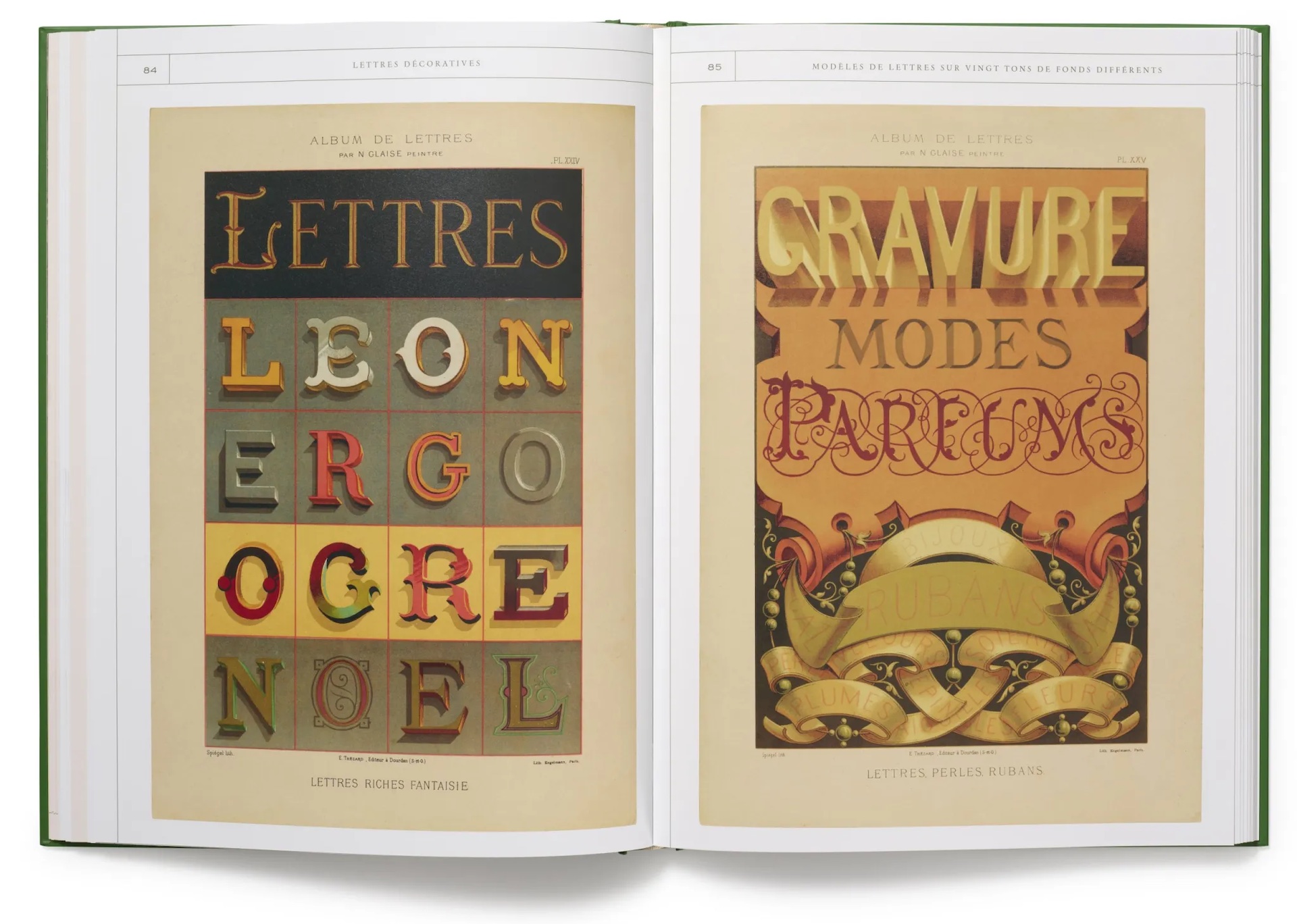
A steal at $65. You can order a copy here.
Color Harmony
It is surprising, but probably shouldn’t be, that various combinations of senses contribute to the extent to which we enjoy a particular experience. For example, you would think that all you really need to enjoy a concert would be a venue that has good acoustics. But, via PopSci, it turns out that color can also have an impact on how much we enjoy a musical performance.
In addition to reverberation and timbre (a sound’s quality or tone that makes it distinct from another sound), a venue’s appearance influences our interpretation of incoming audio.
A study published in The Journal of the Acoustical Society of America takes a close look at this phenomenon.
To illustrate this phenomenon, Weinzierl’s team asked a group of volunteers to experience concerts in various theaters—but with a catch. Given the logistical challenge of ferrying participants around multiple locations, the team broadcast the performances to the volunteers on virtual reality headsets. Each person then watched four shows (two violin and two clarinet recitals) in 12 different venues featuring various combinations of color, brightness, hue, and saturation. To boost the realism, the VR headsets also automatically adjusted the sound depending on where a person moved their head.
Then, the concertVRers were asked to rate the event based on enjoyment, timbre, reverberance, and strength.
There was a distinct correlation between a music hall’s visuals and the perceived timbre of songs. More saturated or cooler hues like blue and green seemed “colder” sounding than the other options. Darker theaters also often increased how much a participant liked the music they heard. At the same time, there was no change in perceived volume depending on coloration—a finding reinforced by past studies.
The upshot: concert hall designers should not only concentrate on the acoustic properties of a venue.
Horsing Around
Consider the centaur, the mythological half-man, half-horse hybrid from Greek mythology:

Adobe Stock
A burning question we have always had is: where are its internal organs? In the horizontal horsey bit, or the vertical human bit? Or are they sort of spread out between the two bits? And what kind of diet would it have—horse or human? Inquiring minds want to know.
Anyway, we bring up centaurs because, via Futurism, a team of engineers in Shenzhen, China, have developed a robot appendage for humans based on the design of the centaur, allowing people to become their own pack animals.
In video demonstrations released alongside a paper published in the International Journal of Robotics Research last month, an engineer can be seen walking around a university campus with a two-legged, centaur-inspired appendage striding along behind him.
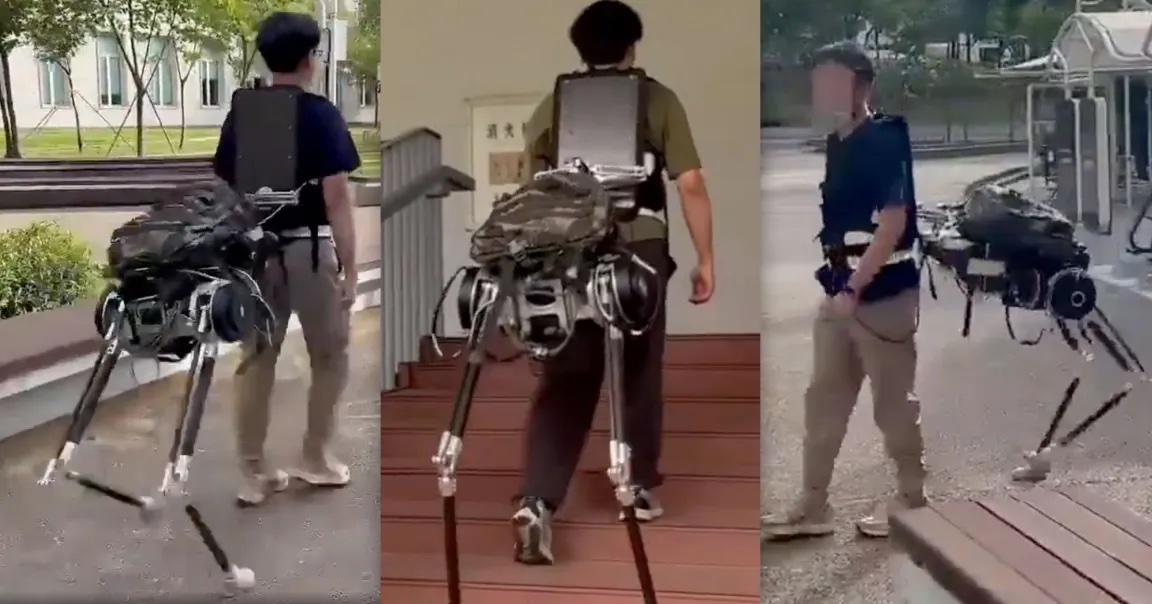
The team found that their approach allowed a wearer to save plenty of energy, or “metabolic cost,” compared to wearing a regular backpack that weighed 44 pounds, similar to the centaur robot.
It has its issues.
The researchers argued that while autonomous robots such as robodogs are “being actively explored as load-transport solutions without direct human involvement,” the approach comes with some drawbacks, like the need to “navigate reliably in complex environments where a prior map is unavailable.” Payload capacity is also limited, and could greatly cut into battery power.
But wait! There’s more!
“Additionally, the Centaur robot can be controlled to interact with the human at the human-robot interface, generating horizontal interaction force in the sagittal plane to provide forward assistance during human walking,” the researchers wrote.
In other words, it can shove you in the back.
Anyone who has lived in New York City knows that an infinitely better idea has been around for decades: the granny cart.

Stud Finder
Via Ars Technica, a clever idea for snow tires, inspired by a scene in the James Bond film, The Living Daylights. If you have seen the movie, you may recall that Bond’s tricked out Aston Martin featured retractable tire studs that 007 could activate and use to cut a hole in the ice around some Bond villain henchfolk. A feature with a very limited number of useful scenarios, but there you are.
Anyway, in 2014, Finnish tire manufacturer Nokian was intrigued by the idea, and came up with a concept for a tire with retractable studs—but found that it would cost so much to manufacture that the tires would cost more than the car they were attached to. But they kept at it, and eventually made headway on a practical “studded winter tire that automatically adjusts to changes in temperature and surface pressure.” The tire is called the Hakkapeliitta 01.
The new tire Is built on the success of Nokian’s already-established Hakkapeliitta line, which originated 90 years ago in 1936. Before the 01, the Hakkapeliitta 10 set the standard for winter tires and is still highly regarded. Since this is such a significant leap for Nokian, it’s starting over again at 01, a practice that has happened only two other times in nearly a century in business.
How does it work?
The rubber tread (made partly of renewable materials like natural rubber, plus bio resin and bio-based oils partially derived from pine resin and canola oil) meets the road, cushioning a thin lock compound layer and an adaptive base that holds the studs in place. The adaptive base layer is the key to the system, as it stiffens in cold temperatures and becomes softer and stickier as the air and surface temperatures rise. Roughly 220 studs dot each, hitting the road 14 times per second at 62 mph (100 km/h). Nokian’s 2,300-foot (700 m) ice runway—which is smoothed out with water and a custom machine with wide wings, like a crop harvester—has been used thousands of times to prove the adaptive base transitions quickly from the ice to the air outside the covered runway and vice versa.
The positioning of the studs is also of paramount importance.
One thing that makes the tires unique, Dyhrman says, is that a robot inserts each stud to ensure it’s optimally oriented for each position. Center studs offer strong support and performance, while the shoulder studs are rotated horizontally for better biting edges and steering precision.
In the US, many states have banned studded tires, as they can wreak damage on roads, and even in those states that do allow studded them, it’s often only during specified months (i.e., winter). So the Nokian tires can help reduce road damage by only being active when there is snow and ice on the road.
Nokian says its new winter tires represent up to a 30 percent reduction in road wear, as the ice grip improved by as much as 10 percent. On top of that, the Hakkapeliitta 01 represents noise levels reduced by as much as 1 decibel from the Hakkapeliitta 10. Some, but not all, of the new tires include another layer, called SilentDrive technology, that reduces interior noise even further.
Look for them to come to North America this fall. No indication on how much they’ll cost. Hopefully not more than a car.
Pompeii and Circumstance
It’s one of the most famous natural disasters of all time. In 79 C.E., dormant volcano Mount Vesuvius became undormant, and buried the Italian city of Pompeii under 4–6 m of volcanic ash and pumice. (It wasn’t lava, since lava, being melted rock, would have solidified and made exploring the ruins impossible.) Via Laughing Squid, Lost in Time created a 3D animation of what the ancient city would have looked like before the eruption.
The artist mapped several notable structures, such as the amphitheater, the gladiator arena, public fountains, and even the homes of residents, all of which were kept beautifully intact until the day of this historically fateful event.

It’s a fascinating look not only at the last days of Pompeii, but what life was like in Italy 2,000 years ago. Watch it here.
Graphene Gets Touchy
Was it a good week for graphene news? It’s always a good week for graphene news! Graphene-liquid metal sensors unlock 3D force detection for robots. From (who else?) Graphene-News:
A University of Cambridge research team has developed a triaxial force microsensor array using graphene-liquid metal composites, enabling robots to sense force magnitude, direction, slip, and surface roughness at scales rivaling human fingertips. This achievement addresses key limitations in tactile sensing for neuroprosthetics, human-machine interfaces, and dexterous robotics by decoupling normal and tangential forces through multiscale pyramid microstructures.
Current tactile sensors tend to be either too cumbersome or too fragile—or even too complex to manufacture. The new approach solves those problems.
Integrated into grippers, the array supports self-adjusted grasping of unknown objects, detecting slip without prior data and estimating roughness for adaptive control. Microscale versions analyze tiny metal spheres' mass, geometry, and density, suiting microrobots and minimally invasive surgery.
The Unfriendly Skies
Granted, we’re not fans of United Airlines (although there is very little difference in airlines these days; they’re all uniformly awful), but we were intrigued by a new policy. Via Gizmodo:
United updated its “Contract of Carriage” document on Feb. 27, 2026 in a move only recently spotted by NBC 5 in Chicago. Rule 21 includes the “Rules of Transport, which lists all the things you can be denied a seat for, which now includes “Passengers who fail to use headphones while listening to audio or video content.”
Good! That makes us more inclined to fly United.
Food Grammar
When different foods are imported into a country, they very often evolve to become very different from how they started—and often unrecognizable (or even unpalatable) to people who come from where those foods originated. We had a friend from India who hated what was called Indian food in the US, and a friend of ours had labmates in grad school from China who, went sent out for “Chinese food,” would not return with eggrolls and chow mein.
Serve spaghetti and meatballs to an Italian, and they may question why pasta and meat are being served together. Order a samosa as an appetizer, and an Indian friend might point out, as writer Sejal Sukhadwala has, that this is similar to a British restaurant offering sandwiches as a first course. Offer an American a hamburger patty coated in thick demi-glace, and they’ll likely raise an eyebrow at this common Japanese staple dubbed hambagoo.
We bring this up, because, via Atlas Obscura, it’s all part of something called “food grammar.”
Yes, much like language, cuisine obeys grammatical rules that vary from country to country, and academics have documented and studied them. They dictate whether food is eaten sitting or standing; on the floor or at a table; with a fork or chopsticks or with fingers. Like sentence structure, explains Ken Albala, Professor of History at the University of the Pacific, a cuisine’s grammar can be reflected in the order in which it is served, and a grammar can dictate which foods can (or cannot) be paired, like cheese on fish, or barbecue sauce on ice cream.
Food grammar describes how various ingredients and dishes become a meal, “much like how a jumble of words becomes a sentence.”
Grammars can even impose what is considered a food and what isn’t: Horse and rabbit are food for the French but much less so for the English; insects are food in Mexico but not in Spain.
And while violations can trigger a response from the “food grammar police,” they can result in new types of meals.
bringing a culinary grammar into a new setting can also result in the creation of interesting, new dishes. And just as some languages, like English, are super elastic, welcoming neologisms easily, while others, like French, are less manipulable, some cuisines are more welcoming of culinary novelty than others.
This Week in Printing, Publishing, and Media History
March 9
1454: Italian cartographer and explorer Amerigo Vespucci born.
1776: The Wealth of Nations by Scottish economist and philosopher Adam Smith is published.
1815: Francis Ronalds describes the first battery-operated clock in the Philosophical Magazine.
1842: Giuseppe Verdi’s third opera, Nabucco, receives its première performance in Milan; its success establishes Verdi as one of Italy's foremost opera composers.
1918: American crime novelist Mickey Spillane. (It was Hammer time!)
1954: CBS television broadcasts the See It Now episode, “A Report on Senator Joseph McCarthy,” produced by Fred Friendly.
1959: The Barbie doll makes its debut at the American International Toy Fair in New York.
1963: American journalist and author David Pogue born.
March 10
1876: The first successful test of a telephone is made by Alexander Graham Bell.
1903: American author, playwright, and diplomat, United States Ambassador to Italy Clare Boothe Luce born.
March 11
222: Roman emperor Elagabalus dies (b. 203).
1702: The Daily Courant, England’s first national daily newspaper is published for the first time.
1851: The first performance of Rigoletto by Giuseppe Verdi takes place in Venice.
1952: English author and playwright Douglas Adams born. Don’t panic!
1970: American lawyer and author Erle Stanley Gardner dies (b. 1889).
1989: Sir Tim Berners-Lee submitted his proposal to CERN for an information management system which would be developed into the world wide web.
2020: The World Health Organization (WHO) declares COVID-19 virus a pandemic.
March 12
1838: English chemist and academic William Henry Perkin born. Whilst trying to synthesize artificial quinine to help battle malaria, Perkin accidentally invented the first synthetic organic dye, mauveine, made from aniline.
1858: American newspaper publisher Adolph Ochs born.
1894: Coca-Cola is bottled and sold for the first time in Vicksburg, Mississippi, by local soda fountain operator Joseph A. Biedenharn.
1922: American author and poet Jack Kerouac born.
1928: American director and playwright Edward Albee born.
March 13
1781: William Herschel discovers Uranus. (Careful with that pronunciation.)
1921: American cartoonist Al Jaffee born.
1930: The news of the discovery of Pluto is telegraphed to the Harvard College Observatory.
1943: American poet, short story writer, and novelist Stephen Vincent Benét dies (b. 1898).
March 14
1663: Otto von Guericke completes Nature of Space and the Possibility of the Void, which postulated the existence of a vacuum.
1836: English author of Mrs Beeton’s Book of Household Management Isabella Beeton born.
1874: Dutch businessman and co-founder of Philips Electronics Anton Philips born.
1879: German-American physicist, engineer, academic, and Nobel Prize laureate Albert Einstein born.
1885: The Mikado, a light opera by W. S. Gilbert and Arthur Sullivan, receives its first public performance in London.
1931: Alam Ara, India’s first talking film, is released.
1936: The first all-sound film version of Show Boat opens at Radio City Music Hall.
1994: Linux kernel version 1.0.0 is released.
2018: English physicist and author Stephen Hawking dies (b. 1942).
March 15
44 BC: Et tu, Brute? Roman general and statesman Julius Caesar dies (b. 100 BC).
1918: American author, critic, and biographer (James Joyce, Oscar Wilde) Richard Ellmann born.
1937: American short story writer, editor, and novelist H. P. Lovecraft dies (b. 1890).