It Won’t Be Flong
How well do you know printing history? Find out in a new book by printing and comics historian Glenn Fleishmann. Flong Time, No See: Forgotten Stories of Printing and Labor is a collection of essays “about how we made and shared the written word—and what we lost along the way.” Now on Kickstarter, some of the stories include:
Bogus! Typesetters were paid to set copy that was thrown away to avoid intrusion on their monopoly. Even the Supreme Court got involved—and said it was legitimate!
Lorem Ipsum Is Garbled: The most reproduced and misunderstood text of the last 40 years doesn’t mean anything. How did it get that way?
Reading the Reprintings: Books hide information about revisions through markings that can obscure the authoritative version of an author’s text or a non-fiction work.
When funded, the print edition will be a 352-page 6x9-in. paperback. There will also be a DRM-free ebook version.
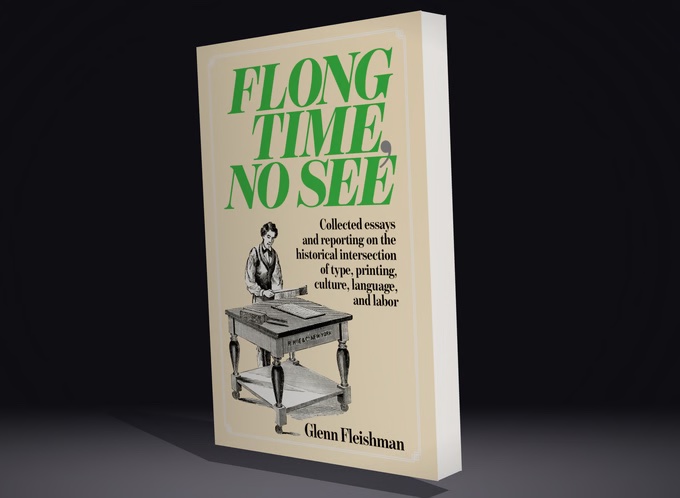
It’s worth it just to discover what a “flong” is.
As of this writing, $11,965 (of a $25,000 goal) has been pledged, with 26 days to go. Reward tiers start at $7.
As I Write Draw This Letter
Ever heard of Ruth Libauer Hormats or her brother Robert Libauer? No, nor have we, but via Print magazine they were pioneers in the development of design tools. If you have ever used one of these...
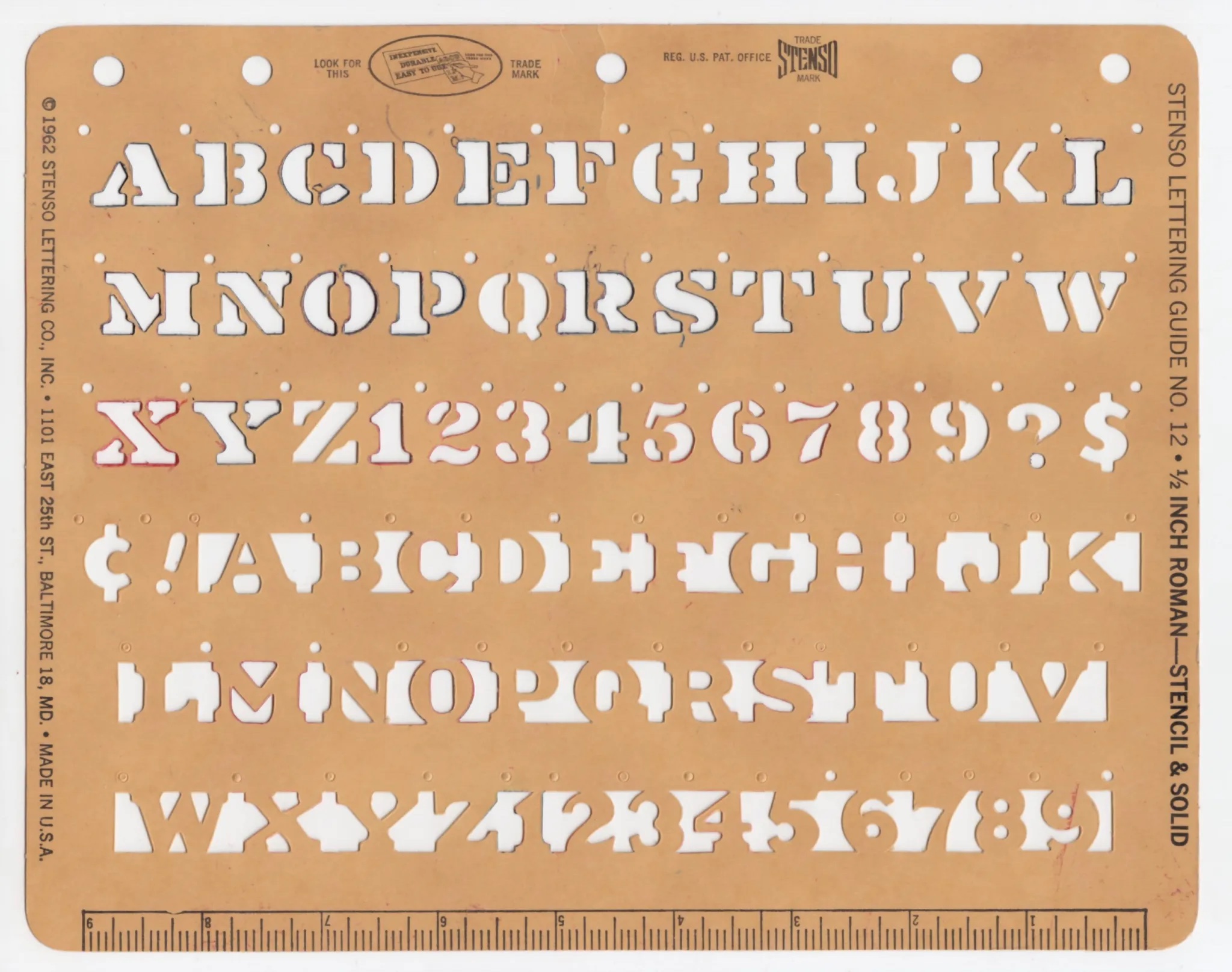
...you are familiar with their work. Yes, it’s a stencil, and while they didn’t invent the concept of the stencil (brass stencils had long been used for marking shipping crates, for example), in the 1940s Hormats and Libauer developed and sold a stencil system designed for students, teachers, or others who wanted an easy to use drawing/lettering system for signs, displays, book reports, or other projects. Called “Stenso guide sheets,” they were produced on heavy cardboard or oaktag.
“The Stenso Lettering Guide was so unique with its spacing holes (called ‘indicators’ by Hormats) that she submitted her patent design in 1940 and was awarded a patent for her invention in 1942,” wrote Levine in an online article titled A Brief History of the Stenso Lettering Company. Even Macy’s, the world’s largest department store, promoted the product’s versatility through live demonstrations.
It also preceded Letraset—dry transfer decal sheets—by more than a decade.
Stencil lettering, characterized by breaks or channels of empty or negative space between portions of each letter, never really went out of fashion. If one considers fashion to include “Post No Bills” signs, military labels, parking garage directional signs, and the Boston Police and Fire department logos (the last are variants of Futura Black), stencil is perpetually with us in a quiet, vernacular way. Yet starting in the 1970s it started coming back into style in a big way.
Catography
Our Mount Monadnock Media Maven, who is still on Xitter, points us to a tutorial on how to write a cat font alphabet.
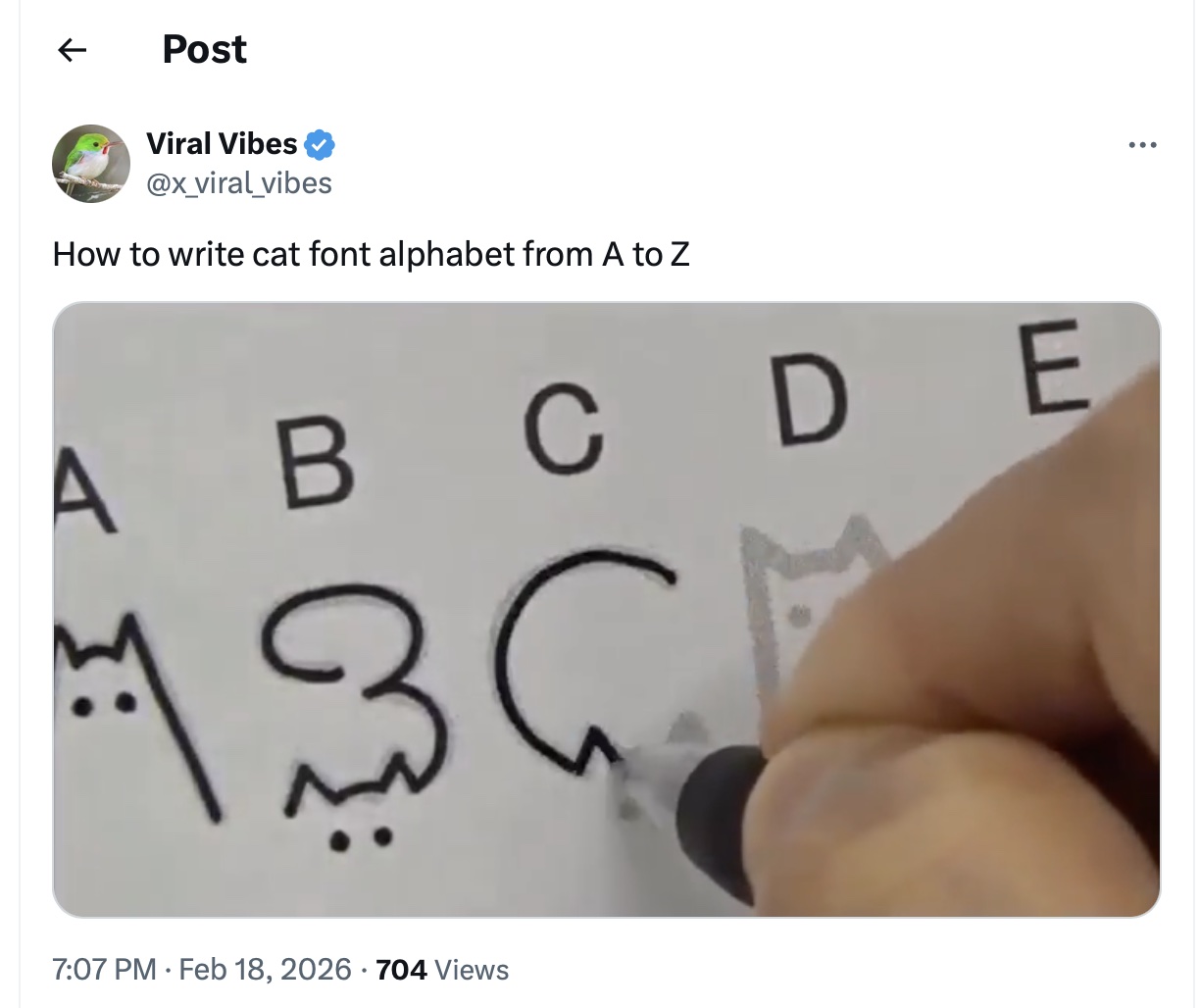
We may use that for our next print edition.
Sitting on a Fortune
The Banque of France, like the U.S. Bureau of Printing and Engraving, prints money. To thwart counterfeiting, they use a proprietary printing process called EverFit, which consist of a cotton fiber paper embedded with holographic elements that react to UV, fluorescent, or infrared light. The notes are then coated with a polymer film to make them durable.
However, every once in a while, there is the inevitable printing error, which makes the bills uncirculatable. However, the EverFit process also makes the defective money unrecyclable. What to do? Well, they make furniture. Via Core77, French furniture company Maximum, which specializes in turning industrial waste into products, turns them into stools.
“Each fragment of [a shredded] EverFit® banknote,” they write, “contains exactly the right proportion of materials needed for its transformation into furniture: a cotton substrate and two layers of heat-sensitive coating. Accumulated, heated, and then strongly compressed, EverFit® shreds form a rigid, smooth, and surprisingly resistant material: Billex.”

Furthermore, the stools “can be recycled infinitely in our workshops,” the company writes. “Because at Maximum we are convinced that archetypes are meant to last and reinvent themselves in line with the challenges and resources of their time.”
A steal at €225. “Chez vous en 5 semaines”!
Conform!
One challenge for various industries looking to use batteries is developing effective energy storage systems that don’t dictate how the device using them needs to be designed, the way today’s physical batteries do. But, via TechSpot, one start-up has turned to 3D printing.
Material Hybrid Manufacturing, founded in 2023 by engineer Gabe Elias, a veteran of both Mercedes-AMG Petronas and Rivian, has developed a way to 3D print complete battery systems directly onto or within surfaces. Its approach could eliminate the rigid rectangular and cylindrical cells that currently define how devices, vehicles, and drones are designed.
Material's proprietary platform, called Hybrid3D, can print every layer of a functional battery – anode, cathode, separator, and casing – in situ, without molds or tooling. The system integrates principles from direct-ink printing and fused deposition modeling to deposit active materials in successive layers only 100 to 150 micrometers thick. After printing, a liquid electrolyte is infused to complete the cell, although the company is pursuing solid-state variants for future product iterations.
This could revolutionize product design.
Unlike conventional manufacturing, which requires metal housings, bus bars, and extensive wiring, the printed approach embeds batteries seamlessly into existing surfaces. In a drone, that could mean distributing energy along the wings or arms. In a wearable, it could curve around the frame of a pair of smart glasses rather than sitting as a fixed module.
R and R
The COVID pandemic had many lasting effects, some good (work from home), some not so good (increased microplastic pollution), and some that were just kind of annoying—namely, QR restaurant menus. They proliferated during the pandemic as a way to avoid potentially germy physical menus, and many places—especially in airports—continue to use them, despite the fact that they don’t always work—or maybe it’s just us. Few people are fans of QR menus, but, via Gizmodo, research purports to tell us that the reason we don’t like QR menus is that we really want AR menus. (Actually, what we really really want are actual human waitpeople.)
The study, led by Soobin Seo of WSU’s Carson College of Business, seems to suggest that restaurants could boost customer interest in and willingness to tell others about their establishment by adding augmented reality (AR) elements to their digital menus. The researchers’ findings were published in the January edition of the International Journal of Hospitality Management, an industry scientific journal that has (to its credit) previously published research on the prevalence of method variance bias in research published in the hospitality industry’s leading journals, IJHM included.
Yeah, because who doesn’t want to download an app (because you know every restaurant would use a different one) and go through whatever tortuous login process is required—set up user ID; password; more secure password; no, more secure than that; security questions; then get emailed/texted a verification code—to order a meal? Can’t we just tell a human, “Could we have the chicken, please”? Anyway, continue:
A sample size of 243 study participants were shown one of three menu formats—AR, QR, and classic printed—then asked to imagine ordering the menu’s signature burger dish and digest information about its many FTT [farm-to-table] ingredients in their menu’s respective format. The participants were then asked about what they gleaned and asked to rate things like their menu’s interactivity, their intention to visit the restaurant, and their intention to share what they learned about their imaginary burger with others. While those with the AR menus did indeed score higher when it came to their willingness to visit, remember, and yap about a theoretical restaurant, their average self-selected response was roughly only .5 higher than those with the QR and paper menus.
They add:
“Consumers increasingly want transparency about where their food comes from, but the way that information is presented really matters,” Seo told WSU Insider. “Augmented reality allows restaurants to share that information in a more vivid, interactive, and engaging way.”
Could be, but simply imagining an AR-based process for this is far different from how it would operate in reality. If we were by ourselves in an airport with a long layover, maybe it would be an interesting diversion, but out with friends or on a date it would not necessarily be practical. Or desirable.
We’re not Luddites (most days), but you know the Around the Web philosophy: for us to adopt any technology, it has to provide a better experience than what it aims to replace. (On a related topic, this month’s Around the Web Book Club selection is Cory Doctorow’s Ens***tification: Why Everything Suddenly Got Worse and What to Do About It.)
Who Ya Gonna Call?
It’s a safe bet Thomas Edison was never ghosted (well, except by the emerging motion picture industry, which relocated from the East Coast to California to get away from him), but he did try to contact ghosts. One of Edison’s least successful, or perhaps even apocryphal, inventions was a “spirit phone.” Via Atlas Obscura, in 1920, Edison told American Magazine: “I have been at work for some time, building an apparatus to see if it is possible for personalities which have left this earth to communicate with us.” Presumably, he did not mean astronauts. He added that,
this new invention would not function by “any occult, mystifying, mysterious, or weird means, employed by so–called “mediums”, but by scientific methods. I am engaged in the construction of one such apparatus now, and I hope to be able to finish it before very many months pass.”
That said, for years there was no evidence—no documentation, blueprints, prototypes, etc.—that Edison ever tried to make a spirit phone, so historians have long thought this was a joke or hoax, or what we would call today “overpromising and underdelivering.” However, in 2015, French journalist Philippe Baudouin uncovered a rare version of Edison’s diary in a French thrift store.
This version includes a chapter that was not printed in the widely known 1948 English edition, called the Diary and Sundry Observations of Thomas Alva Edison. This missing chapter was dedicated to his theory of the spirit world, and how it might be possible to contact it. Baudouin re-published the French edition as Le Royaume de l’au-delà.
Edison was not out of step with the times; trying to contact the dead was tout le rage in the early 20th century.
That a well-respected scientist who greatly influenced modern technology could try to contact spirits might seem unlikely to the public now. But when Edison spoke of his idea in 1920, spiritualists were still going strong in the United States—some even called themselves “phone-voyants,” and claimed that they could harness the electric signals in conventional phones to interpret spirits.
Aside from a couple of Twilight Zone episodes, such a device has never, nor will ever, be made.
Gotta say, though, the twist ending (spoiler alert) of the Twilight Zone episode “Night Call” would not work today, as the Caller ID would likely read “dead fiancé.”
Graphene Goes Nuts
Was it a good week for graphene news? It’s always a good week for graphene news! A new process produces graphene from waste peanut shells. From (who else?) Graphene-News:
Researchers from Australia’s University of New South Wales (UNSW), Australian Nuclear Science and Technology Organization (ANSTO) and The Hong Kong Polytechnic University have developed a rapid, highly efficient process to synthesize graphene from discarded peanut shells - turning agricultural waste into a high-value nanomaterial.
And they’re looking to other types of agricultural waste as well.
Looking ahead, the team plans to extend this approach to other lignin-rich biomasses such as coffee grounds and banana peels, positioning precursor-engineered flash Joule heating as a broadly applicable route to low-cost, high-quality graphene.
Soon, graphene will go bananas.
Back Talk
Ah, the kids today, with their Hula Hoops and their TikTok. And…their archaic language? Says the New York Times via Boing Boing:
The kids are bringing back archaisms: old-timey language that’s been out of use for decades, if not a century or more. Lummox, hoodwink, skedaddle, whence and hence…
They’ve been out of use?
“Older slang is basically an earworm,” an expert told the New York Times. “You just need to hear it once for it to be top of mind, but if you hear it over and over, it’s definitely going to stick somewhere in your brain and can pop up unexpectedly anytime.”
Zounds!
Sucking it Up
Who among us has not dreamed of commanding an army of thousands of robots to do our bidding—or is it just us? Anyway, that’s what a software engineer inadvertently ended up doing when he tried to make a remote control for his robot vacuum. Says Popular Science:
While building his own remote-control app, Sammy Azdoufal reportedly used an AI coding assistant to help reverse-engineer how the robot communicated with DJI’s remote cloud servers. But he soon discovered that the same credentials that allowed him to see and control his own device also provided access to live camera feeds, microphone audio, maps, and status data from nearly 7,000 other vacuums across 24 countries.
It's amusing on the surface, but the implications are kind of terrifying:
The backend security bug effectively exposed an army of internet-connected robots that, in the wrong hands, could have turned into surveillance tools, all without their owners ever knowing.
Sucking up data, you might say. Fortunately, Azdoufal chose not to become a Bond villain. Rather, he told his story to The Verge, which then reported the problem to DJI (the maker of the robot vacuum cleaner).
While DJI tells Popular Science the issue has been “resolved,” the dramatic episode underscores warnings from cybersecurity experts who have long-warned that internet-connected robots and other smart home devices present attractive targets for hackers.
“Dirt Devil” was just supposed to be a cute name for a vacuum brand, not a literal description.
Over the Influencer
We have come to actively dislike the word “influencer.” It reminds us of “influenza,” but far more dangerous.
As we all know, the way restaurants are reviewed has changed. Once upon a time, you could read professional restaurant reviews in the local paper (and some of us still can—this Albany Times-Union reviewled us to discover a fantastic German restaurant) or perhaps a Zagat’s Guide (or a Michelin Guide if you were in the 1950s—oh, wait…wow, they’re still around).
As with everything, the Internet has democratized the restaurant review process—first via Yelp!, now via Google Reviews and, increasingly, TikTok. Which is fine, but the process is prone to abuses, such as posting bad reviews to gain views, or using the threat of a bad review to get a free meal or otherwise chastise waitstaff or be a colossal a-----e. (We did once actually witness someone threaten a bartender with a bad Yelp! review. As “Weird Al” sang: “Think it’s fun threatening waiters with a bad Yelp! review/Because I’m tacky/And if you think that’s fine/Then maybe you’re tacky, too.”)
Of course, even professional reviewers were not above catty comments, but at least there was some sense of professionalism, restraint, and editorial standards.
Anyway, via Food & Wine, one small business owner is taking on so-called food influencers.
Known online as @daadisnacks, NYC-based small business owner Jay, who prefers not to disclose his full name, has accomplished what many social media users try and fail to do: build a large online following for his brand in a relatively short period of time. Jay’s audience has expanded rapidly over the course of just one year. His TikTok and Instagram pages both bear the name of and represent his South Asian popcorn company, Daadi, which sells a packaged snack seasoned with a recipe from his grandmother, the eponymous Daadi, a term for grandmother.
Revenge is a dish best served seasoned.
His videos largely aim to denounce influencers who post scathing restaurant reviews to gain more views, criticize establishments for not giving them a free meal, post culturally insensitive feedback about non-Western cuisines, or commit other forms of what he describes as “scams” against small restaurants. Jay also creates content that highlights less malevolent influencer behavior he deems ridiculous, ignorant, or privileged.
… “I think in an ideal world, if you were able to have somebody who just posts unbiased reviews of the places they go, like a Gen Z Pete Wells or something, I think that could work well. I just think it’s really difficult because, as an influencer, ultimately, you’re reliant on the number of eyeballs you get on a video, and you’re going to be incentivized to say something controversial,” Jay says, noting that negative reviews tend to attract more views. He points to Keith Lee — a content creator with over 17 million followers on TikTok — as an example of someone who shares genuine feedback about the food he eats while still endorsing restaurants.
Bucket List
Now, we freely admit, we like our coffee, a necessity for getting started in the morning. But we don’t consume it by the bucket. Does anyone? Yes, apparently. Dunkin’ is test-marketing new Beverage Buckets, wherein you can get a 48-ounce cup mug bucket of coffee (or other Dunkin’ beverage). Just to be clear, 48 ounces is six cups, or more than a third of a gallon. Says Food & Wine Boing Boing, Dunkin’ is testing the product at select locations in Massachusetts and New Hampshire, and options start at $8.89.
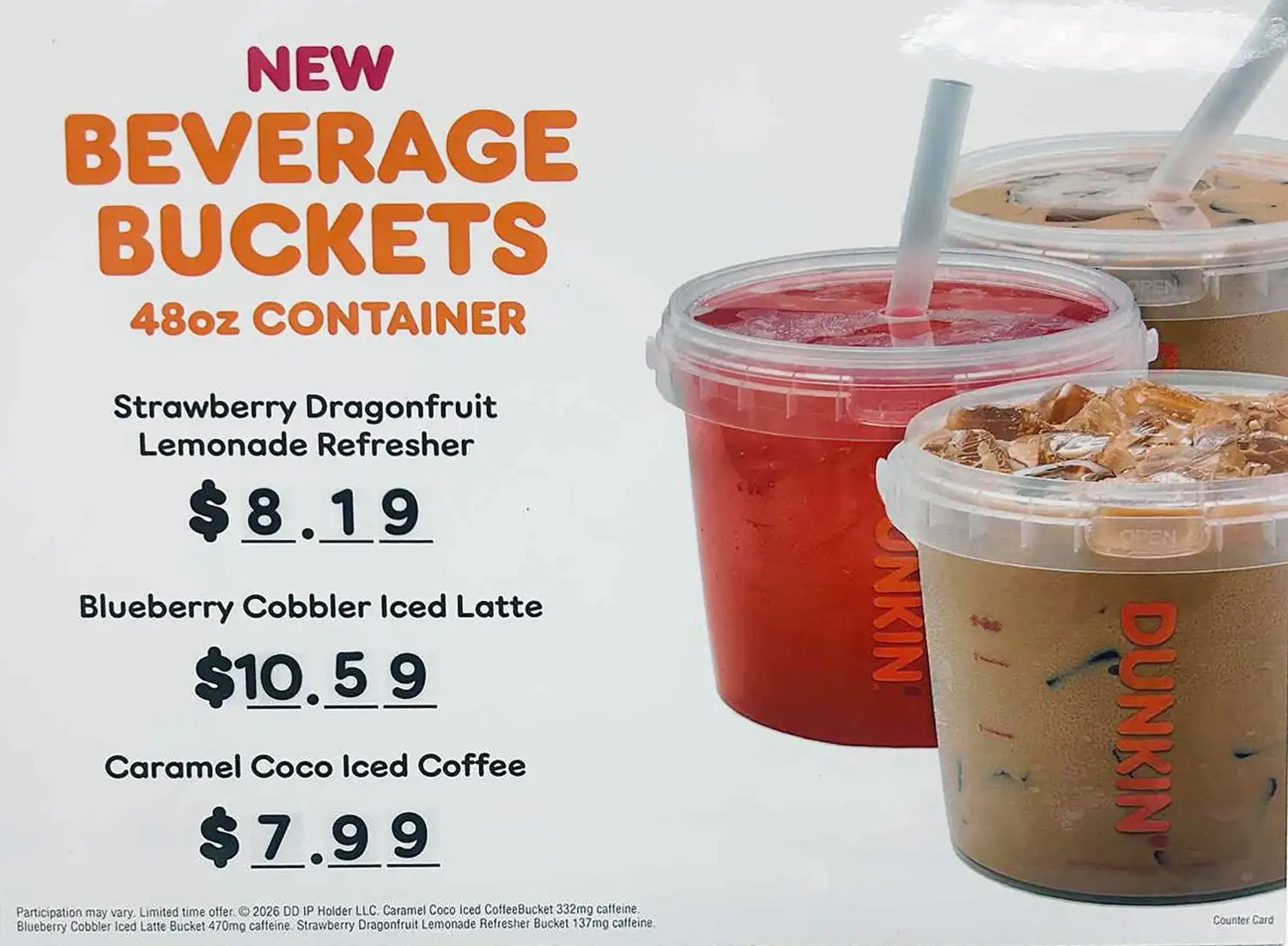
A better name would be the Bladder Buster. It’s not clear that regular ol’ hot joe is an option, but even so, the fine print above identifies the caffeine content of the buckets to range from 137 to 470 mg. We should point out that the FDA estimates (at least for now) that potentially lethal effects such as seizures may be observed with “rapid consumption of around 1,200 milligrams of caffeine.”
We estimate that potentially inconvenient effects like endless trips to the bathroom would definitely be observed with the consumption of 48 ounces of any liquid.
Which may be a moot point:
But as of Wednesday, a spokesperson confirmed that the Dunkin’ buckets of New England’s dreams had already sold out after a limited time of being sold at a handful of stores.
If Starbucks ever goes this route, be sure to keep your cardiologist on speed dial.
This Week in Printing, Publishing, and Media History
February 23
1455: Traditional date for the publication of the Gutenberg Bible, the first Western book printed with movable type.
1633: English diarist and politician Samuel Pepys born.
1821: English poet John Keats dies (b. 1795).
1898: Émile Zola is imprisoned in France after writing J’Accuse…!, a letter accusing the French government of antisemitism and wrongfully imprisoning Captain Alfred Dreyfus.
1904: American journalist and historian William L. Shirer born.
1927; U.S. President Calvin Coolidge signs a bill by Congress establishing the Federal Radio Commission (later replaced by the Federal Communications Commission) which was to regulate the use of radio frequencies in the United States.
February 24
1582: With the papal bull Inter gravissimas, Pope Gregory XIII announces the Gregorian calendar.
1607: L’Orfeo by Claudio Monteverdi, one of the first works recognized as an opera, receives its première performance.
1711: The London première of Rinaldo by George Frideric Handel, the first Italian opera written for the London stage.
1854: A Penny Red with perforations was the first perforated postage stamp to be officially issued for distribution.
1921: American actor Abe Vigoda born.
1955: American businessman and co-founder of Apple Inc. and Pixar Steve Jobs born.
1968: American comedian and actor Mitch Hedberg born.
1989: Ayatollah Ruhollah Khomeini issues a fatwa and offers a USD $3 million bounty for the death of Salman Rushdie, author of The Satanic Verses.
February 25
1644: English pastor, engineer, and inventor of the first practical steam engine Thomas Newcomen born.
1899: German-English journalist and businessman, founder of Reuters Paul Reuter dies (b. 1816).
1928: Charles Jenkins Laboratories of Washington, D.C. becomes the first holder of a broadcast license for television from the Federal Radio Commission.
1943: English singer-songwriter, guitarist, and producer George Harrison born.
1983: American playwright, and poet Tennessee Williams dies (b. 1911).
February 26
1564: English playwright, poet, and translator Christopher Marlowe born.
1616: Galileo Galilei is formally banned by the Roman Catholic Church from teaching or defending the view that the earth orbits the sun.
1802: French author, poet, and playwright Victor Hugo born. (We had a hunch.)
1909: Kinemacolor, the first successful color motion picture process, is first shown to the general public at the Palace Theatre in London.
1918: American author and critic Theodore Sturgeon born. (It was an amok time.)
February 27
1691; English publisher, founder of The Gentleman’s Magazine Edward Cave born.
1807: American poet and educator Henry Wadsworth Longfellow born.
1812: Poet Lord Byron gives his first address as a member of the House of Lords, in defense of Luddite violence against Industrialism in his home county of Nottinghamshire.
1891: American businessman and founder of RCA David Sarnoff born.
1902: American journalist, author, and Nobel Prize laureate John Steinbeck born.
February 28
1683: French entomologist and academic René Antoine Ferchault de Réaumur born. After observing wasps building their nests, Réaumur was the first to propose making paper out of wood.
1827: The Baltimore and Ohio Railroad is incorporated, becoming the first railroad in America offering commercial transportation of both people and freight.
1935: DuPont scientist Wallace Carothers invents nylon.
1939: The erroneous word “dord” is discovered in the Webster's New International Dictionary, Second Edition, prompting an investigation.
1940: Basketball is televised for the first time (Fordham University vs. the University of Pittsburgh in Madison Square Garden).
1944: English graphic designer and cofounder of Hipgnosis Storm Thorgerson born.
1954: The first color television sets using the NTSC standard are offered for sale to the general public.
1970: American journalist, author, and accordion player Daniel Handler born. Under the name Lemony Snicket, he is the author of the children’s book series A Series of Unfortunate Events.
1983: The final episode of M*A*S*H airs, with almost 106 million viewers. It still holds the record for the highest viewership of a season finale.
February 29
1712: February 29 is followed by February 30 in Sweden, in a move to abolish the Swedish calendar for a return to the Julian calendar.
1940: For her performance as Mammy in Gone with the Wind, Hattie McDaniel becomes the first African American to win an Academy Award.
1860: American statistician and businessman, co-founder of the Computing-Tabulating-Recording Company Herman Hollerith born.
March 1
1790: The first United States census is authorized.
1869: Dmitri Mendeleev finishes his design of the first periodic table of elements and sends it for publishing.
1872: Yellowstone National Park is established as the world’s first national park.
1873: E. Remington and Sons in Ilion, N.Y., begins production of the first practical typewriter.
1893: Electrical engineer Nikola Tesla gives the first public demonstration of radio in St. Louis, Mo.
1896: Henri Becquerel discovers radioactive decay.
1914: American novelist and literary critic Ralph Ellison born.
1917: American poet Robert Lowell born.
1917: The Zimmermann Telegram is reprinted in newspapers across the United States after the U.S. government releases its unencrypted text.
1922: American publisher and founder of MAD Magazine William Gaines born.
1998: Titanic became the first film to gross over $1 billion worldwide. (It is worth checking out this site that adjusts the highest-grossing movies for inflation.)
2006: English-language Wikipedia reaches its one millionth article, Jordanhill railway station.