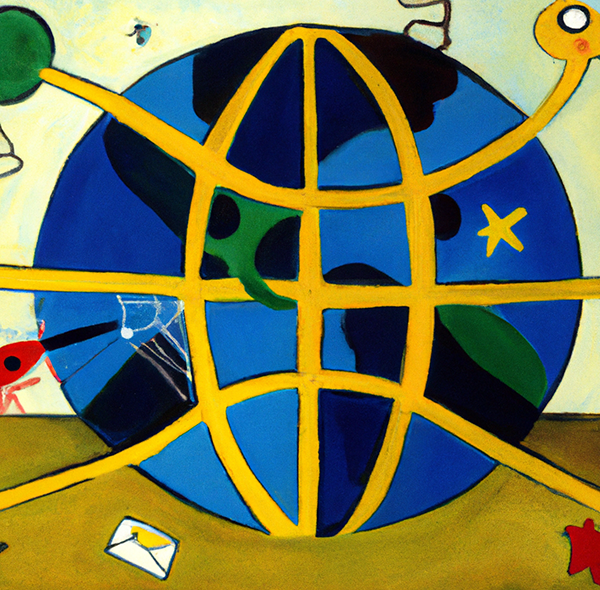
Cobwebs and Strange
Some of you may be lucky enough (or unlucky enough…sometimes it can go either way) to receive a Valentine’s Day card, or at the very least a text. But it’s a safe bet what you get will not be as elaborate as the “3D sculptures” that 19th-century Victorian Valentines used to send. Via Gohar World on Instagram:
paper cobwebs from The Met’s Department of Drawings and Prints.
As a result of advances in printing and paper-making techniques, the custom of sending greeting cards on Valentine’s Day reached its peak in the 19th century. Paper cobwebs were an example of a mechanical, two-piece valentine — a delicately cut geometric pattern that enclosed a private message of love.
The Met’s collection includes a gilded metallic double cobweb, one adorned with hand-painted flowers, and one featuring the solo portrait of a lover. The endearing paper greetings became a hallmark of Victorian life. Whether sentimental or satirical, simple or showy, everyone hoped to receive a valentine on February 14th.
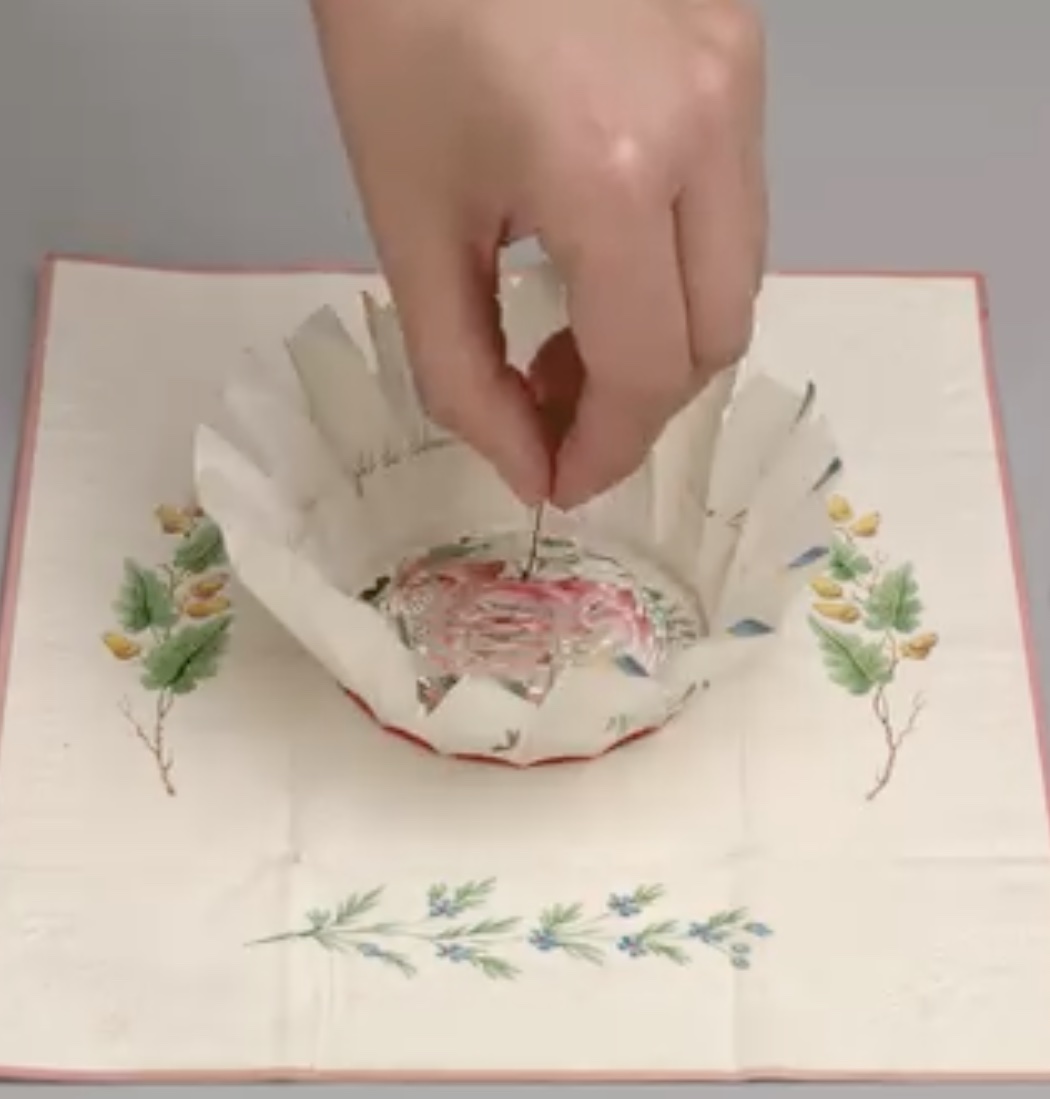
A cobweb is an interesting approach to Valentine’s Day. Interestingly, the Bronx Zoo has an offer whereby for $15 you can “name a roach” after your beloved because, as they say, “roaches are forever.” For those having a decidedly more bitter Valentine’s Day, the Via Aquarium in Schenectady, N.Y., is offering spurned lovers to name a cockroach after “a special someone” (or “unspecial”), which will then “be fed to one of the aquarium’s reptiles and filmed for your viewing pleasure.” We think a world-class team of psychotherapists might be a better option.
A Lego By Any Other Name…
…would hurt as much when you stepped on it.
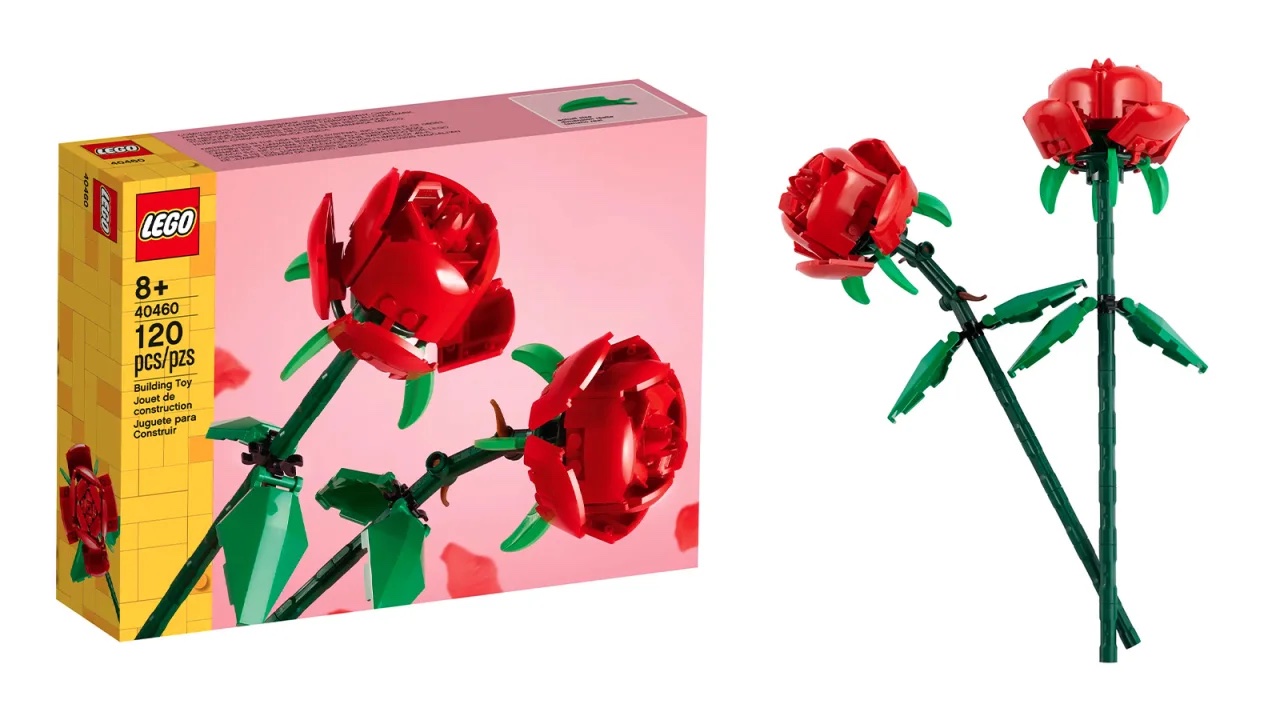
Roses are a traditional Valentine’s Day gift, sure, but who says they have to be organic? Why not Lego roses? Via CNN, Lego has several rose-building kits available.
Lego roses are available in two different kits: the smaller two-stem set and the bigger (and more intricate) bouquet, each at different price points. My husband and I built the set of two roses at home ahead of Valentine’s Day last year, and we had so much fun putting the pieces together while we watched TV. We each tackled one stem, and it took fewer than 20 minutes to complete, making it a super-low-stakes activity.
Well, it beats the cockroach thing.
Losing Mass
The publishing format known as the “mass market paperback” has a very long history. A book designed to be portable and “pocket-sized” was first developed by Venetian printer/publisher Aldus Manutius in the late 15th, early 16th century.
That said, the modern mass market paperback as we know it from airport bookstores dates from the early 20th century. Says Boing Boing:
The mass-market paperback dates to 1935, when Allen Lane launched Penguin Books with 10 reprinted titles priced at sixpence each. During World War II, publishers shipped 123 million pocket-sized Armed Services Editions to troops overseas, and the format boomed after the war — filling bus stations, newsstands, and wire racks at every five-and-dime. In 1974, Stephen King's Carrie fetched $400,000 in paperback rights alone.
Modern book publishers have distinguished mass market paperbacks from trade paperbacks, the latter being larger in size (often the trim size of the corresponding hardcover), whilst the former were much smaller—and cheaper. The subsidiary rights for mass markets were different than for trade paperbacks, and had different royalty schedules. For people on a budget, mass market paperbacks were a great way to buy and read books.
Anyway, we bring all this up because it looks like the mass market paperback is being phased out. According to the New York Times, via Boing Boing:
In 2007, Americans bought 103 million mass market paperbacks — the pocket-sized books crammed into spinner racks at airports, drugstores, and grocery checkouts. Last year the total was 18 million. Now ReaderLink, the largest distributor supplying books to non-bookstore retailers, has told publishers it's dropping the format…
Hudson, which operates airport bookstores nationwide, has been clearing out its mass-market displays. Romance and thrillers — the genres that kept the format alive longest — are migrating to trade paperbacks, a slightly larger size that costs roughly 30 cents more to produce but looks better on a bookshelf.
Kind of sad, but then mass markets aren’t that much of a bargain these days.
Moving to the Cloud from Both Sides
TechSpot asks an interesting question: “who coined the term ‘cloud computing’ and when”? Their choices are:
- John McCarthy (Computer Scientist, 1961)
- Favaloro / O'Sullivan (Compaq, 1996)
- Ramnath Chellappa (Professor, 1997)
- Eric Schmidt (Google, 2006)
Some years ago, before AI sucked all the oxygen out of the room, the last big hyped thing was “cloud computing,” and “moving to the cloud” became a top marketing strategy for software vendors. But the term had much more prosaic origin.
According to an investigation by MIT Technology Review, the earliest documented uses of the exact phrase "cloud computing" show up in late 1996, connected to Compaq Computer and a startup called NetCentric. Sean O'Sullivan kept a daily planner entry dated October 29, 1996 with the phrase "Cloud Computing: The Cloud has no Borders" after a meeting with George Favaloro. Two weeks later, there was an internal Compaq analysis titled "Internet Solutions Division Strategy for Cloud Computing" dated November 14, 1996, laying out a future where software becomes a network-delivered service rather than something tightly bundled to the box on your desk.
But as any expert in etymology can tell you, word origins aren’t always that clear cut.
reporting that later reviewed the document notes it's unclear which of the two authors actually coined the phrase. One of them believed he did, but contemporaneous digital evidence (emails, drafts) is gone, so the best-supported answer is essentially “those Compaq execs, in 1996,” not a perfectly attributable lightning bolt.
You Do the Math
Which came first: numbers or mathematics? Logically, you would think that you wouldn’t be able to do math without numbers, right? As it turns out, via Popular Mechanics, archaeologists have uncovered evidence of an ancient culture that was capable of mathematical thinking—before numbers were invented.
In a new study published in the Journal of World Prehistory, archaeologists from the Hebrew University of Jerusalem analyzed flower motifs painted on pottery by a prehistoric culture known as the Halafian, who lived in northern Mesopotamia from 6200 to 5500 B.C.E.
Referenced as “vegetal motifs,” these depictions—spread across 700 fragments—piqued the interests of authors Yosef Garfinkel and Sarah Krulwich because they appeared to contain petals arranged in a geometric sequence: 4, 8, 16, 32, and 64. This makes these pottery fragments one of the oldest pieces of mathematical evidence from prehistory, and shows evidence of spatial long division from even before the invention of numbers, the authors argue.
Even more:
“These patterns show that mathematical thinking began long before writing,” Krulwich said in a press statement. “People visualized divisions, sequences, and balance through their art.”
Doing the Wave
Has it been 100 years already? Indeed, 2026 will mark the 100th anniversary of quantum physics. (We know you’ve got your party planned already.) Via Galileo Unbound, it was on January 27, 1926, that Austrian physicist Erwin Schrödinger submitted a paper to Annalen der Physik which contained his famous wave equation:
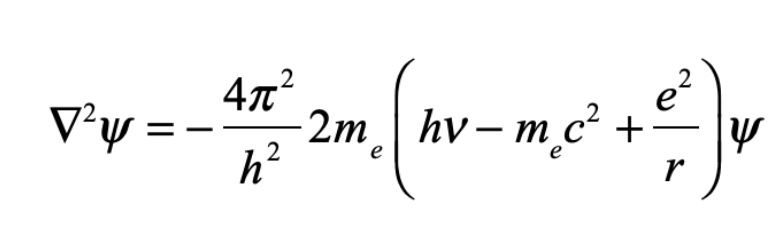
We’re not gonna lie: we don’t really understand that (flowers on shards of pottery is more our speed), but it was the publication of Schödinger’s wave equation (it was actually his second attempt) that was a landmark in the development of quantum mechanics. Says Wikipedia less confusingly:
Conceptually, the Schrödinger equation is the quantum counterpart of Newton's second law in classical mechanics. Given a set of known initial conditions, Newton's second law makes a mathematical prediction as to what path a given physical system will take over time. The Schrödinger equation gives the evolution over time of the wave function, the quantum-mechanical characterization of an isolated physical system. The equation was postulated by Schrödinger based on a postulate of Louis de Broglie that all matter has an associated matter wave. The equation predicted bound states of the atom in agreement with experimental observations.
Basically, quantum mechanics describes the behavior of matter and light, accounting for the unusual characteristics that typically occur at and below the scale of atoms, essentially doing for small stuff what Newtonian physics does for big stuff. Regardless of how well (or not) we understand it, our modern world would not exist without it, so make of that what you will.
In many aspects, modern technology operates at a scale where quantum effects are significant. Important applications of quantum theory include quantum chemistry, quantum optics, quantum computing, superconducting magnets, light-emitting diodes, the optical amplifier and the laser, the transistor and semiconductors such as the microprocessor, medical and research imaging such as magnetic resonance imaging and electron microscopy. Explanations for many biological and physical phenomena are rooted in the nature of the chemical bond, most notably the macro-molecule DNA.
So happy birthday, Schrödinger wave equation!
Raising Erasing Eyebrows
Visitors to the Louvre—particularly those who are not there to steal stuff—are inevitably transfixed by the Mona Lisa’s enigmatic style. But less attention is given to her enigmatic eyebrows. Such as, where are they? As it happens, when Da Vinci first painted her, she actually had prominent eyebrows. OK, maybe not Dan Levy level eyebrows, but they were there. So where did they go? Did art thieves make off with just her eyebrows? Is there a market for that?
As it turns out, restoration is the culprit. Via Laughing Squid, August Moon of 1440 explains how.
Add a protective layer of varnish to seal the paint to protect from moisture and air. …Varnish yellows over time. It darkens. So every few decades, restorers would delicately clean the painting, removing the old yellowed varnish and applying fresh clear varnish. Except removing varnish can be incredibly difficult. …You’re using solvents to dissolve a layer of varnish that sits on top of the paint, running the risk of dissolving the very paint you’re trying to reveal.
And so, over the years, her eyebrows eroded away.
Watch the video here: https://youtu.be/-hGoq9SGymY
Waymo Silly
We love stories like this. It turns out that Waymo’s Autopilot is just a bunch of guys in the Philippines. Says TechSpot:
Waymo's chief safety officer, Mauricio Peña, recently noted that when the company's robotaxis encounter unusual situations, they may request real-time input from a remote response agent, receiving human guidance when needed. While some of the contractors work in the US, many operate from other countries, such as the Philippines.
There is no truth to the rumor that one of them is Imelda Marcos, although it could explain why Waymos head for the nearest shoe store. (Too soon?)
The bigger question is, why not ask for input from the person in the, you know, actual car?
Filipino remote workers also oversaw most of the orders taken through Presto Automation’s supposedly autonomous fast-food drive-thru system. Meanwhile, Amazon's ill-fated Just Walk Out technology, which claimed to handle physical purchases automatically without involving cash registers, actually relied upon workers in India to monitor customers.
It’s amusing how so much of supposedly autonomous technology is just a bunch of people on the Internet.
Out of Office
Here’s a sport that we absolutely have to import. Via Core 77, the Isu-1 GP is a Gran-Prix-style racing event sponsored by the…Japan Office Chair Racing Association (JORA). And it is exactly what you would think it is:
Held in ten cities around the country, the rules are pretty simple: Your vehicle is an off-the-shelf office chair that you propel with your legs. Anyone caught modifying their chair will be disqualified. And you must wear a helmet, gloves, elbow pads and knee pads.
We’ve worked in some offices where those were required accessories, racing or not…

The 2025-2026 season is afoot (as it were), and the next race takes place February 23 in Kumamoto. This is just awesome:
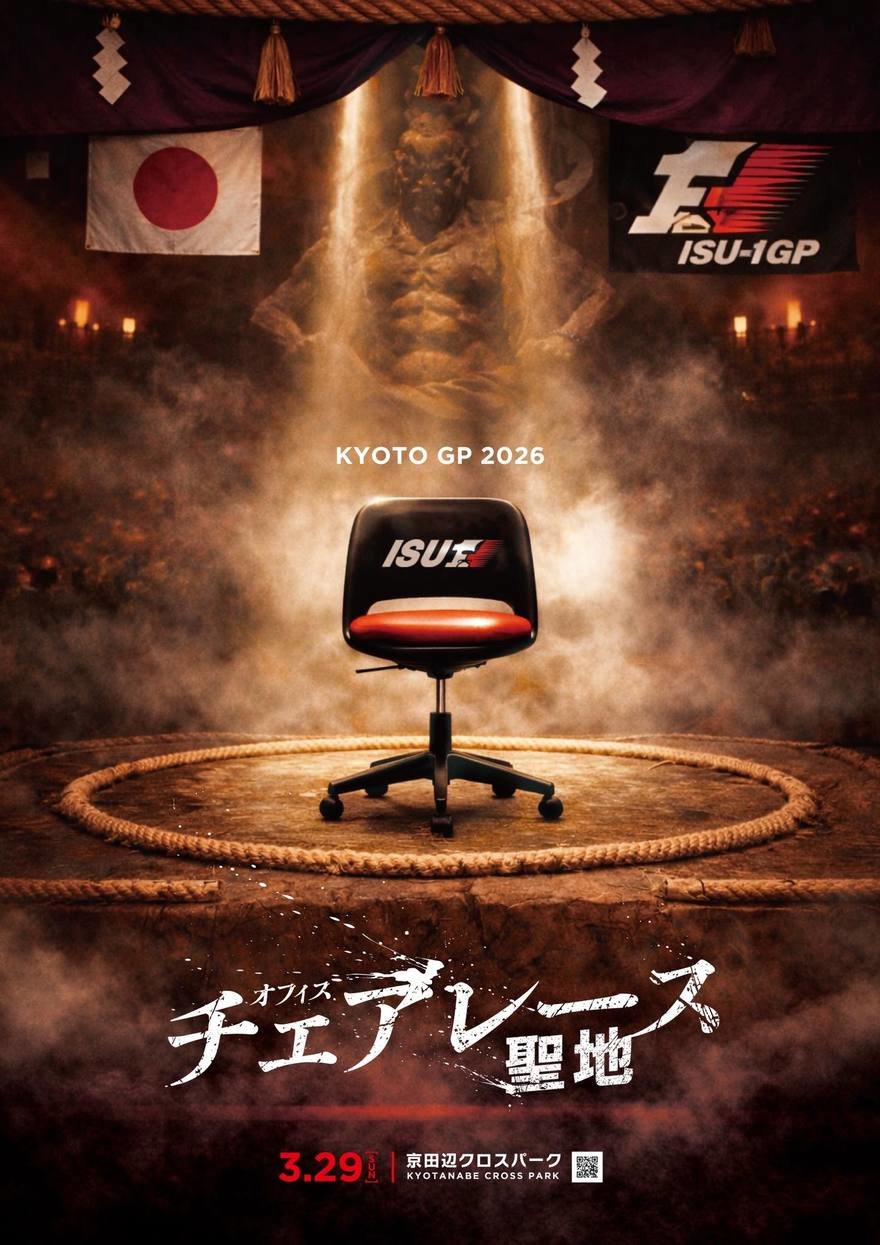
What are the prizes, you may ask? First, second, and third prizes are 90kg, 60kg, and 30kg of rice, respectively. Imagine if the Olympics had similar prizes. “Go for the basmati!”
The Body Shop
Here’s a horror movie just waiting to be made. From Business Insider, a new approach to plastic surgery:
Rather than relying on an implant or a patient's own body fat to add volume to hips or augment breasts, alloClae — which can cost as much as $100,000 per procedure — uses donor fat from a cadaver as a first-of-its-kind body filler.
“Corpse fat injections,” they are referred as. OK.
Business Insider spoke to a half dozen plastic surgeons, largely based in New York and California, who, together, have completed around 75 procedures with alloClae since it became available earlier this year. They described wealthy executives and corporate types clamoring for the product, booking 6 a.m. visits so they could make it to work by 7, and using the filler to look better in their suits — work, not swim, that is. Demand for alloClae has outpaced supply, resulting in a shortage and backlog of appointments.
… Shridharani has male patients who have lost weight on the likes of Ozempic, only to find they don't quite fill out their suits the way they used to.
What…Then why…did you…Norman, coordinate! And wouldn’t it be cheaper and easier and less creepy to alter the suit or just get a new one?
Where specifically does it come from?
When individuals donate their bodies for science, such as organ donations, tissue banks often collect abdominal fat cells. Tiger Aesthetics purchases that fat, screens it for diseases, purifies it, and processes it. By the end, it looks like clumpy butter in a syringe.
Come on, Stephen King, this is right up your alley!
Bowled Over
Looking for a waffle maker? No, nor were we. But if we were, we might consider this one. Via Core 77, the Presto Belgian Waffle Bowl Maker, by American kitchen gadget brand National Presto Industries.

Gotta say, though, it would be nice if it had options or accessories that let you make flay waffles if you so desired.
Lip Service
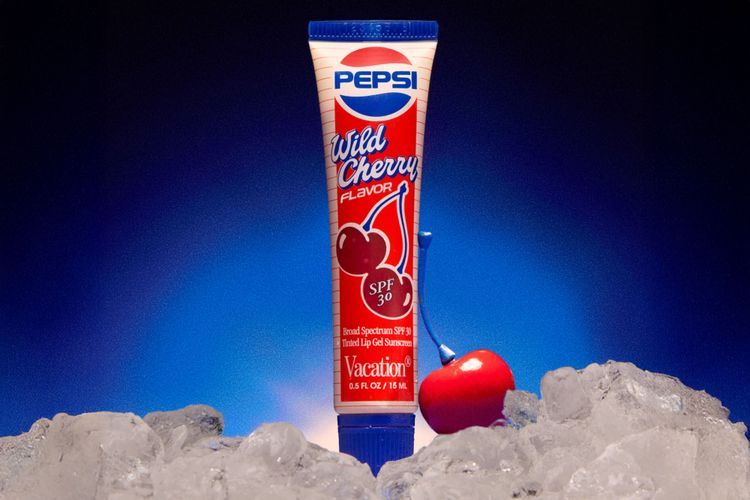
Pepsi is now getting into the cosmetics business. Via (who else?) Food & Wine, the beverage manufacturer has partnered with Vacation Sunscreen to come out with the Wild Cherry Pepsi SPF 30 Tinted Lip Gel.
The lip gel will be available starting February 19 at Target stores nationwide and online through Vacation Sunscreen’s website. Lightly tinted and flavored to evoke Wild Cherry Pepsi, the product comes in twist-off packaging that resembles a classic Pepsi bottle, reinforcing the brand’s nostalgic appeal. The launch also includes a limited-edition lip gel sleeve keyring with a cherry charm, intended as a collectible accessory that can be clipped to a bag or purse.
Founded in 1893 by pharmacist Caleb Bradham as “Brad’s Drink,” the brand was renamed Pepsi-Cola five years later and went on to become one of the world’s most recognizable soft drink brands. The move into beauty reflects a growing interest among legacy food and beverage brands in extending their identities beyond the grocery aisle.
In the future, look for Mountain Dew Mascara, Dr. Pepper Perfume, and Fantaftershave.
This Week in Printing, Publishing, and Media History
February 9
1737: English-American philosopher, author, activist, and pamphleteer Thomas Paine born.
1870: US president Ulysses S. Grant signs a joint resolution of Congress establishing the U.S. Weather Bureau.
1881: Russian novelist, short story writer, essayist, and philosopher Fyodor Dostoyevsky dies (b. 1821).
1923: Irish rebel, poet, and playwright Brendan Behan born.
1964: The Beatles make their first appearance on The Ed Sullivan Show, performing before a record audience of 73 million viewers across the US.
1986: Halley’s Comet last appeared in the inner Solar System.
February 10
1890: Russian poet, novelist, literary translator, and Nobel Prize laureate Boris Pasternak born.
1898: German director, playwright, and poet Bertolt Brecht born.
1940: Tom and Jerry make their debut with the cartoon Puss Gets the Boot.
1962: Roy Lichtenstein’s first solo exhibition opens. It includes Look Mickey, which featured his first use of Ben-Day dots, speech balloons, and comic imagery sourcing, all of which he is now known for.
1967: American director, producer, and screenwriter Vince Gilligan born.
1996: IBM supercomputer Deep Blue defeats Garry Kasparov in chess for the first time.
2005: American actor, playwright, and author Arthur Miller dies (b. 1915).
February 11
1650: French mathematician and philosopher René Descartes dies (b. 1596). Guess he didn’t think.
1800: English photographer, politician, and inventor of the calotype Henry Fox Talbot born.
1840: Gaetano Donizetti’s opera La fille du régiment receives its first performance in Paris, France.
1843: Giuseppe Verdi’s opera I Lombardi alla prima crociata receives its first performance in Milan, Italy.
1847: Thomas Edison born.
1909: American director, producer, and screenwriter Joseph L. Mankiewicz born.
1938: BBC Television produces the world’s first ever science fiction television program, an adaptation of a section of the Karel Capek play R.U.R., that coined the term “robot.”
February 12
1804: German anthropologist, philosopher, and academic Immanuel Kant dies (b. 1724).
1809: English geologist and theorist Charles Darwin born.
1809: Sixteenth U.S. President Abraham Lincoln born.
1885: German publisher and founder of Der Stürmer Julius Streicher born.
1924: George Gershwin’s Rhapsody in Blue receives its premiere in a concert titled “An Experiment in Modern Music,” in Aeolian Hall, New York, by Paul Whiteman and his band, with Gershwin playing the piano.
1948: American computer scientist and engineer Ray Kurzweil born.
1950: English singer-songwriter, guitarist, and producer Steve Hackett born.
1994: Four thieves break into the National Gallery of Norway and steal Edvard Munch’s iconic painting The Scream.
February 13
1914: In New York City, the American Society of Composers, Authors and Publishers is established to protect the copyrighted musical compositions of its members.
1923: American general and pilot, and first test pilot to break the sound barrier Chuck Yeager born.
1950: English singer-songwriter and musician Peter Gabriel born. Here comes the flood.
1967: American researchers discover the Madrid Codices by Leonardo da Vinci in the National Library of Spain.
February 14
1778: The United States flag is formally recognized by a foreign naval vessel for the first time, when French Admiral Toussaint-Guillaume Picquet de la Motte renders a nine gun salute to USS Ranger, commanded by John Paul Jones.
1819: American journalist and politician, and inventor of the typewriter Christopher Latham Sholes born.
1849: In New York City, James Knox Polk becomes the first serving President of the United States to have his photograph taken.
1876: Alexander Graham Bell applies for a patent for the telephone, as does Elisha Gray.
1894: American actor and comedian Jack Benny (né Benjamin Kubelsky) born.
1924: The Computing-Tabulating-Recording Company changes its name to International Business Machines Corporation (IBM).
1961: Element 103, Lawrencium, is first synthesized at the University of California. Hopefully they sent an atom or two to Michael Battaglia.
1975: English novelist and playwright P. G. Wodehouse dies (b. 1881).
1989: Iranian leader Ruhollah Khomeini issues a fatwa encouraging Muslims to kill Salman Rushdie, author of The Satanic Verses.
1990: The Voyager 1 spacecraft takes the photograph of planet Earth that later become famous as Pale Blue Dot.
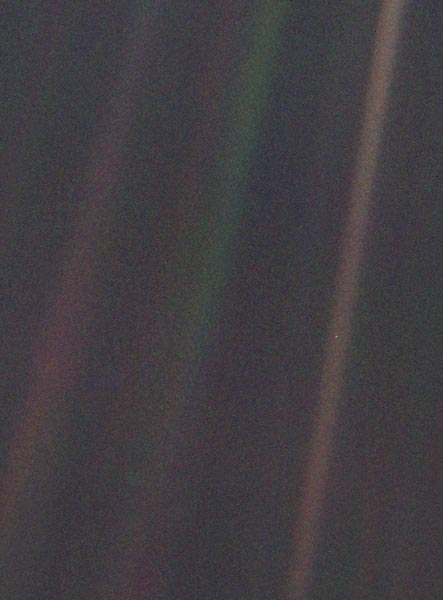
Seen from about 3.7 billion miles, Earth appears as a tiny dot (the bluish-white speck approximately halfway down the brown band to the right) in the darkness of deep space. Makes you think, don’t it?
2005: YouTube is launched by a group of college students, eventually becoming the largest video sharing website in the world and a main source for viral videos.
February 15
1564: Italian astronomer, physicist, and mathematician Galileo Galilei born.
1870: Stevens Institute of Technology is founded in New Jersey, USA and offers the first Bachelor of Engineering degree in Mechanical Engineering.
1946: ENIAC, the first electronic general-purpose computer, is formally dedicated at the University of Pennsylvania in Philadelphia.
1954: American animator, producer, and screenwriter Matt Groening born.
1972: Sound recordings are granted U.S. federal copyright protection for the first time.
2001: The first draft of the complete human genome is published in Nature.