Booktown Rats
Looking for a different sort of vacation or day-trip destination? Why not try a “book town.” What, you may ask, is a book town? Well, via Atlas Obscura, it is a small town that has a lot of independent bookstores. Specifically:
It can’t be too big—not a city, but a genuine town, usually in a rural setting. It has to have bookshops—not one or two, but a real concentration, where a bibliophile might spend hours, even days, browsing. Usually a book town begins with a couple of secondhand bookstores and later grows to offer new books, too.
The first book town is held to be Hay-on-Wye, in Wales, established in 1977 by bookseller Richard Booth. Since then, book towns have proliferated—to some extent—around the world, and there are now dozens of them in as far-flung geographies as Australia, Finland, India, South Korea—and of course the US. Hobart, N.Y., located 60 miles southwest of Albany, is perhaps the emblematic example of a book town.
Booth’s original idea for creating Hay-on-Wye as a book town was, yes, bibliophilia, but also economic development—reinvigorate a dying town, provide employment, keep people from leaving town, and set it up as a tourist destination. And the latter is what drives the motivation to create a book town.
Journalist Alex Johnson is author of the 2018 book Book Towns, a travel guide to these destinations. He confessed to Atlas Obscura that there needs to be a fundamental economic logic to developing a proper book town:
They’ve got to be sensible about providing a large amount of bookshops. You can’t do it with one or two. You need plenty. You need to cover a range of things. Some of the most successful ones have been where it’s not just bookselling. There are publishers or printers or artists or designers. It becomes a creative hub, where the books might be the jumping off point but there’s plenty around it. Even the most hardened bookworm is going to want to do something else—that’s where the picturesque element comes in.
Book It
Um, well, OK. Via Core77:
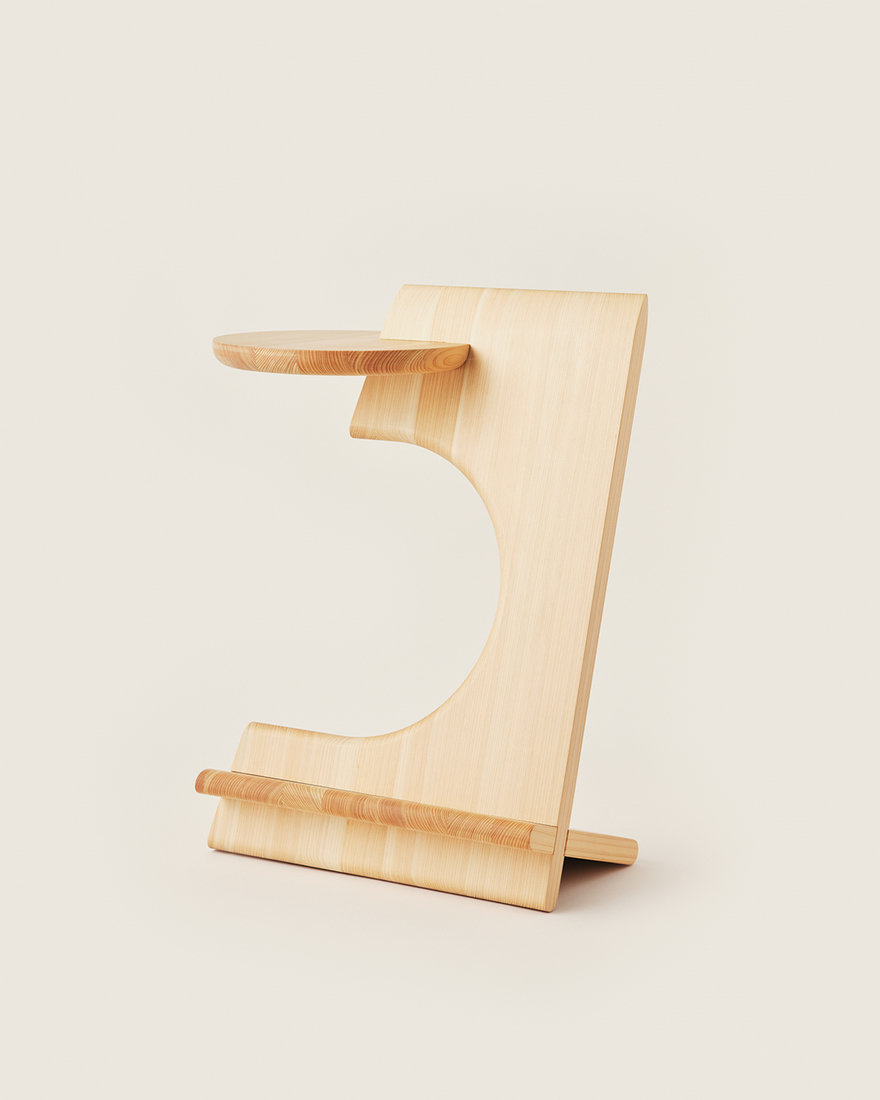
This unique piece of furniture, called Bookmarker, is by Japanese design firm StudioYO. Made from a minimum of materials, it’s meant to be both a functional piece and a love letter to books.
Huh. Norman, coordinate.
Bookmarker is crafted from three parts, cut efficiently from a single piece of vertically laminated Japanese cypress wood, allowing for flat packing. Whether by chance or necessity, the shape formed by cutting the top panel without waste became its defining "individuality," while also enabling easy access to books from both the inside (user's side) and the outside.

Ah.
Game of Cones
Those of us who had posters on our bedroom and/or dorm walls, and then came across them years or decades later, know that they don’t always last. And that’s because, generally speaking, posters aren’t really designed for the long-term. But there is a class of “vintage posters” that some are actively seeking to preserve and/or restore. Via Print magazine, LA’s Fourth Cone Restoration is in the business of restoring old, classic posters.
With a studio in Canoga Park, CA just outside of LA, they’ve honed meticulous techniques to make vintage posters look good as new. Process videos on their Instagram reveal just how incredible these transformations are, and the level of care and detail that goes into their process.
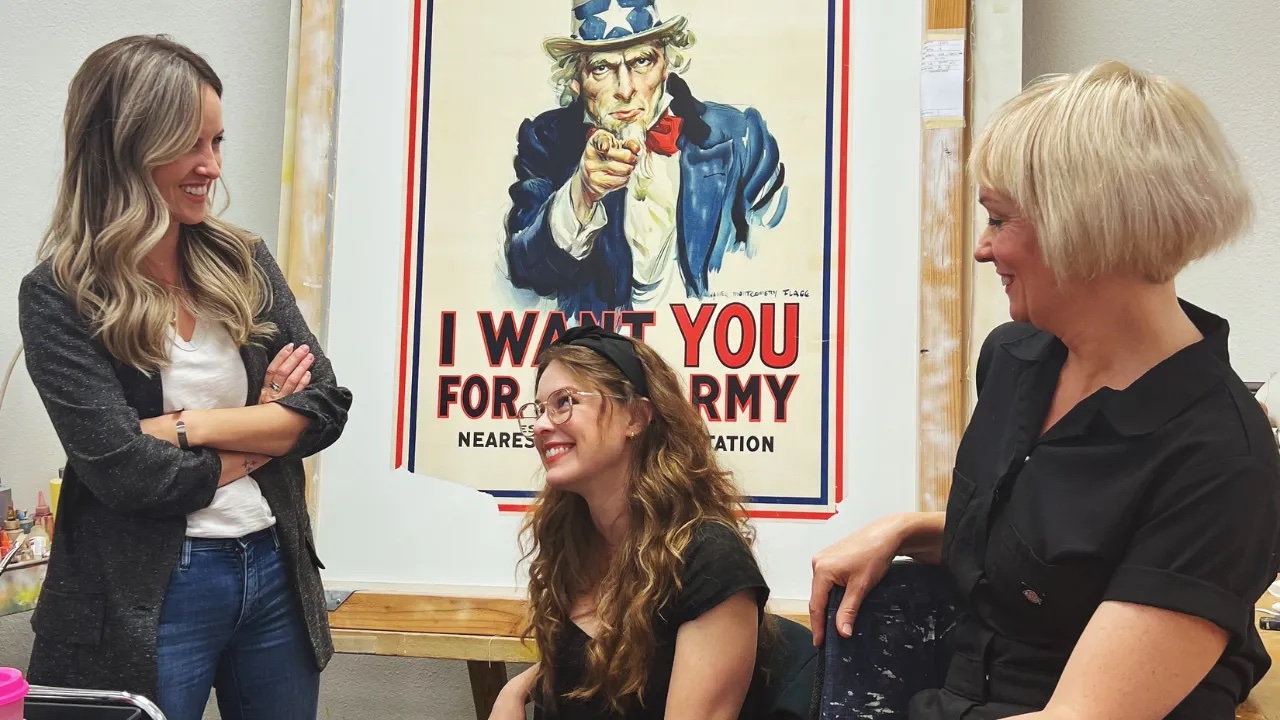
The company founders spoke with Print.
Our field is special in that we are always working with art that was meant to deteriorate. Posters were intended for one-time use— they’re usually made with the cheapest materials possible. Cheap paper often has a high acid content, which means it breaks down over time, turning brown and brittle. In some of the older posters, the paper was made with straight-up river water!
One question one may have is, why is poster restoration so important, especially if they weren’t meant to last in the first place?
Well, as the saying goes, it’s important to remember the past so that we don’t repeat history. That does play some part in the significance of poster restoration. Most posters were printed in large groups, so they’re already documented for the historical record.
What we do, though, is more like bringing the poster into the home. We stabilize it so that it can be displayed in a frame. When a vintage poster is on a wall in your house, you have a constant visual reminder of that piece of history. You’re able to keep it in mind, and you notice new things about it during your daily life.
There’s something special about being let into the secret of information that wasn’t meant to be remembered.
Fair point…
Get the Lead In
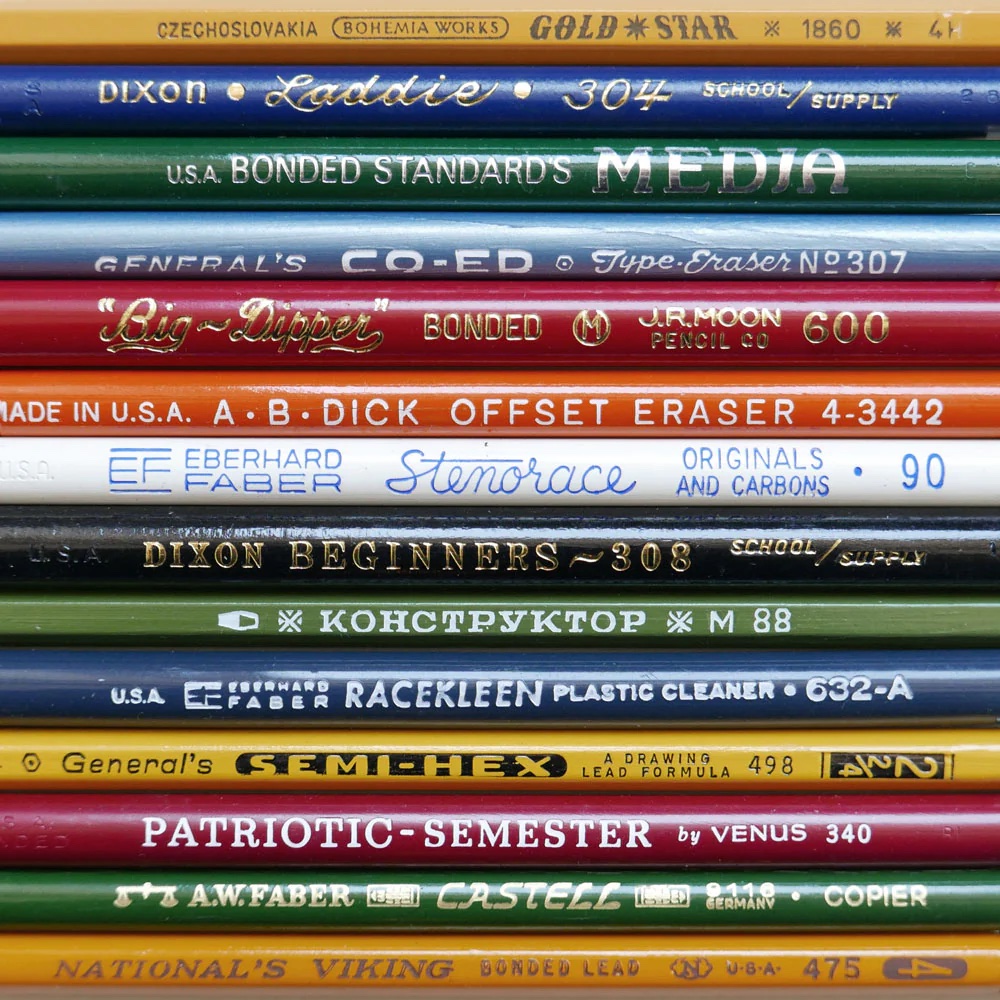
Now, granted, when we saw a Boing Boing headline about a “gallery of pencil typography,” we immediately thought it was going to be type drawn with a pencil. But, no! It’s actually lettering found on pencils.
Present & Correct
The gallery is part of Present & Correct’s ongoing documentation of their vintage and new pencil inventory. If you’re the kind of person who has strong feelings about writing instruments — and if you're reading Boing Boing
Or Around the Web…
you probably are — this is a rabbit hole worth falling into.
Indeed. Go ask Alice.
Block Type
We feel like we linked to this already at some point, but it turns out we haven’t. Via Gizmodo, in 2021, Lego released a typewriter set.
As per Lego’s official site, the set was based on an actual real-life machine used in the 1950s by the company’s founder, and it remains a strikingly beautiful piece of design—you could feed a real sheet of paper through the rollers, its carriage moved as you typed, and each key press triggered a lever that whacked an individual letter against a ribbon.

Alas, the Lego typewriter doesn’t actually type.
The ribbon was a piece of inkless fabric, and the letter blocks were plain 2×1 Lego bricks. For all its cleverness, the set was essentially ornamental.
They have since discontinued it, although you can still get one via Bricklink. A steal at under $200.
A Bad Hand
(Optional musical accompaniment to this item.)
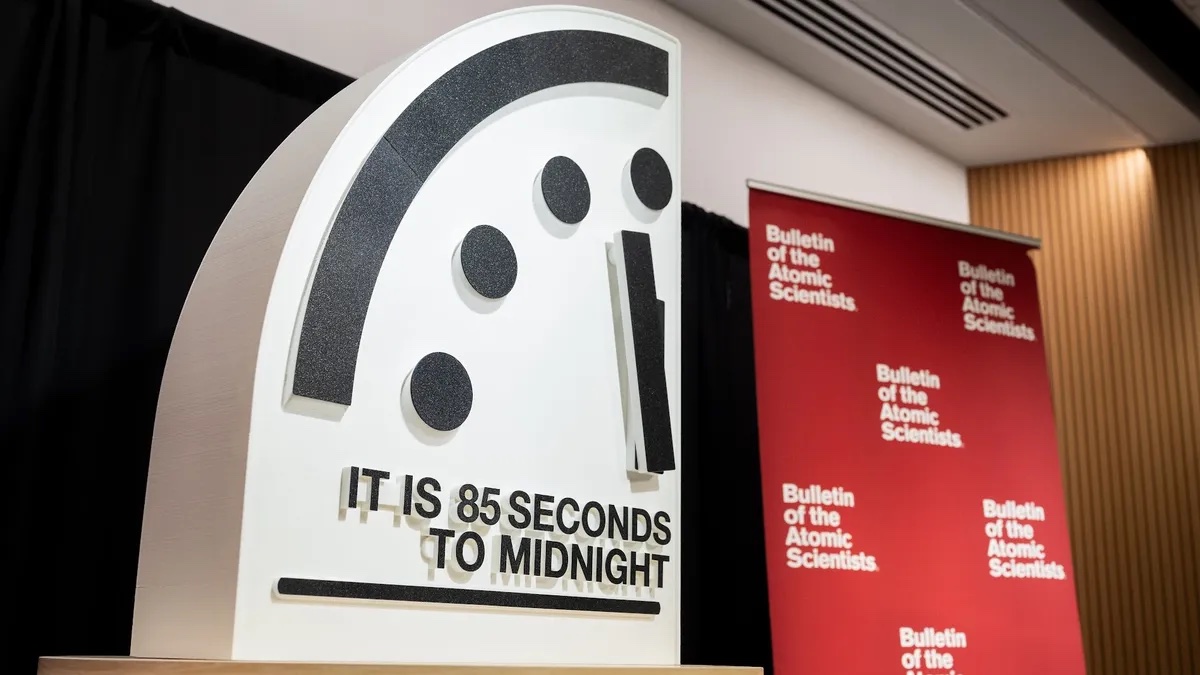
In 1945, in the wake of the advent of the atomic bomb, Manhattan Project scientists created what has come to be known as the “Doomsday Clock,” a status indicator of impending global catastrophe. A cheerful lot, those guys. Basically, it is, as its name indicates, a clock with the minute hand perilously close to midnight—midnight representing, essentially, doomsday.
Bulletin of the Atomic Scientists
The Doomsday Clock has traditionally reflected the imminence of nuclear destruction (it got a lot of press in the 1980s), but the factors that go into the “setting” of the clock have grown to include many other adverse phenomena that humankind has inflicted upon itself.
Making the news this week was the fact that the minute hand has been moved to 85 seconds before midnight—the closest it has ever been.
Humanity continues to court species-threatening disaster through nuclear brinkmanship, a failure to address climate change, and a hasty rollout of artificial intelligence (AI), according to the Bulletin of the Atomic Scientists, the organization that updates the Doomsday Clock.
So that’s cool.
Lithium? Na!
Consider the lithium-ion (Li-ion) battery. It has come to power an increasing number of tools, appliances, and even vehicles, and many people prefer battery-operated machinery to gas-powered ones—and thanks to “Ol’ Li-ion Heart,” our battery-operated snowblower performed flawlessly in last week’s Snowpocalypse.
Like everything, Li-ion batteries do have their downsides and dangers. But, via LiveScience, researchers are working on a safer, faster, and more energy dense alternative: sodium-ion (Na-ion) batteries, which have been around for years, but there were a few bottlenecks that kept them from achieving their potential rapid charging speeds. Until perhaps, now.
All batteries contain an anode and a cathode, the two electrodes that determine how current flows into and out of the device. In Li-ion batteries, the cathode is made primarily of graphite, as it's an excellent material for storing lithium ions to be discharged later.
But Na-ion batteries use hard carbon (HC) — a porous combination of thousands of "turbostratic basic structural units," essentially a complex crystalline structure, that excels at storing sodium ions. This is, in theory, a very fast-charging material.
Previous research into HC found it difficult to prove that this theoretical charging rate is practically possible, however, because ions entering the dense electrolyte at high speed experience a slowdown similar to a traffic jam. But in a new study published Dec. 15, 2025, in the journal Chemical Science, the scientists set out to overcome this hurdle.
And that involved combining small amounts of HC with aluminum oxide, which is chemically inactive. The new electrode thus lets ions flow freely into the HC particles without those traffic jams.
Through careful analysis, the researchers found that sodium ions require less energy to form these clusters. The finding indicates that, under the right conditions, Na-ion batteries — also called SIBs — can achieve faster charge rates than Li-ion batteries can.
They also found that Na-ion batteries are less sensitive to temperature, and are less prone to “thermal runaway,” the chain reaction that can cause Li-ion batteries to burn, or even explode, and prove difficult to extinguish once they do.
In the real world, the results could help Na-ion batteries become more widely adopted for uses that require incredibly fast charging or discharging rates. For example, grid-scale battery energy storage systems would benefit from the capability to rapidly discharge energy on demand. It's also of paramount importance for batteries to remain stable when they're used at scale for storing energy produced by renewable sources.
The next step is to see how Na-ion batteries can be produced at scale.
That Snow Ghost
This looks terrifying, but we want it, especially after last weekend. Via Core77, Chinese robotics company Yarbo (a portmanteau for “yard robot”) is selling what is essentially a Roomba for yard work. The Yarbo Core can be adapted for specific seasonal chores and can function as an autonomous lawnmower, leafblower, and—most crucially—snowblower.
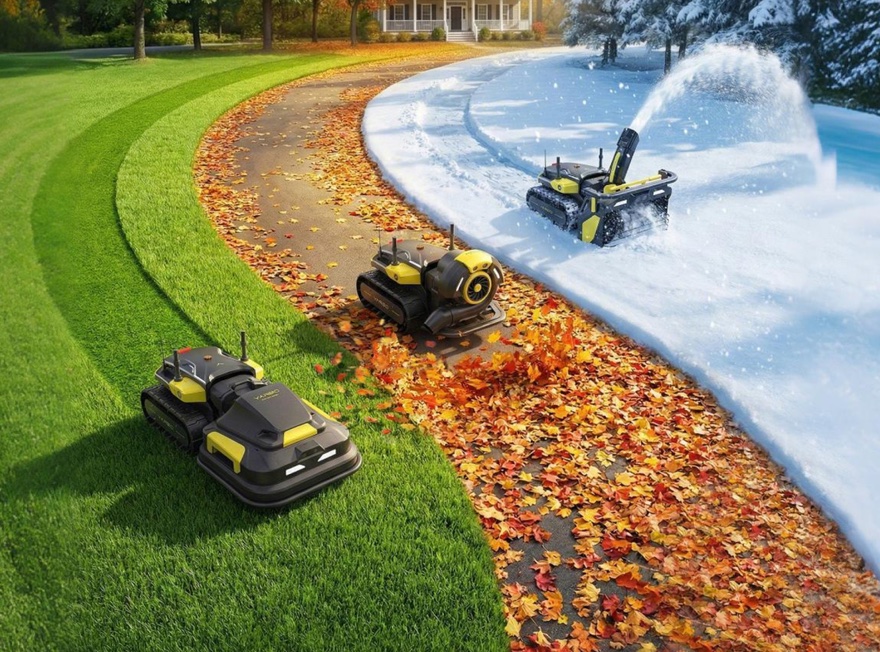
Wow, that’s quite a diverse climate! If you don’t like the weather, just wait a few feet…
Does it work? Apparently, the device requires quite an effort to program. Check out this news report about one New Jersey resident who put it to the test during the recent Snowpocalypse.
Plastic People
It’s a safe bet that plastic is not going anywhere, that despite all the evidence that has come to light regarding the deleterious health and environmental effects of microplastics, it’s just too inexpensive and convenient a material to be replaced with something else. So the trick now is to rethink plastic, to try to develop a kind of plastic that serves the admittedly useful purposes that plastic serves without the harmful side effects. That’s a big ask, as they say, but not out of the realm of possibility. Last week, we wrote about DegraTECH, a new biodegradable plastic signage material. And now, via Food & Wine, a team of Japanese researchers has also been making no small amount of progress on an “ocean-safe” plastic. That is, the oceans are safe from the plastic, not that the plastic is safe from the ocean. In fact, quite the reverse.
In late 2025, a team from the RIKEN Center for Emergent Matter Science (CEMS), led by Takuzo Aida, published their findings in the Journal of the American Chemical Society, describing a plant-based plastic they designed using plant-derived cellulose. They explained that it is “strong, flexible, and capable of rapid decomposition in natural environments, setting it apart from other plastics marketed as biodegradable.”
Of course, biodegradable plastics are not a new thing, but:
they are usually made with other materials that degrade only under very specific industrial conditions, such as high heat or in industrial composting facilities. That means that if they wind up in the oceans, they will likely shed microplastics and take several lifetimes to fully degrade.
So the team specifically set out to develop a plastic that would dissolve almost instantly upon contact with salt water. They concentrated on a critical chemical bond that breaks in seawater, which thus causes the material to dissolve. And further good news is that their new material uses carboxymethyl cellulose, a plant-based substance that’s already FDA-approved and commonly used as a thickening agent in foods like ice cream.
“While our initial study focused mostly on the conceptual, this study shows that our work is now at a more practical stage,” Aida shared in a statement. And, because the ingredients are already common, approved for use in consumer products, and inexpensive, they believe their new material could be rolled out rather quickly.
Let’s hope. Check it out here.
Out of Their Elements
This is an oldie but a goodie—Dr. Joe used to be immensely amused by this.
Via Boing Boing, in 1997, Nathan Zohner, then a 14-year-old student at Eagle Rock Junior High in Idaho Falls, compiled a series of alarming facts about a “forever chemical” called “dihydrogen monoxide.”
It accelerates corrosion. It’s a major component of acid rain. In its solid form, it causes severe tissue damage. Thousands of people die annually from accidentally inhaling it.
Zohner then surveyed 50 ninth-graders to see if they thought the chemical should be banned, and 43 voted yes, and six were undecided. Only one twigged to the fact that dihydrogen monoxide (H2O) is water. Waka waka. Zohner’s science fair project was called, after all, “How Gullible Are We?” Apparently, 98%.
The gag actually goes back further than that.
Students at UC Santa Cruz were circulating dihydrogen monoxide warnings on photocopied fliers in 1989-1990, and Craig Jackson created a Coalition to Ban DHMO website in 1994. But Zohner’s experiment gave the hoax its enduring power as a demonstration of how easily scientific-sounding language can frighten people who don’t recognize what it describes. The hoax keeps resurfacing — in 2013, two Florida DJs were suspended for warning listeners that dihydrogen monoxide was coming out of their faucets.
You Make Me Rael
For fans of 1970s progressive rock, a high-water mark of the genre is the 1974 Genesis concept album The Lamb Lies Down on Broadway. A surreal urban nightmare, it was singer Peter Gabriel’s swansong with the group, and it remains an enduring—if often bewildering—classic. Via Laughing Squid, New York City artist Nathaniel Barlam created an animated interpretation of the entire two-hour double album.
Check out “The Carpet Crawlers.”
Dog Racing
Y’know, it’s been a rough year so far, the Doomsday Clock is ticking down, so what could be more therapeutic than watching six Oscar Mayer Wienermobiles compete in a road race?
Last year marked the inaugural Oscar Mayer “Wienie 500,” an Indy 500–esque event in which six 27-foot Wienermobiles competed in a four-lap race around the Indianapolis Motor Speedway, topping out at 60 miles per hour in 26 seconds. It certainly didn’t escape the notice of Around the Web, but the good news is that after the debut drew more than 8 million viewers and 80,000 live attendees, the Second Annual Wienie 500 is coming this May 22. Says Food & Wine:
“We think the rationale is quite simple — it made people happy. Oscar Mayer’s mission, dating back to the 1880s, is to spark smiles, and that’s exactly what the Wienie 500 did,” Oscar Mayer brand communications director Kelsey Rice tells Food & Wine. “It provided a needed dose of joy, delightfully disarming America in a way only a brand with a fleet of 27-foot hot dogs on wheels could.”

As for the 2026 contestants, Oscar Mayer’s taking us on a trip through America’s most iconic regional hot dog styles. Six sleek Weinermobiles compete for this year’s title: Slaw Dog (Southeast), Chi Dog (Midwest), New York Dog (East), Chili Dog (South), and Seattle Dog (Northwest). Organizers cut the Sonoran Dog from the lineup this year, so they’re letting fans decide the sixth contestant via an Instagram poll. (Fans can nominate one of six regional hot dogs starting tomorrow, or opt to give Sonoran another chance.)
It's a dog-eat-dog competition, but can the racers cut the mustard? Either way, we frankly think you’ll relish the event. So on May 22, get your buns over to a TV!
Check out last year’s Wienie 500 here.
This Week in Printing, Publishing, and Media History
January 26
1918: American author Philip José Farmer born.
1926: The first demonstration of the television by John Logie Baird.
January 27
1756: Austrian composer and musician Wolfgang Amadeus Mozart born.
1785: The University of Georgia is founded, the first public university in the United States.
1832: English novelist, poet, and mathematician Lewis Carroll (né Charles Dodgson) born.
1851: French-American ornithologist and painter John James Audubon dies (b. 1789).
1880: Thomas Edison receives the patent for the incandescent lamp.
1813: Italian composer and philanthropist Giuseppe Verdi dies (b. 1813).
1908: American journalist and publisher William Randolph Hearst, Jr., born.
1922: American journalist and author Nellie Bly dies (b. 1864).
1944: English drummer, songwriter, and producer Nick Mason born. In the flesh.
2009: American novelist, short story writer, and critic John Updike dies (b. 1932).
2010: American soldier and author J. D. Salinger dies (b. 1919).
January 28
1613: English diplomat and scholar, founder of the Bodleian Library Thomas Bodley dies (b. 1545).
1706: English printer and typographer John Baskerville born.
1754: Sir Horace Walpole coins the word “serendipity” in a letter to a friend. What a stroke of luck.
1813: Jane Austen’s Pride and Prejudice is first published in the United Kingdom.
1873: French novelist and journalist Colette (née Sidonie-Gabrielle Colette) born.
1878: Yale Daily News becomes the first daily college newspaper in the United States.
1939: Irish poet and playwright, Nobel Prize laureate W. B. Yeats dies (b. 1865).
1956: Elvis Presley makes his first national television appearance.
1958: The Lego company patents the design of its Lego bricks, still compatible with bricks produced today.
1965: The current design of the Flag of Canada is chosen by an act of Parliament.
January 29
1737: American revolutionary and pamphleteer Thomas Paine (Common Sense, et al.) born.
1845: “The Raven” is published in The Evening Mirror in New York, the first publication with the name of the author, Edgar Allan Poe.
1860: Russian playwright and short story writer Anton Chekhov born.
1886: Karl Benz patents the first successful gasoline-driven automobile.
1888: English poet and illustrator Edward Lear dies (b. 1812).
1923: American author and screenwriter Paddy Chayefsky born.
1963: American poet and playwright Robert Frost dies (b. 1874).
1980: The Rubik’s Cube makes its international debut at the Ideal Toy Corp. in Earl’s Court, London.
January 30
1969: The Beatles’ last public performance, on the roof of Apple Records in London. The impromptu concert is broken up by the police.
January 31
1930: 3M begins marketing Scotch Tape.
1949: These Are My Children, the first television daytime soap opera, is broadcast by the NBC station in Chicago.
1956: English author, poet, and playwright, creator of Winnie-the-Pooh A. A. Milne dies (b. 1882).
2020: The United Kingdom’s membership within the European Union ceases in accordance with Article 50, after 47 years of being a member state.
February 1
1462: German lexicographer, historian, and cryptographer Johannes Trithemius born. His famous treatise In Praise of Scribes implored monks to not abandon manuscript copying. However, his need to distribute a large number of these treatises quickly resulted in his having to have it printed on a printing press, a great moment of historical irony.
1851: English novelist and playwright Mary Shelley dies (b. 1797).
1884: The first volume (A to Ant) of the Oxford English Dictionary is published.
1896: La bohème premieres in Turin at the Teatro Regio (Turin), conducted by the young Arturo Toscanini.
1902: American poet, social activist, novelist, and playwright Langston Hughes born.
1904: American humorist and screenwriter S.J. Perelman born.
1938: American drummer and singer (Mothers of Invention) Jimmy Carl Black born. He was the Indian of the group.
1942: Voice of America, the official external radio and television service of the United States government, begins broadcasting with programs aimed at areas controlled by the Axis powers.
1942: Welsh actor, director, screenwriter, and Python Terry Jones born.
1964: The Beatles have their first number one hit in the United States with “I Want to Hold Your Hand.”
1996: The Communications Decency Act is passed by the U.S. Congress, apparently.