Masters of Public Domain
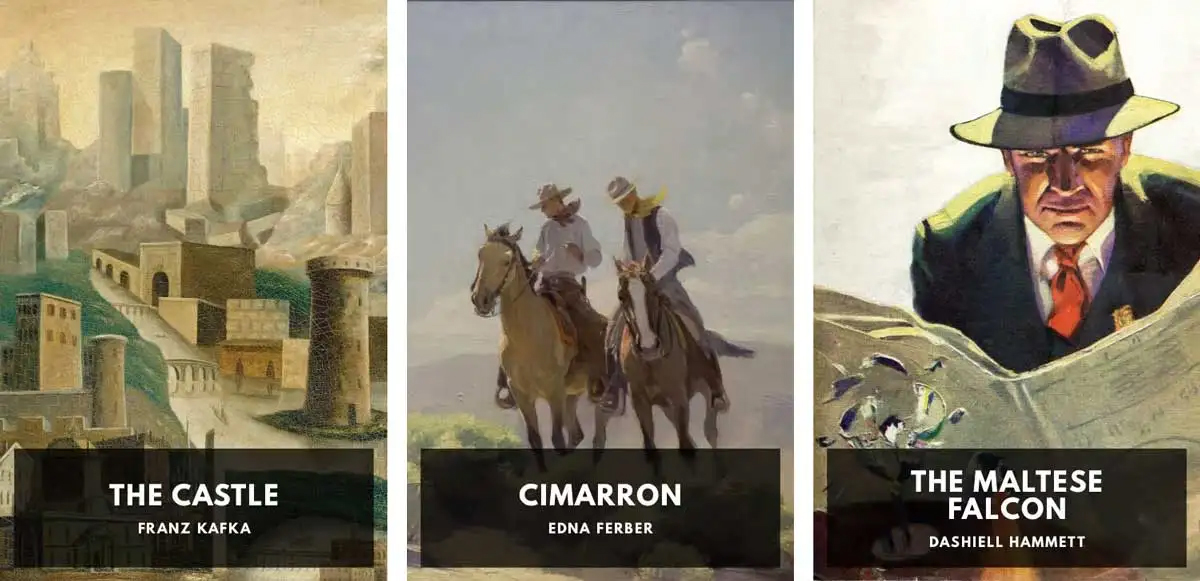
It’s the New Year and you know what that means… Well, it could mean any number of things, but for our purposes it means that a bunch of artistic and literary works have entered the public domain. As of January 1, in literature alone everything published in 1930 is now ours to do with as we please. Via Boing Boing, that includes Dashiell Hammett’s The Maltese Falcon, William Faulkner’s As I Lay Dying, the 1930 English translation of Franz Kafka’s The Castle, Agatha Christie’s first Miss Marple novel The Murder at the Vicarage, and the earliest Nancy Drew mysteries.
Songs entering the public domain include the 1930 recordings of Georgia on my Mind and Dream a Little Dream of Me, movies include the Marx Brothers’ Animal Crackers, one of the funniest movies ever made.
Copyright Lately has an extensive list. Now’s your chance to publish that fan fiction you’ve always wanted to but couldn’t do so legally.
Just Our Type
Print magazine has published its Print Type Report 2026, their look at what the New Year will bring in the world of typography. What are the top type trends for 2026?
To avoid being washed down the culture drain, designers are turning to firsthand evidence: archives, nature, books, objects of antiquity, and the vernacular lettered landscape of city signs. Storytelling drivers, sure. What’s more, original sources anchor a brand’s visual elements in a shared experience.
The evidence of human engineering will be a critical marker of type in 2026, colliding with unbridled AI slop. What endures from this clash will have the stamp of observation fused with ingenuity.
Our physical world is dulling. Artificial intelligence, generative pre-trained transformers, and bots replicate people. The Atlantic reported on the psychological flattening of friendships as we socialize more through our phones, and Kyle Chayka’s Filterworld: How Algorithms Flattened Culture suggests we aren’t even shaping our own culture anymore.
How will typography emerge in this flat era? It will have to be self-willed, distinct and clear, and speak to the future while mining the past. Designers will be outpaced by credibility, not clout.
Be sure to click through to check out some designers’ real-world examples. Such as:
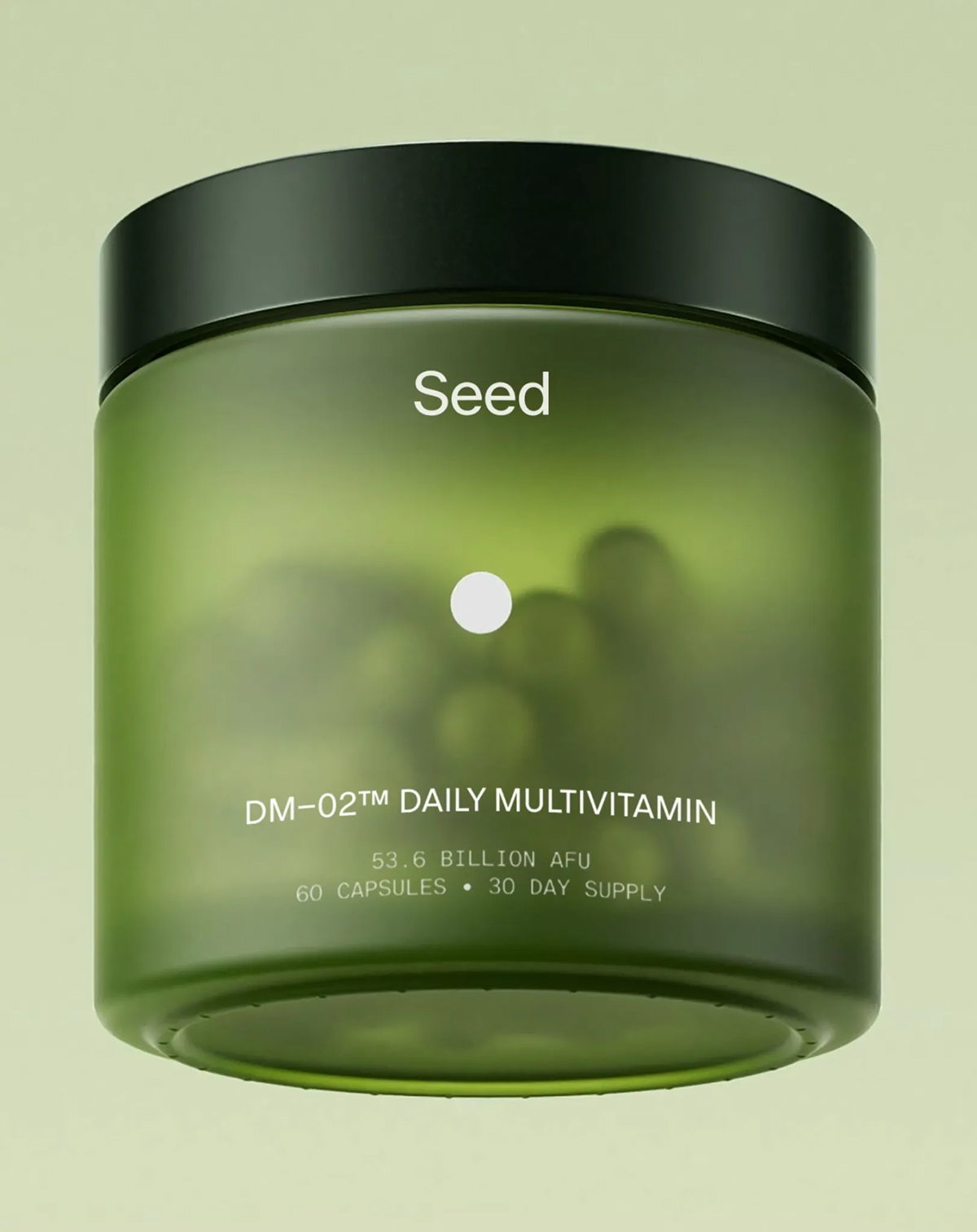
[Mouthwash Research Center (MWRC)] designs for brands like Seed and Brand.ai with clarity and resonance. The studio’s fingerprints come through in how people experience brands anew, ultimately creating more space for story and voice without deprioritizing design aesthetics.
Take Seed.
Please!
The brand’s position challenge? Showing their humanity. “Instead of using Neue Haas Unica, which is very Swiss and very precise, how do we incorporate some level of expression to the typeset?” Tan remarks.
To Sigh For
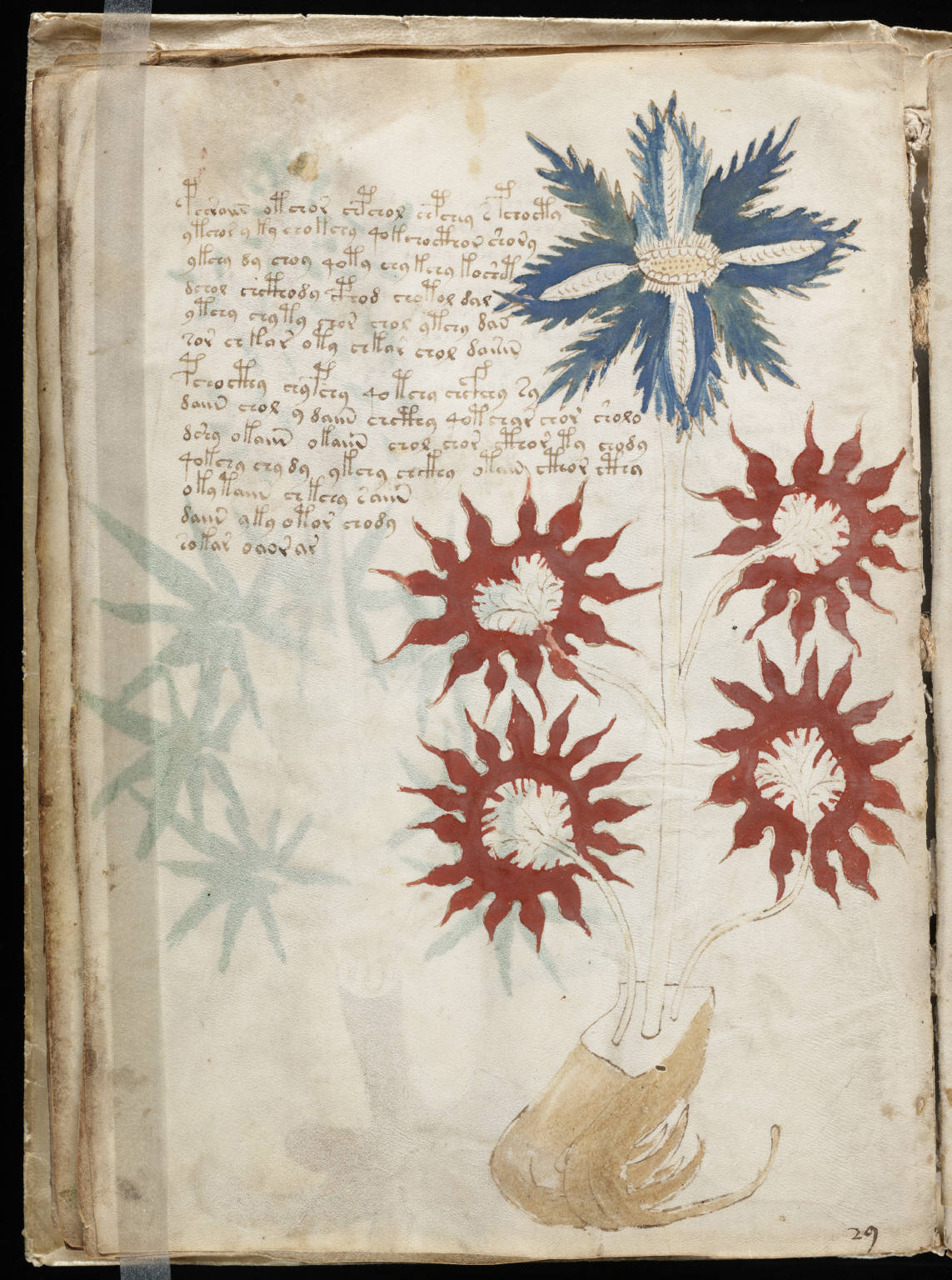
One of the most enigmatic artifacts to come out of the Middle Ages/Renaissance is the Voynich Manuscript. It’s a hand-written illustrated codex composed in an unknown script that scholars refer to as “Voynichese.” It has been carbon-dated to the early 15th century (1404–1438) and is believed to have originated in Italy. It has been studied and pored over extensively but never deciphered. Of course, there is the very real possibility that the manuscript is a hoax, and that the “Voynichese” glyphs are completely meaningless. But what fun would that be?
However, via LiveScience, a new study offers some clues as to what it’s all about.
A unique cipher that uses playing cards and dice to turn languages into glyphs produces text eerily similar to the glyphs in the Voynich manuscript, a new study shows. The finding suggests that an equivalent cipher could have been used to create the mysterious medieval manuscript.
The new cipher — called “Naibbe,” from the name of a 14th-century Italian card game — does not decode the medieval Voynich manuscript, but it offers an idea for how the manuscript was made.
Science journalist Michael Greshko conducted the study, which was published November 26 in the journal Cryptologia.
Naibbe first uses the number from the throw of a die to break a block of Italian or Latin into single and double letters — so “gatto” (Italian for “cat”) could become “g”,”at” and “to.” The cipher then uses the draw of a playing card to determine which of six different tables is used to encrypt the letters into “Voynichese” — the strange and undeciphered glyphs that are apparently grouped into words in the manuscript. The tables are “weighted” by the corresponding number of cards so that the statistical occurrence of the mock-Voynichese glyphs is the same as seen in the manuscript itself.
Mind you, Greshko points out that his Naibbe cipher doesn’t decode the Voynichese, but suggests how it may have been assembled.
Greshko said. “The Naibbe cipher is almost certainly not the way that the manuscript was constructed,” he said. “But what it does provide is a fully documented way to reliably go between Latin and something that behaves kind of like the Voynich manuscript.”
“My hope is that this becomes adopted as a computational benchmark,” Greshko said. “The points of difference between the cipher and the manuscript may point the way to how the text was actually created.”
Signs of the Times, Part the Ongoing: Signs as Art
Via the Good News Network, a New Zealand public art project involving official-looking but tongue-in-cheek signage. Designed and mounted by Cameron Hunt, the signs were part of the Little Street art festival in Christchurch early last month. The signs use the font and color palette of official Christchurch signage, but are jokey.
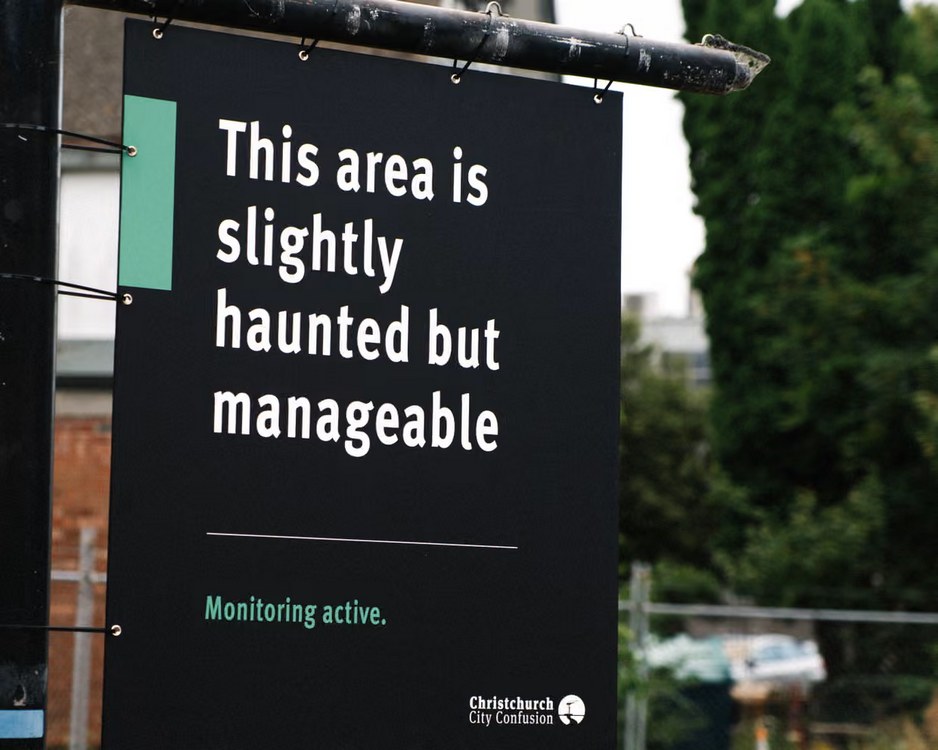
“The idea was to make signs that look official, but with completely absurd messages, therefore creating moments of confusion, followed by little bursts of joy,” Hunt told the Guardian.
Gotta love this one:
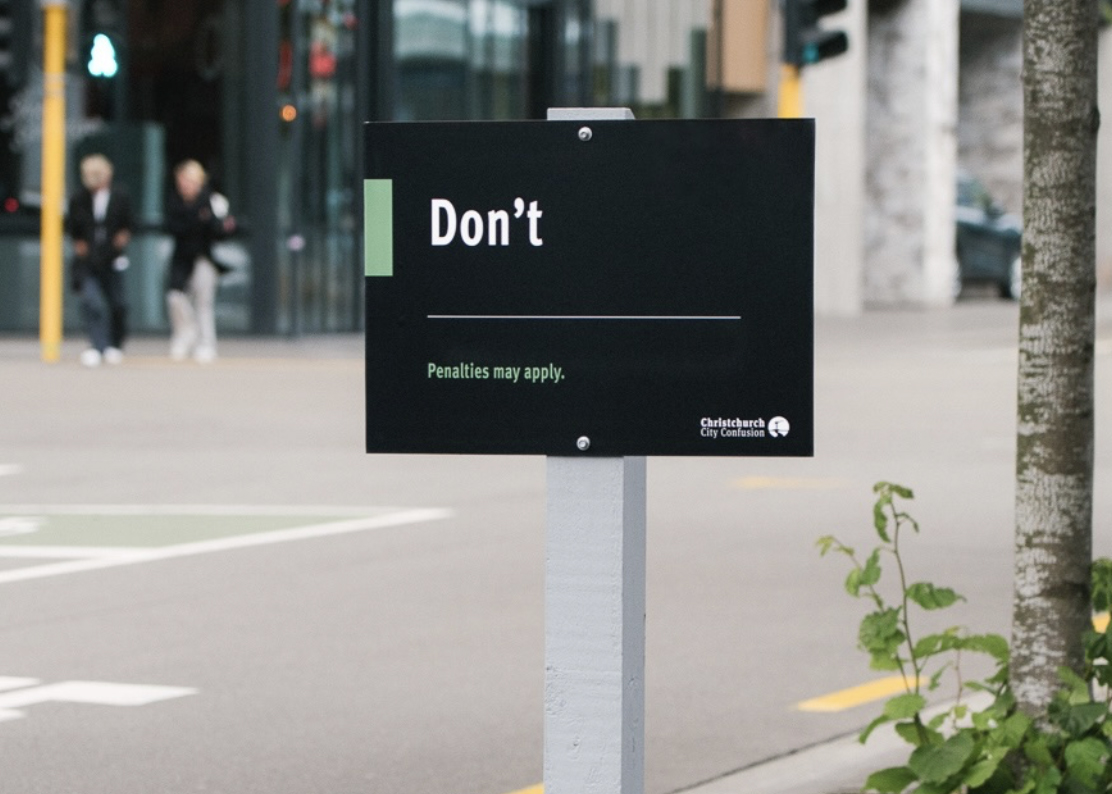
It was apparently very well-received.
Beige Alert
Here’s a question: what color is the universe? It’s tempting to say, “Well, black. Duh.” But we’re not talking about the blackness of space, but rather the average color of all the light from all the 200,000+ galaxies out there.
So, via Boing Boing, in 2002 this is what astronomers at Johns Hopkins University set out to determine. And their answer? A whiteish green.
They announced this to the world, presumably expecting applause. Instead, they got emails pointing out a bug in their code. Oops.
So they fixed their code and published a revised answer in 2003: a pale, creamy beige, hex code #FFF8E7. If you plug that into Photoshop you get:

Huh. Beige.
The team needed a name for this color, so they ran a poll. Suggestions included
Beigey McBeigeFace?
“cappuccino cosmico,” “Big Bang beige,” and “primordial clam chowder.”
The winner: Cosmic Latte.
It’s the color of every photon from every star in every galaxy, averaged together and translated into what a human eye would perceive. (It’s also, coincidentally, the color of the walls in approximately 40% of Airbnbs.)
Alas, Cosmic Latte was never a Pantone Color of the Year.
Bricked
Although we like the low-tech analog nature of LEGO, the relentless march of technology has led LEGO to introduce a “Smart Brick.” Says Core77:
The company has announced their new Smart Bricks, which are no longer a monolithic piece of ABS. Instead they each contain a chip, an accelerometer, sensors for sound and light, LEDs, and even a miniature speaker. The user charges the bricks wirelessly, using a dedicated pad from LEGO, and they'll be rolled out within new Star Wars LEGO sets.
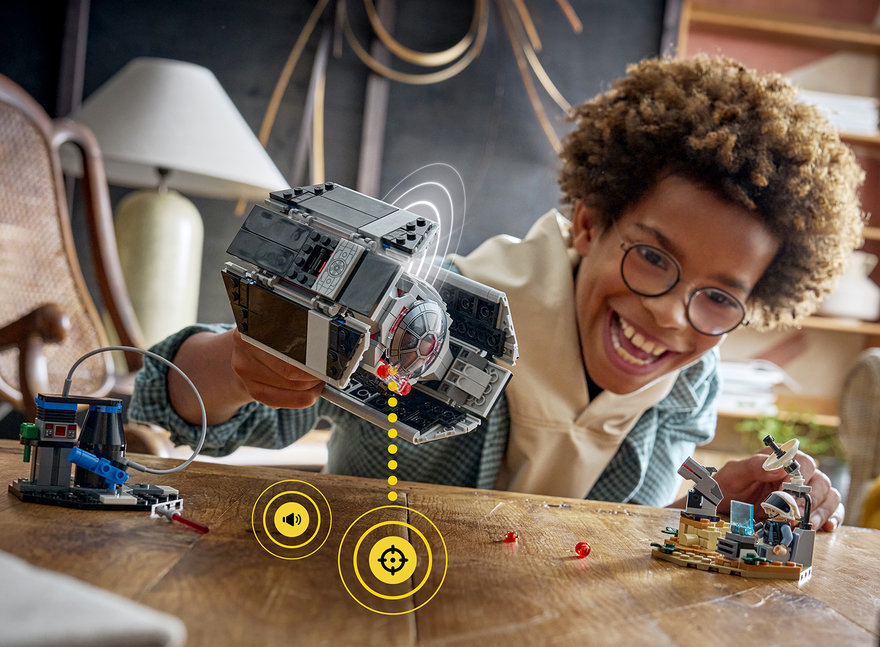
The Smart Bricks are a component of LEGO’s new Smart Play system, which also includes a Smart Tag and Smart Minifigures. Interestingly, they don’t need a power source, but do contain a small chip with a unique digital ID that Smart Bricks can read. As for how this would work:
Emperor Palpatine's Smart Brick throne could start playing the Imperial March when his minifigure is placed in it. Or an X-Wing fighter could start flashing and making laser noises when in proximity to a TIE Fighter. You get the idea.
Could be cool. At least it’s not AI-based, like some horrific children’s toys.
Bring the Receipts
Or, maybe not. People increasingly eschew paper receipts, and that may be a good thing. Via Discovermagazine, receipts are printed on thermal paper.
Most thermal paper depends on bisphenol chemicals to produce text when heated — compounds that have been linked to hormone disruption.
However, researchers are working on thermal paper coatings made from plant-based sources that perform like conventional thermal paper, but without using bisphenols. Their findings are presented in Science Advances.
Instead of starting from scratch, the researchers looked to a material plants already make in abundance. Lignin — the polymer that gives wood its stiffness — contains chemical features capable of driving the color-changing reaction at the heart of thermal printing. It’s also renewable, plentiful, and largely treated as waste, making it an appealing foundation for rethinking thermal paper chemistry.
As any conventional papermaker can tell you, lignin is not a desirable substance when making paper, and is usually removed during the papermaking process. So, too, with the new thermal paper. So the researchers developed a new type of lignin.
Standard extraction methods leave it dark, chemically inconsistent, and difficult to control — all problems for a material meant to produce crisp, readable text. To overcome that, the team used a refined extraction approach that yields lighter, more uniform lignin molecules. By stripping away many of the light-absorbing components, they created a version of lignin that could mix evenly into thermal coatings without dulling the printed image.
But how to get the substances in the paper to react at the right temperature?
To make lignin respond under commercial printing conditions, the researchers added a heat-activated “sensitizer” — a compound that melts during printing and facilitates interaction between the dye and developer. Rather than relying on petroleum-based additives, they tested a sensitizer derived from plant sugars, using a molecule related to xylan, a common component of plant cell walls. The resulting coating could then be applied to paper and tested using real printers.
And, even better:
The biggest difference emerged in biological testing. The lignin-based developers triggered estrogen-like responses at levels hundreds to thousands of times lower than BPA, while the sugar-derived sensitizer showed no measurable estrogenic activity under the same conditions.
With further development, they can hopefully produce a thermal paper that is safer than older formulations.
Weird Science
This week, in Las Vegas, the annual Consumer Electronics Show (CES) kicked off, kind of the drupa for…well, consumer electronics, where all sorts of product introductions and proofs of concept are unveiled. Some look kind of cool, some…just kinda weird.
The Verge identifies some of the wackiest items being unveiled, such as Dreame’s hair dryer that doubles as a lamp:
imagine just sitting on your couch while a crescent-shaped device hangs over your head, drying your hair as you watch TV or play a video game.
We seem to recall our grandmother having something like that in the 1960s and 70s. Granted it wasn’t a lamp—nor did it cost $700—but it was a sedentary way of drying one’s hair.
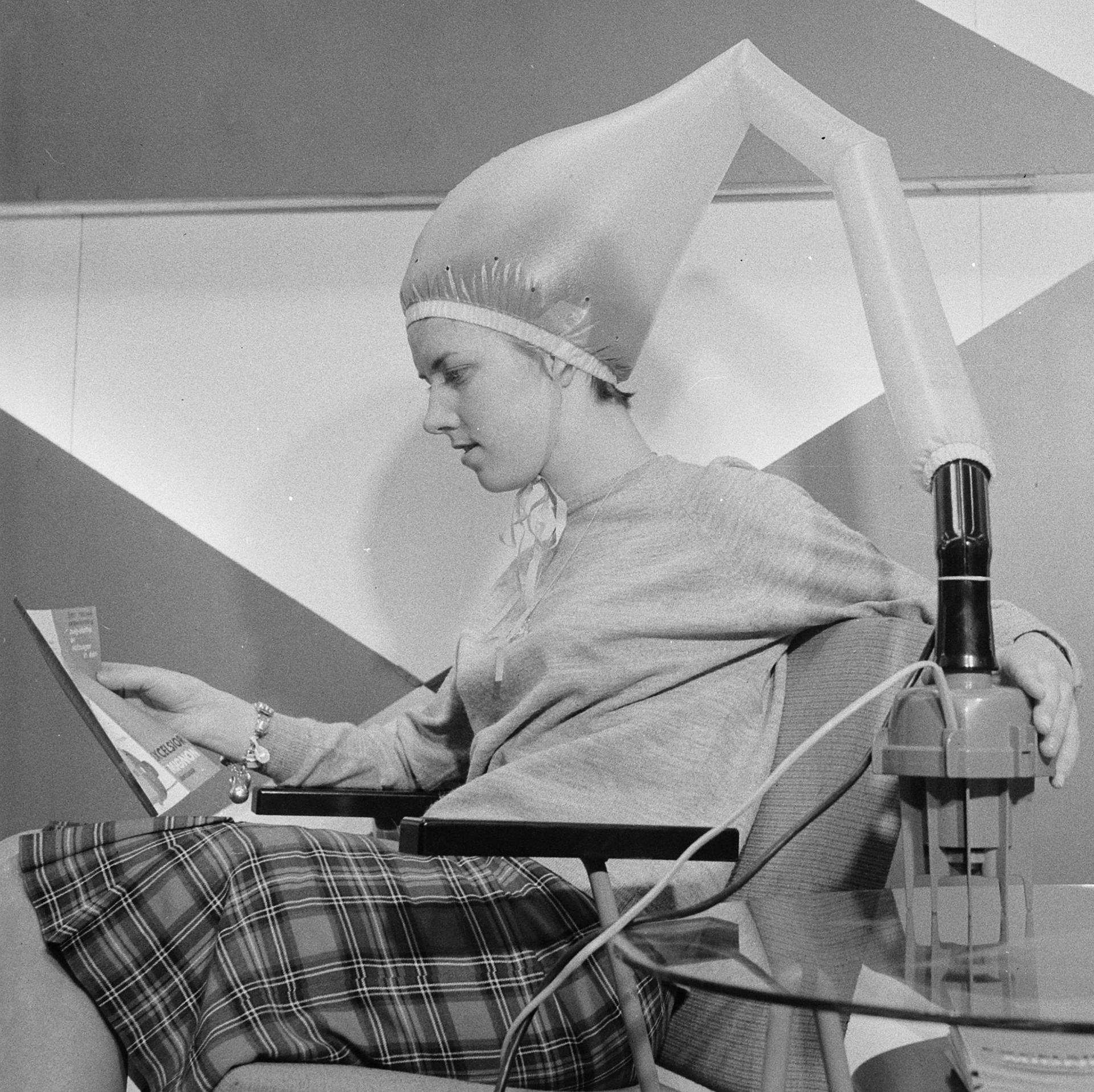
(This is not the Dreame hair dryer, by the way.)
Speaking of hair, how about a pair of AI-powered hair clippers? Yes, Glyde offers an automated pair of clippers that adjusts the blades as it progresses.
But first you have to strap on a “fade band” that the clippers use to detect their position on your head. Then, just turn them on and hope for the best.
And thus is born a new hairstyle: the slop cut.
For the gourmets out there, Seattle Ultrasonics unveiled an electric vibrating chef’s knife that, the company claims, cuts with 50% less effort.
You can charge the knife with a USB-C charger or a $149 mahogany wireless charging tile.
No, that’s all right, we’ll stick with our analog knives, especially since the C-200 Ultrasonic Chef’s Knife goes for $399.
Then there is a term we had to look up—taint zapping—and we’re sorry we did.
The device, called Mor, is attached to an adhesive patch containing electrodes that you, well, stick on your taint.
Apparently “taint” is a euphemism for one’s naughty bits and we’re never going to be able to listen to “Tainted Love” ever again.
Gizmodo has a roundup of the introductions at CES, and confesses to no small amount of disappointment.
there weren’t really any surprises at CES 2026. Pretty much everything that Gizmodo expected to see—mainly AI shoved into every gadget imaginable, for better or worse
Probably worse.
AI-Yi-Yi-Yi, Part the Infinity: Frog Marched
Speaking of AI (and who isn’t?), apparently one use of AI these days is generating police reports. Via UPI, The Heber City (Utah) Police Department has begun using two AI programs, Draft One and Code Four, to automatically generate police reports from body camera footage. Could be useful, except for one little glitch: “A report generated by the Draft One program mistakenly reported that an officer had been turned into a frog.” No, the officer’s name was not Sgt. Prince. Still, he must have been hopping mad about it. Anyway, how does this happen?
“The body cam software and the AI report writing software picked up on the movie that was playing in the background, which happened to be ‘The Princess and the Frog,’” Sgt. Rick Keel told FOX 13 News.
Good thing Alien wasn’t on. Keel added, in one of the greatest understatements of the decade:
“That’s when we learned the importance of correcting these AI-generated reports.”
Ya think?! Aren’t these reports used in court?
Gotta say, though, this would make for an awesome episode of Law & Order.
Graphene Is in Your Head(phones)
Was it a good week for graphene news? It’s always a good week for graphene news! Fender Audio to introduce graphene-enhanced headphones at CES. From (who else?) Graphene-Info:
The new MIX headphones will incorporate 40mm graphene drivers. Graphene’s combination of low mass, high stiffness, and excellent conductivity contributes to greater acoustic precision and reduced distortion compared with conventional driver materials. Fender indicates that these properties help optimize energy efficiency and enhance sound detail across the frequency range.
Here's an ominous-sounding product name:
Fender will also introduce the ELIE (Extremely Loud Infinitely Expressive) Bluetooth speaker line, consisting of the E6 and E12 models. These speakers utilize a digital signal processor and system-on-a-chip architecture to balance output and efficiency. Each supports multiple simultaneous audio channels and stereo pairing capability.
Does it come with a complimentary hearing test?
Keep Watching the Skis
Sorry, that should be skies.
(Optional musical accompaniment to this item.)
If you are an avid amateur astronomer, or just have a fascination with the night sky, Smithsonian magazine identifies 10 celestial events taking place in 2026. Including a planet parade:
a six-planet alignment, also called a planet parade. Mercury, Venus, Saturn, Jupiter, Uranus and Neptune will all be gathered on the same side of the sky, from Earth’s perspective. Saturn, Venus and Mercury will appear as a cluster in the southern sky, while Jupiter will shine brightly near the moon. Uranus and Neptune, however, will not be visible to the naked eye—they’re too faint to make out without the aid of binoculars or a telescope.
Look for that in late February. And the next time all seven planets will be visible at once—a full planetary alignment—will be on February 3, 2034. So mark your calendars for that.
In the early hours of March 3, residents of North America will be treated to a total lunar eclipse.
During this event, the sun, moon and Earth align perfectly during a full moon. This lineup leads sunlight reflecting off the moon to first pass through Earth’s atmosphere, which scatters away blue and violet wavelengths of light. Only the redder wavelengths reach the moon, illuminating it in an eerie rust-colored glow. For this reason, a total lunar eclipse is also known as a blood moon.
There will also be a full blue micromoon on May 31.
Some of us were lucky enough to have caught the total solar eclipse in April 2024 (although, it having been Syracuse, N.Y., it was cloudy, but no less spectacular). If you want another chance to check out a total eclipse, you’ll get your chance on August 12—although you’ll have to travel, as the path of totality will include parts of Russia, Greenland, Iceland, Portugal, and Spain. Some European countries will see a near-total eclipse, and skywatchers across Africa, Asia and North America may also get the chance to see a partial eclipse.
Remember though: “everything under the sun is in tine but the sun is eclipsed by the moon.”
Grocery Stories
Ah, January, when a young man’s fancy turns to…groceries? Food & Wine (who else?) identified their most-liked grocery stories from 2025, an interesting benchmark of what was on the minds of foodies last year. These included “The Italian Products You Should (and Shouldn’t) Buy at Costco, According to an Italian,” “The 5 Best Bottles of Wine at Costco, According to a Sommelier,” “The 5 Grocery Store Chains With the Best Bakery Departments,” and the ambitious “One Man Is Ranking Every Grocery Store Rotisserie Chicken, and These Are the 7 Best.”
TikTok creator Johnny Novo (@jnov__) has tried and ranked nearly every supermarket rotisserie chicken — over 100 at this point, to be exact — so you know where to buy the best.
Sure he’s not sick of chicken at this point?
Costco and Trader Joe’s are well-represented in this list. Make of that what you will.
This Week in Printing, Publishing, and Media History
January 5
1932: Italian novelist, literary critic, and philosopher Umberto Eco born.
1944: The Daily Mail becomes the first transoceanic newspaper.
1953: The play Waiting for Godot by Samuel Beckett is first performed.
January 6
1838: Alfred Vail demonstrates a telegraph system using dots and dashes (this is the forerunner of Morse code).
1852: French educator, inventor of Braille Louis Braille dies (b. 1809).
1878: American poet and historian Carl Sandburg born.
1912: German geophysicist Alfred Wegener first presents his theory of continental drift. (Afterward, everyone slowly moved away from him.)
1931: Thomas Edison signs his last patent application.
1931: American novelist, playwright, and short story writer E. L. Doctorow born.
1946: Shine on, you crazy diamond: English singer-songwriter and guitarist Syd Barrett born.
2000: Kerplonk! American cartoonist Don Martin dies (b. 1931).
January 7
1706: German publisher Johann Heinrich Zedler born.
1831: German postman and founder of the Universal Postal Union Heinrich von Stephan born.
1873: Hungarian-American film producer and co-founder of Paramount Pictures Adolph Zukor born.
1894: William Kennedy Dickson receives a patent for motion picture film.
1912: American cartoonist Charles Addams born.
1927: The first transatlantic telephone service is established from New York City to London.
January 8
1547: The first Lithuanian-language book, Simple Words of Catechism, is published in Königsberg.
1642: Italian physicist, mathematician, astronomer, and philosopher Galileo Galilei dies (b. 1564).
1775: English printer and type designer John Baskerville dies (b. 1706).
1824: English novelist, playwright, and short story writer Wilkie Collins born.
1862: American publisher and founded of the Doubleday Publishing Company Frank Nelson Doubleday born.
1889: Herman Hollerith is issued US patent #395,791 for the “Art of Applying Statistics”—his punched card calculator.
1904: The Blackstone Library is dedicated, marking the beginning of the Chicago Public Library system.
1935: Elvis Presley born.
1941: English actor, screenwriter, and Monty Python member Graham Chapman born.
1942: English physicist and author Stephen Hawking born.
1947: English singer-songwriter, producer, and actor David Bowie born.
January 9
1606: English printer William Dugard born.
1890: Czech author and playwright Karel ?apek born. His play R.U.R. coined the word “robot.”
1944: English guitarist, songwriter, and producer Jimmy Page born.
January 10
1754: English publisher, founder of The Gentleman’s Magazine Edward Cave dies (b. 1691).
1776: Thomas Paine publishes his pamphlet Common Sense.
1927: Fritz Lang’s futuristic film Metropolis is released in Germany.
1990: Time Warner is formed by the merger of Time Inc. and Warner Communications.
2023: English guitarist and songwriter Jeff Beck dies (b. 1944).
January 11
1927: Louis B. Mayer, head of film studio Metro-Goldwyn-Mayer (MGM), announces the creation of the Academy of Motion Picture Arts and Sciences, at a banquet in Los Angeles, California.
1928: English novelist and poet Thomas Hardy dies (b. 1840).
1949: The first “networked” television broadcasts took place as KDKA-TV in Pittsburgh, Pa., goes on the air connecting the east coast and mid-west programming.
1964: Surgeon General of the United States Dr. Luther Terry, M.D., publishes the landmark report Smoking and Health: Report of the Advisory Committee to the Surgeon General of the United States saying that smoking may be hazardous to health, sparking national and worldwide anti-smoking efforts.
1755: General, economist, and politician, 1st United States Secretary of the Treasury, “Ten-Dollar Founding Father” Alexander Hamilton born.
1807: American businessman and philanthropist, founder of Western Union and Cornell University Ezra Cornell born.