Sloppy Firsts
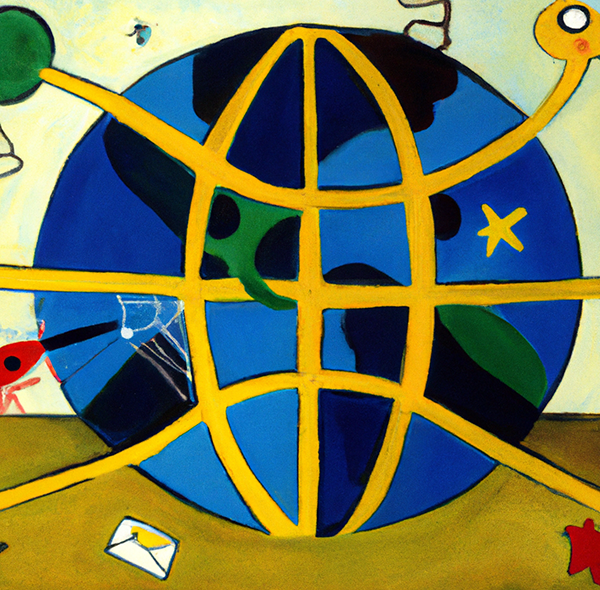
We have our Color of the Year, the Oxford University Press’s Word of the Year, and now we have Merriam-Webster’s Word of the Year: “slop.” Says the dictionary:
Merriam-Webster’s human editors have chosen slop as the 2025 Word of the Year. We define slop as “digital content of low quality that is produced usually in quantity by means of artificial intelligence.” All that stuff dumped on our screens, captured in just four letters: the English language came through again.
Deepfake photos, fake videos, stupid stories, and other…well, slop.
Like slime, sludge, and muck, slop has the wet sound of something you don’t want to touch. Slop oozes into everything. The original sense of the word, in the 1700s, was “soft mud.” In the 1800s it came to mean “food waste” (as in “pig slop”), and then more generally, “rubbish” or “a product of little or no value.”
What were the runners up? Gerrymander, touch grass (“to participate in normal activities in the real world especially as opposed to online experiences and interactions”—never hear that one; is it like “forest bathing?), performative, tariff, and six seven (“Six seven, or 6 7, comes from the song “Doot Doot (6 7)” by rapper Skrilla, used in viral videos and memes featuring the 6’ 7” NBA player LaMelo Ball), which is apparently a kid thing.
We suspect we’ll be using the Word of the Year a lot in the next year and beyond.
Block Printing
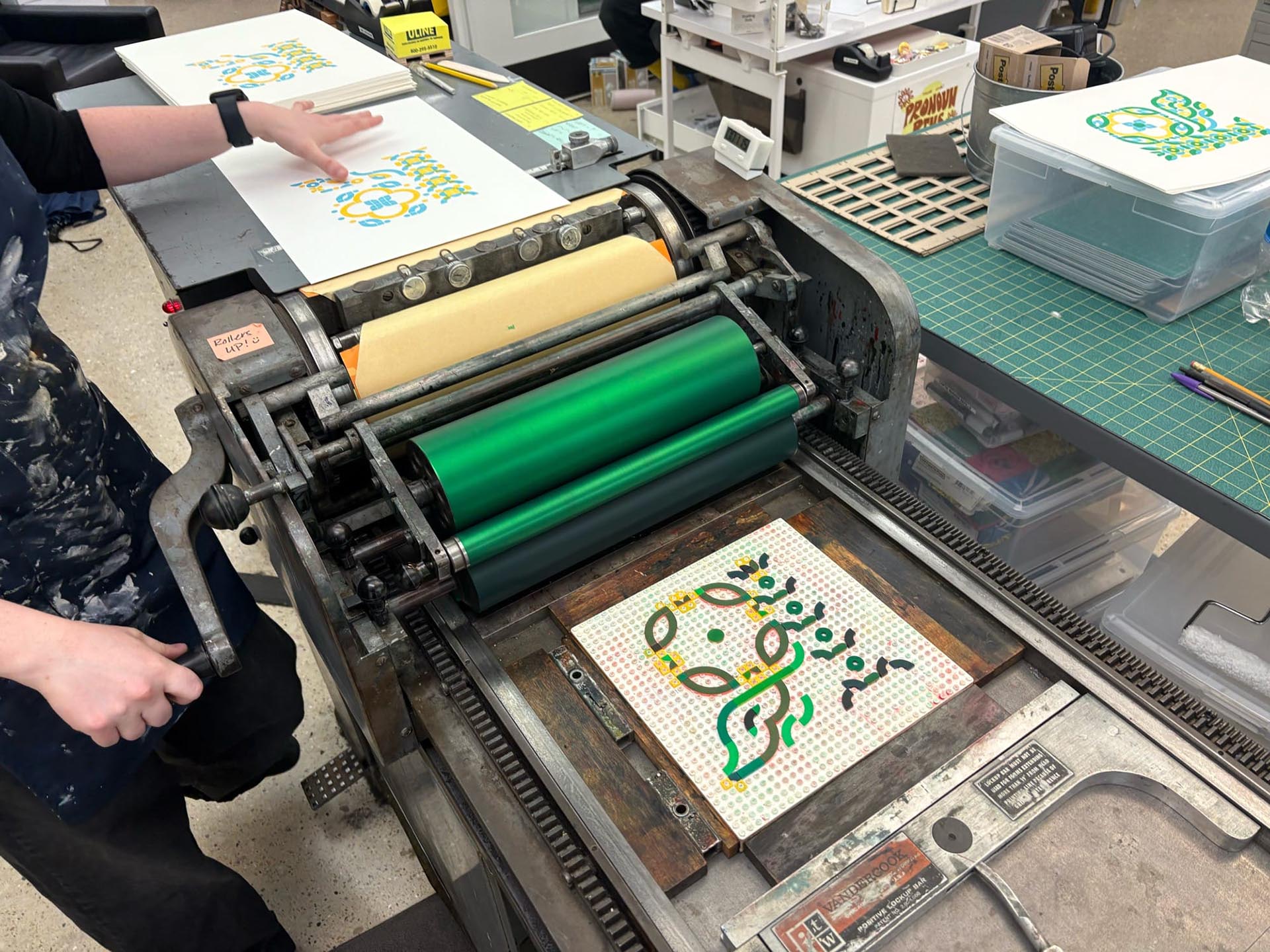
Our Mount Monadnock Media Maven points us toward a design project that used LEGO to create letterforms. Says Colossal:
When designer Pedro Neves was an undergraduate student, he attended an advanced seminar during which students were charged with creating an alphabet using modular elements.
…In his faculty role at the University of Illinois Chicago’s School of Design, Neves organized a graduate course emphasizing modularity for letterform design and typographic compositions. LEGO turned out to be an ideal system, comprising individual elements that operate on a grid and exist in numerous shapes.
Neves then challenged designers from around the world to create a distinctive letterforms. Thirty-six individual designers or design studios participated and their contributions have been compiled in a publication called A2Z: Learning Through LEGO® and Letterforms. There is also a complementary exhibition at the Design Museum of Chicago.
Neves offered to send participants a physical LEGO set so they could tinker with ideas by hand. Then, for their final designs, which could be layered up to three times to achieve different colors and effects, the designers could use five colors loosely based on CMYK, which Neves selected from the Pantone color system. Every letterform incorporates some combination or selection of aqua, red, yellow, purple, and green.
Having a Ball
Via Laughing Squid, Unnecessary Automation 3D-printed a working computer-controlled typewriter, although one designed to print images rather than words. The kicker? It uses one those old IBM Selectric “golf ball” type head.

He also used servos and stepper motors for power and precise character placement, along with custom code to ensure the images are rendered as intended.
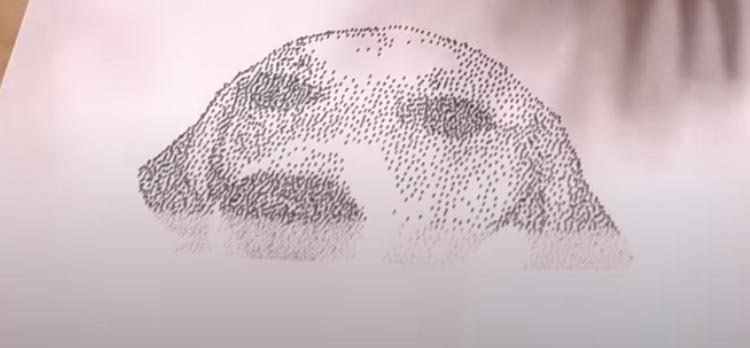
Watch it in action: https://youtu.be/aOf1NUtqHDA
Good Days and Mad
Those of a certain age have fond memories of the heyday of Mad magazine, and one of the best of the “usual gang of idiots” was cartoonist Al Jaffee. Primarily known for his “fold-in” that adorned the inside back cover of every issue, he also wrote/drew other features. Via Boing Boing, one classic Jaffee feature is “If Kids Designed Their Own Xmas Toys,” which appeared in Mad Magazine issue #76, January 1963 (on sale November–December 1962).
Jaffee’s genius lay in presenting children’s crude toy drawings, then building and photographing them exactly as sketched—wonky proportions and all.
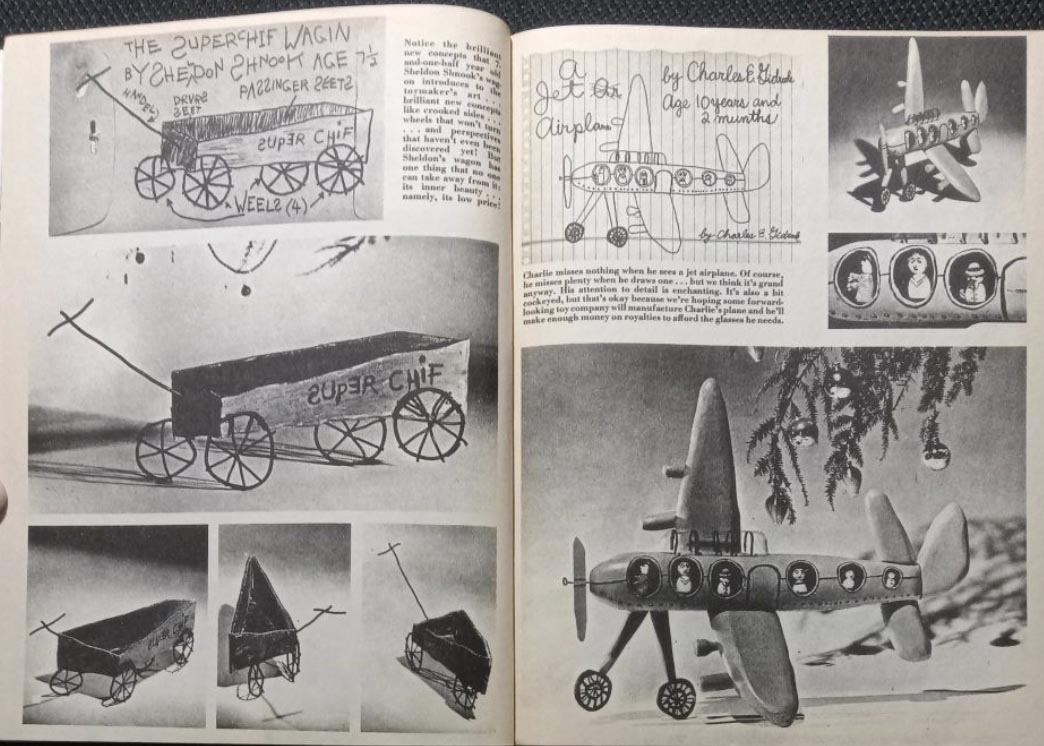
If you’re on BlueSky, the account Alfred E. Newman shared the whole feature.
Here’s a 2016 video interview with a then-95-year-old Jaffe: https://youtu.be/pK6xE-9sdII.
Signs of the Times, Part the Ongoing: Pix in Spaaaaace…
As much as we like and report about signage and display graphics, even we admit that this is a step too far. Says Popular Science:
In 1993, Mike Lawson, an aerospace entrepreneur based in Roswell, Georgia, unveiled his vision for a brave new future of advertising: space billboards.
Mercifully, it never happened, despite his best efforts.
Lawson had meticulous plans for a proposed 1996 launch: His team of engineers would shoot a package of tightly-wound mylar into orbit about 180 miles above the Earth. Once there, the material would unfurl into a thin, reflective sheet up to a mile long and a quarter mile tall, bordered by a series of mylar tubes which would inflate to create a rigid frame holding the mega-banner taut. The sheet would catch the sun’s rays, amplified by a series of small mirrors attached to the platform, and reflect them into the atmosphere. This would create a roughly moon-sized image in the sky of whatever single design the team printed on the banner.
Naturally, any kind of ad copy would be too small to read without a telescope. It was in orbit, so the billboard would be visible from every place on Earth for about 10 minutes a day at each location. Lawson was not the only one proposing space-based advertising, and it is often a common feature of science-fiction.
Fortunately, the general public was actively opposed to the idea.
Still, Lawson’s idea of putting a moon-sized advert into the sky seemingly crossed a line, as the proposal sparked a substantial wave of backlash against him and the eleven firms he claimed had expressed interest in advertising on his rig. Much of the pushback flowed from a gut-level distaste for the idea of spoiling the night sky with something so commercially crass—and in the process creating a world where ads are so large and pervasive they become unavoidable.
Lawson pushed back against the pushback, but to no avail and eventually funding dried up. And to make sure no one tried it again, Congress created a law banning “obtrusive space advertising.”
Not a Page Turner
Ever heard of the “Hawking Index”? Developed in 2014 by mathematician Jordan Ellenberg, it was designed to quantify the extent to which people don’t finish reading the books they buy. It was named after Stephen Hawking’s bestselling A Brief History of Time, believed to be the “most unread book of all time.” (For the record, we did read all of it back in the day.) Says Boing Boing:
Ellenberg's method exploited Amazon Kindle's "popular highlights" feature, which showed the five most-highlighted passages in any book. If those highlights were spread throughout the text, readers were actually finishing. If they clustered at the beginning, people were giving up early. The resulting percentage indicates roughly how far the average reader gets.
Some results?
Hillary Clinton's "Hard Choices" scored 1.9%—meaning most readers bailed almost immediately. Thomas Piketty's economics tome "Capital in the Twenty-First Century" managed only 2.4%. David Foster Wallace's "Infinite Jest" hit 6.4%, and Hawking's own "Brief History of Time" came in at 6.6%.
What about books that people stayed with?
Some books fared better. "Fifty Shades of Grey" reached 25.9%, "The Great Gatsby" hit 28.3%, and "Catching Fire" scored 43.4%. The winner? Donna Tartt's "The Goldfinch" at 98.5%—people who started it actually finished
That would be an eclectic reading list.
Plowed
Every year, the city of Minneapolis has a snowplow-naming contest, which we usually link to when the winners are announced, but this year, Syracuse, N.Y., also had an open call to name its new snowplows. Via Syracuse.com:
As a big fan of the 1993 baseball film “The Sandlot,” [Syracuse Mayor Ben] Walsh loved the suggestion of “You’re Killing Me, Squalls.” The pun from that movie’s iconic line was among three winners Walsh unveiled today at a press conference by the city’s salt storage barn on Canal Street.
The other winners were “Syracuse Saltshaker” and “Snow Big Deal.” They emerged from more than 700 submissions made when the city announced the contest in July, a volume the mayor described as a “testament to how much passion we have for our snow.”
“Passion” might be a polite term for what we have for it.
Syracuse also held a snowplow naming contest in 2020, when the winners were “Blizzard Beater,” “Salt City Express” and “Below Zero Hero.”
At least it wasn’t Plowie McPlowface.
Put Your Eye Out…
Is Christmas Story one of your go-to holiday movies? By choice, or because it’s just always on? If you’re a fan of it—and how could one not be—be sure to make a pilgrimage to Cleveland, Ohio, and visit “A Christmas Story” House and Museum. And, yes, you can actually tour the house used in the movie. Says Atlas Obscura:
The owner of the house began by selling replica “leg lamps” like the one featured in A Christmas Story’s most memorable scene, and was eventually able to purchase the home from the movie. He has since completely remodeled the interior to be an exact replica of the home in the film. Visitors can walk through the period-modeled site, tasting the soap Ralphie washed his mouth out with or firing a BB gun in the backyard.

There is also a museum across the street that features many of the props used in the movie.
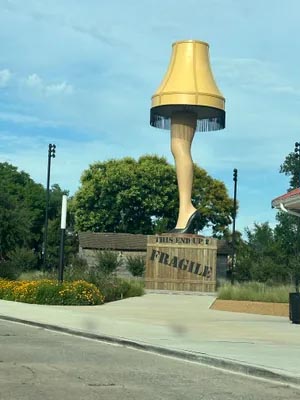
If that doesn’t slake your thirst for A Christmas Story experiences, then head out to Chickasha, Okla., and check out the Chickasha Leg Lamp, 40-foot-tall replica of the famous lamp featured in the movie, erected in 2022.
Graphene Is Connected
Was it a good week for graphene news? It’s always a good week for graphene news! Registration is now open for Graphene-Connect 2026! From (who else?) Graphene-Info:
Graphene-Info is pleased to announce that registration is now open for Graphene-Connect 2026, our flagship two-day virtual event dedicated to graphene industrialization and innovation, taking place online on 11–12 March 2026, in collaboration with Techblick.
How could we possibly resist?
Graphene-Connect tickets start at our special early bird price of $400 (with discounts available for group passes).
OK, that’s how.
All Shook Up
It’s school Christmas pageant season, and perhaps you recall having participated in one or two yourself (hopefully not in an Owen Meaney kind of way) and maybe you have kids or grandkids that are themselves participating. One interesting bit of confusion caught our attention, via the Good News Network.
When 9-year-old Oscar Wilkins heard he’d been given the role of ‘Elvis the Elf’ in the nativity play at his primary school last week, the alliteration left him confused over what to tell his parents.
First of all, we question the use of the term “nativity play,” which we would imagine refers specifically to Jesus’s birth narrative—which does not involve elves. Anyway…
Coming home, Oscar’s sister said neither he nor the school had been able to communicate the ‘elf element’ to his bemused family; the boy simply told them he had been cast as Elvis.
So the parents found an Elvis costume and little Oscar became Elvis.
“We only found out the mistake when we were watching the show and they all walked out—out of 12 kids, they were all dressed as elves except for Oscar,” she said. “It was so funny. A week before they had all met up in costume for a dress rehearsal but didn’t tell us anything was wrong.”
Apparently, Oscar had a blast. Maybe every Christmas pageant needs an Elvis.
Do It for Clippy
Looking for something inappropriate for your next ugly sweater party? Why not try Microsoft’s “Artifact Holiday Sweater.” We were unaware of this, but apparently Microsoft releases a holiday sweater every tear—and has been doing so for the past few years. They passed on doing one last year, but now they’re back with a design featuring a sort of “greatest hits,” if that’s what you want to call them. Says Ars Technica:
the design for this year’s flagship $80 sweater is mostly in line with what the company has done in past years. The 2025 “Artifact Holiday Sweater” revives multiple pixelated icons that Windows 3.1-to-XP users will recognize, including Notepad, Reversi, Paint, MS-DOS, Internet Explorer, and even the MSN butterfly logo. Clippy is, once again, front and center, looking happy to be included.
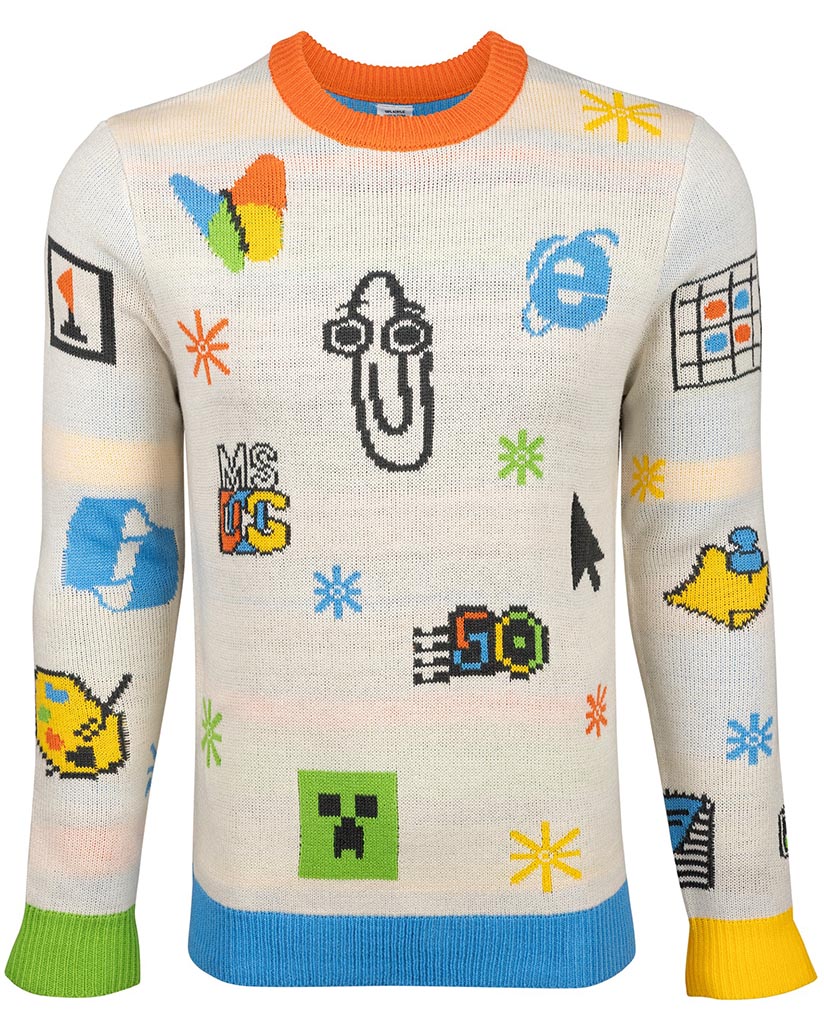
Not all of the icons are from Microsoft’s past; a sunglasses-wearing emoji, a “50” in the style of the old flying Windows icon (for Microsoft’s 50th anniversary), and a MinecraftCreeper face all nod to the company’s more modern products. But the only one I really take issue with is on the right sleeve, where Microsoft has stuck a pixelated monochrome icon for its Copilot AI assistant.
You mean the horribly annoying Copilot AI assistant?
this sweater proves that even explicitly retro-themed vanity projects aren’t immune to the company’s AI push. In sweaters and in Windows PC keyboards, you’re getting a Copilot icon whether you like it or not.
Should we call it slop?
TJ Cooker
Christmas is less than a week away. And for those who have not finished (or, ahem, started) their Christmas shopping, Trader Joe’s may just have you covered, at least in the “stocking stuffer” department. Food & Wine has a helpful round-up of some gift ideas for less than $5. There is the $3 Gingerbread Dude Cookie, the $4 box of Sleigh Ride Cookies, and the freakish looking Break Apart Reindeer:
a holiday treat with a playful secret inside its milk chocolate shell: red gummy “noses” that pay homage to the most famous reindeer of all. It’s the kind of interactive item that kids will enjoy breaking open, and at $4 it’s just as affordable as everything else at Trader Joe’s.

“Come on, kids, time to disembowel Rudolph!”
WhatTheyThink is going on our holiday publishing hiatus. We’ll be back on January 5 with our regular features, videos, and news. On behalf of the entire WhatTheyThink crew, we wish you the most joyous of holiday seasons.
This Week in Printing, Publishing, and Media History
December 15
1791: The United States Bill of Rights becomes law after it is ratified by the Virginia General Assembly.
1939: Gone with the Wind (the highest inflation-adjusted grossing film) receives its premiere at Loew's Grand Theatre in Atlanta, Ga.
December 16
1775: English novelist Jane Austen born.
1901: Beatrix Potter privately publishes The Tale of Peter Rabbit. It goes on to sell over 45 million copies worldwide.
1917: British science fiction writer Arthur C. Clarke born.
1928: American science fiction writer Philip K. Dick born.
December 17
1790: The Aztec calendar stone is discovered at El Zócalo, Mexico City.
1892: The first issue of Vogue is published.
1903: The Wright brothers make the first controlled powered, heavier-than-air flight in the Wright Flyer at Kitty Hawk, N.C.
1937: American novelist John Kennedy Toole (A Confederacy of Dunces) born.
1989: The Simpsons first premieres on television with the episode “Simpsons Roasting on an Open Fire.”
December 18
1892: Premiere performance of The Nutcracker by Pyotr Ilyich Tchaikovsky in Saint Petersburg, Russia.
1958: Project SCORE, the world’s first communications satellite, is launched.
December 19
1776: Thomas Paine publishes one of a series of pamphlets in The Pennsylvania Journal entitled “The American Crisis.”
1843: The novella A Christmas Carol by Charles Dickens is first published. Bah!
1932: BBC World Service begins broadcasting as the BBC Empire Service.
December 20
1948: English keyboard player and producer Alan Parsons born.
1946: The film It’s a Wonderful Life is first released in New York City.
1946: Israeli-English magician, “psychic,” and spoon-mangler Uri Geller born.
1971: The international aid organization Doctors Without Borders is founded by Bernard Kouchner and a group of journalists in Paris, France.
December 21
1879: World premiere of Henrik Ibsen’s A Doll’s House at the Royal Theatre in Copenhagen, Denmark.
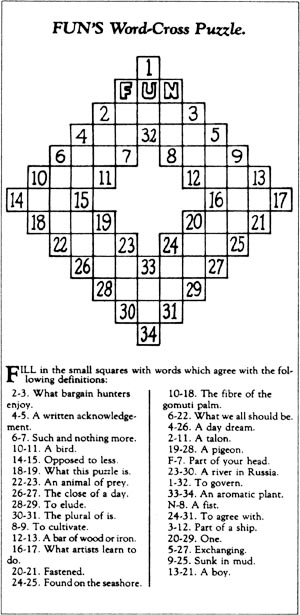
1913: Arthur Wynne’s “word-cross,” the first crossword puzzle, is published in the New York World. The Oreo cookie had been introduced a year earlier. Coincidence? (See if we can spot the cruciverbalists out there.)
1937: Snow White and the Seven Dwarfs, the world’s first full-length animated feature, premieres at the Carthay Circle Theatre.
1940: The late, great American composer, singer-songwriter, guitarist, and producer Frank Zappa born. Watch out where the huskies go.
December 22
1808: Ludwig van Beethoven conducts and performs in concert at the Theater an der Wien, Vienna, with the premiere of his Fifth Symphony, Sixth Symphony, Fourth Piano Concerto (performed by Beethoven himself) and Choral Fantasy (with Beethoven at the piano).
1880: English novelist and poet George Eliot dies (b. 1819).
1891: Asteroid 323 Brucia becomes the first asteroid discovered using photography.
1936: Irish science historian and author James Burke (Connections) born.
2001: Richard Reid attempts to destroy a passenger airliner by igniting explosives hidden in his shoes aboard American Airlines Flight 63; as a result, air travelers passing through security will have to take off their #$^&@! shoes in perpetuity. So thanks for that, Mr. Reid.
December 23
1815: The novel Emma by Jane Austen is first published.
1893: The opera Hansel and Gretel by Engelbert Humperdinck is first performed.
1913: The Federal Reserve Act is signed into law by President Woodrow Wilson, creating the Federal Reserve System.
1947: The transistor is first demonstrated at Bell Laboratories.
December 24
1818: The first performance of “Silent Night” takes place in the church of St. Nikolaus in Oberndorf, Austria.
1822: English poet and critic Matthew Arnold born.
1851: The Library of Congress in Washington, D.C., burns.
1863: English author and poet William Makepeace Thackeray dies (b. 1811).
1871: The opera Aida premieres in Cairo, Egypt.
1906: Reginald Fessenden transmits the first radio broadcast consisting of a poetry reading, a violin solo, and a speech.
1968: The crew of Apollo 8 enters into orbit around the Moon, becoming the first humans to do so. They performed 10 lunar orbits and broadcast live TV pictures.
December 25
336: First documented Christmas celebration in Rome.
1642: English physicist and mathematician Isaac Newton born.
1758: Halley’s Comet is sighted by Johann Georg Palitzsch, confirming Edmund Halley’s prediction of its passage. This was the first passage of a comet predicted ahead of time.
1815: The Handel and Haydn Society, oldest continually performing arts organization in the United States, gives its first performance.
1890: American publisher, co-founder of Reader’s Digest Lila Bell Wallace born.
1924: American screenwriter and producer Rod Serling born.
1938: Czech author and playwright Karel ?apek dies (b. 1890).
2004: The Cassini orbiter releases Huygens probe which successfully lands on Saturn’s moon Titan on January 14, 2005.
December 26
1791: English mathematician and engineer, inventor of the Difference engine Charles Babbage born.
1871: Thespis, the first Gilbert and Sullivan collaboration, debuts. It does modestly well, but the two would not collaborate again for four years and the score has been lost.
1931: American librarian and educator, creator of the Dewey Decimal Classification Melvil Dewey dies (b. 1851).
1963: The Beatles’ “I Want to Hold Your Hand” and “I Saw Her Standing There” are released in the United States, marking the beginning of Beatlemania on an international level.
1966: The first Kwanzaa is celebrated by Maulana Karenga, the chair of Black Studies at California State University, Long Beach.
December 27
1831: Charles Darwin embarks on his journey aboard HMS Beagle, during which he will begin to formulate his theory of evolution.
1845: Journalist John L. O'Sullivan, writing in his newspaper the New York Morning News, argues that the United States had the right to claim the entire Oregon Country “by the right of our manifest destiny.”
1927: Kern and Hammerstein’s musical play Show Boat, considered to be the first true American musical play, opens at the Ziegfeld Theatre on Broadway.
1932: Radio City Music Hall, “Showplace of the Nation,” opens in New York City.
1941: English singer-songwriter and keyboard player Mike Pinder born.
1968: Apollo 8 splashes down in the Pacific Ocean, ending the first orbital manned mission to the Moon.
December 28
1895: The Lumière brothers perform for their first paying audience at the Grand Cafe in Boulevard des Capucines.
1895: Wilhelm Röntgen publishes a paper detailing his discovery of a new type of radiation, which later will be known as x-rays.
1902: The Syracuse Athletic Club defeated the New York Philadelphians, 5–0, in the first indoor professional football game, which was held at Madison Square Garden.
1922: American publisher and producer Stan Lee born.
1945: American novelist and journalist Theodore Dreiser dies (b. 1871).
1958: “Greatest Game Ever Played”: Baltimore Colts defeat the New York Giants in the first ever National Football League sudden death overtime game at New York’s Yankee Stadium.
1973: The United States Endangered Species Act is signed into law by Pres. Richard Nixon.
December 29
1170: Thomas Becket, Archbishop of Canterbury, is assassinated inside Canterbury Cathedral by followers of King Henry II; he subsequently becomes a saint and martyr in the Anglican Communion and the Catholic Church. Chaucer’s The Canterbury Tales are set during a pilgrimage to his shrine.
1766: Scottish chemist and the inventor of waterproof fabric Charles Macintosh born.
1851: The first American YMCA opens in Boston, Mass.
1916: A Portrait of the Artist as a Young Man, the first novel by James Joyce, was first published as a book by an American publishing house B. W. Huebschis after it had been serialized in The Egoist (1914–15).
1926: Austrian poet and author Rainer Maria Rilke dies (b. 1875).
1936: American actress and producer Mary Tyler Moore born.
1941: English singer-songwriter and flute player Ray Thomas born.
1949: KC2XAK of Bridgeport, Connecticut becomes the first Ultra high frequency (UHF) television station to operate a daily schedule.
1989: Czech writer, philosopher, and dissident Václav Havel is elected the first post-communist President of Czechoslovakia.
December 30
1865: English author and poet, Nobel Prize laureate Rudyard Kipling born.
1896: Canadian ice hockey player Ernie McLea scores the first hat-trick in Stanley Cup play, and the Cup-winning goal as the Montreal Victorias defeat the Winnipeg Victorias 6–5.
1927: The Ginza Line, the first subway line in Asia, opens in Tokyo, Japan.
1983: American computer programmer and businessman, co-founder of Instagram Kevin Systrom born.
December 31
1759: Arthur Guinness signs a 9,000 year lease at £45 per annum and starts brewing Guinness.
1790: Efimeris, the oldest Greek newspaper of which issues have survived till today, is published for the first time.
1878: Karl Benz, working in Mannheim, Germany, filed for a patent on his first reliable two-stroke gas engine, and he was granted the patent in 1879.
1879: Thomas Edison demonstrates incandescent lighting to the public for the first time, in Menlo Park, New Jersey.
1907: The first New Year’s Eve celebration is held in Times Square (then known as Longacre Square) in Manhattan. No word if Dick Clark was hosting.
1955: General Motors becomes the first U.S. corporation to make over US$1 billion in a year.
1956: The Romanian Television network begins its first broadcast in Bucharest.
1959: American singer-songwriter and guitarist Paul Westerberg born.
1961: RTÉ, Ireland’s state broadcaster, launches its first national television service.
1980: Canadian philosopher and theorist Marshall McLuhan dies (b. 1911).
1983: The AT&T Bell System is broken up by the United States Government.
1998: The European Exchange Rate Mechanism freezes the values of the legacy currencies in the Eurozone, and establishes the value of the euro currency.
2019: The World Health Organization was informed of cases of pneumonia with an unknown cause, detected in Wuhan. This later turned out to be COVID-19, the cause of the COVID-19 pandemic.
2020: The World Health Organization's issues its first emergency use validation for a COVID-19 vaccine.
January
January 1
1772: The first traveler’s checks, which could be used in 90 European cities, are issued by the London Credit Exchange Company.
1773: The hymn that became known as “Amazing Grace,” then titled “1 Chronicles 17:16–17,” is first used to accompany a sermon led by John Newton in the town of Olney, Buckinghamshire, England.
1788: First edition of The Times of London, previously The Daily Universal Register, is published.
1879: English author and playwright E. M. Forster born.
1919: American soldier and author J. D. Salinger born.
1933: English dramatist Joe Orton born.
1970: The defined beginning of Unix time, at 00:00:00.
1971: Cigarette advertisements are banned on American television.
1983: The ARPANET officially changes to using the Internet Protocol, creating the Internet.
1984: The original American Telephone & Telegraph Company is divested of its 22 Bell System companies as a result of the settlement of the 1974 United States Department of Justice antitrust suit against AT&T.
1985: The first British mobile phone call is made by Michael Harrison to his father Sir Ernest Harrison, chairman of Vodafone.
1992: American computer scientist and admiral, co-developer of COBOL Grace Hopper dies (b. 1906).
1999: Euro currency is introduced in 11 member nations of the European Union (with the exception of the United Kingdom, Denmark, Greece and Sweden; Greece later adopts the euro).
2024: Disney's copyright protection on Steamboat Willie and the original Mickey Mouse expires as they enter the public domain.
January 2
1818: The British Institution of Civil Engineers is founded by a group of six engineers; Thomas Telford would later become its first president.
1920: American science fiction writer Isaac Asimov born.
1929: American author and screenwriter Charles Beaumont born.
January 3
1749: The first issue of Berlingske, Denmark’s oldest continually operating newspaper, is published.
1870: Construction work begins on the Brooklyn Bridge in New York.
1892: English writer, poet, and philologist J.R.R. Tolkien born.
1926: English composer, conductor, and producer George Martin born.
1947: Proceedings of the U.S. Congress are televised for the first time.
1957: The Hamilton Watch Company introduces the first electric watch.
1977: Apple Computer is incorporated.
2000: Final daily edition of the Peanuts comic strip.
January 4
1643: English mathematician and physicist Isaac Newton born.
1809: French educator, inventor of Braille Louis Braille born.
1853: After having been kidnapped and sold into slavery in the American South, Solomon Northup regains his freedom; his memoir Twelve Years a Slave later becomes a national bestseller.
1958: Sputnik 1, the first artificial Earth satellite, launched by the Soviet Union in 1957, falls to Earth from orbit.
1960: French novelist, philosopher, and journalist, Nobel Prize laureate Albert Camus dies (b. 1913).
1965: American-English poet, playwright, and critic, Nobel Prize laureate T. S. Eliot dies (b. 1888).