The White Stuff
(Optional musical accompaniment to this item.)
We know you have been waiting with bated breath, but it’s finally been announced: Pantone’s Color of the Year for 2026 is…white. Huh. Well, OK, not white white, but “Cloud Dancer.” Says Pantone:
PANTONE 11-4201 Cloud Dancer [is] a lofty white that serves as a symbol of calming influence in a society rediscovering the value of quiet reflection. A billowy white imbued with serenity, PANTONE 11-4201 Cloud Dancer encourages true relaxation and focus, allowing the mind to wander and creativity to breathe, making room for innovation.
Oxford’s word of the year for 2025 was “rage bait,” so maybe next year will be calmer. One can hope.
NPR has more reactions:
"It looks like Pantone is in their bridal era," wrote the official David's Bridal account.
We’re not sure about this one:
"The color of the year being colorless is a recession indicator," wrote one Instagram user @shar_fierce
We look forward to seeing how designers make creative use of…white in the year ahead. Boing Boing adds that you can also buy white Cloud Dancer merch.
Just imagine the joy your child will experience when they unwrap a container of Pantone-branded white Play-Doh on Christmas morning.
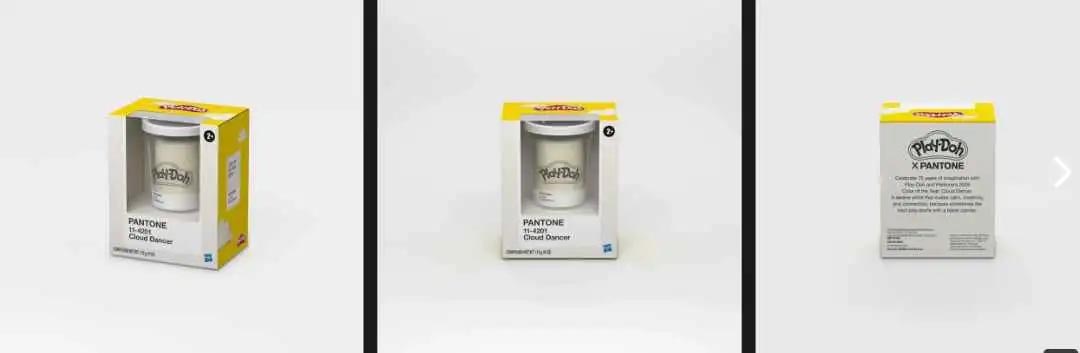
Doh!
Scaffold Factory
If you have been to a city of just about any size, you know there is always construction taking place, and cranes and scaffolding are common urban sights. But, via Print magazine, a New York City group called the Facade Foundation is turning unsightly scaffolding into public art spaces. They unveiled their first installation last April, featuring artwork from the rapper and conceptual artist Shirt.

Since then, the Facade Foundation has installed two other scaffolding works of art, one by June Canedo de Souza entitled “Yellow foot, thorn, fence,” and the other by Anthony Olubunmi Akinbola entitled “Rapunzel,” composed entirely of durags.

Coincidentally, in 2023, New York City launched the City Canvas program, which allows artwork to be installed on temporary structures at active construction sites. Facade Foundation leapt at the opportunity. Print spoke with the FF team. It’s not always easy logistically!
For every facade, it’s us working with the site and its mix of owners, contractors, and construction experts, as well as the artist and their team (who have to bring the artwork to the city so we can make sure it’s not an ad). It’s always important to find (and be available to be found by) people who see our vision and are willing to work with us to do something new.
It would be great to port this concept to other municipalities.
Key Performance
Here’s something that is very cool, but will haunt your dreams. Via Laughing Squid:
A very clever 2020 ad for the video game Dungeon Fighter features a group of performers personifying the letters and characters of a Korean computer keyboard, bringing them to life. This ingenious performance included a strongman space bar, common keys being out of breath, and the relaxing life of lesser-used keys, such as “print screen”.
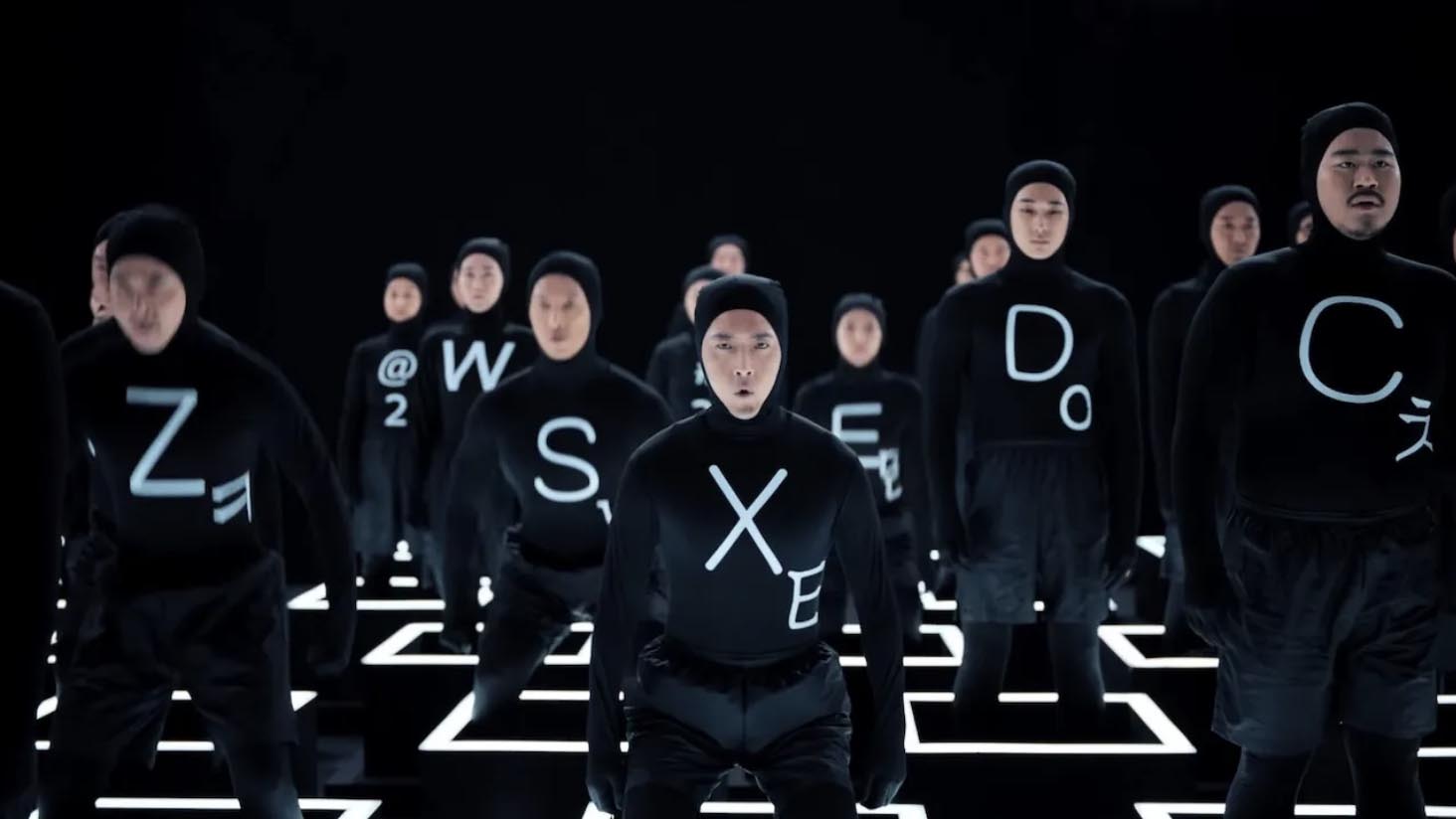
Watch unembeddable video here.
Board Meeting
Do you surf? We would, but we rather like our spines. But if you do like to “hang ten,” as all the young dudes say (if this were 1975) why not do it sustainably, with a surfboard from Swellcycle, 3D-printed using a biodegradable plant material with almost no waste. Via Good News Network:
Regular surfboards are made from blocks of petroleum-based foam, manufactured from fossil fuels. Craftsmen and board designers then cut, shave, and sand away the foam to shape the board, throwing some 40% of the block’s original weight in the landfill.
… Swellcycle works with popular surfboard designers like Spina, Iconoclast, and Tigre Bona, uses almost only solar energy to power its Santa Cruz factory, and reuses the very small amount extra material leftover from the boardmaking process.
The company was founded by Patricio Guerrero, and uses materials such as corn and sugarcane to yield polylactic acid, which is then output from a 3D printer into a latticework that is “then laminated with a 30% degradable epoxy, producing a semi-hollow surfboard that’s more durable than foam.”
What do surfers say?
“They’re really fast, they’re really fun,” said surfer Keaton Mayo, who tested a Swellcycle board at a recent test day. “They’re not your traditional board. It was a blast.”
“I thought it was sensational,” said another surfer, named Sam.
Dude!
Pocket Editions
During the Second World War, the book publishing industry and the U.S. Army collaborated on a series of “Armed Services Editions.” These books—which included some classics, as well as detective novels and nonfiction—were designed to be easy to take into action, were printed in landcape format, and featured bright, primary-colored covers. From 1943 to the end of the war, more than 120 million books were printed and sent to overseas troops during World War II. These editions were the subject of a fascinating 2014 book by Maureen Corrigan called So We Read On: How The Great Gatsby Came to Be and Why It Endures. Indeed, the reason F. Scott Fitzgerald’s The Great Gatsby—dismissed by critics and the public when it was published in 1925—became a classic was due to its being distributed to the troops during the war, and when those soldiers came back, went to college thanks to the GI Bill, and became teachers, one of the books they added to their curricula was The Great Gatsby.
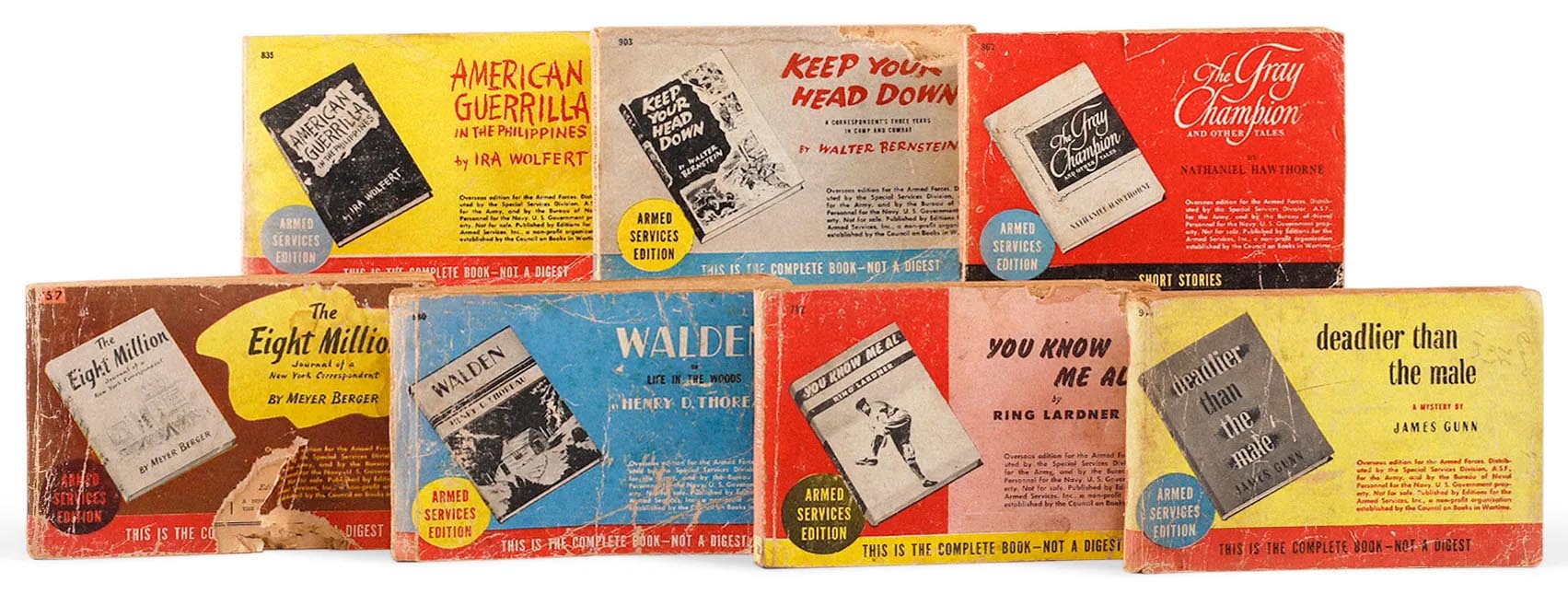
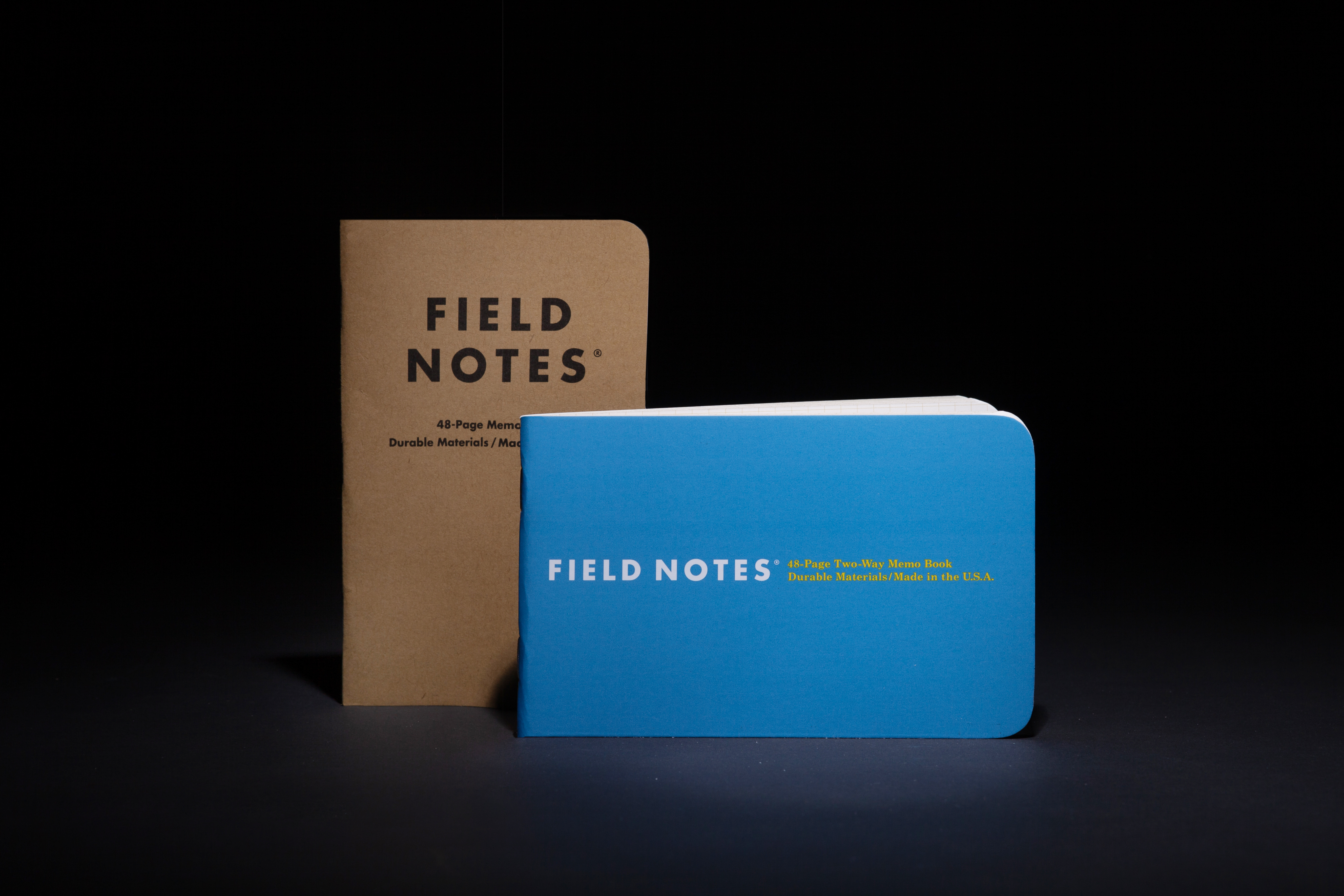
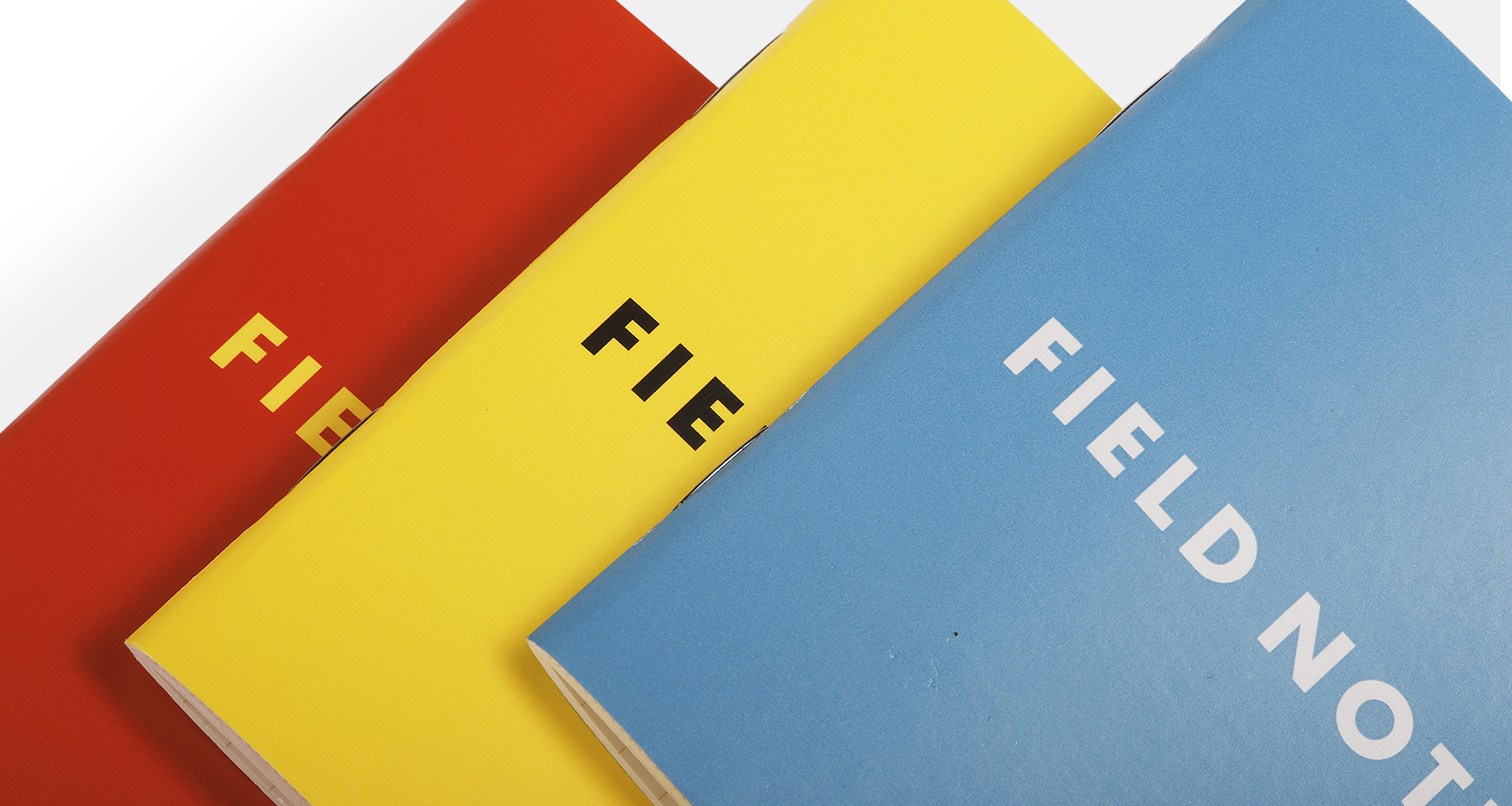
We mention this because, via Print magazine, Field Notes, creator of memo books, has launched a “1943” edition of their memo books designed to resemble the old Armed Services Editions.
We created the “1943” Memo Books to mimic the ASE’s horizontal orientation. While they’re our usual 5.5" x 3.5" Memo Book size, they’re the first with two staples on the short side instead of three on the long side. But while mocking up prototypes, we realized the short-edge binding also works great for a vertical notebook! So it’s up to you, there’s a horizontal cover on one side, and a vertical cover on the other. Whether you want to flip the top of your Field Notes open to take notes as you interview a witness, or spread the pages wide for a panoramic sketch of a crime scene, the 1943 “Two-Way” Edition is the right tool for your investigation.
Or take notes at a press conference, although it can be a fine line…
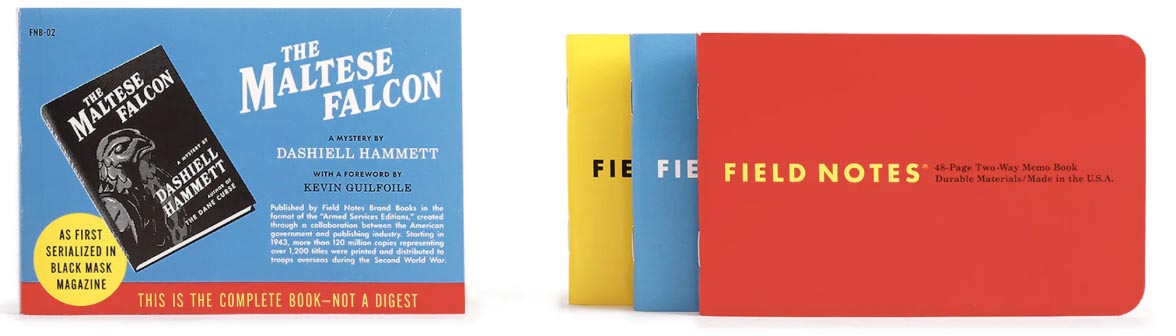
They have also released, via their from Field Notes Brand Books, ASE-esque edition of Dashiell Hammett’s The Maltese Falcon.
Run Through the Mumble
Looking for a typeface that renders type unintelligible? No, don’t use AI. Instead, via Boing Boing, try Mumble Grumble, a font designed for users who need to add dummy text—think greeking or lorem impsum.
Designed for letterers who need to fill large areas with nonsense text. As a time-saving feature, you can press any key in either font and get an entire nonsense word! Mumble grumble i is for very far away text. Mumble grumble ii is for medium-distance handwriting!
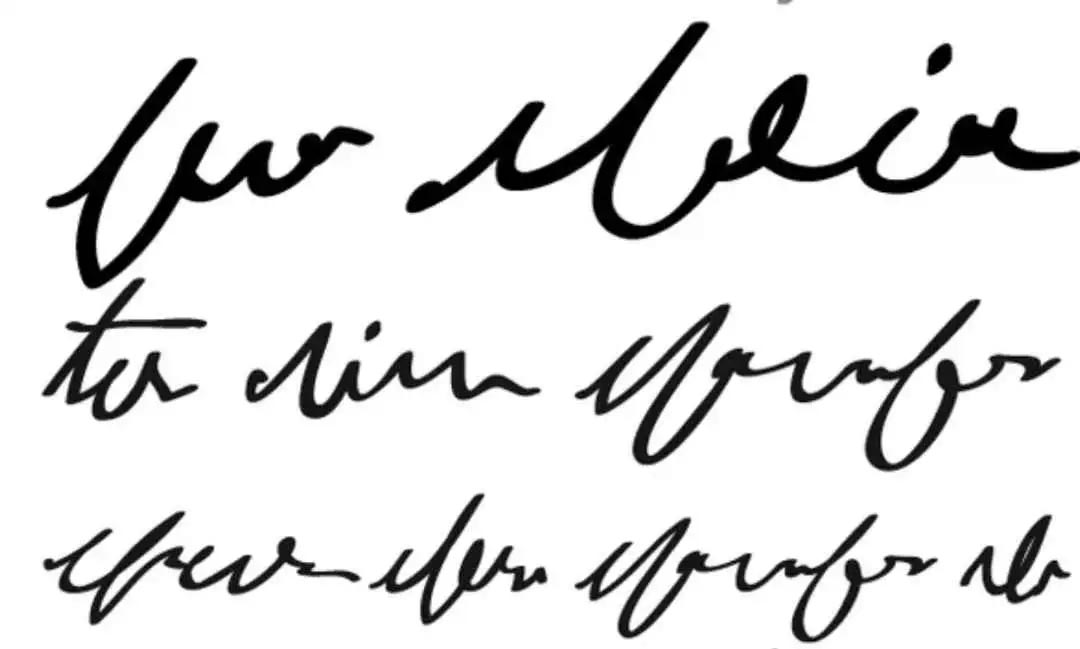
It was designed by comic book letterer Nate Piekos, who also has a new book out about comic book lettering.
Pass the Bubbly
Ah, Bubble Wrap. Who doesn’t enjoy popping it after receiving a shipment that used it. But of course that defeats the purpose of Bubble Wrap, as the goal is to actually recycle it. Alas, few people do, so it often ends up becoming waste.
But, via Core77, there is a more sustainable alternative. Spanish company Artmor has developed the Aircrate—inflatable packaging where you supply the air. It comes like so:
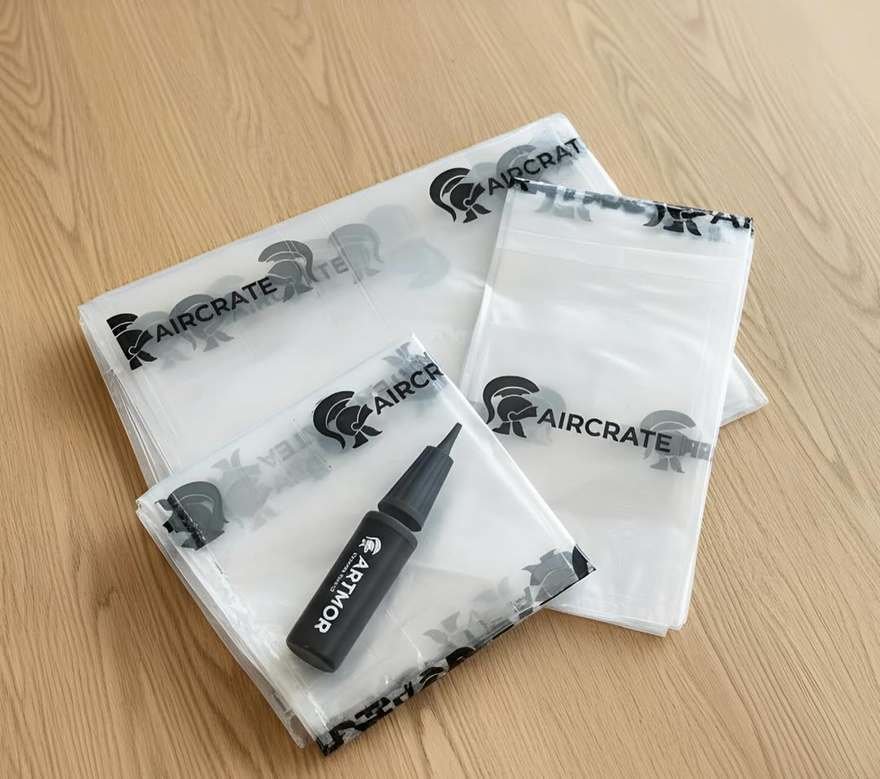
You unfold it, put whatever you are packing inside the sleeve, and then inflate it with your handy-dandy compressor, a balloon pump or a manual pump.

You get a perfect fit—quickly, without using any tape. For art handlers, this saves time. For galleries and museums that rotate pieces in and out of storage, it saves cost and hassle.
Yes, right, it’s designed primarily for shipping art, but rigid wide-format output immediately sprang to mind.
Graphene Is Super
Was it a good week for graphene news? It’s always a good week for graphene news! A new graphene material increases the power and capacity of supercapacitors. From (who else?) Graphene-Info Popular Mechanics:
Supercapacitors represent the future of energy storage and while they far outperform batteries and other power sources, the materials they’re made of only allow them to use a fraction of their total surface area. Supercapacitor electrodes are typically made of graphene, but even graphene (gasp!) has its limitations.
Or at least it did.
Enter mechanical engineer Mainak Majumder and his research team at Monash University in Australia. Aware that demand for high volumes energy density is increasing right alongside demand for compact and portable electronics, Majumder set out to devise a solution for supercapacitor setbacks. The reason that current technology falls short is because of chemical interactions that make it impossible for ions to adhere to spaces between sheets of graphene in 3D structures. While the design flexibility of graphene makes it possible to create denser electrodes, which in turn make it easier for ions to move around, they are still not using much of the potential storage capacity they have.
So, why not create a new kind of graphene?
“We design[ed] a graphene structure tailored to deliver volumetrically-efficient capacitive energy storage,” Majumder said in a study recently published in Nature Communications. “By integrating nano- and meso-scale features of graphene in micron-sized particles, we demonstrate that a multiscale structure, benefiting from each scale, enhances ion accessibility, transport kinetics, energy storage capacity and long-term stability.”
The trick was adding heat to graphene, and they used the resulting material in a new set of electrodes.
The new electrodes were incorporated into pouch cell devices. These flexible, lightweight cells—which are far more efficient than most batteries—allow for a higher energy density, making them ideal for use in electronics. They can be found in not just in electric vehicle batteries, but in gadgets like drones, tablets, and smartphones. Majmuder’s supercapacitors not only outperformed previous graphene structures with especially high energy and power densities, but remained stable, and charged in almost no time. They were so successful that commercialization is already on the horizon.
Sticky
Via LiveScience, researchers have developed a glue strong enough to tow a car—and it’s made from used cooking oil.
Turning nonedible waste into useful polymers is a sustainable way to create new materials, the researchers said in a new study published Nov. 28 in the Journal of the American Chemical Society.
And cooking oil is a problem.
One such waste stream is used cooking oil, where nearly 3.7 billion gallons is generated each year. This waste oil has so far found uses in lubricants, nonstick coatings and fuel, but much of it still gets thrown away. In the new research, the scientists found a way to convert the waste oil into useful plastic materials that are strongly adhesive and recyclable.
And works remarkably well.
The researchers tested the polymer's adhesive strength by sticking two stainless-steel plates together. The plates remained tightly glued, even when up to 270 pounds (123 kilograms) of weight was attached. Towing a four-door sedan on a slightly uphill slope with these glued steel pieces also proved no trouble. This makes these polymers equal to or stronger than the commercially available adhesives that the team also tested.
Island of Misfit Toys
For those of us of a certain age, the Christmas season has always been synonymous with, yes, A Charlie Brown Christmas, but also the holiday films produced by Rankin/Bass. Whether it be Rudolph the Red-Nosed Reindeer (“No child wants to play with a Charlie-in-the-box”), Santa Claus Is Comin’ to Town, or The Year without a Santa Claus (who among us doesn’t know “The Heat Miser Song” by heart?), the stop-motion animation classics were a staple of Christmas.
Mental Floss pays tribute to R/B with “9 Cozy Facts About Rankin/Bass.” It was a labor-intensive process:
Stop-motion productions need to build all kinds of characters that have to be moved bit by bit to make it look like they’re actually moving through a scene. For Rudolph, that meant the studio in Japan had to create 200 puppets to make the scenes come to life. Some puppets may have even been reused for other specials, with different heads or body parts, to accommodate various productions.
Sure, this could all be done digitally today, but it just wouldn’t be the same.
Alas:
Rankin and Bass continued to find success with different television specials and cartoons for years after Rudolph the Red-Nosed Reindeer, but the two producers called it quits in 1987. They still collaborated on occasional titles after that, including hand-drawn animation projects, but the big, regular projects for Rankin and Bass were considered history.
The Hollow Men
One of Jules Verne’s great books is Journey to the Center of the Earth, in which explorers voyage into a decidedly hollow Earth. However, Verne was under no illusions and it was strictly a work of science-fiction and not meant to be taken literally. But that didn’t stop John Symmes Jr., from postulating that Verne got it right, and that the Earth is in fact hollow. Says Atlas Obscura:
Symmes' Hollow Earth Theory posits exactly what it sounds like: that the Earth is in fact hollow. According to Symmes, the empty center of the planet is accessible via shafts located at the North and South poles of the planet, as though Earth is some sort of celestial jewelry bead. These became known as "Symmes Holes".
Uh huh. However farfetched his theory seemed, it gained some traction.
Symmes garnered so much interest that he actually got Congress to vote on funding that would allow him to mount expeditions to the polar regions in the 1820s, where he guaranteed they would find the entrances to the center of the planet. Unfortunately, the government did not share Symmes' sense of wonder and the grant was voted down.
After a while, he tired of the lecture circuit (it just seemed hollow…) and he retired to Hamilton, Ohio, where he passed away in 1829. One of his disciples, Jeremiah Reynolds, trumpeted the Hollow Earth theory for a while, and he even managed to find a ship willing to take him to Antarctica in search of one of the Symmes holes—but to no avail.
If you ever find yourself in Hamilton, Ohio (about 30 miles north of Cincinnati), you can check out the Hollow Earth Monument atop Symmes’ grave in Hamilton’s Ludlow Park.

Symmes' son, Americus Symmes, erected the monument over his father's grave in 1873. The monument features abstract hollow earth, atop a stone pedestal, his original tombstone, and a plaque that explains his theory.
They’ve Got Legs
But we’re not sure they know how to use them…
How does this grab you: Cheez-It-encrusted turkey legs? Yes, there is such a thing. Says (who else?) Food & Wine:
Cheez-It–crusted turkey legs are headed to Camping World Stadium for the Citrus Bowl in Orlando, and a lucky few fans will get to try them on New Year’s Eve.
That’s a definition of “lucky” with we are unfamiliar. (The Daft Punk line “I'm up all night to get lucky” is probably not referring to this.)
So what exactly is on the menu? Juicy turkey legs coated in crushed classic Cheez-It crackers for a crunchy, unmistakably cheesy crust. (They’re priced at a cool $25.)
$25?!?
And for anyone not traveling to Orlando, the brand has an at-home alternative: a Cheez-It–breaded chicken wing recipe that recreates the same flavor.
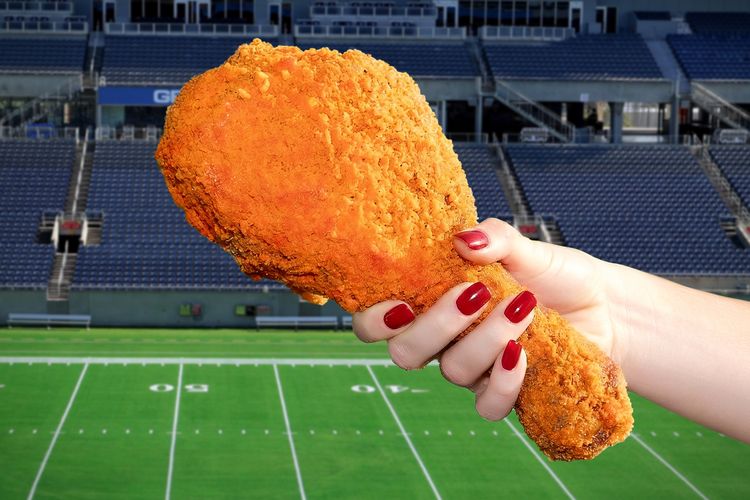
Consider yourselves warned.
This Week in Printing, Publishing, and Media History
November 8
1602: The Bodleian Library at the University of Oxford is opened to the public.
1674: English poet and philosopher John Milton dies (b. 1608).
1847: Irish novelist Bram Stoker (Dracula) became undead born.
1898: Canadian-American actress and singer Marie Prevost born. (Despite the story in Kenneth Anger’s Hollywood Babylon (and a song by Nick Lowe) Prevost was not eaten by her dog.)
1918: German typographer and calligrapher Hermann Zapf born.
1972: HBO launches its programming, with the broadcast of the 1971 movie Sometimes a Great Notion, starring Paul Newman and Henry Fonda.
1973: The right ear of John Paul Getty III is delivered to a newspaper together with a ransom note, convincing his father to pay US$2.9 million
November 9
1818: Russian author and playwright Ivan Turgenev born.
1914: Austrian-American actress and inventor Hedy Lamarr (not Hedley) born. (During World War II, Lamarr and composer George Antheil developed a radio guidance system for Allied torpedoes, unused at the time, but the principles of which were incorporated into Bluetooth technology and are similar to methods used in legacy versions of CDMA and Wi-Fi.)
1934: American astronomer, astrophysicist, and author Carl Sagan born.
1953: Welsh poet and author Dylan Thomas dies (b. 1914).
1967: The first issue of Rolling Stone magazine is published.
November 10
1728: Irish novelist, playwright and poet Oliver Goldsmith born.
1947: English singer-songwriter, guitarist, and producer Greg Lake born.
1969: National Educational Television (the predecessor to the Public Broadcasting Service) in the United States debuts Sesame Street.
1983: Microsoft introduces Windows 1.0.
November 11
1675: Gottfried Leibniz demonstrates integral calculus for the first time to find the area under the graph of y = ƒ(x).
1821: Russian novelist, short story writer, essayist, and philosopher Fyodor Dostoyevsky born.
1855: Danish philosopher, author, and poet Søren Kierkegaard dies (b. 1813).
1922: American novelist, short story writer, and essayist Kurt Vonnegut born.
November 12
1945: Canadian singer-songwriter, guitarist, and producer Neil Young born.
1980: The NASA space probe Voyager I makes its closest approach to Saturn and takes the first images of its rings.
1990: Tim Berners-Lee publishes a formal proposal for the World Wide Web.
November 13
1850: Scottish novelist, poet, and essayist Robert Louis Stevenson born.
November 14
1840: French painter Claude Monet born.
1851: Herman Melville’s novel Moby-Dick is published in the U.S.
1889: Pioneering female journalist Nellie Bly (aka Elizabeth Cochrane) begins a successful attempt to travel around the world in less than 80 days. She completes the trip in 72 days.
1916: American screenwriter and producer Sherwood Schwartz born.
1922: The British Broadcasting Company begins radio service in the United Kingdom.
1952: The first regular UK Singles Chart is published by the New Musical Express.
1967: American physicist Theodore Maiman is given a patent for his ruby laser systems, the world’s first laser.