Message in a…Bottle?
An important—and probably the most important—way of understanding history is by examining the artifacts that past generations, era, and populations have left behind. Books and other written or printed physical documents are not eternal, but with no small amount of serendipity, they can survive for thousands of years. But what about archival media that may not be as preservable? How do we send messages to the future in a way that they will be able to be read? Scientific American takes a deep dive into this question.
When we try to unravel information from the past, we’re limited by what archives and nature have preserved. “The technical structure of the archiving archive determines the structure of the archivable content,” as Derrida put it. Take the oldest known piece of human art, a 73,000-year-old drawing of crosshatched red triangles on a chunk of rock. South African archaeologists found it in a cave called Blombos, about 185 miles east of Cape Town. Whether these triangles were a vision of mountains, an econometric chart of the seal harvest or an accident of boredom is lost to time. Maybe humans were constantly going around drawing ochre triangles on fragments of rock, and symbolic thinking was common. Maybe only Paleolithic geniuses did it. Whoever drew that fragment was thinking about something, but no one here in the future can know what.
In 1996, as already electronic documents and media had proliferated extensively, efforts were launched to ensure that we could “communicate with the future.”
One was the Internet Archive. Even then, historians were envisioning a digital catastrophe: “Electronic records are far more numerous already but at much greater risk of loss” than physical records, wrote librarian David Zeidberg in a 1999 paper. The material of the digital archive—hard drives, optical drives, floppy disks—degrades even more quickly than materials such as film or paper. Old bound editions of journals in basement libraries were all but immutable, but digital documents mutate with a single keystroke. So computer engineer and Internet search expert Brewster Kahle took on the mission of preserving digital information. Computer memory was cheap; Kahle set out to simply save everything. The Internet Archive captures a record of the ever changing World Wide Web at various dates, yet it’s stored electronically, in the same fallible medium as the thing it’s trying to preserve.
The Internet Archive is also known as the “Wayback Machine,” named after time-traveling device in the old cartoon “Peabody’s Improbable History.”
Another initiative, although not as comprehensive as the Internet Archive, is the Long Now Foundation.
They didn’t want to preserve everything, but they did want to preserve some things permanently. Long Nowers such as Stewart Brand, one of the co-founders, looked at what kinds of materials survived the vicissitudes of history and determined to build archives that were expressly aimed at being useful to whoever would be still around in a few thousand years.
These Internet archivists have a point; stuff disappears from the Internet all the time.
A 2024 Pew Research report found that more than a third of all webpages that existed just a decade previous were inaccessible. And one in five government webpages had at least one broken link. In a 2021 report Harvard University researchers found that a quarter of the two million hyperlinks in the digital version of the New York Times were broken. And when digital-only journalism outlets take their archives offline, you can’t just go to a downtown library and check those articles out on microfiche. They’re gone. Meanwhile millions of articles and more than 170 open-access journals are absent from major archives, and the U.S. federal government is abandoning critical databases and data-gathering capacity. If culture is defined by what it saves, then 21st-century culture is sick with link rot.
Even going back to old installments of our own Around the Web—which we have only been compiling for about six years—yields no end of 404 errors when we try to access old links.
Even modern physical media are not as permanent as even books and paper.
And digital media themselves degrade. Magnetic media in computers and phones last about a decade; optical discs can make it for a century unless they're afflicted with "laser rot."
Indeed, an attempt to rewatch the 2003 DVD edition of Blade Runner was ultimately futile, thanks to DVD rot which impacts certain DVDs produced by Warner Bros.
Another question archivists ask is, what should be saved? Everything? Is that possible?
Some scientists have proposed that we save data with nature’s preferred medium for information storage and transfer: DNA. It’s easy enough to translate digital 1’s and 0’s into DNA’s four-base genetic code. In the mid 2010s, researchers theorized that two grams of single-stranded DNA could store nearly a zettabyte, or a million terabytes, of data for thousands of years. Obviously that hasn’t quite come to pass yet. DNA turns out to need an awful lot of error correction, and reliable writing and reading has proven difficult.
But then of course we have to explain to future generations how to read the archives, and that involves saving metadata…somehow.
While You Were Art
Ah, the 1970s. The age of the leisure suit, disco, and…art heists? Via the BBC, art heists really took off in the 1970s. Why?
The era kicked off in May 1972, when two men strode into the Worcester Art Museum in Massachusetts and nicked four paintings by Paul Gauguin, Pablo Picasso, and a purported Rembrandt (actually now believed to have been painted by one of Rembrandt’s students). In the meantime, they held a group of high school students at gunpoint and shot a guard. That the value of the stolen artworks was estimated at around $2 million, suddenly there was a big market for stolen art. And what the market demands, the market supplies.
Mere months after the Worcester Art Museum heist, a robbery since dubbed the “skylight caper” took place in Canada – the Montreal Museum of Fine Arts was raided by three armed robbers, who clinched $2m (£1.5m) of paintings, jewels and valuable objects, marking the largest theft in the nation’s history. Across the Atlantic, in 1976, 119 of Picasso’s final works were pilfered from France’s Palais des Papes by three thieves while they were on show during a visiting exhibition.
Not that art theft had been unheard of before the 70s. In 1473, pirates nicked Hans Memling’s The Last Judgment from a ship bound for Florence, and there was the infamous theft of the Mona Lisa from the Louvre in 1911.
Yet the Massachusetts robbery undeniably signalled a gear change for the art heist industry. According to art historian Tom Flynn, the surge in heists in the 1970s "coincides with the boom of the art market". Citing the 1977 launch of Antiques Roadshow – the long-running BBC TV show in which a team of experts appraise art pieces and objects – and its ensuing popularity, Flynn adds: "It's a cultural change where we start to see works of art as the equivalent of money."
And, as the recent jewel heist at the Louvre illustrates, at the time museum security was pretty porous, especially as many museums were the victims of budget cuts, often skimped on effective security, and would-be thieves got hip to the fact that it was actually pretty easy to just stroll in and grab a Goya off the wall.
But then the issue becomes, what do you do with it? A famous stolen painting is not all that easy to fence.
“The history of art crime and major art heists has been one of opportunist idiots who don't really understand the nature of works of art themselves," he says, referring to their potential for damage, "or indeed the market for works of art. [Then] these guys suddenly discover, to their horror, that the objects they've stolen are very difficult things to shift.”
Is It Art Yet?
Speaking of art, when do we define the beginning of “modern art”? (A music historian studying the history of rock music in one of the greatest podcasts often remarks that “There is no first anything.”) That said, can we get a rough idea of when modern art began? According to the BBC, there is generally a consensus that “modern art” began in the 19th century.
Many point to the 1800s – and paintings like Le Déjeuner sur l’Herbe (1863) by Édouard Manet, Rain, Steam, and Speed – The Great Western Railway (1844) by JMW Turner, and The Third of May 1808 (1814) by Francisco Goya, who was described by the art critic Robert Hughes as “the first modern artist and the last old master”.
Of course, there is no real consensus as to what can be defined as “modern art.” But others can get so granular that they identify Joseph Wright of Derby’s 1768 painting An Experiment on a Bird in the Air Pump.
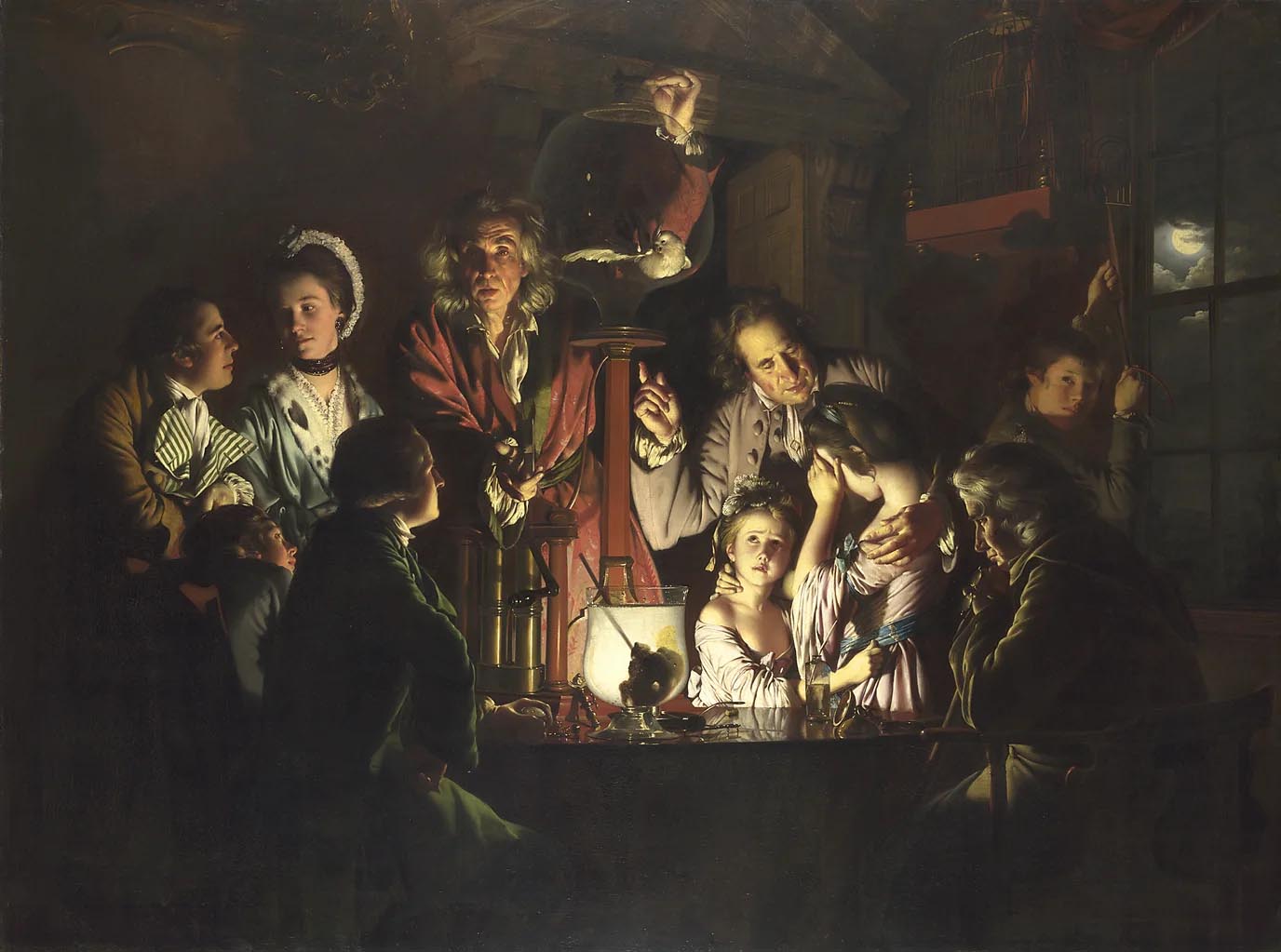
(Credit: The National Gallery, London)
How is this depiction of, essentially, a science experiment “modern”?
First there is Wright's remixing of art historical tradition, taking familiar poses and lighting techniques and repurposing them for a contemporary scene.
This is something that the French poet and critic Charles Baudelaire would declare as a defining feature of modern painting in his essay The Painter of Modern Life in 1863: blending the "ephemeral" changeability of the modern world with the solid, "eternal" qualities of great art from the past. Édouard Manet exemplified this approach in Le Déjeuner sur l'Herbe (1863) which depicted a modern-day picnic but with figures based on Raphael's Renaissance artwork The Judgment of Paris (1510-20).
There is also the second criterion: “the representation of modernisations in society.” We throw a flag on this one as at just about any point in history, a depiction would be “modern” unless looked at from the future. It’s hard to say that anything painted in the 19th century would look “modern.” But then, this is probably why we are not art historians (among infinite other reasons).
At any rate, if art history is your thing, and you are in the London area, check out a new exhibition at the National Gallery in London devoted to Joseph Wright of Derby.
Wild Wild Life
We’re so used to amateur shits ion Instagram and AI slop that we often forget that there are still professional photographers who are more like artists. To that end, we always love checking out the annual winners of the Wildlife Photographer of the Year Award. Via The BBC, this year’s winner is Wim van den Heever, who won with a picture of a hyena standing beside the ruins of an abandoned diamond mining settlement.

Wim van den Heever
The annual exhibition featuring all the winners opened at the Natural History Museum in London on October 17.
Be sure to click through for some other stunning winning images.
In Dis Dress
Sure, AI can help creative people in myriad ways, but as Kate Watts points out in a recent essay in Printmagazine, it lacks soul. Case in point: Coco Chanel.
In 1926, Coco Chanel did something no one expected. She introduced a dress so understated, so stark, that it seemed to reject the era’s obsession with embellishment. The color black, until then, had been reserved for mourning. The silhouette was clean, unadorned, and startlingly modern. Vogue compared it to the Ford Model T, not because it was mechanized, but because it was democratic, accessible, and repeatable.
Even if it had existed then, AI could never have created it.
Chanel wasn’t reacting to market research. She didn’t A/B-test sleeves or iterate toward minimalism based on popular trends. She observed. She felt. She walked the streets of Paris and watched women move—newly working, newly voting, newly aware of themselves in the world. What she designed wasn’t a product of efficiency; it was a product of intuition. She wasn’t trying to impress. She was trying to express.
Is efficiency the be-all and end-all?
Today, we live in a world flooded with generative content. Campaigns that once took weeks can now be assembled in minutes. Copy, imagery, and even entire brand identities can be mocked up, tested, and deployed with the help of AI. It’s impressive. But the more we optimize for speed, the more we risk erasing what gives creativity its power—its soul.
Take as another example the accidental invention of the Post-It Note. In the 1970s, a 3M scientist tried to develop a strong adhesive, accidentally created the opposite: a low-tack glue that could easily be removed and re-attached. A mistake right? But then a colleague realized that the adhesive could be used to temporarily bookmark pages in his hymnal. And thus was born something that virtually every office has.
No algorithm would have arrived at that conclusion. It wouldn’t have pursued the weak adhesive. It wouldn’t have tested for serendipity.
Ultimately:
AI is excellent at making sense of what already works. But it has no instinct for what doesn’t yet exist. AI doesn’t walk the streets. It doesn’t notice mood shifts or cultural undercurrents. And it certainly doesn’t reframe a problem by following a mistake.
Heavy Meddle
As long as there has been media, there has been censorship (or attempted censorship) of it. Via Printmagazine, a new exhibition at the McNay Art Museum in San Antonio looks at print censorship in 19th-century Paris. Called Do Not Meddle with It!!, it was curated by Elizabeth Kathleen Mitchell and uses works from the past to inform the issues we still wrestle with today.
Drawn primarily from the McNay’s collection of works on paper, the exhibition features critical images by Honoré Daumier and Édouard Manet in the context of prints made by their peers and later artists. The latter group includes Pablo Picasso, José Clemente Orozco and José Guadalupe Posada, who were inspired by how artists such as Manet and Daumier dealt with government censorship and used caricature to make protest art. In addition, more recent works by activist artists Guerrilla Girls and Donald Moffett add a contemporary lens to the presentation.
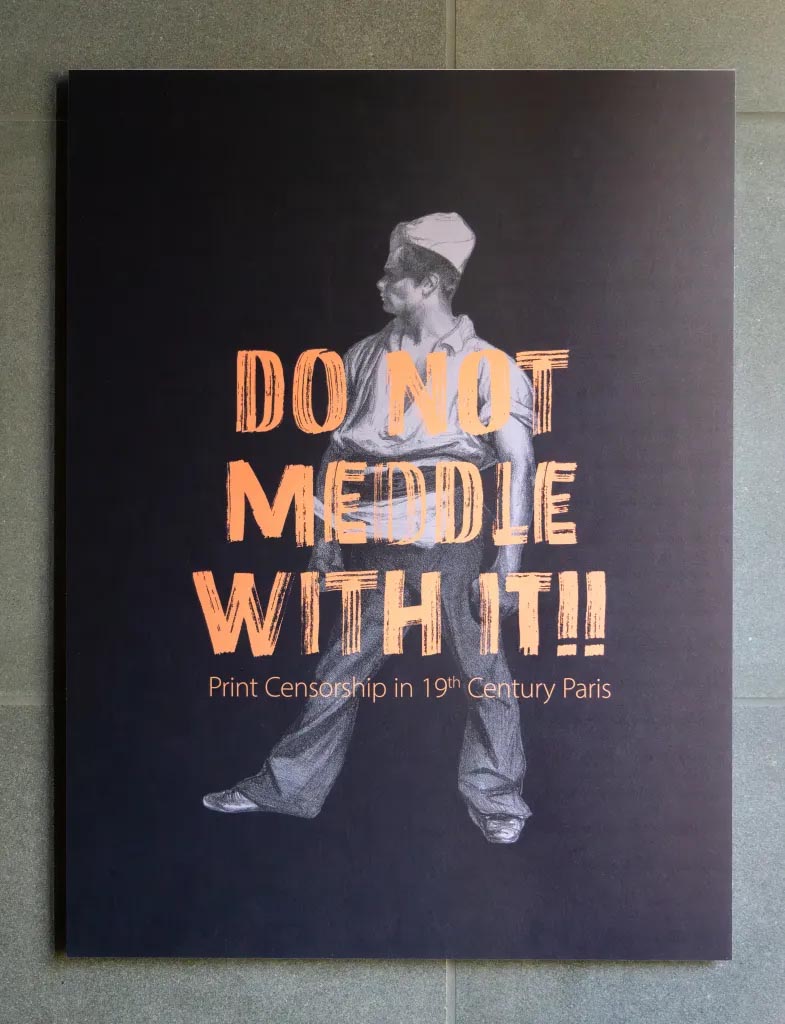
Mitchell talks with Print’s Steven Heller about the exhibition:
I don’t see a lot of difference because today’s artists and cultural critics target many of the same injustices and hypocrisies they did in Daumier’s time, and in similar ways. What feels different is how photography, a 19th-century invention, and now AI, continue to move the line on what we now believe to be visually “real” or factual.
If you are in an Antonio, the exhibition runs through December 7.
Plane Truth
Battery operated aircraft? Is such a thing possible? A start-up called Skydweller Aero thinks so, Via Popular Mechanics, the eponymous Skydweller is an autonomous drone larger than a 747 and featuring a 236-foot wingspan equipped with 17,000 individual solar cells. It’s capable of flying for at least three months non-stop (and we’ve had some flights that seemed that long). It also includes—yikes—1,400 pounds of batteries.
“This is a true, world-changing first in the aerospace industry,” Skydweller Aero CEO Robert Miller said in a press statement at the time. “We are applying cutting-edge, 21st-century materials science, artificial intelligence, and software development to an industry that has spent more than 100 years building piloted, combustion-based aircraft.”
If you are hoping to catch your next flight to PRINTING United on a Skydweller, you’re out of luck.
Skydweller isn’t designed with human passengers in mind. Instead, Skydweller Aero sees its aircraft primarily as a surveillance machine, circling the sky and providing much-needed eyes over conflict zones or other areas of interest. Powered by the Sun, the company estimates that it can stay airborne for at least three months at a time—if not longer.
But it’s hopefully only a matter of time before decarbonization comes to commercial aviation.
Silly String
Remember “string theory”? Sometime in the late 1990s, physicists attempting to come up with a simple, unified “theory of everything” posited string theory as potentially the single, overarching paradigm that describes the universe. It’s an idea whose time has come and gone, so Gizmodo asks, “whatever happened to string theory?”
First of all:
Very broadly speaking, string theory is a mathematical framework that replaces point-like particles with one-dimensional “strings” as the fundamental building blocks of matter. It was initially proposed as an explanation for a different phenomenon but quickly caught the attention of physicists working to unify quantum mechanics and general relativity—two extremely successful, equally valid theories that notoriously don’t get along.
Other scientists took the ball and ran with it, and before long there were “superstring revolutions” that filled in some of the holes in how string theory could indeed explain the universe, and the 1990s and 2000s saw tons of articles, books, and documentaries, including PBS’s The Elegant Universe.
But, as the man said, all things must pass, and soon the string went slack. Or did it? What happened? Gizmodo asked several scientists, and here are a few of their opinions about the fate of string theory.
Daniel Whiteson, a particle physicist at the University of California, Irvine, and the ATLAS Collaboration at CERN, says:
String theory is not dead! The major objection is that its predictions are for things at a microscopic scale that we cannot yet test, so it has not provided a falsifiable prediction. But that doesn’t mean it never will.
John H. Schwarz, a theoretical physicist at the California Institute of Technology, says:
The subject took off [around 1984] and has been very active ever since. The annual string theory conferences are still going strong and typically have several hundred participants. […] A large portion of the theoretical particle physics community is now convinced that we are on the right track to discovering the correct unified theory of our universe (and many naysayers have repented).
On the other hand, Peter Woit, a mathematician and physicist at Columbia University, says:
The idea of string theory as a new fundamental unified theory has been dead for a long time. To simplify a bit, it needs ten space-time dimensions, but we only see four, so you have to get rid of six. Simple scenarios that do this don’t look like the real world; complicated ones can give you almost anything, so predict nothing.
At any rate, click through for the great debate.
Mummy Dearest
Here’s an interesting headline from Gizmodo: “Scientists Recreated the Smell of Ancient Mummies.” The research team was from the University of Ljubljana and the Egyptian Museum of Cairo. And our first question is, what on Earth for?
Smell is ephemeral. Chemically speaking, the molecular structures that cause things to smell eventually decompose. For ancient artifacts, even if the smell is preserved, it’s often overwritten by the various preservatives used to keep the object intact.
How problematic this is really depends on what’s being examined. But it’s certainly an issue for some artifacts or practices “whose purpose was mainly to have a smell, like a perfume flask or incense burner,” said Emma Paolin, a postdoctoral student at the University of Ljubljana in Slovenia specializing in the smell of heritage objects.
That’s a niche specialty, we’ll give it that.
Smell is also known to be closely linked to the parts of our brains that manage our memories and emotions, she added. And so, Paolin and her colleagues—analytical chemists, anthropologists, and museum conservators from Europe and Egypt—set out to get a whiff of an ancient Egyptian process famous for its emphasis on smell: mummification.
And because the team’s research “offer[s] a new window into Ancient Egyptian life, beliefs, and funerary customs,” they are the winner of the 2025 Gizmodo Science Fair for reproducing the smell of mummies.
Way Mo’ Carnage
Here’s a tip for today’s and tomorrow’s leaders: try not to kill anyone. That should be obvious, but maybe it’s not. Via Futurism, Waymo robotaxis have been estimated to be so safe that—at least according to the company’s data—its driverless vehicles are involved in 91% fewer crashes compared to human-operated vehicles. That said, the company is ready (although probably not waiting) for the first driverless car fatality.
And yet the company is bracing for the first time when a Waymo does kill somebody — a moment its CEO says society will accept, in exchange for access to its relatively safer driverless cars.
Will we? Really?
“We really worry as a company about those days,” said Waymo co-CEO Tekedra Mawakana on Monday during TechCrunch‘s Disrupt summit, as reported by SFGate. “You know, we don’t say ‘whether.’ We say ‘when.’ And we plan for them.”
Then again, we as a society accept the current rate of automotive fatalities in exchange for a convenient way of getting around. The idea of course is to make these things safer, be they driverless or driverful.
Still:
And even with its above-average safety record, Waymos have been known to behave in inexplicable ways, such as when one passed a stopped school bus that was unloading kids in Atlanta. That’s a violation that normally garners $1,000 fine and a court hearing, but nothing was issued to the company.
Leaf It Alone
Autumn is here and it is prime leaf-raking season (we are told…). We have vague recollections of having been a child and jumping into piles of raked leaves (although back then most deciduous forests had not yet evolved). But Mental Floss asks something we never thought about way back when: is it safe to do so?
It’s hard to imagine that this iconic pastime could pose any serious threat, but there are actually some risks involved for both children and adults. Below, we’ll go over some of the biggest concerns around jumping in leaf piles and what you can do to be as safe as possible while soaking up the autumn season.
They identify the potential for various creatures to be secreted within the leaves—specifically ticks, and especially due to the dramatic increase in tick populations due to climate change, especially in the Northeast. And of course the biggest danger from ticks is Lyme disease. But you can leap unto the leaves in a tick-safe manner:
Firstly, cover as much skin as possible by tucking your pants into your socks and your sleeves into gloves. It’s also a good idea to put on tick repellent. In addition, it’s ideal to wait until temperatures have dropped below 40°F, as that’s when ticks enter semi-hibernation. And of course, always perform a thorough tick check once you get inside.
There could also be spiders, snakes, and other critters lurking beneath the leaves. Also be cognizant of what kind of surface is under the leaf pile. If the leaves have been raked onto the driveway or other hard surface, the leaping will not be much fun.
At any rate, this Public Service Announcement has been provided courtesy of Around the Web.
Foodcation
Have you ever chosen a vacation destination solely because of food? If you, you are ahead of your time, as that has become a trend among younger people: so-called “foodcations.” Says (who else?) Food & Wine:
A new survey of 2,000 Americans, commissioned by Visit Anaheim and conducted by Talker Research, revealed that one in five respondents — 21% — has taken a trip solely for food. The survey also found that, on average, individuals spent $910 on their most recent "foodcation" and said they'd be willing to spend around $1,929 if a trip included the chance to eat something they’d really been wanting to try, like sushi in Tokyo.
So where is the number one foodcation destination?
The most-desired "foodcation" is a trip to Philadelphia, Pennsylvania, for an authentic Philly cheesesteak
Having been to Philadelphia many times, we are not fans of cheesesteak. Independence Hall, the Liberty Bell, the US Mint, and South Street were of more interest. A close number two is New York City:
That was followed very closely by people who are dying to head to New York City for a slice of New York-style pizza (27%).
They could at least take in a show while they were there.