Signs of the Times, Part the Continuing: Lost In Berlin
Type designers can be inspired by the strangest (or even most prosaic) things. Such as, for example, wayfinding signage. Via Print magazine, designer Federico Parra Barrios moved from Bogotá to Berlin in 2024, and became so enamored of the embossed metal plaques that comprise Berlin’s wayfinding system, that he created a font based on them.
Distortion was the inspiration and starting point for Barrios’ research, both in the embossing (which contorts both the underlying material and the applied forms) and the use of horizontal space (the compression of extra-long words). So, he began exploring what happens when you force a standard-width typeface into a highly condensed version.

Out of this experimentation comes Lost, a variable-width font, from the Normal style (standard width), to the Compressed style (super condensed). Amidst the narrowing, you can see the forms evolve: stems become thinner, while some connection points get thicker and rounder. Barrios also created a system of frames (round, straight, or pointed terminals, accessed in Stylistic Sets) that create a vintage cartouche effect around words.
Catty Comments
Whilst today’s Internet is chock full of cat memes (although we mercifully haven’t seen that many lately, unless AI is working on it), cat memes have always been with us. (In the 1970s, B. Kliban’s cat cartoonswere everywhere.) But even as long ago as Victorian England, cat cartoons were all the rage—specifically, those of illustrator Louis Wain, whose animal cartoons dominated the period’s magazines, children’s books, and postcards. Via Atlas Obscura, Wain was born in London in 1860, attended the West London School of Art, and soon became a freelance illustrator. He and his wife (who sadly passed away from cancer three years after their wedding) owned a cat named Peter, and Peter often became the subject of Wain’s illustrations. And cats would soon come to define his artwork.
Wain’s cat drawings began as sober, realistic affairs but his specialty became creatures that walk on hind legs, grin with wide mouths, wear clothes, celebrate Christmas, play golf and drink cocktails. They’re cute, but also sort of sinister; they glare and wink, their tongues loll, they get up to mischief. Wain’s work was hugely popular, as he illustrated hundreds of children’s books, and during a stint in New York City, drew newspaper cartoon strips. Among his celebrity fans were H.G. Wells, the celebrated science fiction author.
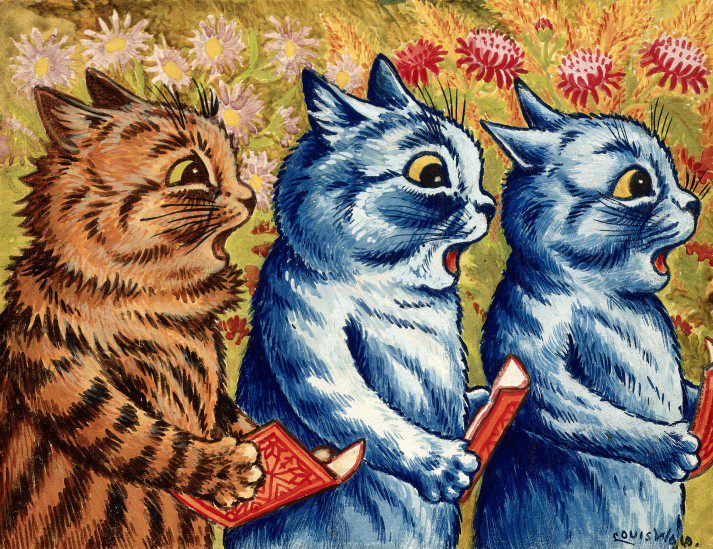
By the early 1900s, Wain began having mental health issues, was certified insane, and was committed to the Springfield Mental Hospital in London. He would spend the rest of his life in various institutions until his death in 1939. People began scanning his art—specifically, eight of his cat drawings, which range from cuddly to psychedelic and are known as the “Famous Series”—and used it as evidence of his deteriorating mind. The truth, though, is a bit more complicated.
Dr. Walter Maclay was a psychiatrist who had a thing for art created by psychiatric patients (he also liked to experiment with mescaline) and, believing art was a reflection of a patient’s mind, he curated the Guttman-Maclay Collection of psychiatric art. Wain would become Maclay’s “poster child” and he featured Wain’s illustrations as “the illustrated decline of an artist.
In the 1960s, a writer named Rodney Dale discovered the works of Wain and began to investigate what little info there was of his life. His research led to the biography Louis Wain: The Man Who Drew Cats, published in 1968 and which challenged the notion that Wain’s art was reflective of his declining mental health and instead suggested alternative explanations for Wain’s change in illustrative style—namely, his interest in wallpaper design.
More recently, a more expansive view of Wain away from “mental patient” has been gaining currency. In 2012, psychiatrist David O’Flynn gave a gallery talk as part of a Wain exhibition, and declared that the paintings were essentially the work of two men—the artist who created them and the doctor who assembled them and lent them new meaning. But the exact, detailed artworks can hardly be seen as the work of “a man who’s losing his ability to draw or create at all” O’Flynn points out.
Clippy
It’s not the crown jewels, but, hey, it’s not nothing: an impressive paper clip collection has finally found a new home. Via Boing Boing, the owners of London stationery supply store Present & Correct are now the proud owners of David Walker’s paper clips.
David Walker has been collecting paper clips from around the world for much of his life. He recently moved into a new home & his daughter has been sorting through his belongings. His clip collection couldn't make the move but was kindly donated to us. It was such a lovely thing to receive in the post, and document. You know we love a clip!
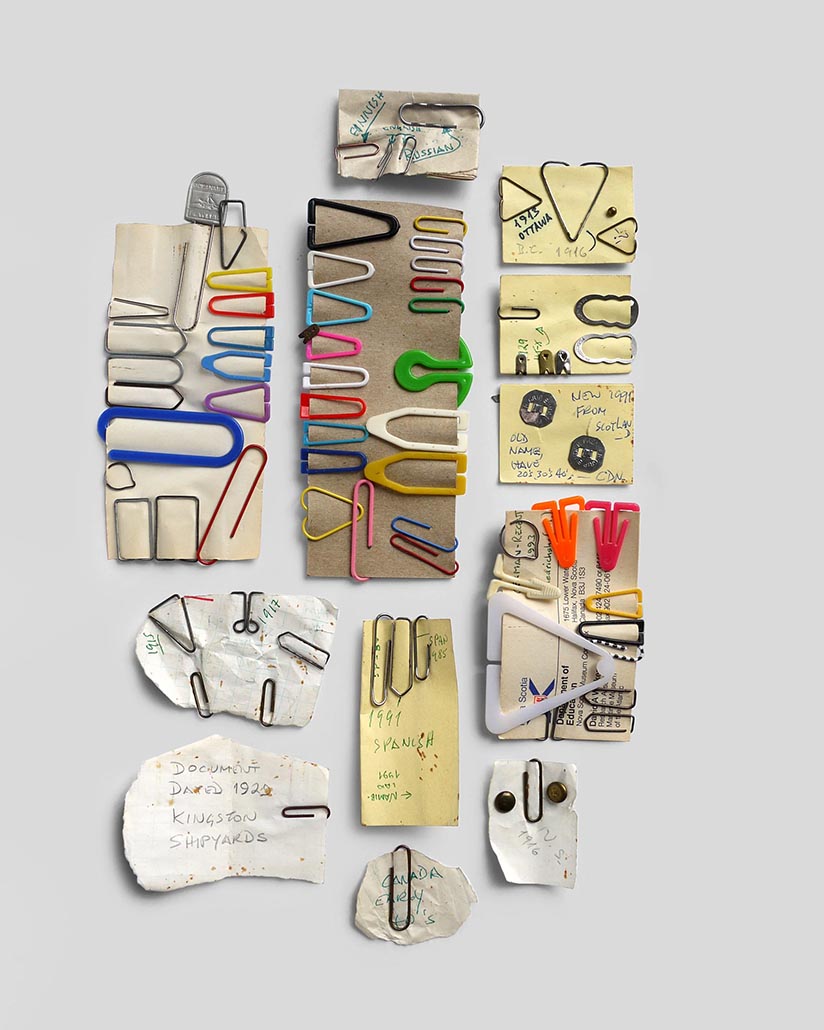

The annotation is beautiful, the locations of discovery and the overall aesthetic of the collation on cards and scraps of paper make us very happy indeed. They will be treasured.
Boxed In
Do you worry about—or have you been the victim of—package theft? If so, this anti-package-theft mailbox from Stonemore may be for you. Says Core77:
Boxy and made of powder-coated steel, they're meant to be anchored through the base to a concrete pad. Up top is a letter slot. Below that is a package door, behind which is a hinged floor that drops your package into the compartment below.

Packages too big to fit through the hinged opening can instead be inserted directly into the compartment below, (if you're willing to give your carrier a key or the code). To retrieve your mail or packages, there's a full-length locked door on the back of the unit.
A—ahem—steal at $430 for the Hudson model. There is also a less-expensive $300 Cali model.
Saved!
If you’re like us—and we know we are—you have boxes full of old media (floppies! Zip Disks! SyQuest cartridges!) that are unreadable by any current technology. If you need to retrieve anything on these legacy media, you may be stuck, although if you are near the Museum of Printing Frank probably has something that will read it.
But at Cambridge University in the UK, a project is underway to rescue what could very well be valuable material from old, outdated media. Via Good News Network:
The initiative began when the archive received a box of 5.25-inch floppy disks from a DOS-formatted computer that belonged to none other than physicist Steven Hawking, who was able to use early computers despite his disability from ALS.
OK, those could have some good stuff on them. So a group of archivists launched an initiative called “Future Nostalgia.” Because the problem isn’t so much finding hardware that will read the media, but software that can read what is on it, as they were all formatted for different computers, OSes, and even individual programs. What can read old WordPerfect documents? Or anything written with a Diamond Word Processor?
That means that as many as a dozen different early computing systems are needed to read the full spectrum of floppy disk formats, and it’s not always straight forward finding these machines.
Nor is it straightforward that the disks themselves are readable. They may be moldy, if stowed away in an attic for example. Iron oxide on the surface of the plastic may corrode material away. It can also lose its magnetism, preventing it being from read entirely.
That is why Talboom and her team are urgently trying to acquire collections of noteworthy writers or authors—like Hawking—and further digitize them from their early floppy disk format. So far, in addition to Hawking, they’ve uncovered abstract lists by the poet Nicholas Moore, articles from a society of the paranormal, and more.
Kind of makes you admire print more and more, doesn’t it?
AI-Yi-Yi, Part the Infinity: I’ll Be…Somewhere For You
For reasons passing understanding, someone decided to have AI recreate an episode of Friends—and while we have no intention of watching it (heck, we never much cared for the original) it is by all accounts intensely cringe-inducing. Says Futurism:
While the set appears to be largely recognizable, the cast members bear almost no resemblance to the show’s actual human actors.
Performers also sprout random limbs, their hands teleport through doors, and at one point, towards the end of the video, one sloppified cast member mysteriously sheds a clone of herself, who immediately takes a seat on a nearby couch.
We’re not sure why any of this is necessary.
“This must be amazing if you’re not really into the whole ‘jokes’ or ‘storyline’ aspects of sitcoms, and the thing you like about TV is just seeing all the colours and shapes moving around,” one user joked.
Then again, AI had nothing to do with My Mother the Car, so there’s that.
Signs of the Times, Part the Ongoing: Signtertainment
We’re not big fans of Reddit, let alone sub-reddits, but via Boing Boing one that we may want to check out is Funny Signs, a collection of weird and usual signage spotted in the wild.
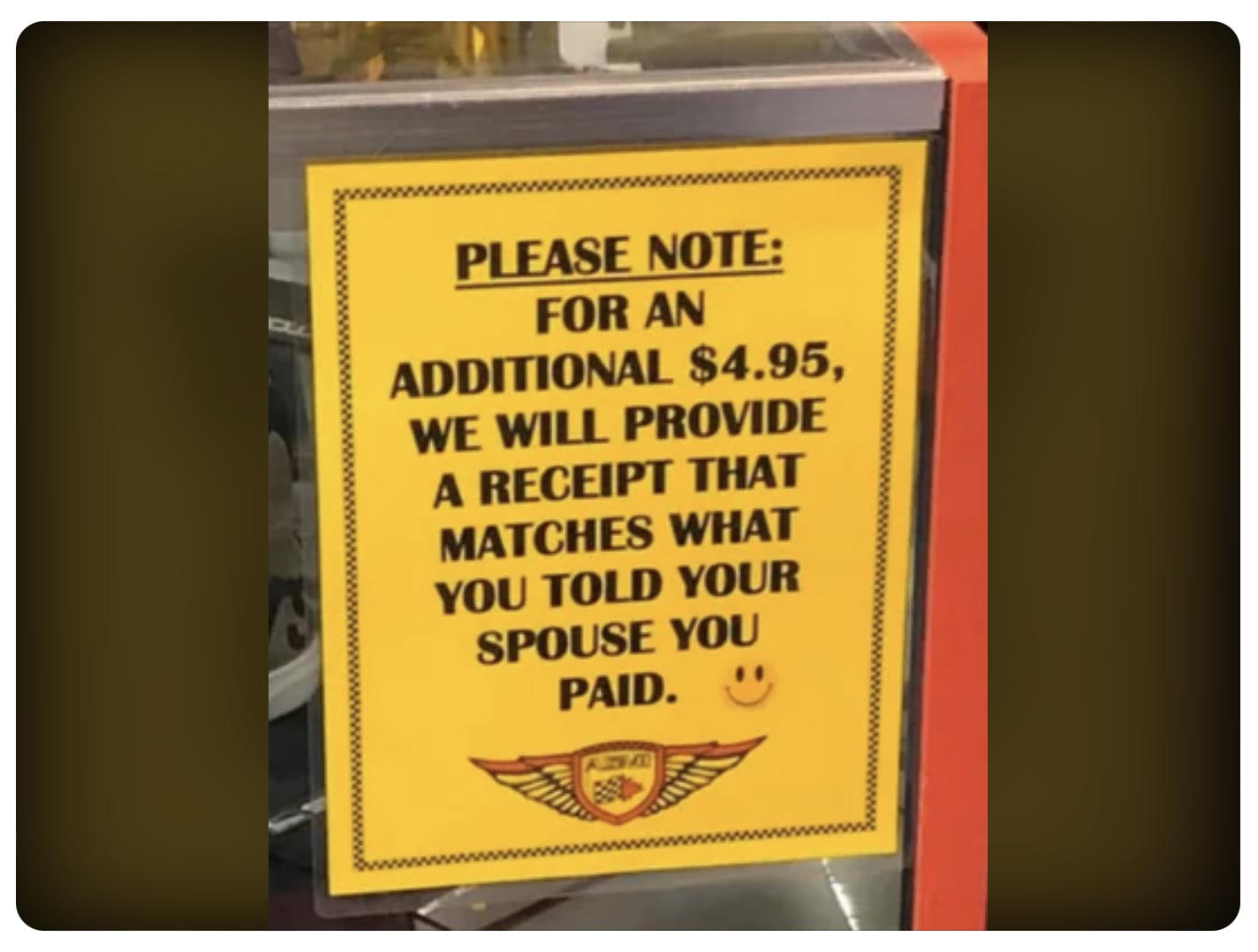
Hours Minutes of amusement!
Dino Sore
Sure, why not? Via Futurism:
AI-powered dinosaurs are coming, pumped out by robotics companies looking to drum up a little prehistoric spectacle.
The firms involved both hail from China, the world heavyweight in robotics production. Within the last few weeks, the companies LimX Dynamics and Yuejiang Technology Co (Dobot) have both launched AI-powered robot dinosaur platforms, though with different approaches.
Robot dinosaur platforms. OK.
Dobot calls its version the Sinosauropteryx, named after the feathered, bipedal carnivore first uncovered by Chinese farmers in 1996. The robotic version, according to the South China Morning Post, features bipedal locomotion, optical sensors, and pre-programmed motion-controls.
Unembeddable video here.
After the Flood
When we think of the word “flood,” we usually think of water. But in fact there are other fluids—some quite viscous—that caused floods, some quite serious and fatal. Boing Boing has a round-up of some of the most notable “non-water floods” in history.
There is the infamous Great Molasses Flood that killed 21 people in Boston, Mass., in 1919. It happened when a storage tank containing 2.3 million gallons of molasses burst—and the flood of molasses tore through the streets at a surprising 35 miles per hour. Yikes.
Then there was the Wisconsin Butter Flood that comprised a combination massive fire and flood in 1991 at a large processed meat and dairy storage facility in Madison, Wis. The fire lasted for eight days—miraculously causing no fatalities but millions of dollars in damages.
Due to the thick, fatty pool of dairy, ladder trucks could not effectively enter and leave the area, nor could fuel trucks enter to refill the ladder trucks' gas tanks.
Other non-water floods on the list include the London Beer Flood of 1814, the Dublin Whiskey Fire of 1875, the Rockwood & Company shipping department fire in New York City in 1919 (causing a flood of molten chocolate and butter), the Pepsi fruit juice flood of 2017 in Russia, and more.
Non-water floods are extremely rare compared to floods involving water. Cleanup from non-water floods can often take years, and pose many risks for workers. If you're bored of your current anxieties and need a new unlikely thing to feel anxious about, hopefully this topic will be of use to you.
Graphene Brings the Heat
Was it a good week for graphene news? It’s always a good week for graphene news! Graphene heat-transfer fluid. From (who else?) Graphene-Info:
The patented graphene-enhanced fluid extends Haydale’s HDPlas® plasma-functionalization technology into the multi-billion-pound global cooling and thermal-management market, directly addressing one of the most critical physical constraints on modern computing and digital-infrastructure growth: heat dissipation.
… With JustHeat and now its graphene-enhanced heat-transfer fluid, Haydale has established the two core pillars of its commercial platform - heating and cooling - each built on its scalable HDPlas® technology. As compute loads surge and energy efficiency becomes a global priority, Haydale's fluid enters the market at a time when demand for energy-efficient cooling is increasing.
Cool.
Around the Webb, Part the Ongoing: Mooning
What has the James Webb Space Telescope found now? A new moon of Uranus! Says Scientific American:
The research team that made the discovery estimates that the moon, dubbed S/2025 U1 for now (at least, until the International Astronomical Union assigns an official name), is just 10 kilometers, or six miles, across, making it particularly small. “I could walk around this moon,” says Heidi Hammel, a planetary scientist and astrophysicist, who was not involved in the research.
Technically you could walk around any moon if you had the time. But, regardless, this brings Uranus’ moon count to 29.
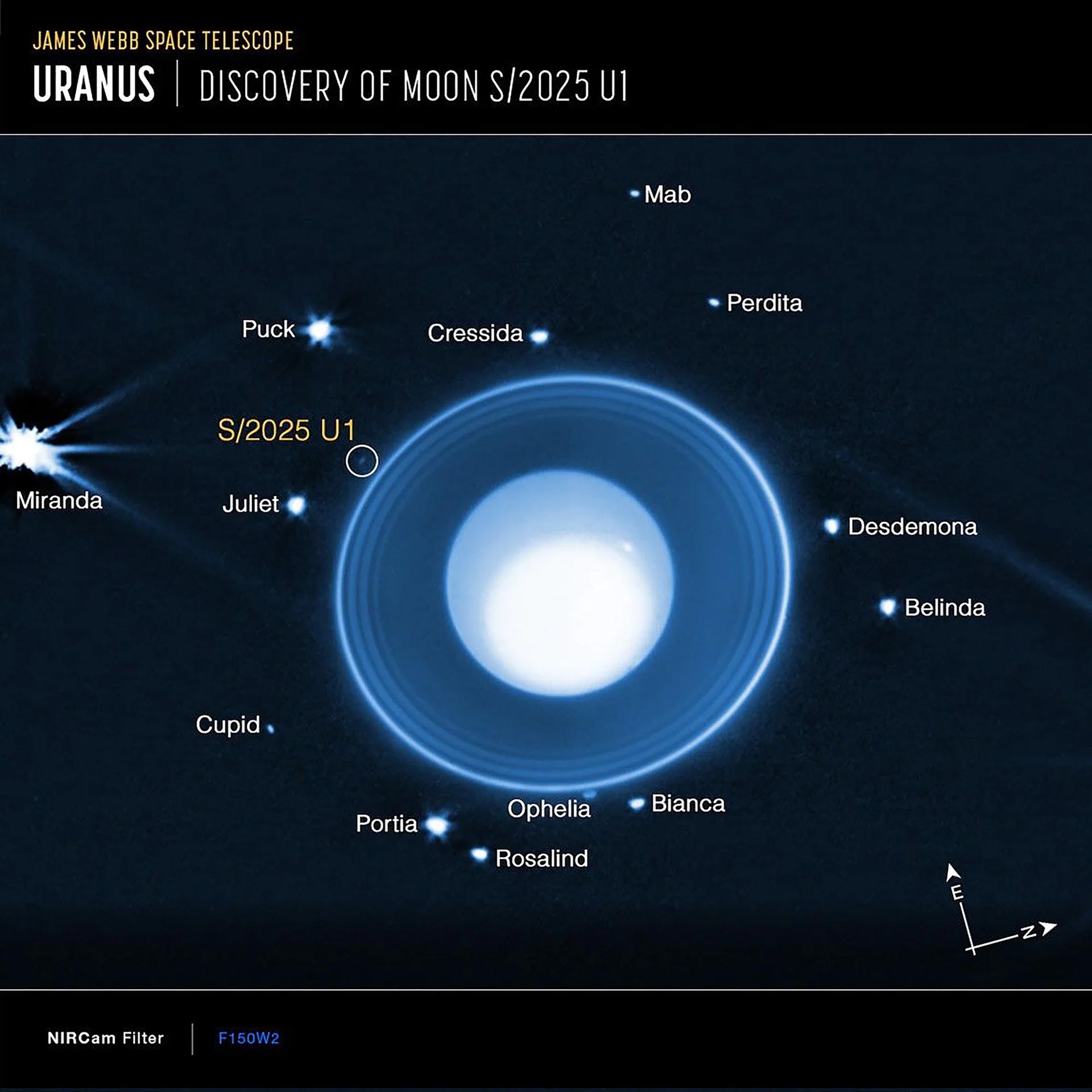
Caption from SciAm: Astronomers using NASA’s James Webb Space Telescope discovered a new moon orbiting Uranus in images taken by Webb’s NIRCam (Near-Infrared Camera). This composite image shows the moon, designated S/2025 U1, as well as 13 of the 28 other known moons orbiting the planet. NASA, ESA, CSA, STScI, M. El Moutamid (SwRI), M. Hedman (University of Idaho)
“One of the reasons this moon is interesting is that it’s very close to the main ring system,” Hammel says. Unlike Saturn’s rings, which are packed together, Uranus’s rings are more like Hula-Hoops, with lots of separation between each. The rings cluster between a main inner system and a faint outer one, Hammel says, and researchers speculate that the rings are sculpted by the planet’s little orbiting moons.
The things we can do.
Turkey Pants
Are you hosting Thanksgiving this year? Eager to look like a complete snickerdoodle? If so, be sure to pick up a pair of Butterball “Thanksgiving Hosting Pants.” Says (who else?) Food & Wine:
Butterball has partnered with chef apparel brand Hedley & Bennett to create a practical and suitable Turkey Day uniform — and these Thanksgiving Hosting Pants are designed to assist home chefs during this busy holiday. Each pair features six thoughtful details to make cooking easier, including dedicated thermometer pockets and loops for kitchen tools.
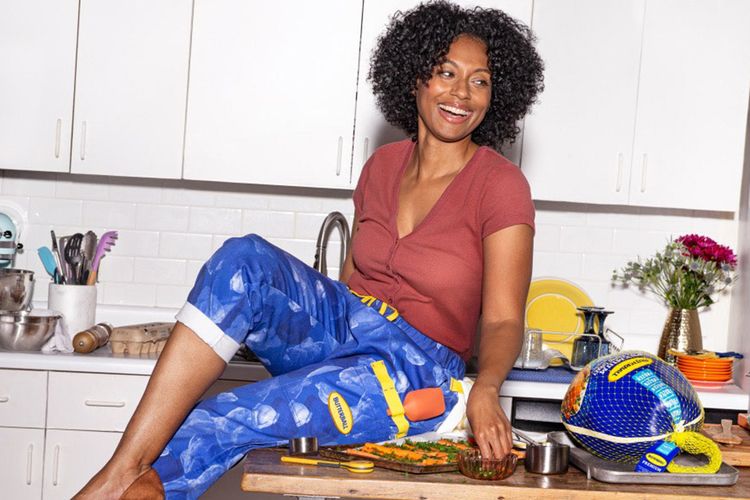
A dedicated pocket holds a meat thermometer, which is Butterball’s top-recommended tool for the big day.
We just keep that jabbed in our thigh all day. Is that weird?
(And of course, there’s also a phone pocket to consult the Turkey Talk-Line’s help at a moment’s notice.) Meanwhile, towel and utensil loops keep the most-used tools within easy reach, while a bottle opener ensures holiday drinks stay flowing. To finish it all off on a personalized note, Butterball says cheeky, pun-forward iron-on patches for a fun, playful touch.
And of course the Butterball Hotline always evokes memories of the classic scene from The West Wing:
This Week in Printing, Publishing, and Media History
November 10
1728: Irish novelist, playwright and poet Oliver Goldsmith born.
1947: English singer-songwriter, guitarist, and producer Greg Lake born.
1969: National Educational Television (the predecessor to the Public Broadcasting Service) in the United States debuts Sesame Street.
1983: Microsoft introduces Windows 1.0.
November 11
1675: Gottfried Leibniz demonstrates integral calculus for the first time to find the area under the graph of y = ƒ(x).
1821: Russian novelist, short story writer, essayist, and philosopher Fyodor Dostoyevsky born.
1855: Danish philosopher, author, and poet Søren Kierkegaard dies (b. 1813).
1922: American novelist, short story writer, and essayist Kurt Vonnegut born.
November 12
1945: Canadian singer-songwriter, guitarist, and producer Neil Young born.
1980: The NASA space probe Voyager I makes its closest approach to Saturn and takes the first images of its rings.
1990: Tim Berners-Lee publishes a formal proposal for the World Wide Web.
November 13
1850: Scottish novelist, poet, and essayist Robert Louis Stevenson born.
November 14
1840: French painter Claude Monet born.
1851: Herman Melville’s novel Moby-Dick is published in the U.S.
1889: Pioneering female journalist Nellie Bly (aka Elizabeth Cochrane) begins a successful attempt to travel around the world in less than 80 days. She completes the trip in 72 days.
1916: American screenwriter and producer Sherwood Schwartz born.
1922: The British Broadcasting Company begins radio service in the United Kingdom.
1952: The first regular UK Singles Chart is published by the New Musical Express.
1967: American physicist Theodore Maiman is given a patent for his ruby laser systems, the world’s first laser.
November 15
1926: The NBC radio network launches with 24 stations.
1968: The Cleveland Transit System becomes the first transit system in the western hemisphere to provide direct rapid transit service from a city's downtown to its major airport.
1971: Intel releases the world’s first commercial single-chip microprocessor, the 4004.
November 16
534: Justinian I, who was an Eastern Roman (Byzantine) emperor in Constantinople, approves and publishes the second and final revision of the Codex Justinianus.
1889: American director, producer, and playwright George S. Kaufman born.
1904: English engineer John Ambrose Fleming receives a patent for the thermionic valve (aka the vacuum tube).
1914: The Federal Reserve Bank of the United States officially opens.
1938: LSD is first synthesized by Albert Hofmann from ergotamine at the Sandoz Laboratories in Basel.