(This article originally appeared on WhatTheyThink.)
Background
In consumer product industries there is a constant pressure to get to market faster. This creates a lot of primary and supporting challenges across the supply chain. For example, when you want to go faster, how do you keep the process high-quality and on a high compliance level? How can you do things faster with people who are not very skilled? Additionally, with the shifting markets, products and packaging changes are going increase. On a global scale, we are seeing new markets emerging for packaging, so we have challenges, but also opportunities. This is a perfect storm for the introduction of intelligent supply chain automation. The real goal is to accelerate packaging creation and update production processes in an environment where sustainability and skilled labor are becoming more of an issue.
The Issues
Today, we hear that the average time to market can be anywhere from four to six months. As a result of the shifting and growing markets, consumer product companies are now looking for ways to reduce that to as little as two months—or even two weeks. Ultimately, the people who are buying packaging or sponsoring the product launch have an aspiration. The entire process needs to go faster. What are the constraints? Where are the challenges? Is it the content on the box or label? Is it a shape issue? How much time do I have to put into those selections or the process as a whole if there are really only a finite number of shapes and options?
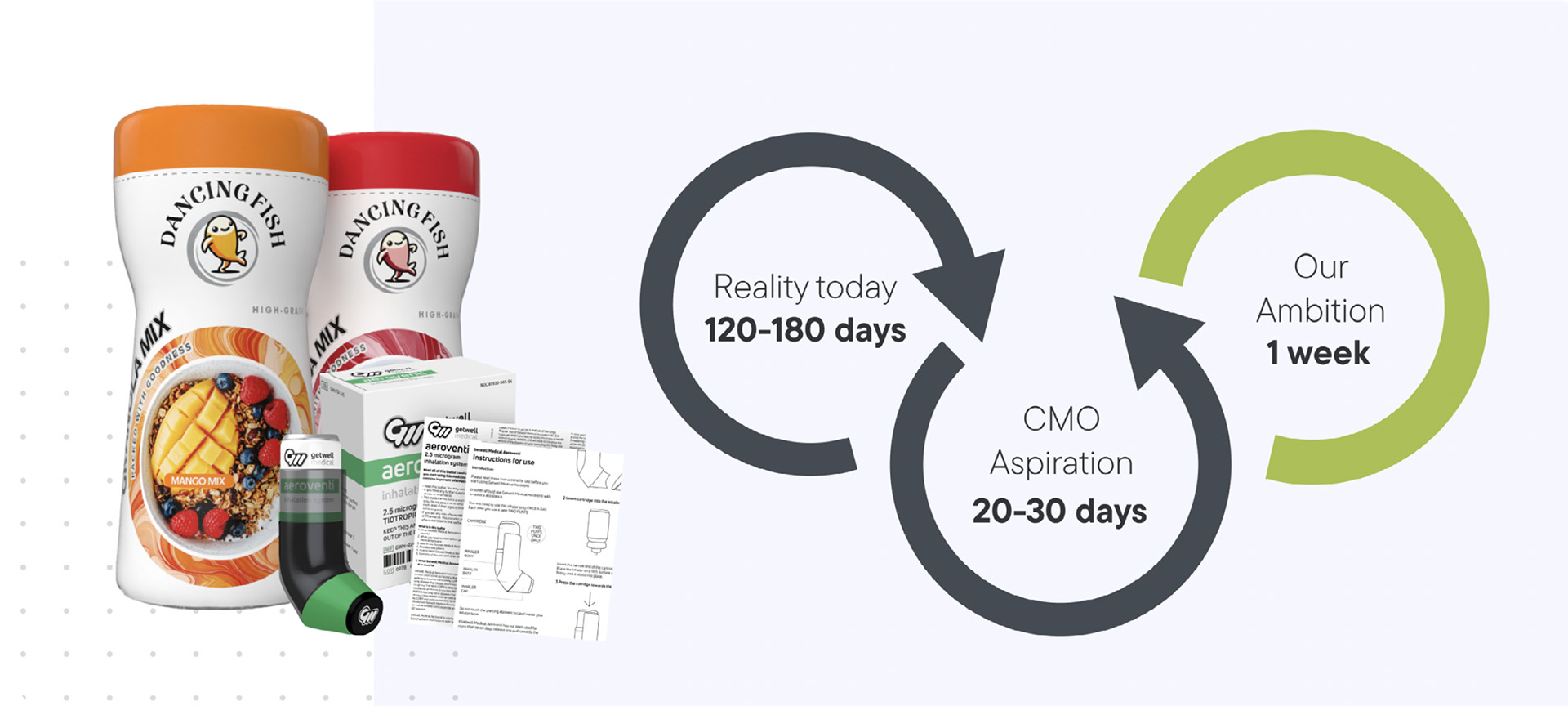
For production, if it is a new die there is undoubtedly a time penalty. If you don’t use a die and use a laser instead, it could be done in two or three days, although today that is primarily a solution for short runs. These types of decisions are changing with market and technology developments.
One of the main constraints is that we are talking about a fairly conservative industry. It really becomes an issue of risk measurement, and then procurement. This is probably not going to change with technology—ultimately we are still dealing with people. However, it is about connecting with the customer, so what decisions and tools can be used to solidify that connection and the FMOT (first moment of truth)? You can still bring your communication and connect to the consumer without really changing or challenging the manufacturing constraints too much. But how do we bring that level of understanding and knowledge upstream and throughout the value chain?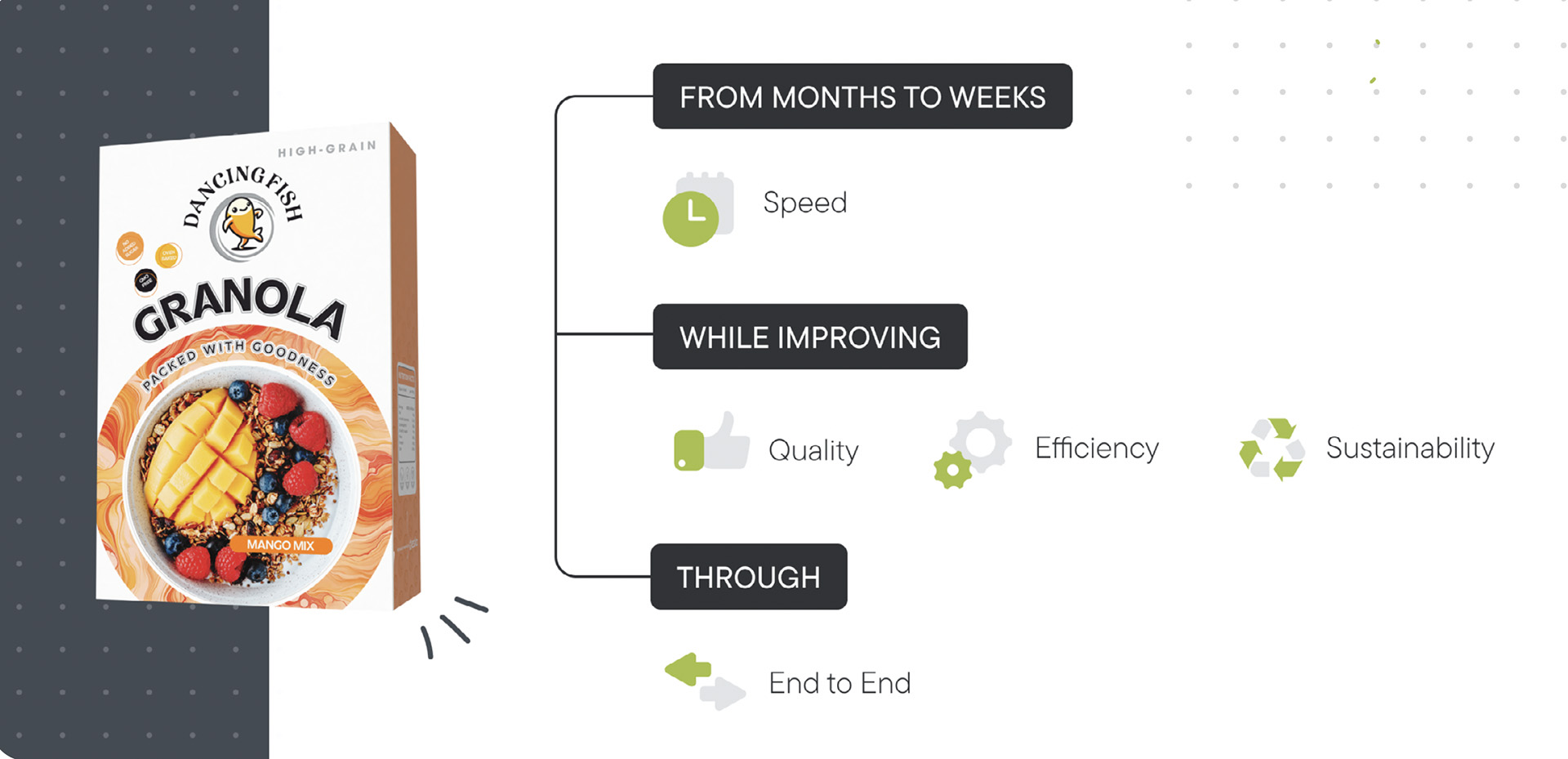
This type of decision making is happening all the time and ESKO had to start thinking about how to connect all these pieces together with a platform—a modern platform. How can you help the people to make those decisions earlier, while they’re aware of the risk, but also meet their demand? Ultimately the decision becomes: I’m OK to compromise these constraints. Can you go faster? The way that you look at the industry challenges has to be from an end-to-end process perspective. The solution needs to evolve as a maturity process, including technology and people’s maturity.How do you drive that with innovation, tools, software, hardware in that journey where every day is a new day.
Organize and optimize, and once your direction and foundations are clear, then you can start thinking about solutions and can even begin to take some people out of the process. While improving, we need to recognize that this is a very conservative industry which needs speed, predictability, quality, and standards compliance, while keeping cost under control without compromising. Add to that both environmental and social sustainability, a moving target as one of the other dynamics. Through all of this we need to educate the industry and bring the information and the knowledge there. That’s how ESKO sees their S2 platform and end-to-end process as piece of the story.
S2 Brings It All Together
With S2 and their historic and future innovation and software implementation, ESKO believes this is where they need to help the product and packaging supply chain evolve and mature. Like many other solutions providers, they focused on automation, but in last five years, they see that automation and the intelligence are coming together. So that’s why they started combining that automation and intelligence together in their roadmap and innovation, and as time goes on you will see this goes hand in hand. Automation and intelligence are coming together. The intelligence is come coming from what we know already as an industry, and ESKO and other solution providers are starting to move in that same direction.
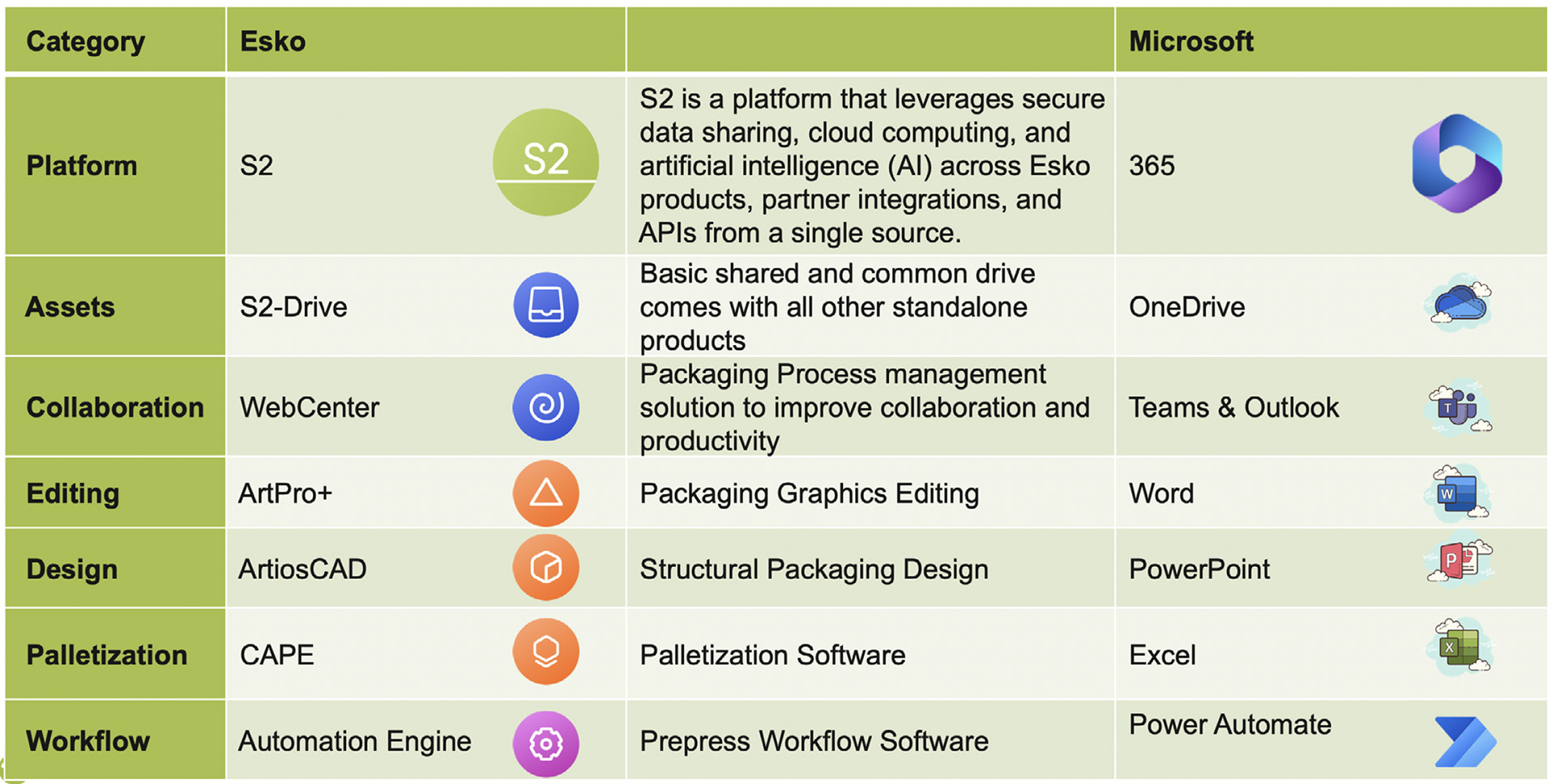
They chose to name their platform S2 to reflect what their customers are looking for. They are looking for sustainability for their business, including sustainable profitable growth and environmental sustainability. Those are the two hottest themes in the industry today. In the diagram above, they attempt to compare the Microsoft 365 model of collaboration and tools to their S2 structure. However, I think the comparison sells their solution short.
So how do you bring all these different domains in the product and packaging supply chain together using automation and intelligence? ESKO has been developing and automating tools for each of the process domains for decades. For example they target design with ArtPRo+, structure with ArtiosCAD, workflow automation through Automation Engine, etc. They have also been collecting data and facilitating the use of that data through WebCenter. So the S2 platform is where all these domains come together integrating and sharing information, but there is another tool that will be collecting, analyzing and sharing intelligence behind it, which is the S2-drive.
Intelligence and Data Standardization
To truly take advantage of Agentic AI and achieve complete automation, you need to have enough information to analyze. The more information you have, the better the quality of the analysis will be. Without that volume of historic data, there is little value in trying to use it for automation, although it might have some value in supplying it to a skilled individual to evaluate in a dashboard. We also know that data structure is also critical. However, most of what we have today are tribal standards which are implemented by a single customer or process domain. But for this to work for the industry as a whole, you need to have a standardized level of structure and the ability to translate centralized data which can be referenced, used, and then linking multiple standards and custom logic to build analysis. You also need an API-first type of architecture, since in a supply chain there are dozens of partners and customers using multiple different disparate systems, which they all need to connect together to share data.
Today, ESKO is one of only a few companies in the print and product packaging industry that have a long history of customer job and operation data to begin to pull this together. Some of the others include HP and Heidelberg. Each of them are now beginning to use some of that information to build intelligent systems. However, a lot of that captured information, even though it is housed in a central SaaS repository, it is still somewhat tribal in nature. So how do we, as an industry, begin to create and share that standardized structure and translation?
First, let’s talk about sharing. Most companies, whether brands, producers, or those as a part of the supply chain, are usually reluctant to share much of their proprietary development or production information. However, once the product comes to market, it is available for almost anyone to analyze. ESKO has been discussing this with some of their WebCenter customer base of brands and producers. They are explaining the controls and benefits of sharing some of this development and production information in order to bring intelligence to each of their own respective processes. The indications are that they are very interested once they fully understand the full scope and process.
Next, even if/when they do share, how to ensure that the information is in a standardized structure? If all of the information is in tribal form, it would be difficult to map it between sources. This goes beyond the data formats like XML, JSON, etc., because we are now looking for content structure and alignment. Standardizing classification of print and packaging applications and processes is essential for machine learning (ML) and process data collection and the use of AI to support future growth and intelligent supply chains. The good news is that the Unified Printing Taxonomy was created to provide a real-world taxonomy that not only represents the industry today, but is structured to evolve as the print industry continues to expand, and it addresses product intent as well. The structure allows classifications to cross over into adjacent application spaces, an important issue as printing systems can now be utilized for applications they were not originally intended to address. Additionally, standards like, Process Steps, developed by the GWG and JDF/JMF developed by CIP4, can provide standardized content definitions for processing. Now the real issues is adoption across the various supply chain domains.
ESKO correctly believes that AI-driven packaging, where AI can do a very meaningful job using very specialized agents, is possible. These could include AI agents that could be used to find a similar design brief. So if you’re thinking about something, you can query it to detect from an existing previous job. The same goes for structure, art, production, etc. From there, it can go to the respective database to find a match, a near match if it can’t find exact matches, and can suggest something similar through pattern recognition and translate that into a potentially useable package design and creation plan. The same concept could be used for other areas in concept, design, and production if the historic data is structured and available. But the fundamental thing is that all of the domains need to share, then you will have a future value. Because AI cannot work without data.
There can be multiple agents for each of the processes, like about how to create a good brief, or how do you assemble artwork, or find a compatible structure? Once you understand the product intent, you can not only automate the processes, you can also automate quality control and compliance. The idea is, you take a file and then you run it through an engine and based on the rules and guidelines of the product intent that you specified. As this begins to come together in practice, it can continue to train and understand all those kind of dynamics.
Product Manufacturing Component
This concept is needed across the entire supply chain and Veralto, the holding company of ESKO, recently purchased TraceGains to further their reach. TraceGains is a leading provider of cloud-based supply chain management software, focused primarily on the food and beverage industry and consumer packaged goods (CPG) companies. It enables companies to increase supply chain agility, improve quality and compliance, and accelerate new product development through its advanced networked platform.
TraceGains delivers solutions for supplier compliance, quality management, and product development, helping brands collaborate efficiently across supply chains. It offers a collaborative platform that connects thousands of suppliers and brands, enabling instant sharing of critical documentation and information essential for meeting regulatory standards. They offer a unique Networked Ingredients Marketplace, supporting rapid data exchange, supplier collaboration, and efficient procurement. They also manage ingredient documents, supplier audits, incident tracking, and risk management to ensure food safety and regulatory compliance. This is in addition to solutions that are used for digitizing workflows, automating compliance, and driving fast go-to-market velocity for new products.
In Summary
Packaging supply chain automation using AI is not only possible, ESKO is one company that has a plan as developing against that to ensure that it happens.
More to Come…
I would like to address your interests and concerns in future articles as it relates to the manufacturing of Print, Packaging, and Labels, and how, if at all, it drives future workflows including “Industry 4.0 and 5.0.” If you have any interesting examples of hybrid and bespoke manufacturing, I am very anxious to hear about them as well. Please feel free to contact me at [email protected] with any questions, suggestions, or examples of interesting applications.