(Be sure to watch David Zwang’s webinar “Intelligent Automation Reality Check.”)
Background
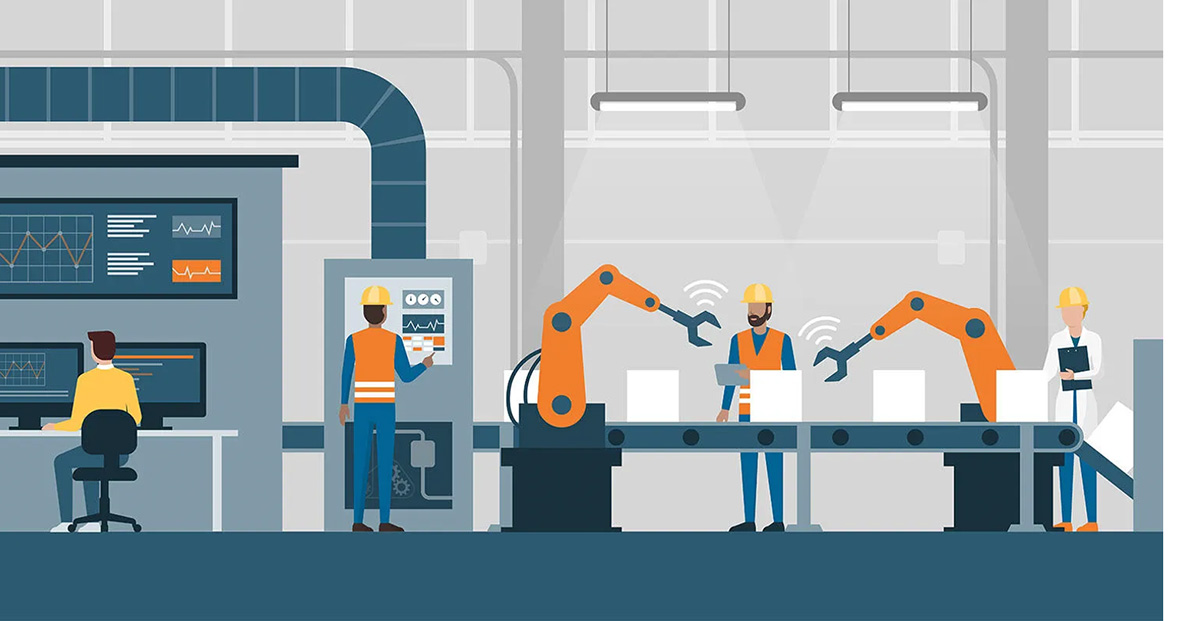
As we move from Industry 4.0, where cloud communications and data sourcing are fairly common place, to Industry 5.0 where we use that platform to build distributed value chains, remote production and cyber physical systems, there has naturally been a lot of discussion around artificial intelligence (AI). Surely there are areas where AI can offer some benefits to the print supply chain today and even more so tomorrow. However, there are so many different types of print applications and the supply chains for each of those applications can be very different as well. Much of that benefit will be dependent on the growth of machine learning (ML) data and any new demands of the print applications.
Demand
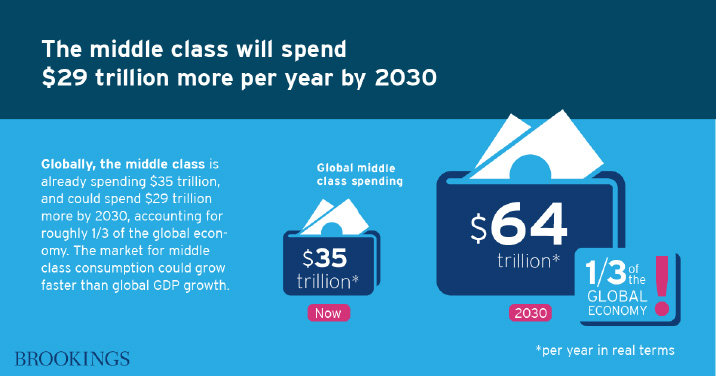
There are a lot of headwinds out there right now. However, history has taught us that this too will pass. Print and especially packaging will continue to grow as long as there is economic growth. The last decade has seen a record expansion of consumerism with current spending at annual growth rate of about $35 trillion per year, and projected to reach about $64 trillion by 2030 according to Brookings. That growth, driven by the growth of the global middle class, translates to about 1/3 of the global economy.
Along with that growth we are seeing purchasing habits change, and things will continue to change. Cloud implementations are growing at an incredible rate. According to Grandview Research, “the global cloud computing market size was valued at US$483.98 billion in 2022 and is expected to grow at a compound annual growth rate (CAGR) of 14.1% from 2023 to 2030.”
Online shopping has been growing and it is projected that it will drive 24% of all retail in 2025 and be affected by 85% of global consumers. If you add the increased SKU proliferation, a result of the segmentation of the larger consumer base, this challenges the existing methods of production and supply chain. All of this drives the need to streamline and automate production and business systems to meet the new market requirements, and will continue to bode well for print, and digital print in particular. This growth will vary based on the print and packaging applications.
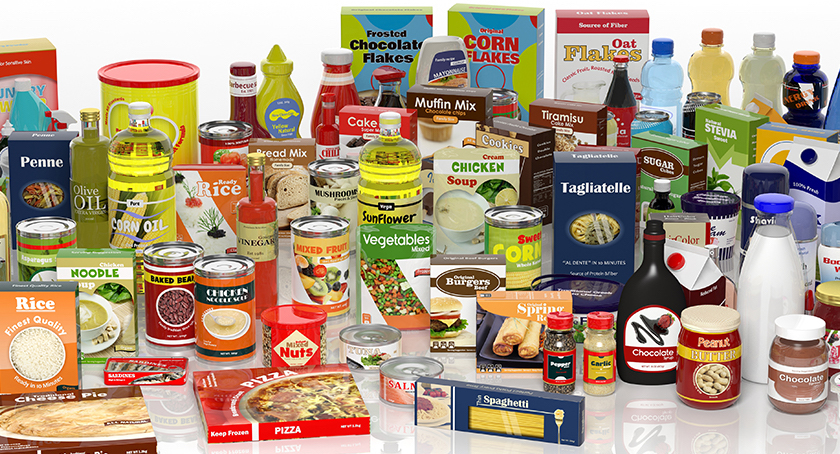
Commercial print in specific applications like digitally printed direct mail is expected to see mid-range double digit growth of, while digitally printed books are expected to continue to see high double digit growth. while other areas will see some modest growth, but lower by comparison. While the continued growth of consumerism will help drive the growth in packaging production. Packaging growth is estimated at US$1.14 trillion in 2024 and expected to reach US$1.38 trillion by 2029, at CAGR of 3.89%. While online purchasing is expanding at the expense of brick and mortar retail, the display graphics market is still holding its own. Display graphics, which was estimated at $41.88 billion in 2024, is expected to reach $45.26 billion by 2029 growing at a CAGR of 1.56%.
However, décor and apparel print is poised to pick up some of that capacity. For example, the global decorated apparel market size was valued at US$28.98 billion in 2023 and is expected to grow at a compound annual growth rate (CAGR) of 13.0% from 2024 to 2030. Which will also provide new opportunities for industrial print production.
So demand is still strong in various sectors of the print economy, however the headwinds and market shifts demand production flexibility. And while resignations continue to outpace new hires, it offers opportunities to retool.
Automation Is and Will Be the Key
AI is constantly trending in the news, much of it in the form of textual and image content generation. However, what are the real benefits today for print and packaging production and supply chains? Intelligent automation is starting to find its way into print and packaging production systems. Whether it is in machine or production system learning, scaling process automation, robotic processes, or even supply chain alignment, we are beginning to see more solutions introduced and they are having an impact.
Most of the AI that we see today is supported by machine learning (ML). In ML, the machine or software has the ability to modify its behavior dynamically when exposed to more data. The “learning” part of machine learning describes the AI algorithms which attempt to optimize behavior along a certain dimension; i.e., they usually try to minimize error or maximize the likelihood of their predictions being true. Increasingly, new data science based cloud platforms and frameworks specifically designed to increase the amount of available data and algorithms’ “deep learning” using that collected data. By expanding the amount of collected data used to compare against and make predictions, it increases the likelihood of the decisions being true.
However, if we look at print and packaging application production, it introduces some challenges to this model. Print applications and production really fit into two overriding categories; printing services, and printed products. Printing services rely on ad hoc design and variable production techniques, contrasted against constrained design and predefined printed products. In each case, there is an effect on margin, with printing services usually demanding a higher margin. However, with these differences there is also an effect on the value and amount of ML data that can be captured to provide the benefits of AI algorithms for production.
While not impossible for complete AI production systems in print, today, the areas where we are seeing implementations and real value in AI are Predictive Maintenance, Quality/Color Performance, Internal Production Performance, Comparative Production Performance, and Machine Control. As we have more historic ML data, this will open new opportunities for AI automation.
Standardizing Data Will Help
The print industry has been going through a major evolution since the introduction of digital technologies. This evolution has not just evidenced itself in the development of new equipment, it has also altered the way that print is manufactured, used, and the applications it is used for. In the past, the vast majority of print was manufactured by dedicated printing companies, publishers, and packaging converters, yet today it is also being performed as an integral part of manufacturing in many fields.
Standardizing classification of print and packaging applications and processes is essential for ML and process data collection and the use of AI to support future growth and intelligent supply chains. Working with the various industry stakeholders, educators, including PRINTING United Alliance members who use proprietary and legacy terminology, the Unified Printing Taxonomy was created to provide a real-world taxonomy that not only represents the industry today, but is structured to evolve as the print industry continues to expand. The structure allows classifications to cross over into adjacent application spaces, an important issue as printing systems can now be utilized for applications they were not originally intended to address.
The taxonomy is available today at https://taxonomy.printing.org and it’s been downloaded by 100+ organizations to date. In an effort to ease the transition from proprietary data to UPT standardized data, the PRINTING United Alliance is currently working on an AI-based “tagging” solution that will allow an organization to “feed” their content assets into the AI agent and it will apply the appropriate nodes as metadata from the UPT. This is being beta tested currently internally at the PRINTING United Alliance. While there is no specific release date for the tagging solution, with the PRINTING United Expo coming up soon, it could be a natural target.
Low-Hanging Fruit
There are two areas that are ripe for AI in print and packaging today. The first is marketing. Today, there are in excess of 100 data sources, and over 300 million records covering 98% of Americans. Marketing AI is the process of using AI capabilities like data collection, data-driven analysis, natural language processing (NLP), and machine learning to deliver customer insights and automate critical marketing decisions. AI can offer several advantages in direct marketing, enhancing the effectiveness of campaigns and improving overall outcomes. The key to this is Predictive Analytics, with which AI can predict customer behavior based on historical data, helping marketers anticipate the needs and preferences of their audience. This allows for more accurate targeting and the creation of direct mail campaigns that resonate with specific segments.
The other is Supply Chain Automation. The global supply chain faces challenges and disruptions often. Labor shortages and geopolitical conflict have contributed to continuous supply chain disruption. Also, as previously mentioned, the growth in ecommerce platforms has expanded the volume of goods being produced and shipped. Supply chain automation uses automation technology, like AI, ML, and digital process automation to perform and monitor supply chain tasks with limited human intervention. The use of this technology can streamline the management of printed goods and services and help scale the organization. The introduction of new technologies, such as automation and AI tools, provide companies new tools and methods to cope, plan, and forecast the ever-changing landscape.
Intelligent Automation (IA) Is an Important Starting Point
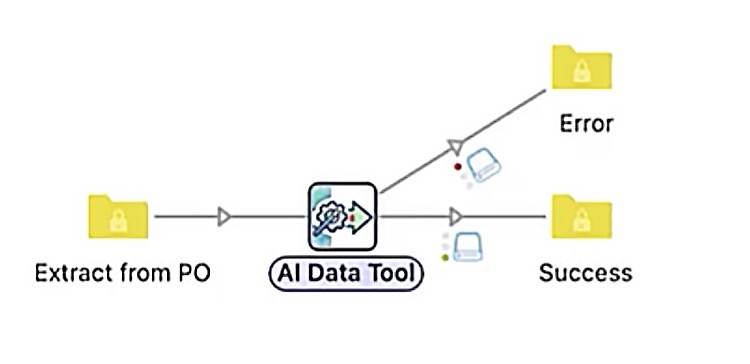
In advance of, and in addition to, the availability of enough ML application, process and production data, rules-based automation solutions are designed with a higher level of flexibility and built-in intelligence to support the automation of a wider range of applications. Going beyond the production of templated products and pages, and addressing the variability of day-to-day production, solutions today increasingly use the rules-based pipeline automation model. This type of system supports the use of tasks, triggers, actions, and filters that can be configured through a rules-based engine, providing an almost endless variability and control of processes. The availability of pipeline automation systems that support print and marketing service providers has been growing. Those who have implemented these types of systems have achieved significant benefits in reducing production time and costs.
Pipeline workflow solutions can be developed and supported by hardware manufacturers or agnostic in that they are more flexible in working in with disparate systems. It is important to note that some of the rules-based solutions developed by hardware manufacturers can be compatible with third-party systems as well, but as you research, you need to be specific in your requirements.
More to Come…
I would like to address your interests and concerns in future articles as it relates to the manufacturing of Print, Packaging, and Labels, and how, if at all, it drives future workflows including “Industry 4.0 and 5.0.” If you have any interesting examples of hybrid and bespoke manufacturing, I am very anxious to hear about them as well. Please feel free to contact me at [email protected] with any questions, suggestions, or examples of interesting applications.