Remember the Name
Joseph Caroff may not be a household name, but chances are you are familiar with his work. He was a prolific designer, responsible for the James Bond gun logo, the film posters for West Side Story and The Last Temptation of Christ among a kajillion others, the movie title sequences for A Bridge Too Far and Brighton Beach Memoirs, and the book jacket for Norman Mailer’s The Naked and the Dead. We mention him up because he passed away on August 17, the day before he would have turned 104 (!).
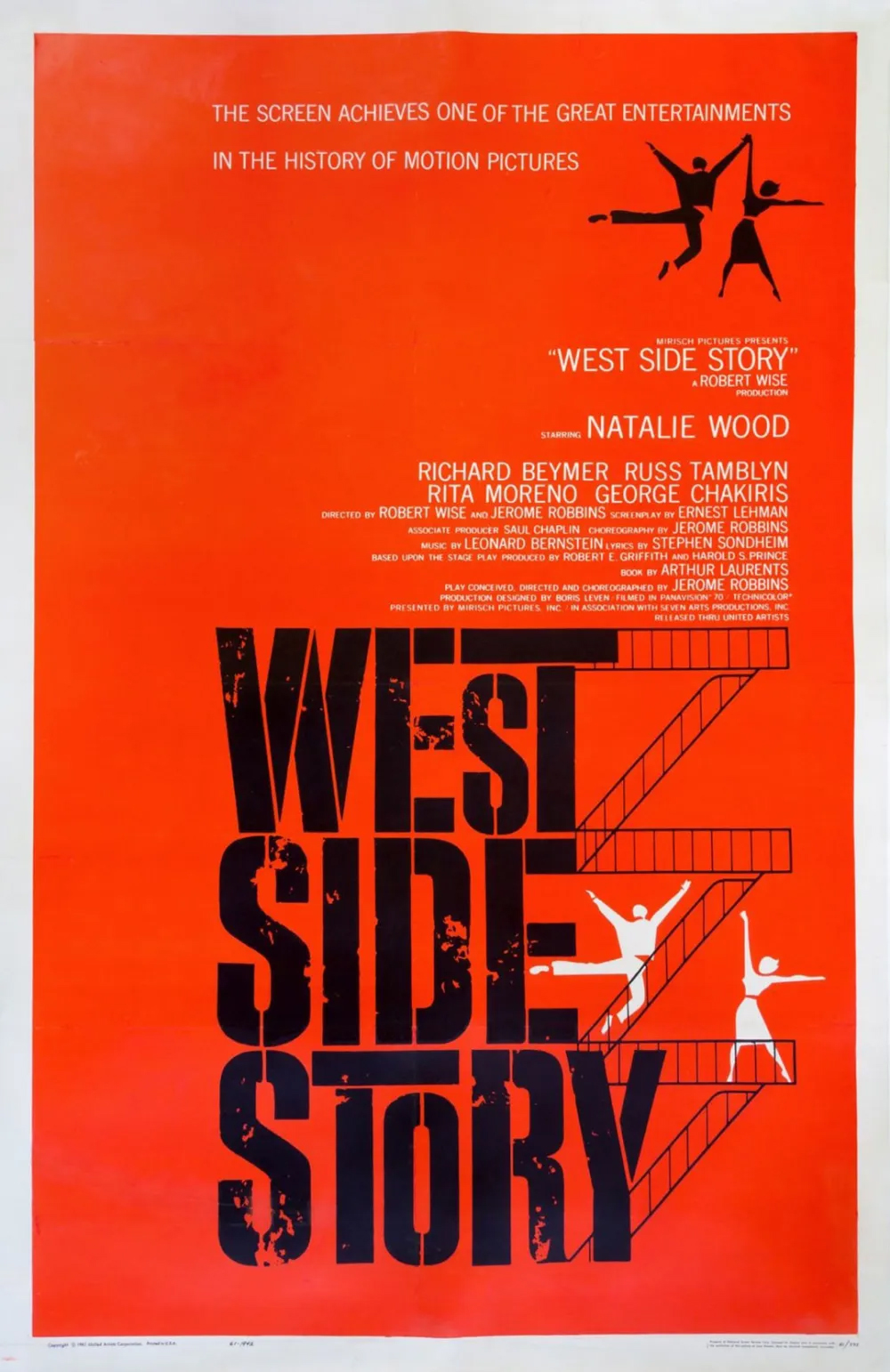
Print magazine offers a tribute to Caroff via an interview with historian, designer, and author Thilo von Debschitz, who recently rediscovered the work of Caroff, much of which was done anonymously.
Joe does not feel bad for not being chronicled. He saw himself as a service person, as a problem-solver for his clients. Almost none of his work was signed. [Unlike] Saul Bass or Paul Rand—which he admired—Joe did not invest a lot into self-promotion. Therefore, his name did not became famous, therefore he has been mostly unknown for people like you and me. It would be wonderful if a design historian could try to put the pieces of his professional life together—I am sure that there is a lot to discover. Unfortunately, Joe has nothing left from his work as a designer—no sketches, no documents, nothing.
Let us do what we can to help recognize the work of a master.
Oldest Record Book
It started as an argument by two British bird hunters who, during a shooting party in 1951, argued over what was the fastest game bird in Europe: the golden plover or the red grouse. One of the arguers—Sir Hugh Beaver—later discovered that no reference book he could find indicated what the fastest game bird in Europe actually was, much less whether it was the plover. (Spoiler alert: the plover is faster, but neither one of them is the fastest game bird in Europe, which would be the red-breasted merganser.) Sir Hugh, as it happened, was at the time the managing director of the Guinness Breweries. As such, he likely spent a fair amount of time in pubs, and knew that these sorts of questions were often hotly debated among the public. He then thought that a book that could be used to answer these questions—or settle “bar bets”—might be successful.
And it was.
Compiled by Norris and Ross McWhirter, twin brothers who ran a fact-finding agency in London, The Guinness Book of (Superlatives and now) Records debuted in 1954 and was initially distributed for free to pubs across Britain and Ireland as a marketing tool for Guinness. On August 27, 1955, the first public edition went on sale and it quickly became a bestseller.
That was 70 years ago this week, and via The Guardian, Guinness World Records is celebrating its Platinum Anniversary by looking back at some of the craziest records, such as:
Beth Johnson demonstrates the world’s largest yo-yo, in Cincinnati, Ohio. Measuring 3.6258 metres in diameter and weighing 2,095.6kg, the disc plunged 36.5 metres on a rope attached to a 68-tonne crane before successfully rebounding.
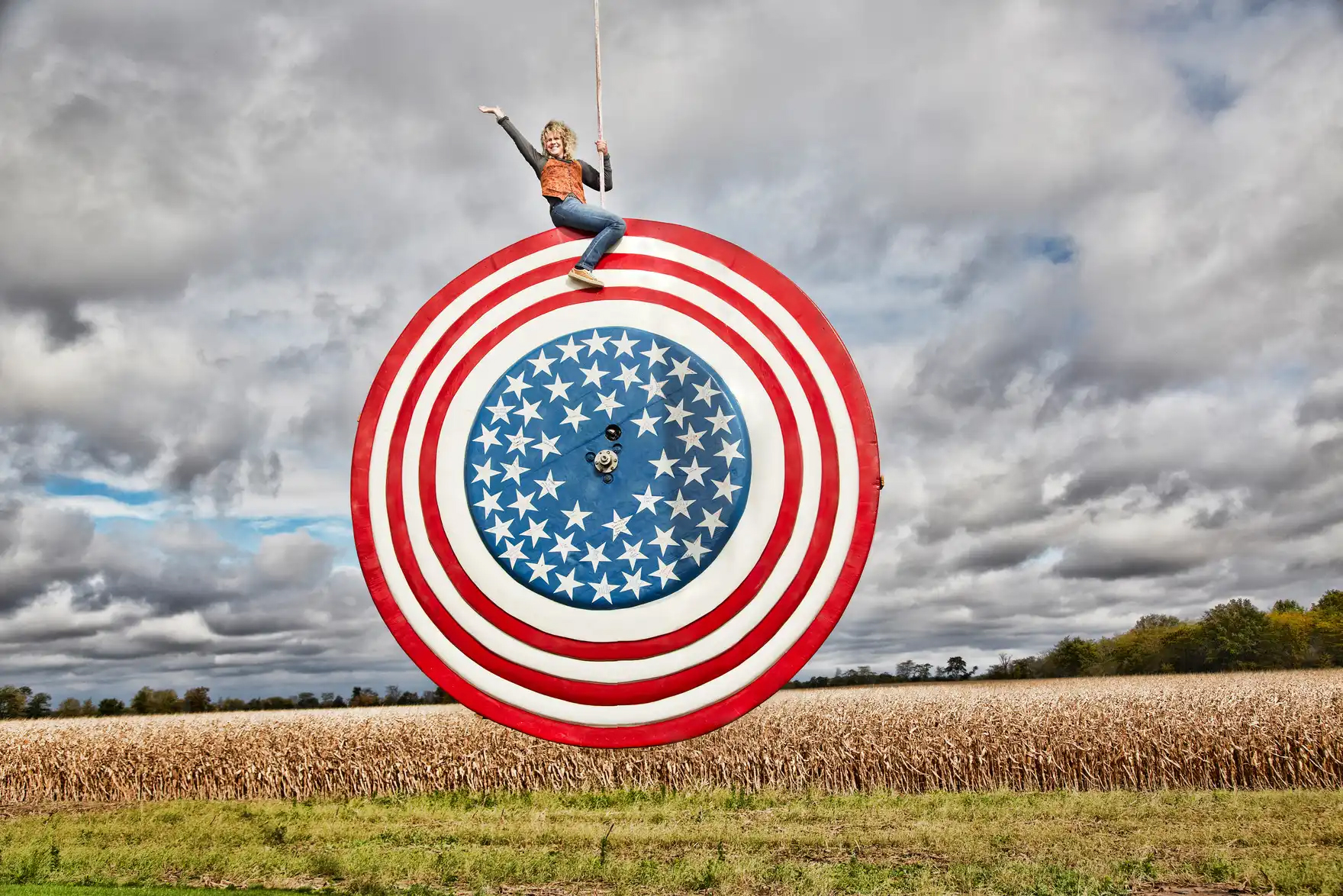
And, yes, the print edition still very much exists.
Don’t Stop the Presses
It’s hard to come across positive stories from the newspaper industry these days, but this week, some good news did come out of, of all places, Wyoming. Via The Guardian, News Media Corporation (NMC) had announced that seven local papers in Wyoming were to be immediately shut down and the presses turned off. But then a miracle happened:
A group of Wyoming news executives stepped into the fold, buying eight of the papers – seven in Wyoming, and one just across the border in Nebraska. Printing would resume, and staff at the papers, who never stopped working during the closure, would receive full pay.
Four papers in South Dakota were likewise brought back from the brink of closure.
Rob Mortimore, one of the news executives who stepped up to purchase the Wyoming papers and the publisher of the Torrington Telegram, has worked in Wyoming news for 24 years, and sees the mission as vital.
“When communities lose their newspaper, they lose their voice,” he said.
Bully for them!
Byte Size
Let’s see if we can spot the over-50s out there—who remembers Byte magazine? Byte was one of the earliest computer magazines that ran in print from 1975 to 1998, and in its heyday was one of those giant doorstops of a magazine the likes of which we alas will likely not see again. Via Boing Boing:
Before Hackernews, before Twitter, before blogs, before the web had been spun, when the internet just was four universities in a trenchcoat, there was *BYTE*. A monthly mainline of the entire personal computing universe, delivered on dead trees for a generation of hackers. Running from September 1975 to July 1998, its 277 issues chronicled the Cambrian explosion of the microcomputer, from bare-metal kits to the dawn of the commercial internet. Forget repackaged corporate press-releases; *BYTE* was for the builders. Inside, you'd find Steve Ciarcia teaching you to build a speech synthesizer from scratch, the inner details of a RISC pipeline, deep dives into the guts of Smalltalk, and Jerry Pournelle's legendary columns from Chaos Manor. This wasn't just about what a computer could do, but *how* it did it. The source code of a revolution which continues to this day.
Now, at byte.tsundoku.io, you can explore the entire history of the “small systems journal.” It’s an interesting way to navigate: it starts with what looks like an abstract blur:

But when you zoom in, you can see it is actually every page of every issue of Byte laid end to end.
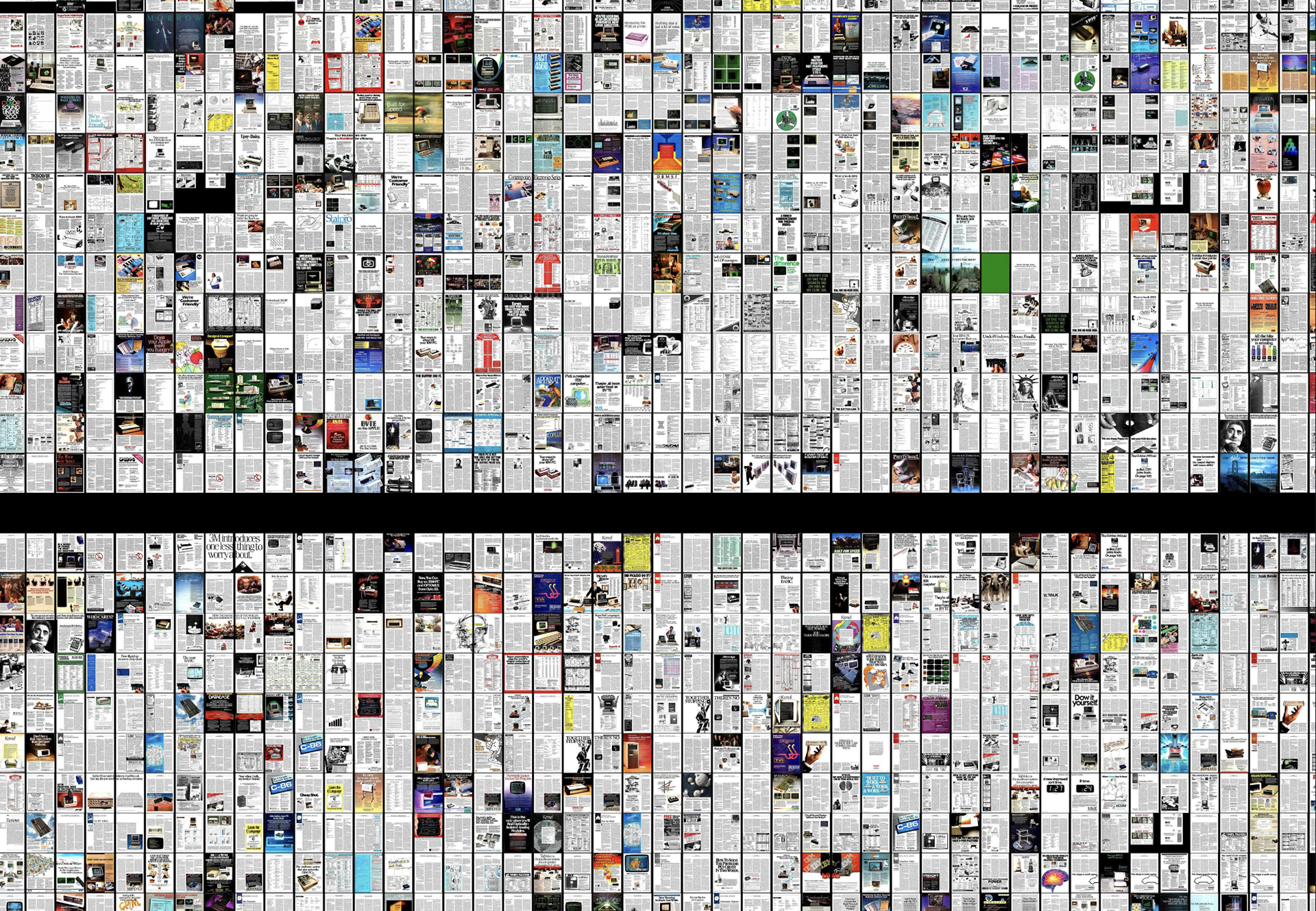
This is practically (practically? It is) a history of the computer industry. Poking around at random you can find some interesting things, like some Apple rumors from 1982.
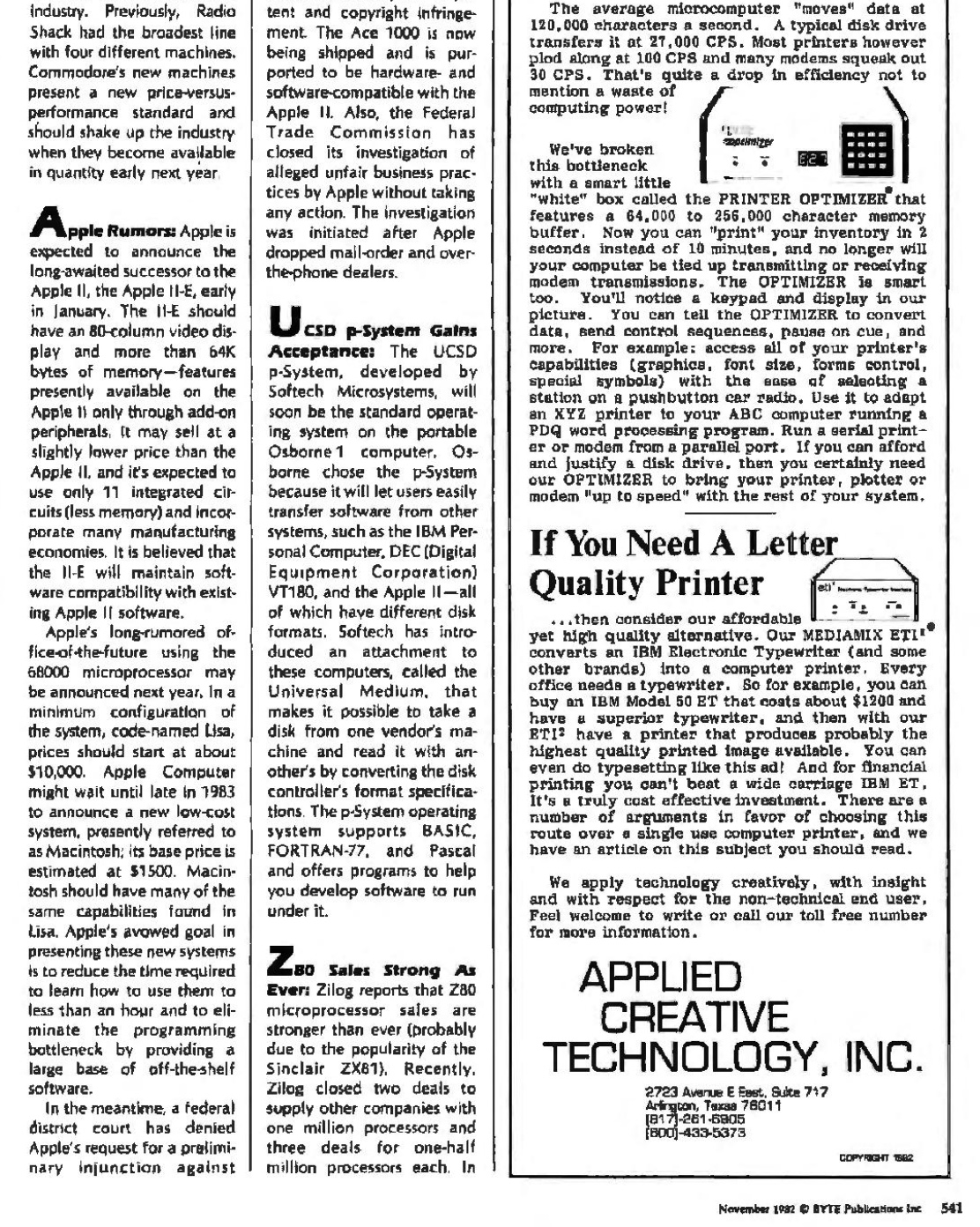
There are all sorts of rabbit holes to go down…
Key Change
Core77 raises an interesting point: “on a daily basis you still use something invented in the 1860s.” Most of us can probably guess what that is. It’s not really an object per se, but a kind of user interface. Yes, the QWERTY keyboard, patented by Christopher Latham Sholes in 1867.
Initially, the QWERTY keyboard only provided capital letters, allowing early typists to send shouty correspondence to each other. But in 1878 Sholes came up with the shift key, allowing one to type both capital and lowercase letters with a relatively compact layout.
Go call Frank—he can tell you the rest of the story. But startup company TypeMax thinks the QWERTY keyboard layout could use an upgrade.
They reckon that symbols we hardly ever used in the 20th century—like # and @—are now daily parlance. Furthermore, coders use symbols constantly. Thus the design of their QwertyMax keyboard adds a dedicated symbol row above the numbers, as well as keys for commonly-used shortcuts and browser navigation controls on the right.
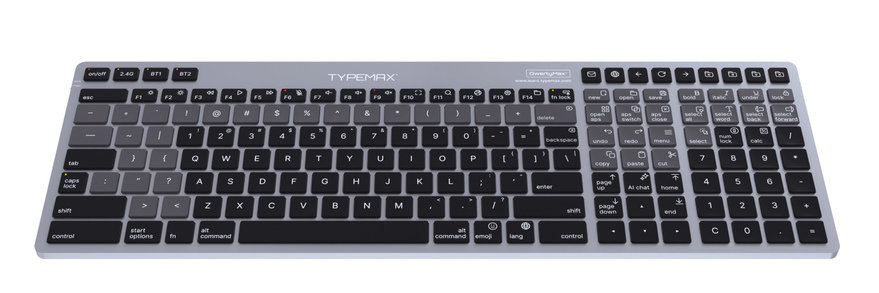
The real sign of the times, though, is the QwertyMax’s addition of a key that Sholes would not have been able to comprehend. Down at the bottom is a dedicated “emoji” key.
We envy Sholes…
This doesn’t enable anything on the physical keyboard itself, but automatically opens your computer’s emoji panel on-screen.
Joy.
Currently, no indication of price or release date, but you can sign up for a waitlist promising 50% off…whatever they end up charging.
Signs of the Times, Part the Ongoing: Roping Them In
Here’s a scenario virtually any sign shop will recognize: “deliver a school wayfinding system on a tight deadline and at a low cost.” Via Core77, Taiwanese design studio Hand Heart Design was tasked with such a mission by Taiwan’s National Kaohsiung Normal University (NKNU). They took an interesting approach, eschewing print or conventional signage materials.
HHD's solution was to mass-produce metal plates with a grid of holes drilled in them. This was cheaper and less time-consuming than ordering individually printed plates; the "graphics" were instead provided by a template and lengths of rope.
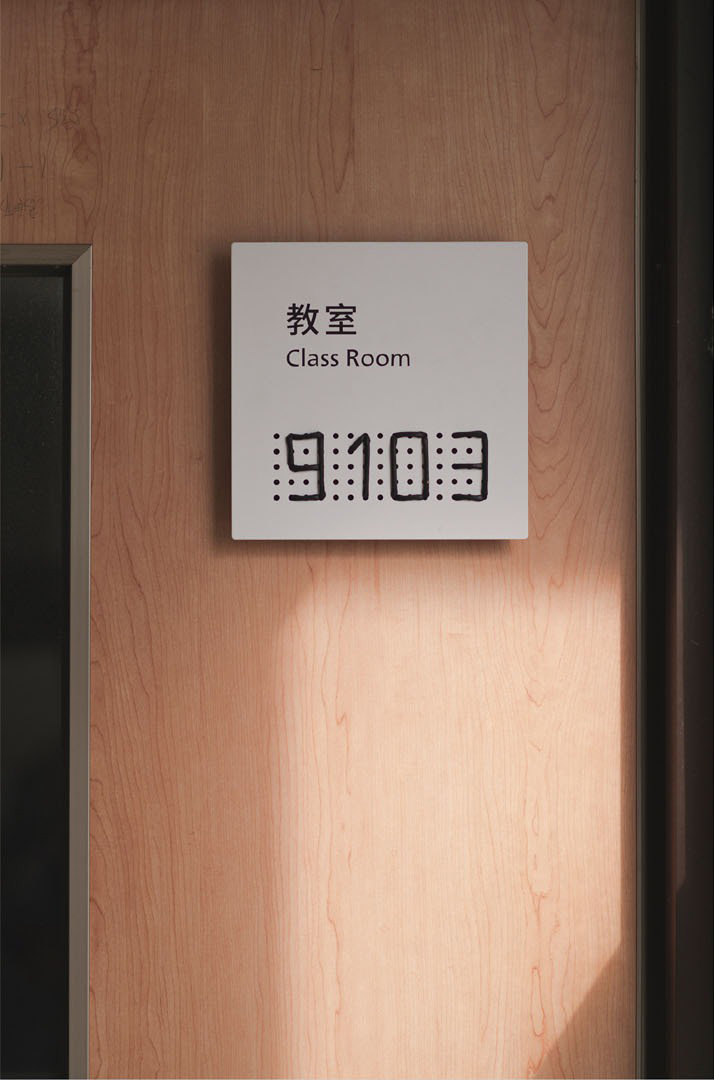
It does have a weird aesthetic, although an American signmaker will immediately spot one omission a Taiwanese school probably doesn’t have to worry about: an ADA-compliant Braille translation.
“Working within a very limited time and budget, the design team transformed seemingly unremarkable limitations into design highlights, selecting modular perforated metal as the base material and selecting waterproof and resilient wax rope to weave various icons from the humanities, sciences, and art through a connection of dots and lines.”
The modular approach has its advantages.
“In addition to conveying the spirit of research, the reusable and sustainable material also provides a modular solution for subsequent maintenance and development. This breakthrough design finds infinite possibilities for expansion in the extension of dots.”
All Welles That Ends Well
One of the most notorious events in media history took place on the evening of October 30, 1938. Orson Welles’ Mercury Theater of the Air broadcast an adaptation of H.G. Wells’ novel The War of the Worlds on CBS Radio. Presented as a series of news bulletins—but despite the fact that the broadcast began with a disclaimer that it was fiction, many listeners, perhaps having missed any of the disclaimers, thought a real invasion was underfoot and panic ensued. The event made Welles’ name—despite the fact that he had not been all that enthusiastic about it to begin with.
Anyway, the faux invasion was “reported” to have begun in the very real town of Grover’s Mill, N.J., located about 11 miles from Princeton. If you’re ever in the area, via Atlas Obscura, you can check out a monument that was erected to commemorate the…well, lack of occasion.
In 1988, the unincorporated community of Grover's Mill—the very real town featured as the landing site of the very fictional Martian invasion—erected an eight-foot-high bronze monument to this unique event in broadcasting history. Inscribed with a description of the evening and a rendering of the alien craft from the story, the monument stands in a quiet location near a pond.
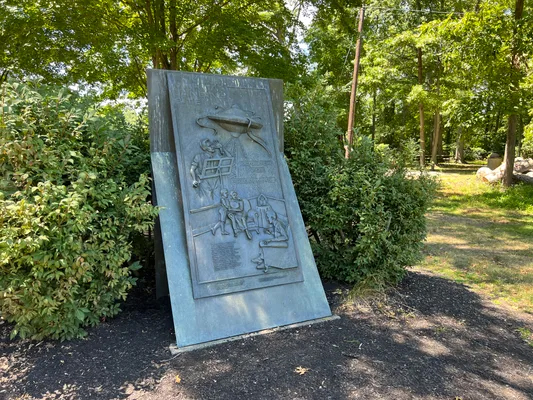
Although the stories of mass panic were exaggerated and then debunked over the years, it was a milestone event in broadcasting.
Graphene Takes a Breath
Was it a good week for graphene news? It’s always a good week for graphene news! New graphene-based sensor can help diagnose diabetes and prediabetes based on a breath sample. From (who else?) Graphene-Info:
Researchers from Penn State, Hebei University of Technology and collaborators have developed a sensor that can help diagnose diabetes and prediabetes on-site in a few minutes using just a breath sample. The team's new work describes a highly sensitive acetone gas sensor with ultralow detection limit based on zinc oxide (ZnO)/laser-induced graphene (LIG) composite with heterostructures on interdigitated electrodes prepared by one-step laser direct writing and simple drop casting.
Previous diagnostic methods relied on measuring glucose levels in blood or sweat, but the new sensor detects acetone levels in one’s breath. Acetone levels above a threshold of ~1.8 parts per million indicate diabetes.
Just a Prawn in Their Game
Here’s phrase we never thought we’d see on not one but two occasions: “radioactive shrimp.” But, yes. Via NBC News:
Southwind Foods, a California company, is recalling a “limited quantity” of its frozen shrimp after it was possibly exposed to Cesium-137 (Cs-137), “a soft, flexible, silvery-white metal that becomes liquid near room temperature” used for medical devices and gauges, according to the Environmental Protection Agency.
And also, too:
The move comes just days after a similar recall from the Indonesian food company PT. Bahari Makmur Sejati, also known as BMS Foods, of frozen shrimp sold at Walmarts across the U.S. The FDA said it is actively investigating reports of radioactive exposure in the shrimp's shipping containers.
Consumers who bought the recalled frozen shrimp should not eat the product and should either throw it away or return it to the place of purchase for a full refund.
Or perhaps have it creep back to the store of its own accord…
To paraphrase what we said earlier this month about a radioactive wasp’s nest: “Ah, if only this were the 1950s; how many B movies would this have inspired, where giant irradiated wasps shrimp terrorize a small town? What might have been!”
Wound Up
Do you pore through medieval manuscripts? Nor so we, usually, but one figure that occasionally turns up in medieval medical manuscripts is the Wound Man.
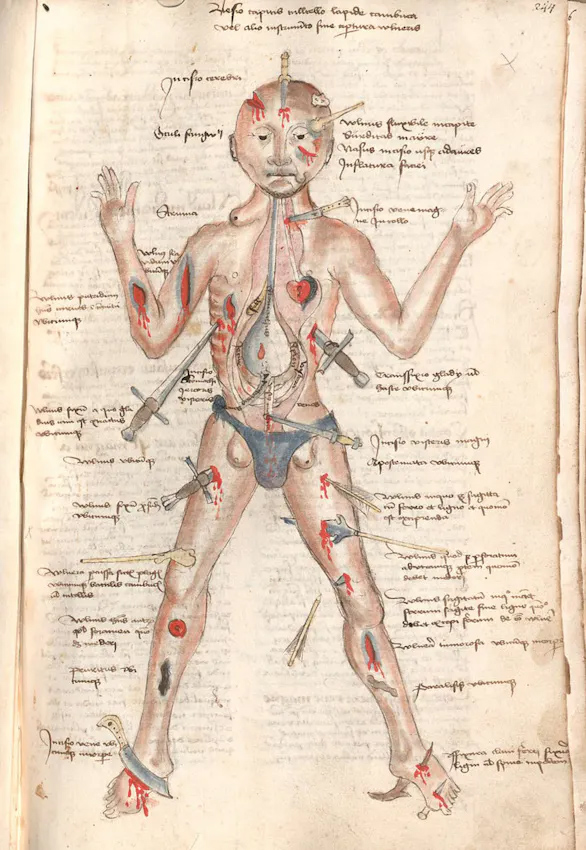
A Wound Man from a late 15th-century manuscript, Bayerische Staatsbibliothek Cgm 597 — Source (CC BY-NC-SA 4.0).
I think we’ve all had weeks like that.
Jack Hartnell at Public Domain Review takes a look at the history of this sporadically recurring figure. He hastens to add that the purpose of the rather gruesome image is not to inspire fear or horror, but rather to identify cures and treatments for the indicated maladies.
The earliest known versions of the Wound Man appeared at the turn of the fifteenth century in books on the surgical craft, particularly works from southern Germany associated with the renowned Würzburg surgeon Ortolf von Baierland. Accompanying a text known as the “Wundarznei” (The Surgery), these first Wound Men effectively functioned as a human table of contents for the cures contained within the relevant treatise. Look closely at the remarkable Wound Man shown above…and you see that the figure is penetrated not only by weapons but also by text.
… The Wound Man image was a convenient way for medieval surgeons to navigate their texts, but it was also an arresting reminder for both practitioners and patients of the vital knowledge contained within such manuscripts. It was living proof of the efficacy of the surgical enterprise, and a popular inclusion in medical works alongside a wide variety of related images that plotted diseases, the zodiac signs (see image below), bloodletting points, and anatomical schemes onto a similarly arranged human body. See, for example, this post from the Wellcome Library blog on the “Disease Woman” image.
Ah, yes…When Wound Man Met Disease Woman—there’s a rom-com just waiting to be made.
If you have ever been to the Tower of London, a similar, though less graphic, Wound Man functions as a safety warning:
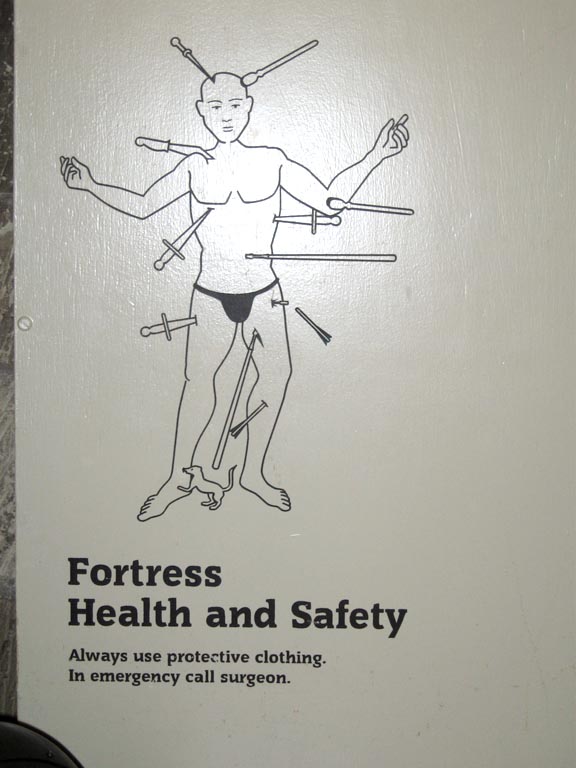
In other words, don’t tour the Tower of London wearing just a thong. Please.
Matching Mole
If you took high school chemistry, one chemical term that was always a source of amusement was the “mole.” Basically, a mole is a unit of measurement, the base unit in the International System of Units (SI) for “amount of substance.” Via Wikipedia:
One mole is an aggregate of exactly 6.02214076×10²³ elementary entities (approximately 602 sextillion or 602 billion times a trillion), which can be atoms, molecules, ions, ion pairs, or other particles.
You get the idea, and if you remember chemistry you may recall that Avogadro’s number is involved, wherein the class usually devolved into jokes about avocadoes. Anyway, we’re basically talking about 602,214,076,000,000,000,000,000 somethings.
But we do recall a classmate, during an exam that included the question, “What is a mole?” writing “A small, furry mammal.” Waka waka.
This was dredged up from the depths of our subconscious by this item on Laughing Squid, in which Randall Munroe of xkcd and Henry Reich of MinutePhysics were asked, “What if there were a mole (the unit) of moles (the animal)?” This would mean 602,214,076,000,000,000,000,000 small burrowing animals.
If these moles were released onto the Earth’s surface, they’d fill it up to 80 kilometers deep — just about to the edge of space — or where the edge of space used to be before all the air was displaced by moles This smothering ocean of meat would wipe out most life on the planet and it would really mess up my iNaturalist wildlife-sighting stats. So doing this on Earth is not a good option.
So…be careful.
Playing Ketchup
Botanically, tomatoes are a fruit—but is that any reason to use them to make a smoothie? Via (who else?) Food & Wine, Heinz has partnered with Smoothie King to release the first-ever Tomato Ketchup Smoothie,
blending açai sorbet, strawberries, raspberries, apple juice, and Heinz’s signature ketchup into a sweet-tart drink with a distinct tomato finish.
On the other hand, you could’ve had a V8.
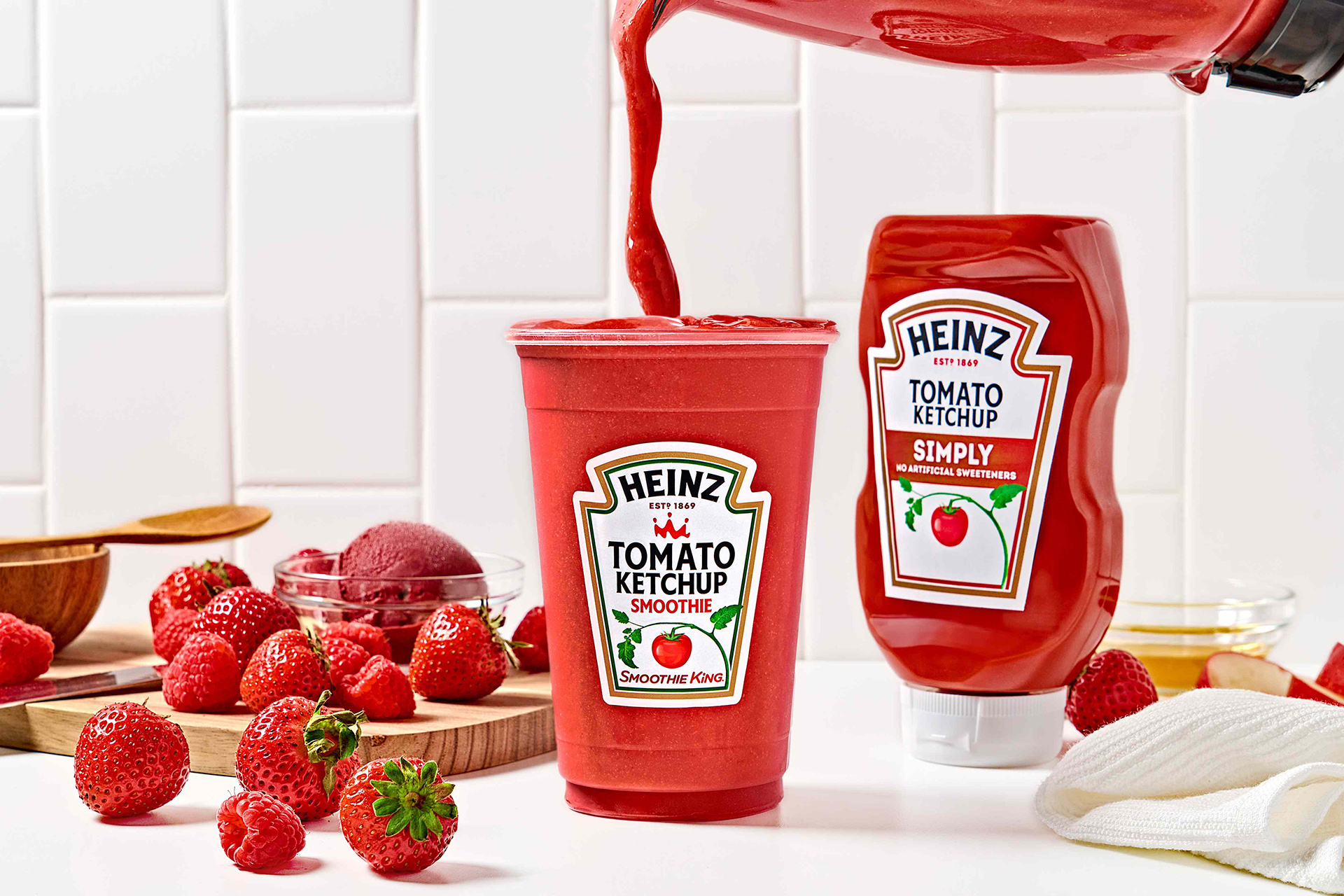
The smoothie will be available at select Smoothie King locations in Atlanta, Chicago, Denver, Miami, and New York while supplies last, and rings in at just $5.70.
So…nowhere near us. Cool.
This Week in Printing, Publishing, and Media History
August 25
1609: Galileo Galilei demonstrates his first telescope to Venetian lawmakers.
1835: The first Great Moon Hoax article is published in The New York Sun, announcing the discovery of life and civilization on the Moon. (No one would ever fall for something like that today.)
1867: English physicist and chemist Michael Faraday dies (b. 1791).
1900: German philologist, philosopher, and critic Friedrich Nietzsche dies (b. 1844).
1954: English singer-songwriter, guitarist, and producer Elvis Costello (né Declan MacManus) born.
1991: Linus Torvalds announces the first version of what will become Linux.
2012: Voyager 1 spacecraft enters interstellar space becoming the first man-made object to do so.
August 26
1740: French inventor (hot air balloon) Joseph-Michel Montgolfier born.
1873: American engineer and academic and inventor the Audion tube Lee de Forest born.
1952: American journalist and puzzle creator Will Shortz born.
August 27
1770: German philosopher and academic Georg Wilhelm Friedrich Hegel born.
1871: American novelist and journalist Theodore Dreiser born.
1933: The first Afrikaans Bible is introduced during a Bible Festival in Bloemfontein.
1953: Canadian singer-songwriter, guitarist, and producer Alex Lifeson (né Alexandar Zivojinovich) born.
1971: American publisher, co-founded Random House Bennett Cerf dies (b. 1898).
August 28
1749: German novelist, poet, playwright, and diplomat Johann Wolfgang von Goethe born.
1845: The first issue of Scientific American magazine is published.
1898: Caleb Bradham’s beverage “Brad's Drink” is renamed “Pepsi-Cola.”
August 29
1831: Michael Faraday discovers electromagnetic induction.
1997: Netflix is launched as an internet DVD rental service.
August 30
1797: Mary Shelley, English novelist (Frankenstein) and playwright, born.
1909: Burgess Shale fossils are discovered by Charles Doolittle Walcott, which would serve as the subject for one of the best science books ever written: Stephen Jay Gould’s Wonderful Life.
1956: Comedian, actor, producer, and screenwriter Frank Conniff (“TV’s Frank” from Mystery Science Theater 3000), born.
August 31
1688: English preacher, theologian, and author (Pilgrim’s Progress) John Bunyan dies (b. 1628).
1867: French poet and critic Charles Baudelaire dies (b. 1821).
1895: German Count Ferdinand von Zeppelin patents his navigable balloon. It went over like a...well, actually it went over rather well (for a bit).
1897: Thomas Edison patents the Kinetoscope, the first movie projector.
1944: English illustrator Roger Dean born.