Great Danes
If you have ever bought books in Denmark (we have not), you may have discovered that there was a 25% sales tax on books—the highest in Europe. However, the country is currently undergoing a “reading crisis.” According to an education report from the Organisation for Economic Co-operation and Development (OECD), “24% of Danish 15-year-olds cannot understand a simple text, up four percentage points in a decade.” (To be fair, we have received texts and other messages that were so misspelled and garbled as to be unintelligible, but the researchers probably corrected for that.)
Anyway, the report was so alarming that the Danish government said it was removing the book tax to encourage more people to buy (and presumably read) them. Says Le Monde, “The measure would cost the state an estimated 330 million kroner ($51 million) a year.”
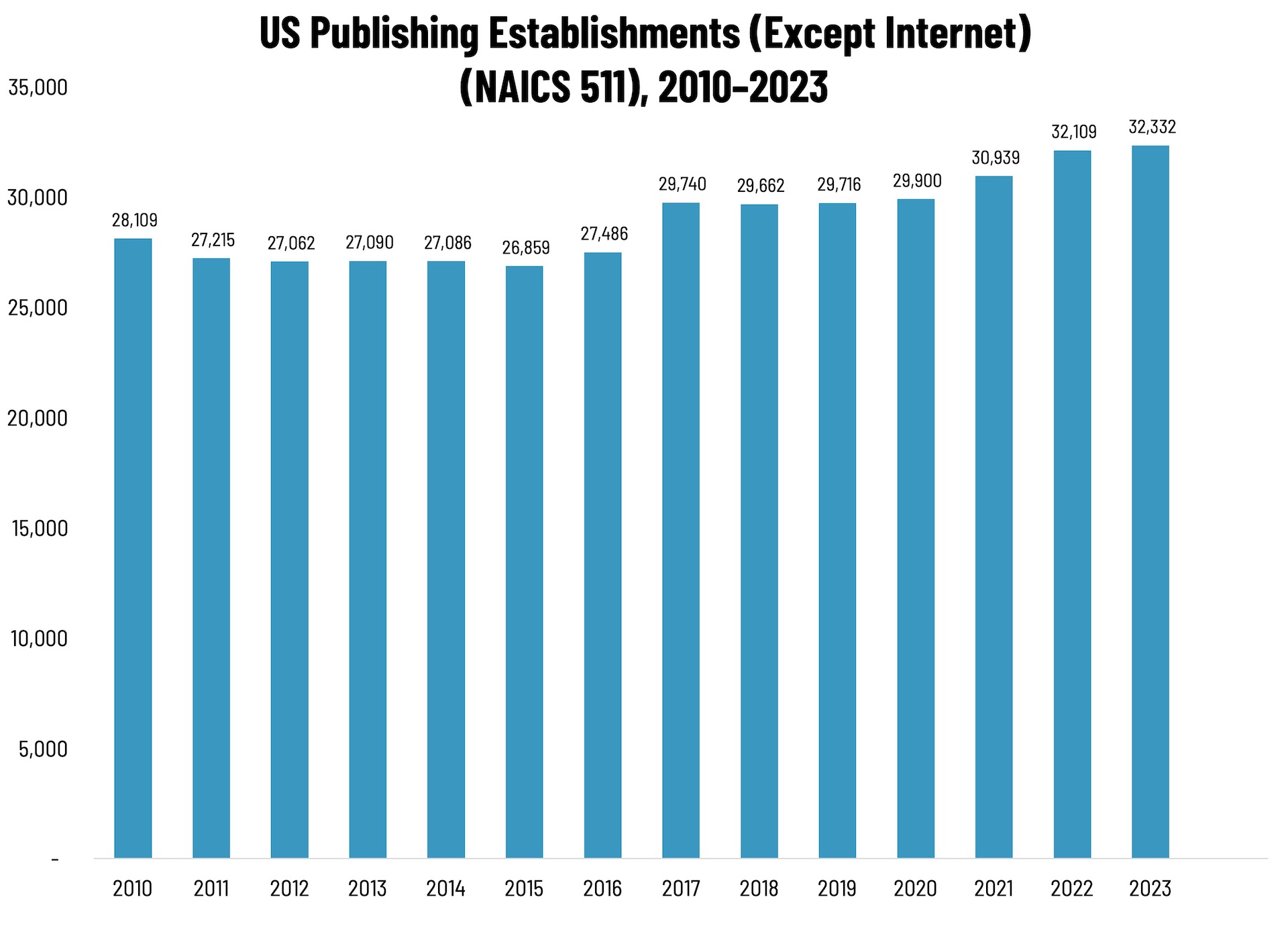
Denmark’s publishing industry had pushed for the tax cut, saying in a May report the government needed to “guarantee access to physical books for all Danes – both children and adults.”
Signs of the Times, Part the Ongoing: Let’s Go Out to the Lobby
Granted, we have not been to a movie theater seemingly since Citizen Kane was first released (we hear movies are in color now), but via Core77 a new trend in moviegoing has popped up in recent years:
Signage letting time-strapped moviegoers know whether they can leave after the final scene without missing anything.
First of all, if we ever get so time-strapped that sitting in a theater for an extra—what?—five minutes is going to be a hardship, then perhaps we should just not leave the house at all. Anyway, the signage.
These signs are presumably improvised by staff, and their designs—and therefore their efficacy in conveying helpful information--vary widely.
Core77 then proceeds to rate several of them on a scale from Worst, to Bad, to Good, to Best, to Looks Good But is Actually Bad.
The worst?
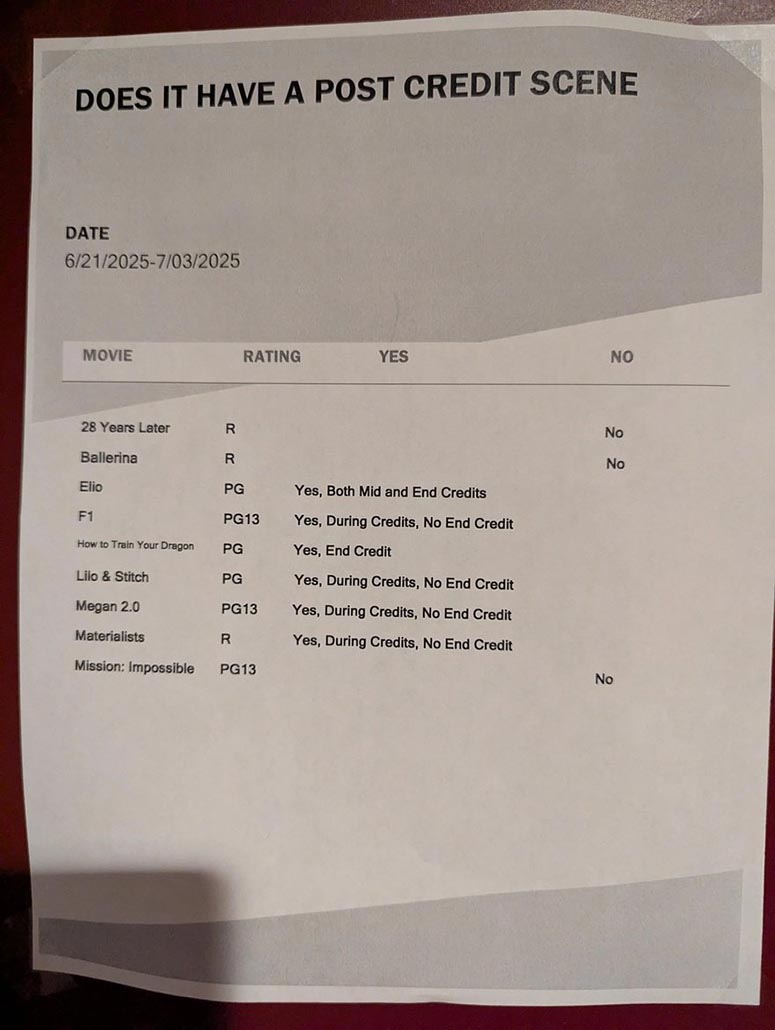
“This is wordy, visually dense, and difficult to parse.”
And the best?

Has the benefits of the Good design, but is easier to read due to the large letters and graphics. They’ve also taken the time to emulate the font style of the movie title, increasing recognizability.
OK, all you signmakers out there. Get thee to a movie theater!
Staples of Packaging
In our regular coverage of packaging printing and converting, we usually focus on printing technology, but can give short shrift to some of the other aspects of converting—such as, for example, fastening packaging materials. Sure, industrial-scale converting operations have the appropriate equipment, but what about small businesses that want to create their own packaging? Via Core 77, one cool new tool was developed by a Korean company called Cornervery, whose eponymous implement is a 90-degree stapler.
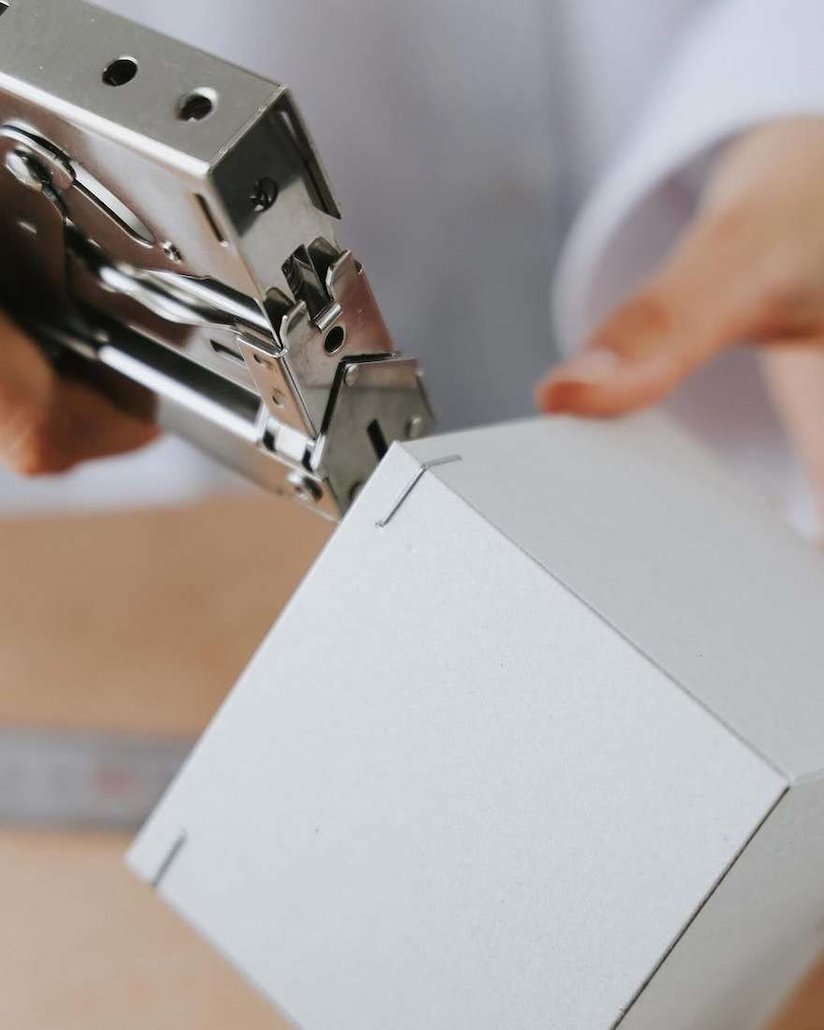
The company that makes it…says It’s a more economical way to make packaging; paperboard can be die-cut to minimize waste, there are no overlapping flaps required, and tape and glue are not needed.
This is said to produce easy-to-recycle package.
“Since it is possible to make the boxes without tape or glue, if the staples are removed, paper and staples can be sorted and recycled,” the company writes.
The staples are available in silver and bronze. A steal at $315. Naturally, you’ll need to also buy the company’s specially designed staples (you can’t pick up a box in, say, Staples) which cost $16 for an 80-pack, though you can save a bit if you buy in bulk).
Panel Show
One of the biggest (and saddest) bits of collateral damage from the waning of the newspaper industry is the loss of the comics page. Sure, they still exist, but we’re not sure what’s even on them anymore.
Back in the day (that day being the 1980s), we were big fans of Gary Larson’s The Far Side, one of the smartest, funniest, and often most surreal of the comic strips. (If you were in college in the 1980s, it seemed virtually every professor regardless of department had at least one Far Side comic taped to their office door.) Unusually, The Far Side comprised a single panel, rather than the four or five most comic strips used. Family Circus and Dennis the Menace were two other single-panel strips, and one Far Side book has some examples of what happened when comic page editors accidentally swapped the captions for The Far Side and Family Circus or Dennis the Menace.)
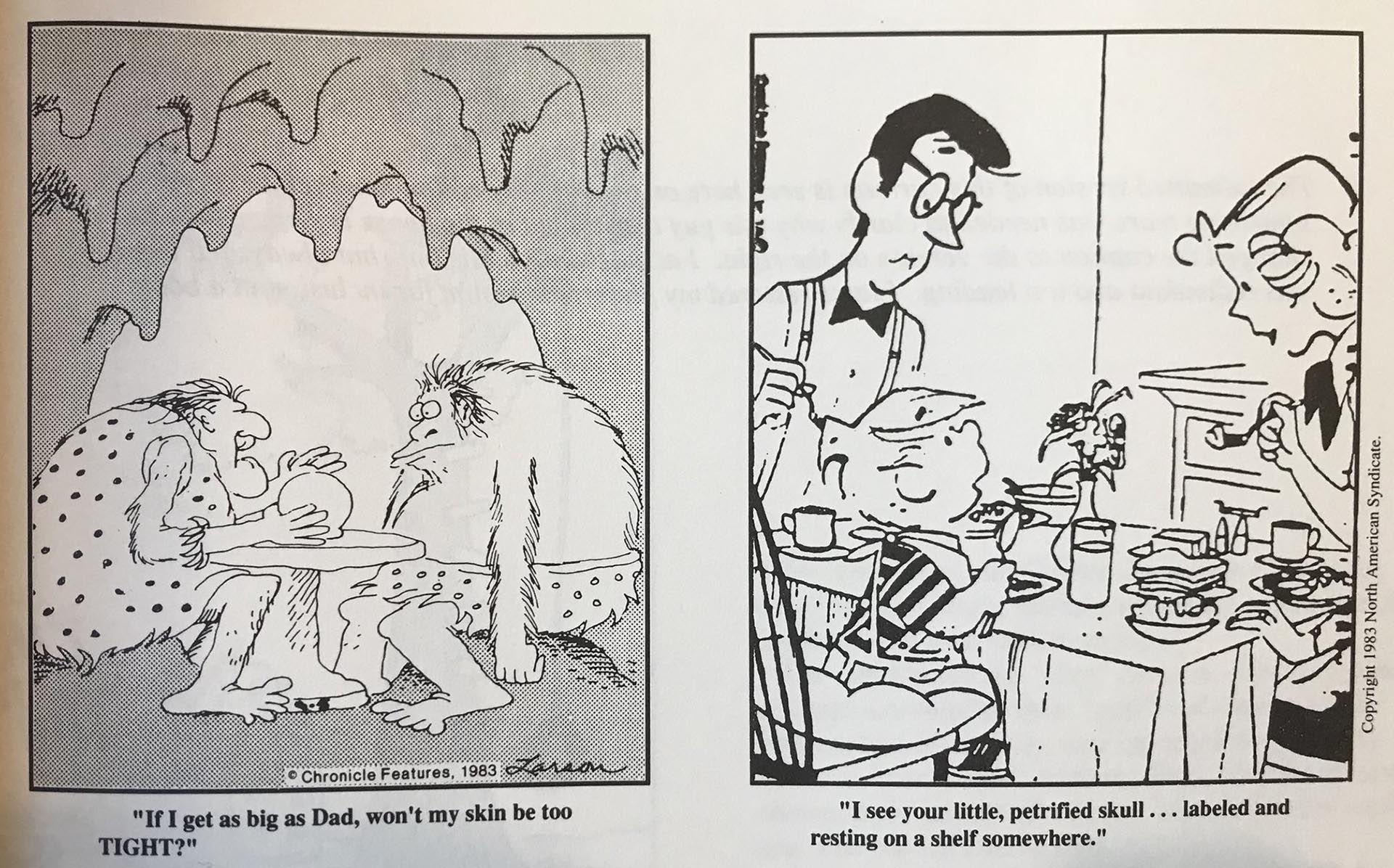
The single-panel comic strip has a long history and fans of the Netflix series Wednesday and various Addams-adjacent projects may not be aware that the Addams Family began in 1938 as a series of single-panel comics drawn by Charles Addams for The New Yorker.
The single-panel comic strip was deceptively simple, but via Laughing Squid, video essayist Solar Sands of Comic Swap Art “explored the limitless insight found within the limited space of single panel comics.”
He focuses on The Far Side, the pre-Garfield cat comic Heathcliff, and one called Pants, which we have never heard of.
The single panel comic is a limited type of artwork. It challenges the artist to tell an often comedic, visually simple and clear story within the boundary of a single still frame, save for the caption at the bottom. When done well, this profound limitation can result in profound efficiency.
Sedimental Journey
Our Mount Monadnock Media Maven points us to New York-based Jessica Drenk, who takes upcycling to new heights. Namely, using “objects like junk mail and pencils to create elaborately layered, sculptural pieces evoking banded crystals and colorful sedimentary stone,” says This Is Colossal.
Drenk’s forthcoming solo exhibition, Elemental Form at Galleri Urbane [in Dallas], continues to plumb the relationship between ephemerality and eternity. The gallery says, “Building in layers, Drenk renders erosion, sedimentation, and crystallization human-made.”

“Aggregate Triptych 4” (2025), junk mail and used paper, 42 x 88 inches
Many of Drenk’s wall pieces are made solely of paper, while some new pieces, like the Slice series, incorporate plaster. Redolent of the way marble is sliced from quarries in neat slabs, “Aggregate Triptych” or “Flow” look as though they have been hewn directly from some much more expansive deposit. Panning out, we might see streams and oxbows amid a vast natural landscape.
If you’re in Dallas, be sure to check out Elemental Form which runs from September 6 through November 8. More info on the artist’s website and Instagram.
An Artist Phones It In
Can you sing? Can you also paint? If yes, we’re impressed. But we’d be more impressed if you could do both simultaneously, like Welsh singer Margaret Watts Hughes who could “sing” paintings. Via Boing Boing, in 1885, Hughes was singing into an “Eidophone,” basically a mouthpiece connected to a rubber membrane. There were some seeds scattered on the membrane, and as she sang, the seeds formed themselves into geometric patterns. That was her “aha!” moment.
She soon replaced the seeds with colored pastes and, by pressing a glass plate against the membrane, fixed the fleeting shapes as permanent images: “daisies” whose petals unfurled at one pitch and withdrew at another, swirling galaxies of pigment, plant-like filaments that look like nothing ever seen on land or sea.

Impression Figure by Margaret Watts Hughes, pigment on glass, date unknown. Courtesy of Cyfarthfa Castle Museum and Art Gallery — photography by Louis Porter.
See more of her images and learn about the Eidophone—and its connection to Alexander Graham Bell’s telephone—here.
AI-Yi-Yi, Part the Infinity: Beyond the Furby
Those of you who were kids in the 1990s (or had kids in the 1990s)(or had grandkids in the 1990s) may remember the Furby. Launched in 1998 by Hasbro, it was a freakish electronic toy (today it would probably be marketed as “AI-enabled”) that, out of the box, spoke some weird factory-installed language called “Furbish” but was programmed to gradually start speaking English words and phrases; supposedly, it was intended to resemble the process of learning English. (At the time, at the office we worked in, we toyed with the idea of getting a Furby and connecting it to the phone system.) It was one of those “must have” toys in 1998 and 1999. (In 2005, they released the “Emoto-Tronic Furby,” which included voice recognition and was sold until 2007.)
We flashed back to the Furby while reading this story at Futurism about a new generation of AI-enabled toys for children. Essentially chatbots, some of them can have quite horrific impacts on children.
One of the best-known of these “AI-infused stuffed toys” is made by Curio, and comprises a child-friendly chatbot and voice acting by electronic musician Claire “Grimes” Boucher. It was trained on OpenAI’s API and interactive Discord conversations, but there’s
a strange caveat found in the company's privacy policy acknowledging that Microsoft's Azure Cognitive Services, OpenAI, Perplexity AI, and the parental verification platform Kids Web Services may all "collect or maintain personal information from children through the App or Device." As the NYT notes, that runs counter to the company's claims that it doesn't retain kids' interactions for anything other than parental review in the toys' apps…
If that sounds dodgy to you, consider there are cheaper, no-name AI-enabled toys that could be potentially worse.
These random sites, with names like "Little Learners" and "FoloToy," vary in their specifics if not their price ranges, which are roughly the same as the toys sold by Curio. Little Learners is the shadiest of the two, with its Trustpilot rating of 2, AI-generated graphics of kids and their families with the toys, and zero details about what AI undergirds the chatbot built into the product.
Although most of those “Trustpilot” complaints focus on terrible return policies, shipping issues, fake reviews, and other stuff having nothing to do with AI.
As always (and we remember Lawn Darts), caveat emptor:
With so many examples of AI's ills, from people falling into obsession and psychosis when interacting with chatbots to the growing privacy concerns surrounding even the most sophisticated models, it seems very premature to be introducing this technology to kids — especially when the companies selling these AI toys are opaque about what's going on with their data and what makes their chatbots safe for kids.
Graphene Works Well
Was it a good week for graphene news? It’s always a good week for graphene news! Graphene-enhanced workwear for women. From (who else?) Graphene-Info:
U.S-based women’s workwear brand Dovetail has launched a graphene-enhanced collection said to be “smarter, lighter, stronger and more comfortable than ever”. The brand's recently launched Graphene Collection is a line of work pants infused with graphene technology. The John Deere collaborator partnered with Chinese mill Freedom Denim for the 10 oz. and 13 oz. graphene denim used in the collection.
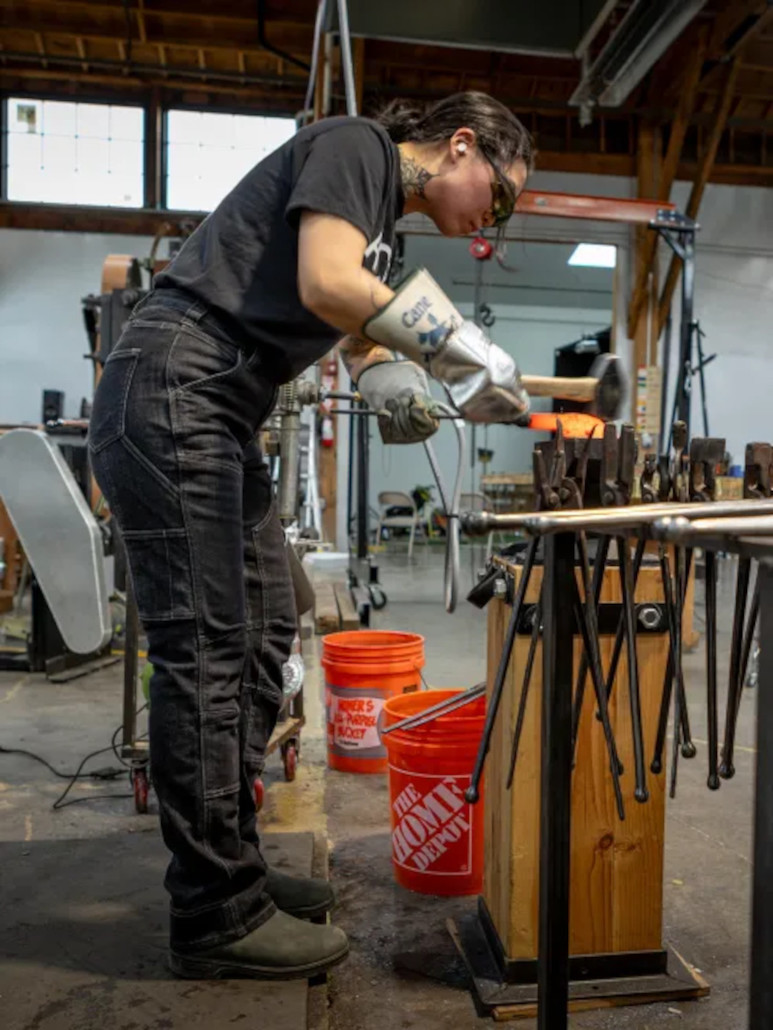
The graphene nanomaterial is “infused into each fiber at the molecular level, giving fabric a permanent boost in performance”. Dovetail says the integration retains the original weight and stretch of the fibers while delivering “game-changing benefits” like strength and enhanced temperature regulation to keep wearers comfortable in any season.
Bot Battle
It had to happen…it’s been building to this. Yes, the very first “robot Olympics.” China’s inaugural World Humanoid Robot Games took place last week in Beijing. Reports Gizmodo:
The three-day event kicked off Thursday, August 14, inside Beijing’s 12,000-seat National Speed Skating Oval, a venue originally built for the 2022 Winter Olympics. Over 200 teams from 16 countries including Japan, Brazil, Germany, and the U.S., competed across 26 competitions. The contests ranged from classic track-and-field events and gymnastics to kickboxing, soccer, medicine sorting, and even hotel cleaning.
As for the wi— Wait…what? Medicine sorting? Hotel cleaning? Maybe we should make those events in the human Olympics. (We also hasten to add that back in the early 20th century there were many Olympic events beyond athletics. Indeed, “printmaking” used to be an Olympic event. We continue.)
At the games, the humanoid robots pulled off some impressive feats. The first gold medal went to Unitree Robotics, whose H1 humanoid completed the 1,500-meter race in just 6:34 seconds. Unitree founder and CEO Wang Xingxing told local media that he expects future robots to run autonomously, most of them are still being controlled remotely. The H1 humanoid robot currently goes for about 650,000 yuan (US$90,494).
Why not split the difference and take a tip from horse racing: robot jockeys.
However, not everything went smoothly, proving the tech still has some limitations. Some robots froze at the starting line or failed to finish their race, and one robot even lost an arm mid-race. In a soccer match, one clumsy robot triggered a pileup.
That would be, in the parlance of ABC’s “Wide World of Sports,” “The agony of defeat.”
That’s a Stretch
You have GOT to be kidding. Not The Onion, but rather The Guardian (via Boing Boing). Men are deliberately breaking their legs and having them lengthened in a bid to become taller.
The 38-year-old is one of a growing number of men traveling to clinics like Istanbul's Wanna Be Taller for leg lengthening surgery. At 5'6", Frank spent $32,000 to gain nearly 3 inches in height — a procedure that involves breaking the leg bones, inserting metal rods, and slowly stretching them apart as new bone grows in the gaps. The global limb lengthening industry is projected to reach $8.6 billion by 2030.
“Global limb lengthening industry…” Oy. It sounds like some kind of torture.
Patients face potential blood clots, chronic pain, joint issues, and even death. Last year, a Saudi patient died from a blood clot 16 days after surgery. Frank himself suffered a pulmonary embolism during recovery, though he survived. The grueling rehabilitation requires months of physiotherapy to learn to walk again, along with strict medication regimens.
But why?
Frank insists the pain was worth transcending what he calls “the curse” of being short. As he told The Guardian: “It’s hard to explain if you’re not a short man yourself, but in modern society it’s almost a curse.”
Is it? Still? Rather than leg-lengthening, we’d rather extend the bones in the neck, so our head swayed at the end of a long stalk. Hey, we’d be taller, and if you’re going to go through all that, why not make it as disconcerting for others as possible.
We Repeat…
So, now, here’s the occupational hazard of compiling these Around the Web collections. One gets through a writeup of something outré, but then has the sneaking suspicion that we did it already.
For example, coming across a story in Discover this week, we stopped and said to ourselves, “Wait, didn’t we link to a story about how a dye used in Doritos can make mice invisible?” Mind you, this isn’t the sort of editorial question we usually ask, and our CMS lacks a tag for “invisible mice” stories. (Oh, Adam…) But it did sound familiar, and, it turns out, yes, we did, last fall.
Anyway, Discover’s “Key Takeaways on Invisible Mice”:
- Invisible mice do exist from recent research that used a type of dye from the chip Doritos to create a transparency effect that lasted about 10 to 20 minutes.
- Research on transparent mice can help us learn more about physiological processes in internal organs and the brain in humans.
- Other researchers have even used the technique in invisible mice to turn a human eye transparent
And what we said last time:
So you shouldn’t rub Doritos on your skin? Ah, no: they created a transparency-inducing lotion. Come on, they’re not calling it vanishing cream? (Do they still make vanishing cream?)
Think of this as a summer rerun. (Do they still have summer reruns?)
When It Rains It Pours
Do you like salt? We mean, really like salt, to the extent that you can get this snooty about it? From (who else?) Food & Wine:
Whenever someone I know goes out of town, the only item I ask them to bring back is locally harvested salt. Before I became a chef, my office desk drawer was full of it. I would slide it open to reveal Maldon, applewood-smoked salt, kosher salt, black Icelandic salt, Pangasinan Star fleur de sel, and a little tin of Jacobsen — a crunchy salt harvested on the Oregon coast.
So no container of Morton’s for her.
How about this, though: strawberry salt?
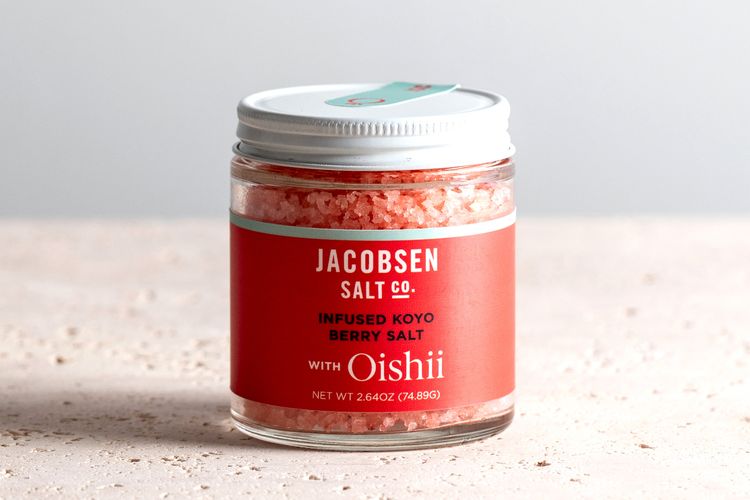
Last year, Jacobsen Salt Co. launched a sea salt with Oishii, the vertical farm known for its luxury strawberries grown to replicate Japanese varietals, which sold out within 36 hours. Now it’s back. Dubbed “summer in a jar,” JSC x Oishii Infused Koyo Berry Salt is a mix of Jacobsen Kosher Sea Salt, cane sugar, and Oishii’s Koyo Berry.
Does it pass muster, or it is (ahem) a salt on the taste buds?
Koyo Berry salt has a pretty pink hue and smells of strawberries grown by the ocean. Upon first taste, I couldn’t place the strawberry flavor. I was expecting a big burst of juicy flavor like Oishii’s original Omakase berry. The Koyo notes are a bit tart, but they get lost among the large clods of sea salt. My instinct was to add more of the condiment to every bite of food to coax more berry flavor, but the salt overpowered it.
But you can get used to anything.
once I started experimenting with the salt and other toppings, I found that it was indeed a welcome addition to everything from ice cream to fresh fruit.
A steal at—yikes!—$18 for a 2.64-ounce jar. Maybe we’ll stick with Morton’s.
This Week in Printing, Publishing, and Media History
August 18
1850: French novelist and playwright Honoré de Balzac dies (b. 1799).
1868: French astronomer Pierre Janssen discovers helium.
1958: Vladimir Nabokov's novel Lolita is published in the United States.
August 19
1631: English poet, literary critic, and playwright John Dryden born.
1646: English astronomer and academic John Flamsteed born.
1662: French mathematician, physicist, and philosopher Blaise Pascal dies (b. 1623).
1839: The French government announces that Louis Daguerre’s photographic process is a gift “free to the world.”
1906: American inventor (the Fusor) Philo Farnsworth born.
1921: Star Trek creator Gene Roddenberry born.
1939: English drummer and songwriter Ginger Baker born.
1964: Syncom 3, the first geostationary communication satellite, was launched.
1977: American comedian and actor Groucho Marx dies (b. 1890).
August 20
1858: Charles Darwin first publishes his theory of evolution through natural selection in The Journal of the Proceedings of the Linnean Society of London, alongside Alfred Russel Wallace’s same theory.
1882: Tchaikovsky’s 1812 Overture debuts in Moscow, Russia.
1890: American short story writer, editor, novelist H. P. Lovecraft born.
1920: The first commercial radio station, 8MK (now WWJ), begins operations in Detroit.
1926: Japan’s public broadcasting company, Nippon H?s? Ky?kai (NHK) is established.
August 21
1888: The first successful adding machine in the United States is patented by William Seward Burroughs.
1952: English singer-songwriter and guitarist Joe Strummer born.
1961: Motown releases what would be its first #1 hit (in America), “Please Mr. Postman” by The Marvelettes.
2005: American businessman, founded Moog Music Robert Moog dies (b. 1934).
August 22
1485: “A horse! My kingdom for a horse!” The Battle of Bosworth Field, the death of Richard III and the end of the House of Plantagenet.
1849: The first air raid in history. Austria launches pilotless balloons against the city of Venice.
1862: French pianist and composer Claude Debussy born.
1893: American poet, short story writer, critic, and satirist Dorothy Parker born.
1902: Theodore Roosevelt becomes the first President of the United States to make a public appearance in an automobile.
1920: American science fiction writer and screenwriter Ray Bradbury born.
1971: American singer-songwriter and guitarist Craig Finn born.
August 23
1946: English drummer, songwriter, and producer Keith Moon born.
1966: Lunar Orbiter 1 takes the first photograph of Earth from orbit around the Moon (not Keith).

1973: A bank robbery gone wrong in Stockholm, Sweden, turns into a hostage crisis; over the next five days the hostages begin to sympathize with their captors, leading to the term “Stockholm syndrome.” (Some trade shows are like that.)
1991: The World Wide Web is opened to the public.
August 24
1456: The printing of the Gutenberg Bible is completed.
1891: Thomas Edison patents the motion picture camera.
1995: Microsoft Windows 95 is released to the public in North America.
1998: First radio-frequency identification (RFID) human implantation is tested in the United Kingdom.