AI-Yi-Yi, Part the Infinity: Sheer Cat Attack
A subset of so-called AI—and a subset of large language models (LLM)—are “reasoning language models”: LLMs that are trained to break problems down into small steps, revisiting them and revising them so these reasoning models can solve more complex problems. However, according to a new study, they are easily confused by cats. But then, to their credit, so is everyone. Via Boing Boing:
The study found that Injecting “query-agnostic adversarial triggers – short, irrelevant text that, when appended to math problems, systematically mislead models to output incorrect answers.” Some models were up to 700% more likely to get an answer wrong when subjected to a CatAttack.
To illustrate:

Obviously a human encountering the catfact would disregard it, but even the most sophisticated reasoning language models yielded results that were less than purrfect. Now, granted, it’s not just cats. Conclude the researchers:
Our work on CatAttack reveals that state-of-the-art reasoning models are vulnerable to query-agnostic adversarial triggers, which significantly increase the likelihood of incorrect outputs. Using our automated attack pipeline, we demonstrated that triggers discovered on a weaker model (DeepSeek V3) can successfully transfer to stronger reasoning models such as DeepSeek R1, and models from different model families, increasing their error rates by up to 700%. These findings suggest that reasoning models, despite their structured step-by-step problem-solving capabilities, are not inherently robust to subtle adversarial manipulations, often being distracted by irrelevant text that a human would immediately disregard.
And not only do they generated wrong answers, they take longer.
Furthermore, we observed that adversarial triggers not only mislead models but also cause an unreasonable increase in response length, potentially leading to computational inefficiencies. This work underscores the need for more robust defense mechanisms against adversarial perturbations, particularly, for models deployed in critical applications such as finance, law, and healthcare.
Let the fur fly!
Hello, Dollight
Here is the challenge for today’s industrial design brands:
How do you create meaningful, customizable products without the compromises of mass production or the exclusivity of full custom work?
One potential answer may be the Dollight, a 3D-printed lamp developed by San Diego industrial design firm Official Use Only whose motto is, via Core77, “When personal design meets custom manufacturing.” OUO spun out a separate company, Dolop to produce the lamps.
We developed a collection of sculptural table lamps inspired by Japanese Kokeshi dolls. Each Dollight is 3D-printed fresh when ordered, offering 100+ combinations through food-inspired colors and textures, while connecting every purchase to charitable causes through the Sweetest Slice Program.
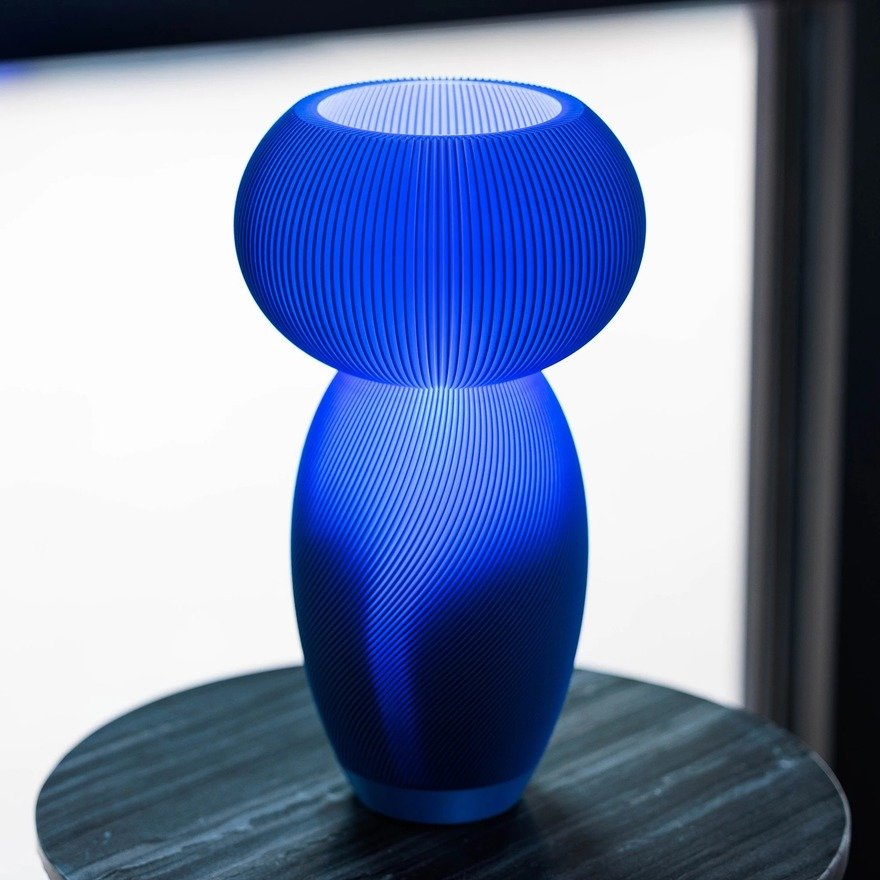
Instead of choosing between mass production and custom work, we found the sweet spot: on-demand 3D printing that enables artisan-scale manufacturing with designer oversight. Each Dollight is made fresh when ordered, allowing infinite customization without inventory risk.
By “customization” they mean “color” and “texture.”
Over 100 combinations through 16 food-inspired colors and multiple textures, but the selection process feels intuitive rather than overwhelming. Customers create something uniquely theirs without needing design expertise.
Within limits, natch. So if you wanted it to instead look like, for example, a shapely human leg, you’d be out of luck—but, as it turns out, there are other sources for that.
And there are other benefits
The Sweetest Slice Program means every color choice supports local causes—education, healthcare, conservation, food security. Beautiful lighting becomes beautiful impact.
Gotta say though, there a lot of background info and industrial philosophy, but no indication of what one would cost.
Still, if you’re in the market for a lamp, check it out.
Stranger Than Nonfiction
What’s the strangest book you ever read? Big Think rounds up a short list of what it deems the strangest books ever written.
They do go for the obvious, including James Joyce’s inscrutable Finnegans Wake on the list.
Most of the words are recognizably English, but Joyce manipulates them for his own ends. The book’s paragraphs feature odd word combinations, snippets of other languages, and, shall we say, bold choices of onomatopoeias. In many cases, this hybridized language is used to make increasingly obscure references to religion, mythology, literature, philosophy, and other texts. Consider when Hamlet is deemed “Camelot, prince of dinmurk,” and you’ll have an idea of how far you can throw the rabbit hole.
We’ve mentioned Gadsby by Ernest Vincent Wright here before (it was written without the letter “e”), and the 15th-century Voynich Manuscript is pretty famous:
a 15th-century book that is clearly about something strange, written in a language that has proven impossible to decipher, and yet exhibits traits of being a real language. It has been owned by alchemists, maybe even an emperor, and went missing for centuries.
If you’re looking to spice up your summer reading, check out the full list.
The Original Fake News
If you lived in New York City in the 1870s…you’d be really really old now. No, sorry, if you lived in New York City in the 1870s, chances are you’d be a regular reader of the New-York Herald, one of the most important and influential newspapers of its time. For example, it was the Herald that financed Henry Stanley’s search to find Dr. David Livingstone in the interior of Africa (leading to the famous greeting—and Moody Blues song—“Dr. Livingstone I presume?”).
But the Herald was also not above the occasional dodgy stunt. On November 9, 1874, they ran a front-page story supposedly reporting that the animals had escaped from their cages in the Central Park Zoo and were on the loose in the city.
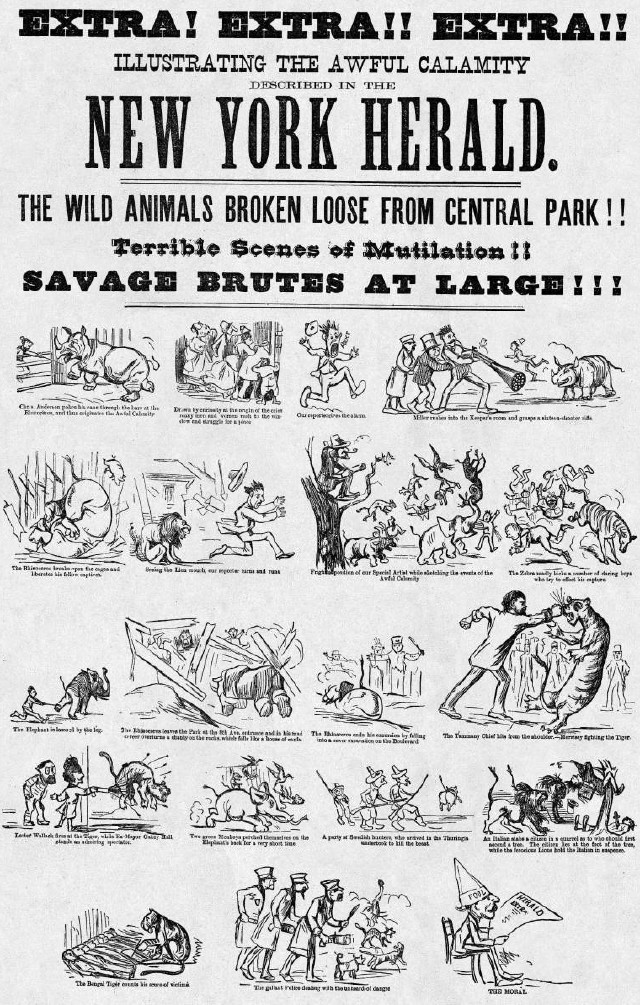
“Savage Brutes at Large”—headline writers were quite something back then. Adds (spoiler alert) The Museum of Hoaxes:
A lion had been seen inside a church. A rhinoceros had fallen into a sewer. The police and national guard were heroically battling the beasts, but already forty-nine people were dead and two hundred injured. It was "a bloody and fearful carnival," the article despaired. And the animals were still on the loose!
One questions the physics of how a rhino falls into a sewer. And, indeed, one questions the entire story because it was in fact not true. But that didn’t stop mass panic from overtaking the city. To the paper’s (only slight) credit, they did point out, at the end of the article and in a much smaller point size, “the entire story given above is a pure fabrication.”
Why would they do this? To sell more papers? Actually no: according to Thomas Connery, an editor at the Herald, whose idea the story was, it was to raise awareness of the shoddy conditions at the Central Park Zoo.
Connery claimed that the idea for the hoax came to him after he witnessed a leopard almost escape while being transferred from an animal-carriage into its cage in the Central Park Zoo (referred to as the “menagerie” at the time). Wishing to call attention to the conditions at the zoo, Connery first thought of writing a column scolding the zoo keepers, but then decided that something more attention-grabbing was needed. He conceived of the idea of “a harmless little hoax, with just enough semblance of reality to give a salutary warning.”
Casting about for a writer to whom to assign the hoax article, he finally settled on Joseph Clarke, who really went to town.
Backing down from the mangled body with a swiftness almost incredible from his bulk, the rhinoceros plunged his horrid horn into the dead keeper...
The panther was crouched over Hyland’s body, gnawing horribly at his head. I recognized his body by the striped shirt which I could just see hanging tattered from the arm...
Men and women rushed in all directions away from the beast, who sprang upon the shoulders of an aged lady, burying his fangs in her neck and carrying her to the ground.
The guy missed his calling; he should have gone into horror writing.
At any rate, it was probably not journalism’s finest moment, although we’d certainly see worse.
Chalk It Up

Here’s an interesting form of street art. Via Laughing Squid, Ann Arbor, Mich.-based sidewalk artist David Zinn turned a manhole cover into a waffle iron for a 3D chalk-drawn possum and squirrel named Clem and Stuart.
And today’s bit of trivia. Why are manhole covers round? Because a circle is the only geometric shape that won’t allow the very heavy cover to fall back through the hole and hit someone on the head.
Let’s Talk Trash
You know how it is. You want to throw your trash in the bin, but you inevitably miss. If you weren’t raised by wolves, you’ll pick it up and try again. If you were, you’ll leave your rubbish on the ground and your wolf family will still shame you.
Anyway, this may be a moot point. Via Laughing Squid, engineers at HTX Studio have developed trash cans that automatically catch garbage in mid-air. The trash can spot when a piece of trash has been tossed, and it will rush over and catch it. It is also self-emptying. They also took things perhaps a bit too far:
With the basic function working we created three specialized bins. One can mop the floor plays rock-paper-scissors with you. Make you feel invincible One has a lid so it can now …talk trash…. And then came the ultimate bin The Punishment Bin equipped with a soft dart launcher If someone litters you can remote control it to fire a warning shot. Swap the dart for a laser pointer and you’ve got a mobile cat toy. Link them all to the same remote and you can take your bins for a walk.
Still, this is pretty cool.
Detroit Bot City
In related garbage news, via Futurism, Detroit has started using robots to pick up trash and provide other municipal services:
The machine is a BeBot litter robot, and it and other mobile bots have become increasingly common signs in Motown, according to Crain's Detroit Business, as they clear beaches of litter and do other important tasks such as removing snow from streets, cut grass next to highways, pick up food waste, and even provide on-demand charging to city shuttle buses wherever they may be located.
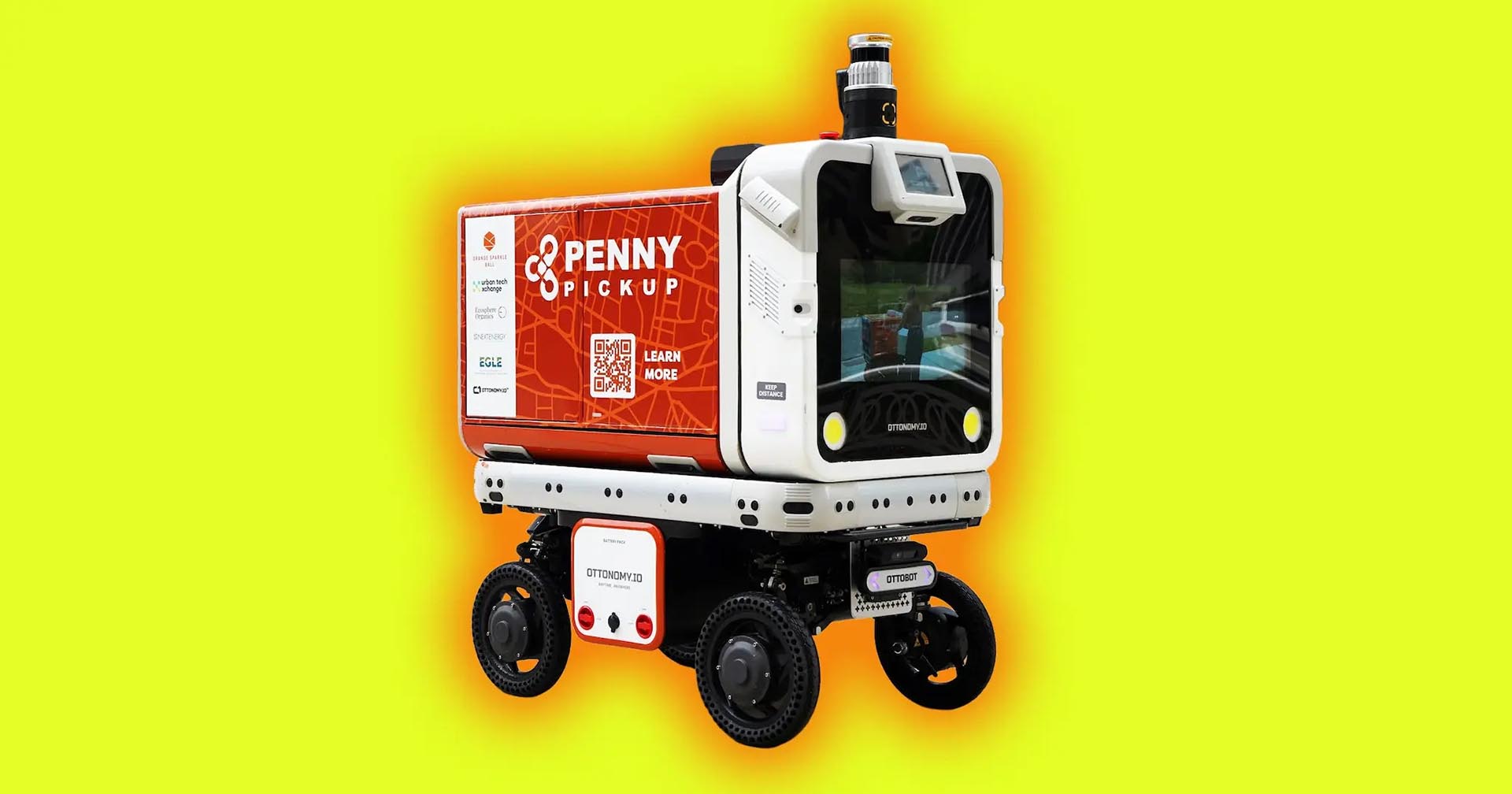
There is also the Penny Pickup, a robot that collects food waste from restaurants and sends it to a composter. There is also the Snowbotix, which tends to wintry streets. And another bot cuts grass along the highway.
And, uh oh, better get Lee Marvin on the phone:
Beyond these municipal bots, there are even boxing bots. A humanoid robot was seen walking in the city in the last couple of weeks, eliciting stares and smiles from pedestrians. The robot was walking and shaking hands with city residents as part of a promotional tour to create viral buzz for the Detroit-based Interactive Combat League, which stages fights between robots.
If the loser could be programmed to say “You knocked my block off!” if would be perfect.
So what’s with Detroit and robots?
These robots are part of a burgeoning tech ecosystem in the city, which has embraced them to boost municipal services and foster tech innovation in the once-mighty hub for automobile manufacturing. (Yes, Detroit was the setting of the 1987 Paul Verhoeven movie "RoboCop.")
"The automotive industry, and Detroit in particular, has a deep history of building things to make the world move," Detroit’s chief officer of mobility innovation told Crain’s. "Today, we are seeing those skillsets grow in the field of robotics and other emerging technologies aimed at improving core city services. Detroit is working across multiple platforms to bring the next generation of solutions to our city and put them to work."
Graphene Is Always On My Mind
Was it a good week for graphene news? It’s always a good week for graphene news! A graphene-based brain-computer interface. INBRAIN Neuroelectronics has been conducting the world’s first-in-human clinical study of its graphene-based brain-computer interface (BCI) technology. Why? Basically, to study the performance and safety of graphene-based electrodes used during the surgical removal of brain tumors. From (who else?) Graphene-Info:
Interim analysis of the results from the first cohort of four patients enrolled in the study demonstrated no device-related adverse events, a key component of the primary endpoint of the study. During awake language mapping, the device captured distinct high gamma activity linked to different phonemes, the smallest units of sound in speech, showcasing exceptional spatial and temporal resolution, even with micrometer-scale contacts. The ultra-thin, sub-micrometer graphene electrodes also proved compatible with commercially available, CE-marked electrophysiology systems, reliably recording real-time brain signals throughout the surgical procedures.
Would it surprise you to know that graphene offers many benefits for neurosurgical procedures? Of course it wouldn’t!
It enhances surgical precision by enabling smaller and more densely packed electrodes, allowing surgeons to define and preserve critical functional areas during tumor resection. Its flexibility enables accurate decoding and mapping in anatomically complex or hard-to-access brain regions, including the walls of the tumor resection cavity. Additionally, the device’s ability to decode high-frequency activity offers huge scientific opportunities including the potential to reveal in situ interactions between glioma cells and neurons, offering potential insights into new therapeutic targets for halting tumor progression.
Ah, brain surgery. Still, it’s not rocket science is it?
Leavin’ In a Jet Car
We’ve linked here often to various attempts at inventing a flying car, and Core77 has a nice historical round up of fictional and actual conceptions of a flying car. The latest iteration is, in its own way, kind of retro:
Dallas-based aerospace company FusionFlight is developing something closer to the 20th-century vision of a flying car: A passenger compartment, and little else. They've done this by eschewing rotors and working with jets.
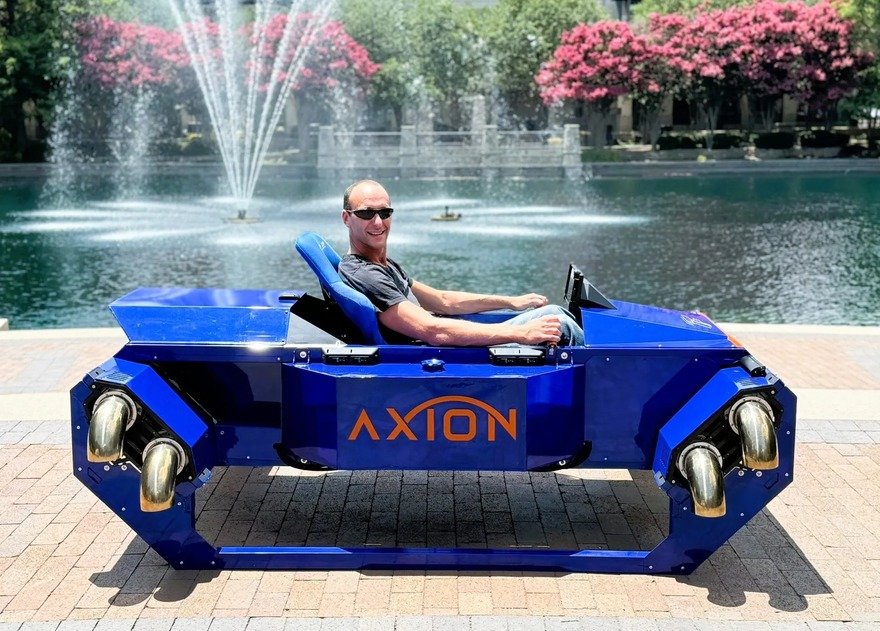
His Axion is a personal VTOL powered by pairs of micro-jets at each corner, and the bulk of the craft is occupied by two 15-gallon fuel tanks. These can be filled with regular "gas-station diesel," the company says, and can then haul a 176-lb. pilot at 225 mph for 15 minutes.
Feel free to do the math based on your own weight.
The company says the hot gas emitted by the micro-jets doesn't reach the ground during take-off or landing, and so doesn't damage the landing pad surface.
Not sure the landing pad is the thing to worry about. Anyway, the eight jets provide enough redundancy (and a big enough carbon footprint, no doubt) should one jet fail. Two jets…well…
Furthermore, they point out that being jet-powered, the Axion “is not as susceptible to inclement weather as other propeller and winged-based vehicles.”
Well, except insofar as there appears to be no roof or canopy which can’t be fun for the driver/pilot in a rain or snow storm.
Interestingly, the pitch video does not actually show it flying:
Although another clip does—albeit remote-controlled:
Hopefully it comes with air sickness bags.
Them!
Here’s a headline to reckon with. From The Guardian: “Radioactive wasp nest discovered at nuclear waste storage site in South Carolina.” This from a US Department of Energy report identifying the discovery of said wasp nest at a facility in South Carolina that was once manufactured parts for nuclear weapons. Ah, if only this were the 1950s; how many B movies would this have inspired, where giant irradiated wasps terrorize a small town? What might have been!
All the Young Dudes
What is the most important word in the English language? “The,” arguably, but via NPR, it could very well be “dude.” The word evokes 1980s and 90s Southern California beach culture (some of us were kicked out of Los Angeles for not being able to use the word “dude” without irony) and let’s not forget The Dude from The Big Lebowski. However, NPR traces the etymology of the word “dude” and finds that it dates back to the 19th century.
The exact origin of the word has been difficult for linguists to pin down, but Gerald Cohen, a professor at Missouri University of Science and Technology, published a book on the topic in 2023 with two other language scholars. Cohen says it seems to have been coined in reaction to a particular fad among young men in New York City in the late 19th century. Think hipsters of the 1880s.
The style of dress was “over the top” and “fancy”—what we might call “foppish”—and they adopted a faux-English lifestyle that was easy to mock, if one was into fop-shaming in the 1880s.
Eventually, these men became known as “dudes,” likely in reference to Yankee Doodle, who, as the old war song goes, was an unsophisticated American who “stuck a feather in his cap” in an attempt to parade as a kind of European “dandy” in high society.
Cohen and Co. even found a derisive poem published in a New York City newspaper titled “The Dude,” composed by an unknown poet named Robert Sale Hill. Its final lines:
America can ill afford
To harbor such deformity,
And we would humbly thank the Lord
To spare us this enormity.
As might be expected, the result was to make dudism even more of a craze.
An 1883 article from the New York Times describes a “dudes’ picnic” where thousands of young people rushed to a park in Harlem at the promise of seeing men in “full dude dress.”
This led to the advent of the “dude ranch” in the late 19th-century in which Easterners would travel out west and play cowboy. It became such a popular pastime that the National Dude Ranchers Association was founded in 1925.
Over the course of the 20th century, the term began to be applied to minority populations—first derisively, then adopted as a term of solidarity, as often happens. The word got watered down a bit over the course of the next 80 years until it ended up in LA and Hollywood got a hold of it.
Now, Kiesling says, the word, which began in reference to young men, has lost a lot of its gender connotation but is still meant to show familiarity with a person. Maybe you don't use it with your boss or a stranger, but with your friends or acquaintances to show that you're in the same group.
The Taste Keeps Going…and Going
Have you ever licked a battery? This is not a random question, as some years ago at some trade show, it was a topic of conversation amongst the WhatTheyThink staff, and much to our surprise those of us who answered in the negative—understanding how electricity works—were decidedly in the minority.
Anyway, for the majority of folks out there who do lick batteries, have we got a treat for you: battery-flavored tortilla chips. From (who else?) Food & Wine Foodbeast:
Rewind, a snack brand based in the Netherlands, has released corn chips that taste like 9-volt batteries. The idea was inspired by childhood nostalgia, specifically the tiny tingle that comes from licking the tip of a 9-volt battery, which was like a weird rite of passage for little kids.
Was it? Guess we missed that one.
Rewind wants to take you down memory lane, but in flavorful fashion.
And how do they do this, dare we ask?
“We used a blend of citric acid and sodium bicarbonate to create the tongue-tingling effect, and balanced it out with mineral salts, which give the chips a metallic tang. The result is surprisingly tasty and it’s definitely a flavour that sparks curiosity,” Says Mattias Larsson, chef and flavorist leading flavor development.
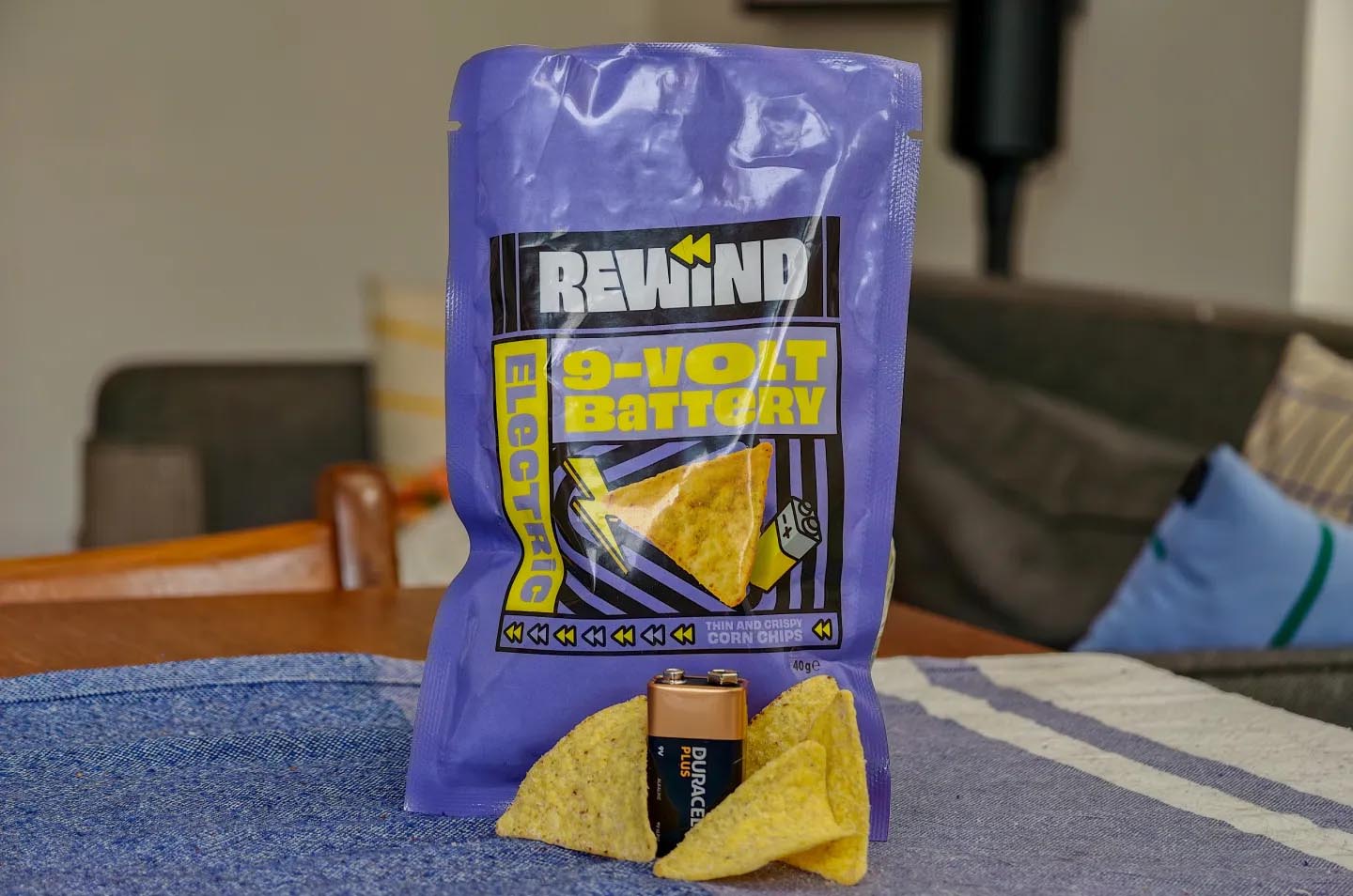
The chips are now available in the Netherlands, and are coming soon elsewhere in Europe, but no news of a U.S. release, which may be fortunate.
Now, if they invented a tortilla chip that could power electronic devices, they’d really have something.
We Will All Go Together When We Go
Last week, we bid farewell to Ozzy Osbourne, and this week, at the opposite end of the musical spectrum perhaps, we bid farewell to Tom Lehrer, the consummate musical satirist.
Lehrer’s sardonic numbers, backed up by a dazzling prowess at the piano that reflected his love for up-tempo Broadway show tunes, enchanted audiences in the 1950s and 60s.
…Well ahead of his time on issues including pollution and nuclear proliferation, Lehrer made his mark with biting humor and zany rhymes.
A mathematician by training, he had no interest in pursuing music full time and gave it up in the 1960s to focus on teaching, aside from a brief stint writing songs for the kids’ show The Electric Company in 1972.
Despite the brilliance of his original songs, a fan favorite is “The Elements,” little more than a recitation of the chemical elements in the periodic table (there were only 102 at the time) to the tune of Gilbert and Sullivan’s “A Modern Major General.”
This Week in Printing, Publishing, and Media History
July 28
1844: English poet Gerard Manley Hopkins born.
1866: At the age of 18, Vinnie Ream becomes the first and youngest female artist to receive a commission from the United States government for a statue (of Abraham Lincoln).
July 29
1805: French historian and philosopher Alexis de Tocqueville born.
1818: French physicist Augustin Fresnel submits his prizewinning "Memoir on the Diffraction of Light", precisely accounting for the limited extent to which light spreads into shadows, and thereby demolishing the oldest objection to the wave theory of light.
1953: Canadian musician Geddy Lee (né Gary Lee Weinrib) born.
1958: U.S. President Dwight D. Eisenhower signs into law the National Aeronautics and Space Act, which creates the National Aeronautics and Space Administration (NASA).
July 30
Both English novelist and poet Emily Brontë (1818) and English singer-songwriter and producer Kate Bush (1958) born.
1909: English historian and author C. Northcote Parkinson, coiner of “Parkinson’s Law,” born. He would soon grow to fill the entirety of his crib.
1932: Premiere of Walt Disney’s Flowers and Trees, the first cartoon short to use Technicolor and the first Academy Award-winning cartoon short.
2006: The world’s longest running music show Top of the Pops is broadcast for the last time on BBC Two. The show had aired for 42 years.
July 31
1703: Author Daniel Defoe is placed in a pillory for the crime of seditious libel after publishing a politically satirical pamphlet, but is pelted with flowers.
1790: The first U.S. patent is issued, to inventor Samuel Hopkins for a potash process.
1919: Italian chemist and author Primo Levi born.
August 1
1774: British scientist Joseph Priestley discovers oxygen gas. (What had everyone been breathing before that?)
1819: American novelist, short story writer, and poet Herman Melville born.
1965: Frank Herbert's novel Dune was published for the first time. It was named as the world’s best-selling science fiction novel in 2003.
1981: MTV begins broadcasting in the United States and airs its first video, “Video Killed the Radio Star” by The Buggles.
1981: American author, playwright, and screenwriter Paddy Chayefsky dies (b. 1923).
August 2
1790: The first United States Census is conducted.
1870: Tower Subway, the world's first underground tube railway, opens in London, England, United Kingdom.
1922: Scottish-Canadian engineer, inventor of the telephone Alexander Graham Bell dies (b. 1847).
1924: American novelist, poet, and critic James Baldwin born.
1932: The positron (antiparticle of the electron) is discovered by Carl D. Anderson.
1988: American short story writer and poet Raymond Carver dies (b. 1938).
2018: Apple Inc. becomes the first U.S. company to be valued at over $1 trillion.
August 3
1527: The first known letter from North America is sent by John Rut while at St. John's, Newfoundland.
1778: The theatre La Scala in Milan is inaugurated with the première of Antonio Salieri’s Europa riconosciuta.
1811: American businessman, founder of the Otis Elevator Company Elisha Otis born.
1859: The American Dental Association is founded in Niagara Falls, New York. (Was their theme song “Bridge Over Troubled Water”?)
1860: French-Scottish actor, director, and producer, inventor of the Kinetoscope William Kennedy Dickson born.
1946: Santa Claus Land, the world’s first theme park, opens in Santa Claus, Ind.
1977: Tandy Corporation announces the TRS-80, one of the world’s first mass-produced personal computers.