Signs of the Times: Rikki Don’t Text That Number
It is not uncommon, when driving or walking around in the summer months, to see handmade signs nailed to utility poles advertising various kinds of services. One we see on a regular basis is for a “Pressure Cleaning” business:
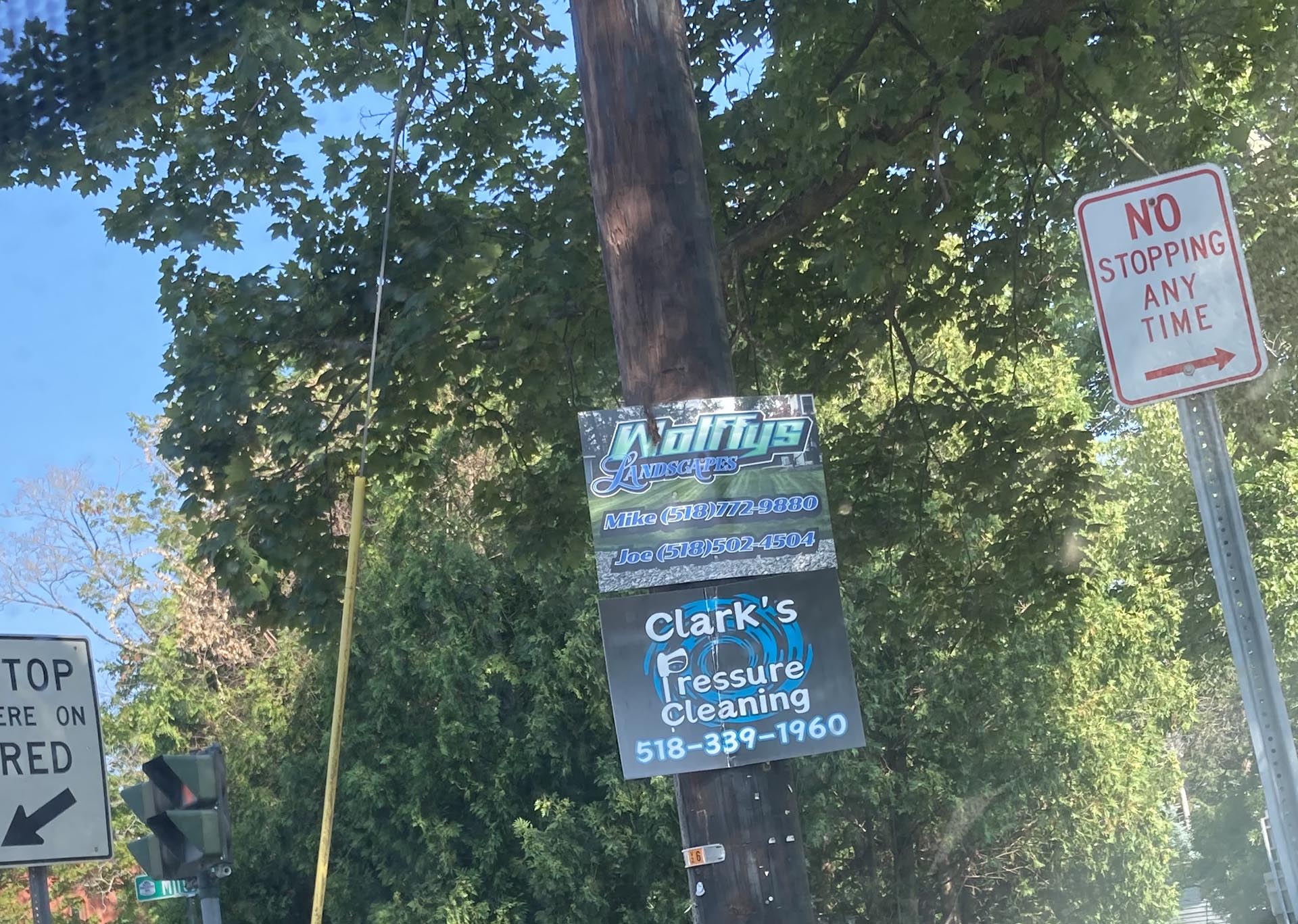
We can’t help but envision someone going “Come on! Clean, damn it! Clean! Now! Hurry up!” But we digress… Does anyone respond to these signs?
Well, via KBBBlog, Kate Bingaman-Burt was entranced by a series of colorful signs posted around Portland, Ore.
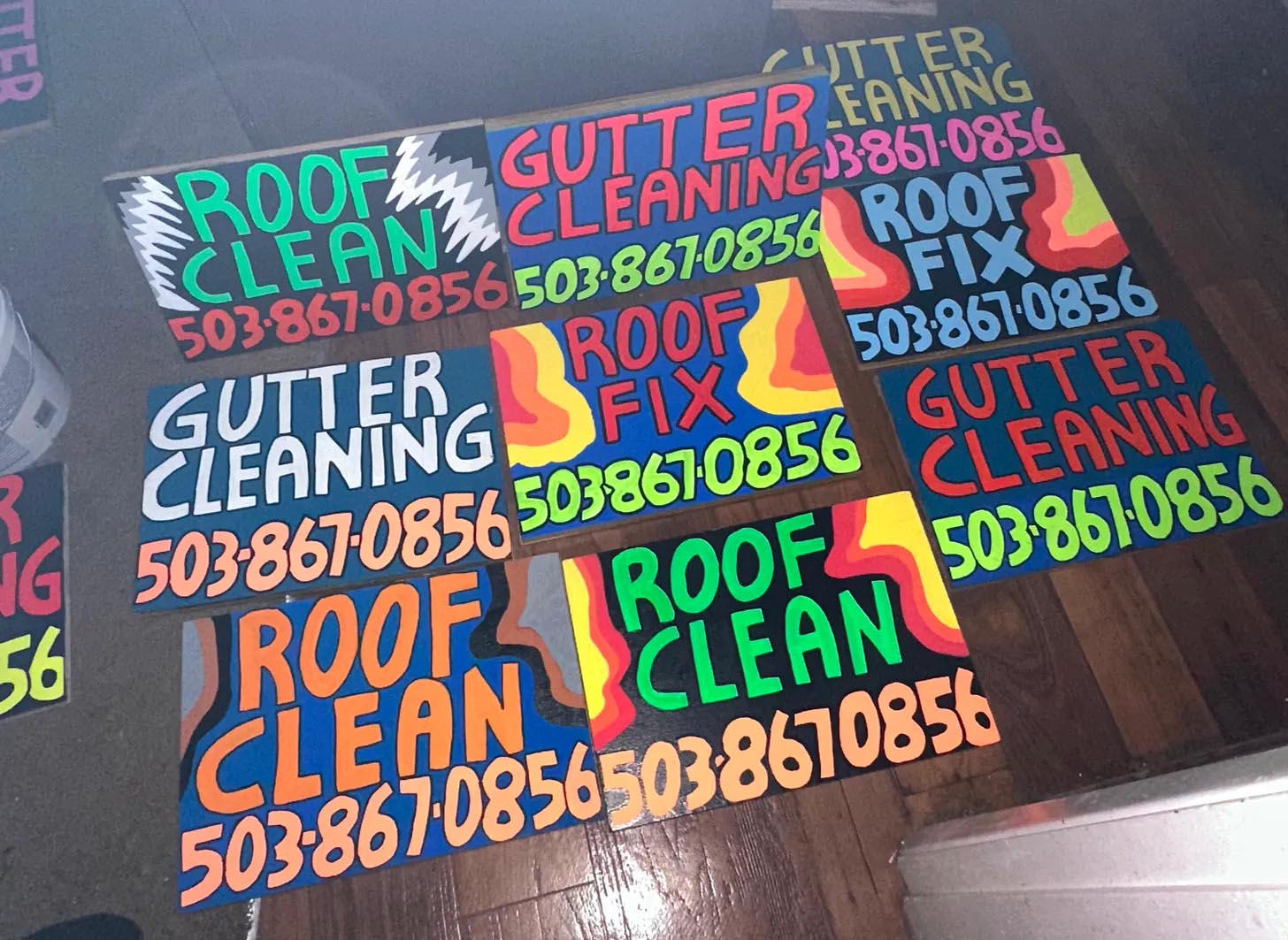
They advertise roof cleaning, house washing, and gutter clearing—sometimes just “ROOF CLEAN” in big, blocky letters—all in a riot of vibrant colors and lettering styles that feel totally human, wonky, and great. I felt a real kinship with whoever was making these type and color choices, and spotting the signs became a highlight of my drives around Portland. Every time I shared one on Instagram, folks responded with love and adoration.
So she texted the number on the sign and met Landon.
Landon owns the business and makes the signs. He paints them at night while watching sitcoms, mounts them with serious screws, and takes breaks to swim when it’s too hot to be on a roof. He is also the proud owner of a 100lb German Shepherd and 12 aquariums! Over several days, we had a long and lovely text conversation about work, color, signage, and his process for making these delightful signs.
Click through for a nice, long conversation about his process, the materials he uses, and his roof/gutter cleaning business.
If you want one of Landon’s signs and you're local, shoot him a text! His number is on his signs! He’s open to selling them, and he’s also open to custom orders. And if you need your roof cleaned, patio washed, or gutters gutted, Landon is your guy.
Shake It Like a Polaroid Picture
Polaroid—yes, that Polaroid—has a new camera out, the Flip, and is promoting it using a campaign called “The Camera for an Analogue Life” that taps into “tech fatigue.” Says Creative Bloq:
Combining Polaroid photos with provocative copy lines including, “AI can't generate sand between your toes,” and “Real stories. Not stories & reels.”, the campaign, designed in-house, is a timely reminder of the importance of connection and living in the moment. Like all the best print ads, these stick in the mind for a while.
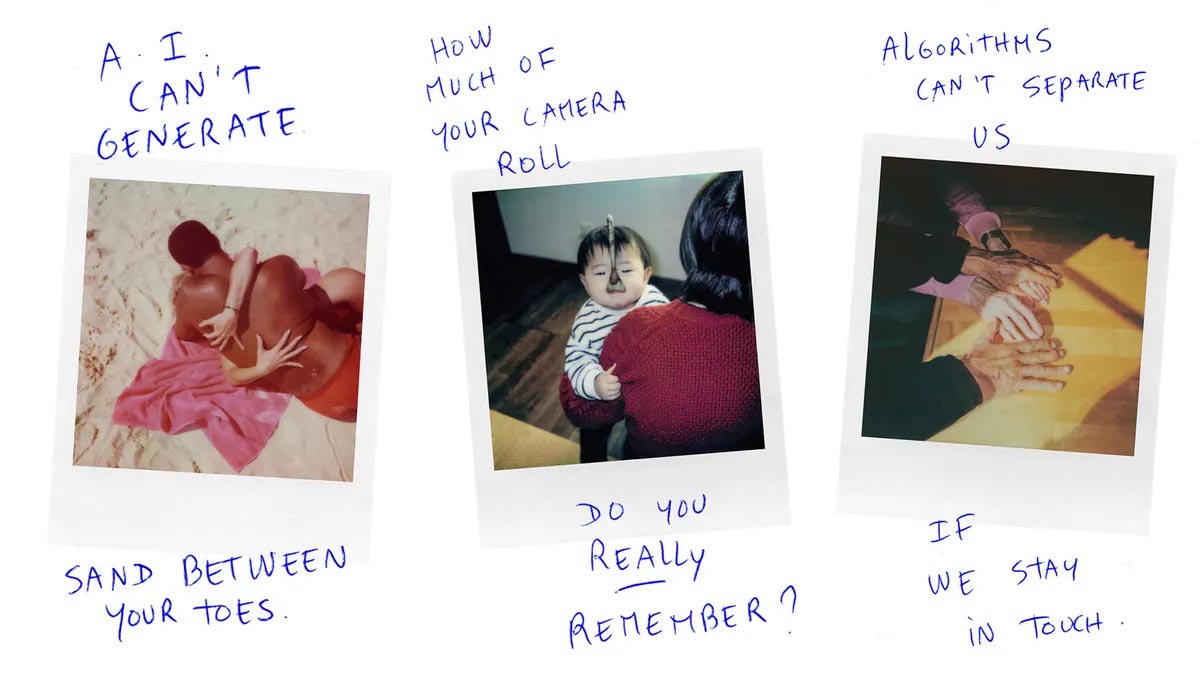
“We are analog creatures, built to connect through our senses but the more we lose ourselves in digital algorithms, the more we drift away from empathy and real connection,” says Patricia Varella, Brand and Creative Director at Polaroid. “There is something magical in a Polaroid picture. It captures the humanness in all of us, wrinkles and all, and reminds us that the best of life happens in the real, physical world.”
Polaroid’s strategy involves placing the ads—comprising billboards and posters—not only in high-traffic areas but also near Apple Stores and Google’s New York and London offices.
“By deliberately placing billboards and fly posters next to spaces synonymous with tech culture,’ Polaroid says it created “a striking juxtaposition, prompting passersby to pause and reconsider their relationship with the digital world.”
Goodness knows we often do.
Phygit Spinner
Over at Print magazine, packaging designer and brand strategist Vicki Strull debunks the idea that print is having a renaissance—because it was never dead to begin with.
Because print was never dead, and I don’t believe it ever should have been disregarded or pushed to the sidelines for digital. That’s because digital and physical work best in tandem. When it comes to online and in-real-life brand experiences, it’s not one or the other. A brand’s best approach is an integrated, multi-platform, multi-sensory strategy.
She adds:
Ever since the early 2000s, graphic designers have started becoming digital-first designers. They learned to design for the screen—for websites, UX, and social media BEFORE they learned to design for print, and that’s IF they had even designed for print. Digital-first designers (maybe you) might not recognize the advantages of print because print feels a little old-school. But trust me when I say: today’s print is NOT your grandfather’s print. And digital is NOT all that.
She uses the term “phygital”—which is not our favorite word in the world—to describe the intersection of the physical and the digital.
Brands are seeking more meaningful engagement beyond what they’re doing online, and to that end, they are rediscovering that tactile, immersive print and packaging are something digital simply cannot replicate.
News Hawk
Remember those old movies in which you would occasionally see a corner newspaper seller shouting “Extra! Extra!” and reciting some plot-specific headline? Such newspaper vendors do still exist, although we are not convinced they ever really yelled “Extra! Extra!”—or even “Supplémentaire! Supplémentaire!” Meet Ali Akbar, 72, who is Paris’ last remaining newspaper hawker, selling copies of Le Monde, which he has done for more than 50 years. From Gulf News:
Known for his quick wit and infectious smile, Akbar is now believed to be France’s last remaining newspaper hawker. His dedication and unique charm recently caught national attention, earning him one of the country’s highest honours: the Légion d’Honneur. President Emmanuel Macron will present the award at a formal ceremony at the Élysée Palace this fall.

Born in 1953 in Pakistan, he left the country as a teenager and journeyed through Afghanistan, Iran, and Greece before he finally settled in France. After doing a bunch of odd jobs, he bought a newsstand and started selling papers.
To Akbar, selling newspapers has never just been about making a living — it’s about connecting with people, spreading cheer, and becoming part of the rhythm of daily life. “When you have nothing, you take whatever you can get,” he says. For the residents of Saint-Germain, Akbar has become much more than a vendor—he’s a local institution.
He used to sell up to 300 papers a day, but that has dropped to about 40, yielding him around $70 a day.
Despite the decline of print media, Akbar continues his trade with unwavering dedication.
That’s the spirit!
Intramural Activity
Via Core77, next month, the Republic of Singapore celebrates its 60th anniversary as an independent nation, and to mark the occasion the National Museum of Singapore is exhibiting the country’s largest LEGO mural. Comprising 265,743 LEGO blocks, it depicts Singapore shops as they were in the 1960s.
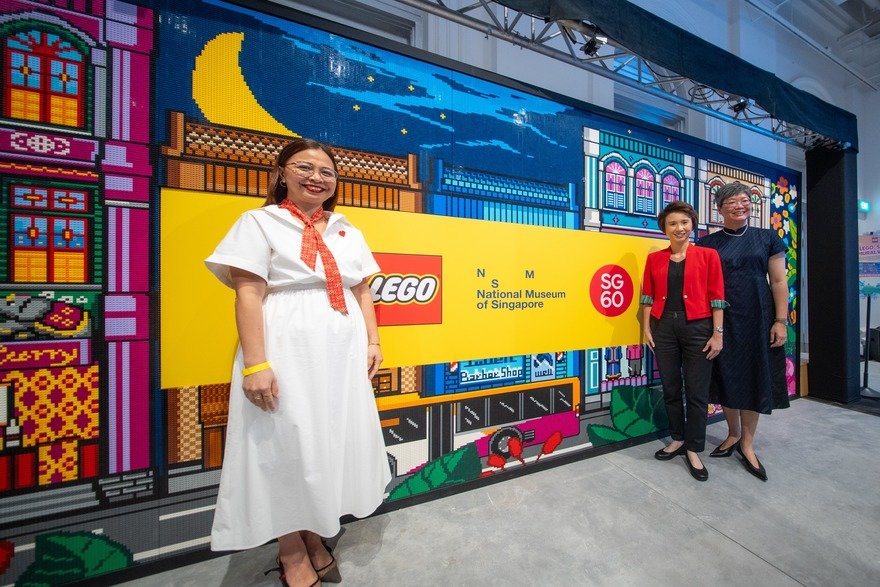
Schoolkids (and other visitors) are invited to help complete the mural: they used numbered spaces on the mural and a diagram to fill in the blanks from a “brick inventory.”

Pretty neat.
First Class Technology
Everyone loves to complain about the Post Office even though, it is one of our industry’s most important partners. There also tends to be the perception that the USPS is technologically behind the times but, via The Verge, over the years, the USPS that pioneered many things that we take for granted today.
Take, for example, aviation. After the First World War, the Postal Service worked with the Army Signal Corps to launch the first airmail service using leftover WWI aircraft. The planes were even more barebones than your average Southwest flight.
An excerpt from a 1968 issue of Postal Life called the early aircraft “a nervous collection of whistling wires” with “linen stretched over wooden ribs, all attached to a wheezy, water-cooled engine.”
There was a magazine called Postal Life?
At the time, pilots literally risked their lives delivering mail — 34 of them died between 1918 and 1927. “There was no commercial aviation, no airports. There was no radio. There was no navigation,” USPS historian Stephen Kochersperger says. “The Postal Service had to develop all of those things just for getting the mail delivered.”
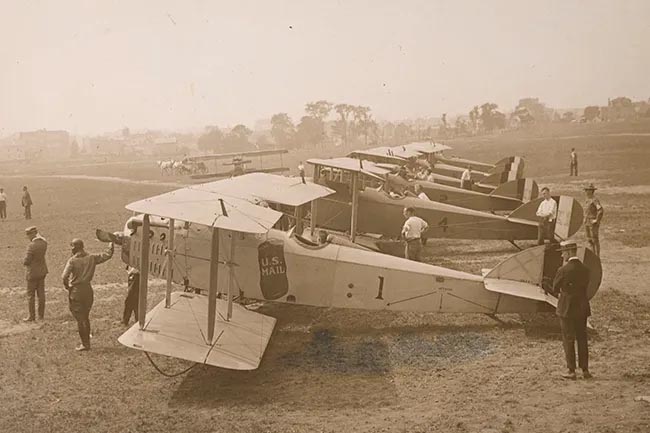
National Archives and Records Administration
Once the USPS proved it could deliver mail by plane, Congress ruled that it could contract airmail to emerging commercial aviation companies. These contracted airlines discovered they could make even more money by carrying passengers. And thus began the modern aviation industry. (We have mixed feelings about this.)
Not all their ideas panned out, such as the ill-advised plan to deliver mail by missile.
In 1959, the USPS and the US Navy loaded a Regulus I missile with two mail containers that had 3,000 letters in total. The missile traveled 100 miles in around 23 minutes, successfully landing at a Navy base in Mayport, Florida, with the help of a parachute. Despite its success, the idea never took off. It turns out missiles just can’t carry that much mail.
Too bad; they could have branded them “missile missives.”
The USPS was also an early adopter of optical character recognition (OCR).
In 1965, the USPS began to send large volumes of mail through OCR machines, allowing a “digital eye” to recognize addresses and automatically sort letters. If the machine couldn’t make out a person’s handwriting, the USPS would send an image to a remote encoding center (REC) for human review.
Today’s USPS OCR equipment can read handwritten mail with nearly 98% accuracy, and machine-printed addresses up to 99.5%. They have been using machine learning for 20 years and is now looking into adopting AI.
Also, believe it or not, the USPS briefly offered email. Via the National Association of Letter Carriers, in 1978 (!), the USPS proposed what it called E-COM (Electronic Computer Originated Mail). After much review and gnashing of teeth, it officially launched in 1982. It was a system with which businesses (mostly banks and insurance companies, the biggest postal customers who were already using computers to prepare bills and other mailings) could transmit electronic messages to the USPS, who would then send them electronically to post offices around the country, where—dig this—the messages would be printed, inserted in envelopes, and delivered by a letter carrier. (Amusing, yes, but remember that this was before anyone really had a home computer, much less a way to receive any kind of electronic message.)
Early in the development of E-COM, AT&T had been working on computer-to-computer email and put up a fuss about how the government’s E-COM service would undermine their own. As a result, the Postal Rate Commission (PRC) ruled that USPS couldn’t create its own electronic network but that telecommunication companies could transmit E-COM messages. This complicated everything and the cost of a message grew by 60%—the USPS was initially going to charge 15¢ per message—the same as (ha!) a First Class stamp at the time—but soon found they had to charge more. The E-COM service actually grew, but not enough, and was discontinued in 1985.
According to a 2008 report by the USPS historian, during its first year, 3.2 million E-COM messages were sent, and more than 600 customers submitted applications for the service.
Ah, what might have been….
Ad Blocker
OK, now, granted, we don’t always like looking at ads, particularly when they are horribly obtrusive, like pop ups online. But what about ads we come across in the physical world, like billboards and other outdoor advertising? Well, say what you want about them, but this idea just seems ridiculous. Via Futurism:
an enterprising software engineer posted an experiment with a pair of smart augmented reality glasses. When you don a pair of the specs and look at a billboard, or even the label on a food container, a red rectangle pops up to block the offending visual clutter from your view.
Come on; is a red rectangle an improvement over an ad or a label? Really?
Back in 2015, a group of college students in Pennsylvania developed a head monitor that uses image processing software to blur out advertisements in real life. But it was a cumbersome helmet, so that device never left the proverbial garage.
Now that’s just silly. And no one is forcing anyone to actually stare at an ad for any length of time, in a Clockwork Orange kind of way. And most people are staring at their phones anyway, so who cares?
Drink Ink
Worried about being out on the town and someone spiking your drink? Unfortunately, this still remains a thing. But, via Boing Boing, scientists have developed a temporary tattoo that can detect γ-hydroxybutyrate (GHB), a chemical commonly associated with drug-facilitated sexual assault (DFSA).
The innovative sticker, developed by Korean scientists, looks like a decorative temporary tattoo but packs serious protective power. Just dip your finger in your drink, touch the sticker, and if it turns red, that gin and tonic has been tampered with. The design offers a significant advantage over current testing methods, which can be awkward to use in social settings or take several minutes to show results.
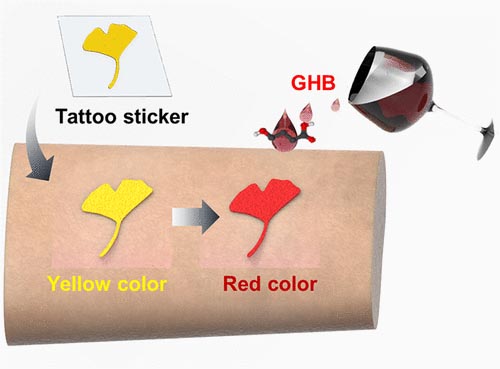
In their report, published by the American Chemical Society, it works with any beverage from cocktails to coffee, and the red indicator lasts up to 30 days, if it is needed as evidence after the fact.
The researchers say the stickers are cheap to produce and could hit the market soon. Given that drink spiking remains an ever-present threat – even among friends and acquaintances – this fashionable safety measure couldn't come at a better time.
Sad but true.
Graphene Is Patently Obvious
Was it a good week for graphene news? It’s always a good week for graphene news! Graphene Manufacturing Group granted battery patent. From (who else?) Graphene-Info:
GMG has signed a collaborative research agreement with UQ – Australian Institute for Bioengineering and Nanotechnology (AIBN) to continue its collaboration on the battery. The University of Queensland is also a recipient of AUD$880,000 (around USD$577,000) of Australian Government grant funding to further develop the Graphene Aluminum Ion Battery.
Bed-In
We all have the experience of having to physically be somewhere—school, work, etc.—but not being able or willing to get out of bed. But now, thanks to Gu Yupeng from China’s Yunnan province, you may be able to have the best of both worlds thanks to his motorized bed. Via Boing Boing:
Gu Yupeng designed this motorized bed to be able to roll over rough terrain. It can even roll through shallow water. During a flood or natural disaster, this bed could save lives, especially for people who may need mobility aids. In the video, he demonstrates the bed's foldable canopy to protect him in the rain. He also parks his bed next to a pond and goes fishing.
It has a range of 50 km, and he is even adding a self-driving mode, which is perfect if you want to randomly crash into things.
Have a Pint…of Ice Cream
Do you like Guinness, the Irish stout? Do you like ice cream? If so, good news! Guinness and Van Leeuwen Ice Cream have teamed up to create a limited-edition Guinness-flavored ice cream. Says (who else?) Food & Wine:
The new product, called “Lovely Day for a Guinness,” will be packaged in custom cartons inspired by the design of this summer’s limited-edition Guinness Draught Stout. Pints of the ice cream are now available for purchase at Van Leeuwen Scoop Shops nationwide for $11.15 or online at vanleeuwenicecream.com for $12, while supplies last.
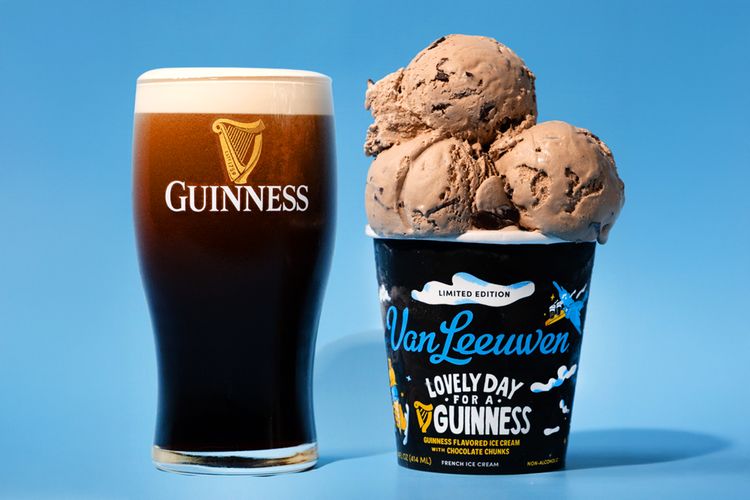
Say what you want, but this certainly sounds more appealing than Van Leeuwen’s past partnerships:
This isn’t the first time that New York City-based Van Leeuwen has teamed up to create an unusual ice cream flavor. The company has previously released Kraft Mac & Cheese-, Grey Poupon Dijon Mustard-, and Hidden Valley Ranch-flavored pints. While some of these creations might seem unappealing, a few have been quite popular with customers, and Van Leeuwen has brought back its bright orange Kraft Mac & Cheese ice cream to stores more than once.
Consider yourselves warned.
Ozzfest
Finally, we can’t end the week without bidding farewell to the Prince of Darkness himself, Ozzy Osbourne, who passed away last Tuesday. Via Laughing Squid, we highlight the time Conan O’Brien brought Ozzy in to cheer up his staff after the tragic events of September 11, 2001:
RIP, Ozz. You were enjoyed.
This Week in Printing, Publishing, and Media History
July 21
1816: German-English journalist and founder of Reuters Paul Reuter born.
1899: Ernest Hemingway born.
1911: Marshall McLuhan, Canadian author and theorist, born.
1948: Doonesbury creator Garry Trudeau born.
1969: At 02:56 UTC, astronaut Neil Armstrong becomes the first person to walk on the Moon.
2015: American novelist, short story writer, and playwright E. L. Doctorow dies (b. 1931).
July 22
1598: William Shakespeare’s play The Merchant of Venice is entered on the Stationers’ Register. By decree of Queen Elizabeth, the Stationers’ Register licensed printed works, giving the Crown tight control over all published material.
1893: Katharine Lee Bates writes "America the Beautiful" after admiring the view from the top of Pikes Peak near Colorado Springs, Colo.
1898: American poet, short story writer, and novelist Stephen Vincent Benét born.
1932: American novelist Tom Robbins born.
1967: American poet and historian Carl Sandburg dies (b. 1878).
July 23
1829: In the United States, William Austin Burt patents the typographer, a precursor to the typewriter.
1888: American crime novelist and screenwriter Raymond Chandler born.
1903: The Ford Motor Company sells its first car.
1957: English comedian, actress, and screenwriter Jo Brand born.
1962: Telstar relays the first publicly transmitted, live trans-Atlantic television program, featuring Walter Cronkite.
July 24
1847: Richard March Hoe patented the rotary-type printing press.
1895: English poet, novelist, and critic Robert Graves (I, Claudius and Claudius the God) born.
1900: Zelda Fitzgerald, American author, poet, and wife/drinking buddy of F. Scott Fitzgerald born.
1901: Author O. Henry is released from prison in Columbus, Ohio, after serving three years for embezzlement from a bank. The ending was not a surprise.
1969: Apollo 11 splashes down safely in the Pacific Ocean.
July 25
1834: English philosopher, poet, and critic Samuel Taylor Coleridge dies (b. 1772).
1837: The first commercial use of an electrical telegraph is successfully demonstrated in London by William Cooke and Charles Wheatstone.
1965: Judas! Bob Dylan goes electric at the Newport Folk Festival.
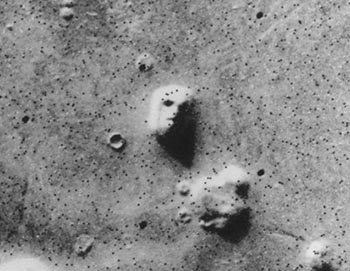
1976: Viking 1 takes the famous Face on Mars photo.
July 26
1502: German printer Christian Egenolff born.
1856: Irish playwright, critic, and Nobel Prize laureate George Bernard Shaw, born.
1887: Publication of the Unua Libro, founding the Esperanto movement.
1894: English novelist and philosopher Aldous Huxley born.
1928: American director, producer, screenwriter, and cinematographer Stanley Kubrick born.
1989: A federal grand jury indicts Cornell University student Robert T. Morris, Jr. for releasing the Morris worm, thus becoming the first person to be prosecuted under the 1986 Computer Fraud and Abuse Act.
July 27
1866: The first permanent transatlantic telegraph cable is successfully completed, stretching from Valentia Island, Ireland, to Heart's Content, Newfoundland. They could now communicate with each other to their heart’s content.
1940: What’s up, Doc? The animated short A Wild Hare is released, introducing the character of Bugs Bunny.
1938: Gary Gygax, creator of Dungeons & Dragons, born.