Type O Personality
Ah, typos. Yes, we know we are as prone to them as anyone, and we do still cringe when we catch one after the fact. But, as it turns out, we don’t have to blame ourselves (or Autocorrect, increasingly) for typos: we can blame Titivillus. Who? you might ask. Well, via Boing Boing, he is “the medieval demon of typos.” Says Princeton University’s Medieval Studies department, he is responsible for “slips and sins in song, speech, and writing.”
Medieval Studies scholar Jan Ziolkowski, from Harvard University, traces his origins back to at least 1200, when he began showing up in paintings and sermons in medieval Europe and beyond.
Although it appears that in some characterizations, Titivillus was actually a typo scold.
Historian Amanda Foreman, writing in The Wall Street Journal, further explains that Titivillus, the “medieval demon of typos” who likely inspired the phrase “the devil is in the details,” took typos very seriously. She recounts that medieval scribes were “warned that Titivillus ensured that every scribal mistake was collected and logged, so that it could be held against the offender at Judgment Day.” Yikes!
Since “typo” is shorthand for “typographical error,” we’re not sure the term can be applied to handwritten manuscripts, but we get the point.
So, if you find a typo in this week’s Around the Web (and we’ll be happy if you only find one), don’t blame us!
A Good Sign
We have some potentially good news in the DIY signage world. Via Core77, Samsung has introduced the EMDX, a wireless, battery-powered color e-paper electronic sign. Because electrophoretic e-paper technology only uses power when the display is changed, it can last for up to 200 days on a single charge. At 32 in., it’s a fairly respectable size.

Samsung is targeting schools and offices, as well as the retail, transportation and healthcare sectors. For now at least, the technology is expensive enough that the customer base will be institutional, as opposed to say, mom-and-pop coffee shops. As long as these things stay at $1,200 each, baristas will still need good penmanship.
Core77 worries this will take business away from sign shops, perhaps not realizing that this kind of thing is the merest fraction of what a sign company does.
Autodidact
We’re not entirely sure we understand this, but, via Print magazine, a new typeface that also includes instructions for handwriting. Called Didactica (not the Greek goddess of pedants), it was designed by Sabrina Lopez, a Buenos Aires-based designer and founder of Typesenses, along with The Type Founders. It points up her background in calligraphy.
In its realization, Didactica provides valuable tools for handwriting instruction. As well it should! Lopez’s research about handwriting instruction around the globe, detailed below, is truly impressive. Didactica is available in six weights (from Light to Black), plus a variable font with an adjustable slant (0°–10°). It also includes educational versions accompanied by guidelines, directional arrows (Ductus), stroke paths (Direction), and even left-handed variants via OpenType features. It’s an ideal font for parents, teachers, and educational publishers because it works seamlessly in Microsoft Word and Pages (Apple).
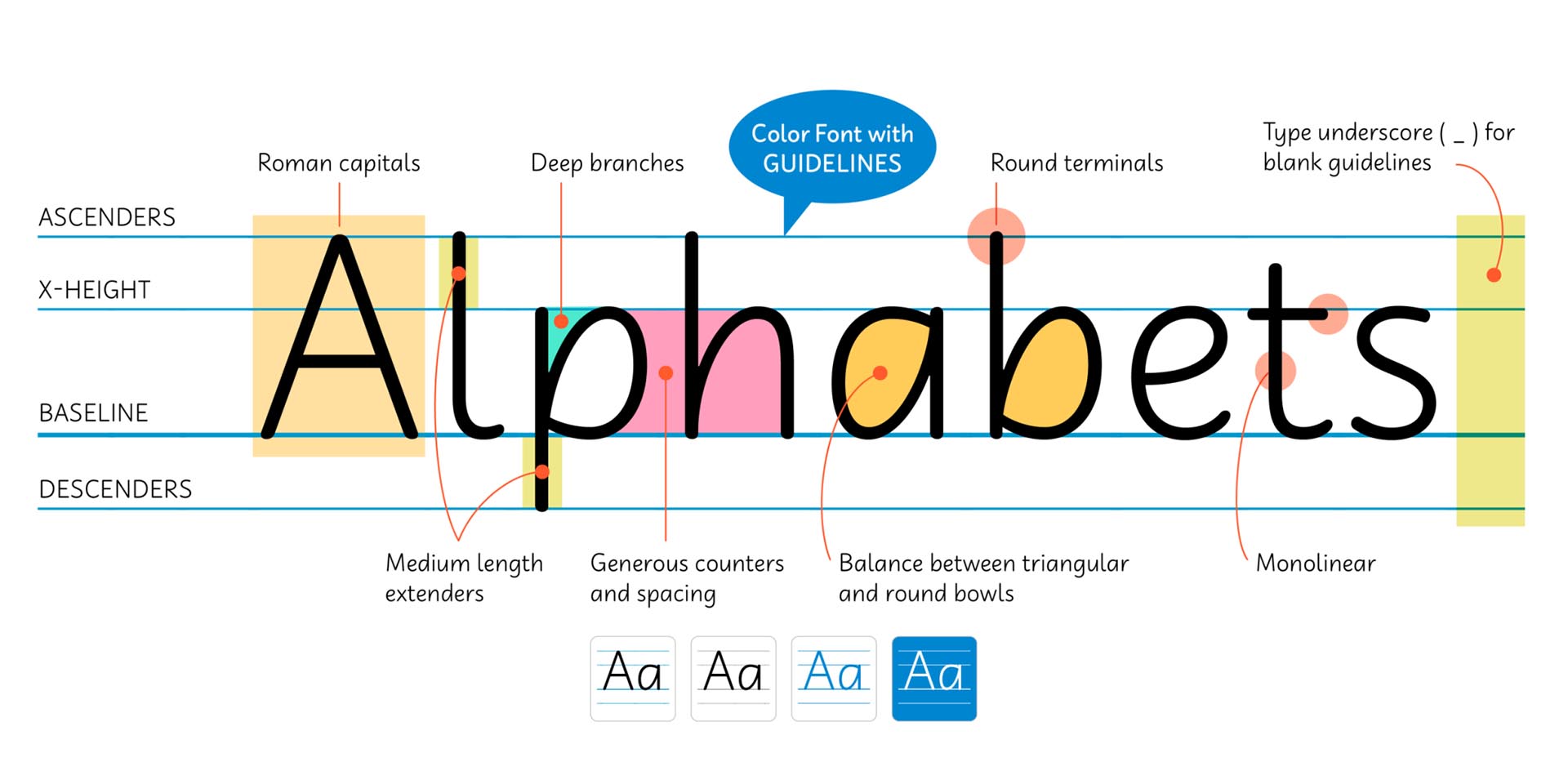
I designed Didactica as any other font in my catalogue. In my design process, I always start with calligraphy or hand lettering. All my typefaces, including the grotesque Honesta, have that handmade appeal. I am used to working with a style that involves manual skill. The long hours of reading helped me to shape the design in my mind before drawing. Additionally, my background in calligraphy contributed to the design decisions in making the letterforms, as well as the feedback and mentorship from TTF. Instead of changing any traditional type design rules, I’m using them in the context of educational use: OpenType features, Color Fonts, and Variable Fonts.
It is also designed to help children as they start learning to write.
Although my intention wasn’t to create a handwriting model but a typeface which looks familiar to kids in their first years of literacy, Didactica supplies useful tools for handwriting instruction.
In the Bag
Attempts at reducing plastic bag use have thus far ignored one big application area for plastic bags: the bags that hold the hardware needed to assemble furniture and other materials. However, IKEA is changing that, and is switching from plastic to paper for its fastener bags. Via Core77:
“The bags are produced in-house using paper made from production waste,” says Lukas Exner, Production & Distribution Manager at IKEA Components, who adds that then bags took several years of testing to develop. The payoff, he reckons, will be worth it. “This shift will reduce our virgin plastic consumption by up to 1,400 tons annually. It clearly shows how even the smallest change can generate great results.”
It's all part of IKEA’s goal of eliminating all virgin plastic from their products by 2030, and their goal to eliminate virgin plastic in their packaging by 2028.
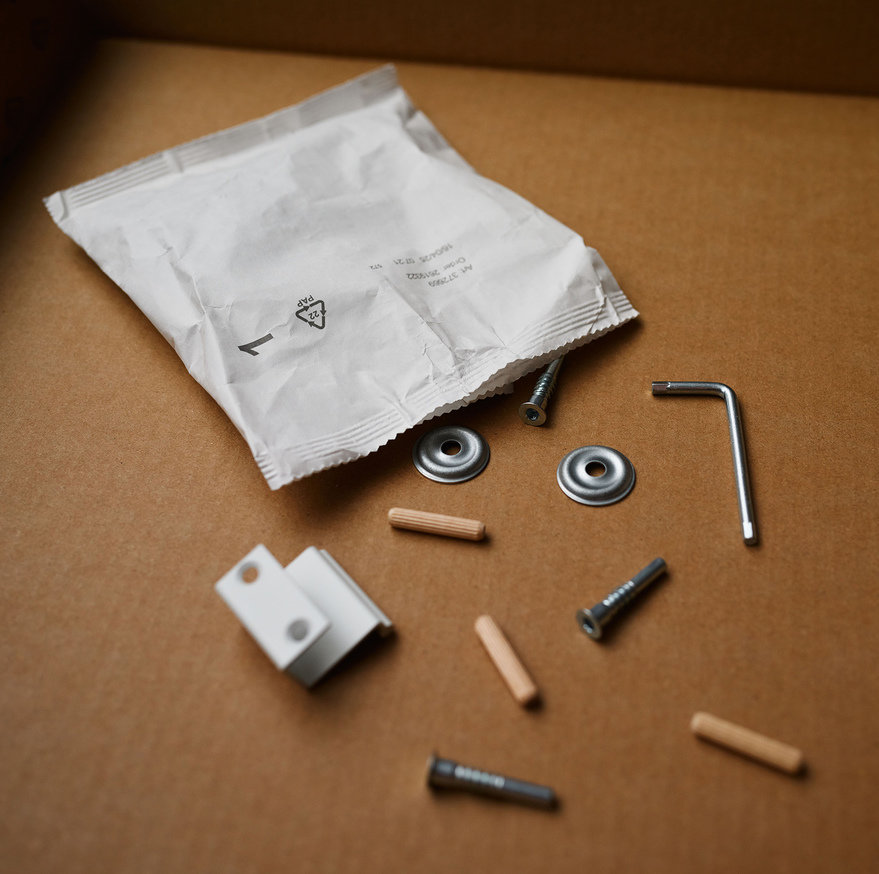
However, if you have ever put screws and other metal hardware in, say, an envelope, you know that they can easily rip through the paper. IKEA had this problem. So they had to fudge the no-plastic thing slightly.
In order to make the new bags durable enough to hold fasteners, the company found they had to add a “thin plastic coating,” but says the bags are still recyclable. They also say they’re “investigating the possibility of replacing this plastic coating with renewable materials.”
Remember, sustainability is a journey not a destination. But then, as one of the commenters pointed out, “Coconut husks were used as packing material for centuries.” So there’s an interesting idea, if only because “husks” is a fun word to say.
Em and Em
The em dash. Originally named for the width of a capital M (as opposed to an en dash, named—you guessed it—for the width of a capital N), it has apparently become a divisive punctuation mark, but then it always kind of was. Some people overuse them, some people actively loathe them, and some people have lives and don’t really care all that much. Now, via Salon, AI is bringing the em dash back into the conspiratorial spotlight.
Conjecture about ChatGPT’s apparent addiction to the em dash has been percolating online for months. Posts in Reddit’s r/ChatGPT ask, “Has anyone noticed how ChatGPT tends to use em dashes frequently?” and “Is an em dash (—) proof of AI manipulation?”
Honestly, we have been using (perhaps overusing) em dashes decades before ChatGPT was a gleam in our dystopian eye.
Tech-business headlines have warned against “the telltale sign that you used ChatGPT.” A viral Instagram reel posted by LuxeGen (“Gen Z’s go-to source of fashion, beauty, life advice & pop culture”) featured two young influencers roasting a fashion brand whose use of “the ChatGPT hyphen” stained their branding with AI cringe. Reddit posts have taken on a frantic tone (“ChatGPT has ruined the em dash forever”). And this isn’t conspiracy territory, either. Users report that ChatGPT regularly ignores directives to exclude em dashes from generated text; per one member of the OpenAI developer community, “I will even remind ChatGPT not to use it and it will agree, and then do it immediately again.” (No means no, ChatGPT!)
And em dashes have a literary history. Emily Dickenson used them, James Joyce famously used them in Ulysses, and Vladimir Nabokov used em dashes within em dashes—even we haven’t gone that far.
Writers who use em dashes likely developed the habit because they tended to read a lot of other writers who used them and, unconsciously or not, emulated that style. Likewise, large language models that end up using em dashes likely were also trained on em dash-favoring source material. So there.
So, accuse us of using AI if you like, but we are not going to change!
Dating Safari
Whilst some of us in the Around the Web Cultural Accretion Bunker are dubious of online dating or dating apps, we’d be curious (morbidly so) to see just what this would turn up: via Wired, a dating site that matches singles based on their browser histories.
Browser Dating users upload their 5,000 most recent searches, which are turned into a “browsing personality profile” by AI.
That could be entertaining.
While the idea sounds antithetical to an era where dating and social media profiles writ large are perfectly curated, that’s exactly the point, according to Browser Dating artist and developer Dries Depoorter, who is known for creating digital projects with an eye for mischief that blur the line between reality and farce. (He insists the dating site is 100 percent legit.)
As opposed to Hinge or Raya
Huh?
where users craft their profiles with expertly angled-photos and facts cherry-picked to make themselves seem as witty and interesting as possible, on Browser Dating, there is no hiding the real you. “Instead of choosing the best pictures or best things about yourself, this will show a side of you that you’d never pick. You’re not able to choose from your search history—you have to upload all of it.”
Hmm…It would be interesting to try this after putting together Around the Web.
Two Tired
We’ve heard of smart appliances, the smart home, etc., now we have “smart tires.” Why do we need smart tires? Via Ars Technica:
Do you remember the Pirelli Cyber Tire?
Ah, like it was yesterday. Or, more correctly, not at all.
it's a sensor-equipped tire that can inform the car it’s fitted to what’s happening, both with the tire itself and the road it's passing over.
The Cyber Tire has a sensor to monitor temperature and pressure, using Bluetooth Low Energy to communicate with the car. The electronics are able to withstand more than 3,500 G as part of life on the road, and a 0.3-oz (10 g) battery keeps everything running for the life of the tire.
OK, that sounds potentially helpful.
other applications suggested themselves—potentially a Cyber Tire could warn other road users about aquaplaning. Then again, we’ve been waiting more than a decade for vehicle-to-vehicle communication to make a difference in daily driving to no avail.
Oh, that would go well.
Apulia’s program does not rely on crowdsourcing data from Cyber Tires fitted to private vehicles. Regardless of the privacy implications, the rubber isn’t nearly in widespread enough use for there to be a sufficient population of Cyber Tire-shod cars in the region. Instead, Pirelli will fit the tires to a fleet of vehicles supplied by the fleet management and rental company Ayvens. Driving around, the sensors in the tires will be able to infer how rough or irregular the asphalt is, via some clever algorithms.
From our rather extensive experience, its actually pretty easy to not infer but know concretely (as it were) the state of a road. We can’t wait for someone to hack our tires.
Graphene Takes a Breath
Was it a good week for graphene news? It’s always a good week for graphene news! A graphene-based “methanol breathalyzer” to efficiently diagnose poisonings. From (who else?) Graphene-Info:
Researchers at the University of Adelaide have developed a simple, low-cost prototype sensor that quickly and easily detects small amounts of methanol in breath. This is a step toward developing a “methanol breathalyzer” to efficiently diagnose poisonings.
Methanol poisoning is commonly the result of drinking windshield washer fluid, which is not one of your top beverages. (On a more serious note, it is a not uncommon form of attempted suicide.) Methanol can also be air-borne and the sensor can be used to detect in the air. An added complication is that methanol can easily be confused with ethanol.
Initially, the sensor struggled to differentiate methanol and ethanol in a breath-like environment. Therefore, the team used statistical analysis and a trained machine learning algorithm to distinguish the gases. These artificial intelligence tools allowed the sensor to detect methanol at parts-per-billion and ethanol at parts-per-million concentrations.
The graphene-based approach can provide a scalable, cost-effective solution for use in medical diagnostics, industrial monitoring, and consumer safety.
Reviews That Stick
Do you love sticks? No, not cue sticks, hypodermic needle injections, or even the boondocks, but actual wooden sticks, the kind that originated as tree branches. Well, sure, who doesn’t? If sticks are your jam, be sure to join “Stick Nation,” a community of stick fanciers that regularly produces “Official Stick Reviews.” Via Boing Boing:
Buddies Boone Hogg and Logan Jugler started Official Stick Reviews in 2023 when, just for fun, they recorded and posted a review of a stick they found. In this recent interview, Boone Hogg states that after that first video became a surprise viral hit, the stick-loving pair decided that it was their "duty" to collect and share other reviews of sticks from all over the world. In that same interview, Hogg explainsthat, because most of us played with sticks as children, people are drawn to stick reviews because it's a kind of nostalgia that "taps into a childhood experience."
Are there stick controversies? Heck, it’s the Internet, so of course there are!
the surprisingly controversial and passionate “modified” versus “natural” stick debate that is ever present in the stick-loving community.
Official Stick Reviews also hosts “Stick of the Year” and “Stick of the Month” contests. How exactly does one judge a stick?
Hogg explains that while there are “lots of metrics” by which to judge a winner, it truly comes down, in the end, to the “aura of the stick.”
Ah.
Rosemary, Baby
If you’re cooking a roast chicken or something and someone reminds you “don’t forget the rosemary,” it turns out that very herb may help you remember it. That is, researchers have found that that rosemary may help in the fight against Alzheimer’s disease. Says Food & Wine:
In February, researchers from The Scripps Research Institute published findings from their study on a new compound called diAcCA, which they designed as an oral medication that could one day hopefully help treat Alzheimer's disease. As the researchers explain, diAcCA is derived from carnosic acid (CA), a natural antioxidant found in rosemary and sage, which is already known to reduce inflammation and oxidative stress—two factors strongly linked to Alzheimer’s progression in previous studies.
Rosemary and sage. What about parsley and thyme?
Their work, published in the journal Antioxidants, demonstrated that in mouse models, diAcCA could deliver therapeutic doses of carnosic acid to the brain, resulting in improved "memory and synaptic density." Their analysis also revealed a significant decrease in inflammation in the brain following treatment.
There is even better news.
They noted that carnosic acid is already listed on the US Food and Drug Administration’s “generally regarded as safe” (GRAS) list, which could make clinical trials involving humans easier to conduct, as the ingredient itself wouldn't require additional FDA approval.
Cool.
Cheesed
Well, now it’s serious. Via Futurism: “Climate Change Is Ruining Cheese.”
In interviews with Science News, veterinary researchers and dairy farmers alike warned that changes to the climate that affect cows are impacting not only affects the nutritional value of the cheeses produced from their milk, but also the color, texture, and even taste.
Whilst it appears that Titivillus got involved in that passage, we get the idea.
Researchers from the Université Clermont Auvergne, which is located in the mountainous Central France region that produces a delicious firm cheese known as Cantal, explained in a new paper for the Journal of Dairy Science that grass shortages caused by climate change can greatly affect how cows’ milk, and the subsequent cheese created from it, tastes.
Ultimately:
“If climate change progresses the way it’s going, we’ll feel it in our cheese,” remarked Bouchon, the French researcher.
Mac and Me
There is something unsettling about the phrase “viral mac and cheese” (although it’s probably better than bacterial mac and cheese), but apparently, a particular strain of mac and cheese became popular on social media. From (who else?) Food & Wine:
Tineke Younger (@tinekeyounger), better known as Tini, is a former Next Level Chef contestant and a chef with a massive social media following — 11 million followers on TikTok and more than a million on Instagram. In November 2023, Younger shared a tutorial on how to make her mac and cheese, and the video quickly went viral, amassing 139 million views as of this writing.
Her secret ingredient? A can of Nestlé’s Carnation evaporated milk. So Carnation collaborated with Younger to launch “Kickin’ Jalapeño Flavored Evaporated Milk,” which sounds like a Maalox Moment waiting to happen.
In 2024, the jalapeño-infused milk debuted through a limited social giveaway on a first-come, first-served basis. “There were three drops leading up to National Mac and Cheese Day, with each ‘selling out’ in mere seconds,” the brand explains.
Three drops of milk? Wow, that is a limited release.
Now, Kickin’ Jalapeño Flavored Evaporated Milk — featuring “the perfect hint of heat from natural jalapeño flavor” — is making a return. Beginning June 16, it will be available nationwide via Walmart.com for an MSRP of $1.84. “For generations, Carnation has been the secret ingredient to elevate recipes from ordinary to extraordinary,” said Lais Ferreira, senior marketing manager at Carnation.
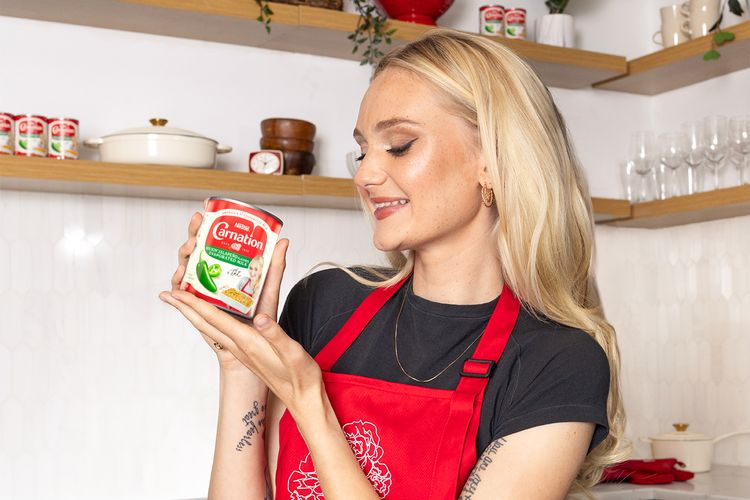
It will be available while supplies last. If you don’t want to venture into a Walmart you can buy a can or two here before they’re sold out. Consider yourselves warned.
This Week in Printing, Publishing, and Media History
June 16
1903: The Ford Motor Company is incorporated.
1904: Irish author James Joyce begins a relationship with Nora Barnacle and subsequently uses the date to set the actions for his novel Ulysses; this date is now traditionally celebrated as “Bloomsday.”
1911: IBM is founded as the Computing-Tabulating-Recording Company in Endicott, N.Y.
1917: American publisher Katharine Graham born.
June 17
1882: Russian pianist, composer, and conductor Igor Stravinsky born.
1898: Dutch illustrator M. C. Escher born.
1901: The College Board introduces its first standardized test, the forerunner to the SAT.
June 18
1466: Italian printer Ottaviano Petrucci born.
1812: Russian author and critic Ivan Goncharov born.
1854: American publisher and founder of the E. W. Scripps Company E. W. Scripps born.
1858: Charles Darwin receives a paper from Alfred Russel Wallace that draws eerily identical conclusions about evolution as Darwin had been developing. Darwin thus races to publish his own conclusions.
1942: Paul McCartney born.
1948: Columbia Records introduces the long-playing (LP) record, which, curiously, is seeing a bit of a renaissance today as a medium for delivering music.
June 19
1623: French mathematician and physicist Blaise Pascal born.
1846: The first officially recorded, organized baseball game is played under Alexander Cartwright’s rules on Hoboken, N.J.’s Elysian Fields with the New York Base Ball Club defeating the Knickerbockers 23–1.
1897: American comedian Moe Howard born.
1934: The Communications Act of 1934 establishes the Federal Communications Commission (FCC).
1947: Indian-English novelist and essayist Salman Rushdie born.
1948: English singer-songwriter Nick Drake born.
1978: Garfield, holder of the Guinness World Record for the world’s most widely syndicated comic strip, makes its debut.
2018: The 10,000,000th United States Patent is issued (“Coherent Ladar Using Intra-Pixel Quadrature Detection,” assigned to Raytheon Company).
June 20
1840: Samuel Morse receives the patent for the telegraph, which becomes the dominant communication method. Until...
...1877: Alexander Graham Bell installs the world’s first commercial telephone service in Hamilton, Ontario.
1928: American saxophonist, flute player, and composer Eric Dolphy born.
[year withheld]: Frank Romano born. Shortly thereafter, was visited by three “iMagi” bearing gold from Gutenberg’s goldsmith shop, a line of type from Ottmar Myrrh-genthaler, and he’ll be Frank-incensed if he reads this.
1975: The film Jaws is released in the United States, becoming the highest-grossing film of that time and starting the trend of films known as “summer blockbusters.”
2003: The Wikimedia Foundation is founded. The Wikimedia Foundation is a nonprofit charitable organization dedicated to encouraging the growth, development, and distribution of free, multilingual, educational content, and to providing the full content of these wiki-based projects to the public free of charge. Most notably, it operates Wikipedia.
June 21
1903: American caricaturist, painter and illustrator Al Hirschfeld is born.
1905: French philosopher and author Jean-Paul Sartre born.
1944: English singer-songwriter and guitarist Ray Davies born.
1957: American author, illustrator, and creator of the Bloom County comic strip Berkeley Breathed born.
1973: WTF: the Supreme Court hands down the decision in Miller v. California 413 US 15, establishing the Miller test for obscenity in U.S. law.
1978: The original production of Tim Rice and Andrew Lloyd Webber’s musical Evita, based on the life of Eva Perón, opens at the Prince Edward Theatre, London.
June 22
1906: Austrian-born American director, producer, and screenwriter Billy Wilder born.
1969: The Cuyahoga River catches fire in Cleveland, Ohio, drawing national attention to water pollution, and spurring the passing of the Clean Water Act and the creation of the Environmental Protection Agency.