Goldfish Adoration Was Not Crackers
Consider the goldfish. Today, a cheap fairground prize, the ultimate ephemeral pet, and often a child’s first brush with mortality. But once upon a time, they were prized by royalty and were symbols of status, particularly in China. Says Public Domain Review:
Goldfish are part of the carp family, Cyprinidae. The species of this family are generally brown or silver and reproduce quickly — which is why they have long been cultivated for food in China. At some point in the ninth or tenth century, mutated carp with bright yellow-orange scales appeared. These “gold” fish were saved and bred as ornamental pets, allowing strange and wonderful new forms to emerge that would probably not have survived in the wild. During the twelfth-century Song Dynasty, nobody outside of the imperial family was allowed to raise these fish, as yellow was the imperial colour. In the seventeenth century, the goldfish made it to Portugal and then the rest of Europe over the following century. By the late nineteenth century, the exotic golden creatures had become fast-breeding playthings for children.
Histoire naturelle des dorades de la Chine was a monograph on goldfish published in Europe in 1780.
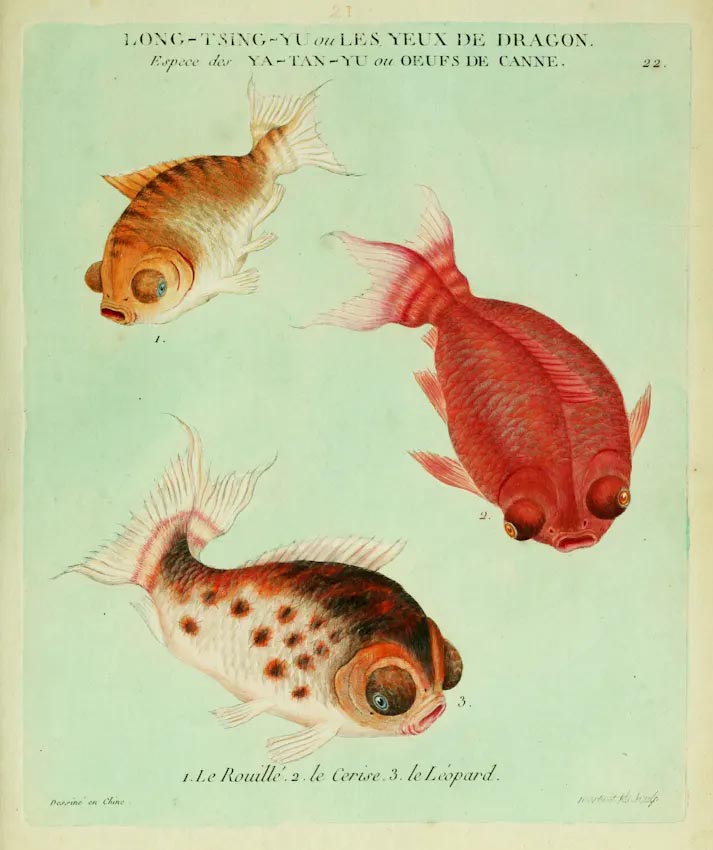
Less a natural history than a cultural account, Histoire naturelle des dorades was based on a roll of paintings and notes sent to Louis XV’s court minister, Henri-Léonard Bertin, by two Chinese priests with whom he was in close contact: Aloys Ko (Gao Ren) and Étienne Yang (Yang Zhide). Bertin was a serious Sinophile and had an extensive collection of Chinese texts and objects, which he saw as a rich resource for bettering Western arts, crafts, architecture, and agriculture.
The 48 plates depict 88 kinds of fish. The book is very rare today, with few first editions still extant. In 2022, a first edition sold at Christies for more than £27,000 ($36,600). Don’t flush that down the loo!
Graphene Rices to the Occasion
Was it a good week for graphene news? It’s always a good week for graphene news! Graphene-based packaging extends the shelf life of instant rice. From (who else?) Graphene-Info:
Korea-based TwoDM has developed a new packaging technology to extend the shelf life of instant rice by up to three months. In a recent interview in the Korean press, Kim Young-jin, co-chief executive officer (CEO) of TwoDM Co., said that the company recently finalized development of a new container that dramatically blocks moisture and oxygen, which allows instant rice to last up to 12 months instead of the usual 9 months.
The packaging uses a graphene barrier developed by TwoDM and manufactured into containers by Dae-A C&I.
Tests by the Korea Conformity Laboratories (KCL) found that the new container's moisture permeability was 0.22, 62% lower than the market standard (0.58), while oxygen permeability was 0.022, 15% lower than the typical container (0.026).
And production costs are said to be reduced by up to 20%.
Blue Book Value
More AI awesomeness. Via Gizmodo:
It’s no secret that AI is wrecking America’s educational system. With easy access to apps like ChatGPT—which can answer any question and also write full-fledged essays for you—high school and college students have begun to cheat their way through life, content to let an algorithm do the thinking, and the test-taking, for them. It’s no surprise, then, that some educators have gone analog, in an effort to stem the tide of anti-intellectualism sweeping the nation.
But there is an upside—and one that benefits the printing and paper industries. Those of a certain age may recall those old “blue books” high school and college students used to write essays or take tests (we remember a trigonometry class that used them). Well, sales of them are up. Says the Wall Street Journal:
Sales of blue books this school year were up more than 30% at Texas A&M University and nearly 50% at the University of Florida. The improbable growth was even more impressive at the University of California, Berkeley. Over the past two academic years, blue-book sales at the Cal Student Store were up 80%. Demand for blue books is suddenly booming again because they help solve a problem that didn’t exist on campuses until now.
Unfortunately, they don’t solve the student AI problem entirely.
Philip D. Bunn, an assistant professor at the Covenant College in Georgia, recently wrote on his blog that the traditional essay (which, until ChatGPT came along, was a great indicator of a student’s intellectual capacity and was very difficult to fake unless you went to the trouble of hiring a ghostwriter) cannot be replaced by the in-class essay. Bunn writes that “the process of writing a paper outside of class cannot simply be replicated in a blue book exam, and something serious is lost if we give up entirely on the traditional essay, whether those essays are more analytic, argumentative, or research-based.”
High Definition
Boing Boing asks, “What English word has the most definitions?” Can you guess? It’s only three letters long and the Oxford English Dictionary documents 600 definitions. Interestingly, the new winner of the most-definitions award only recently unseated the previous champ, which had 400 meanings.
The original word was “set.” Via Mental Floss:
When the first edition of the Oxford English Dictionary was published in 1928, the word with the most definitions was set. However, the word put later outpaced it.
The most recent winner? “Run,” with 645 definitions.
[Author Simon] Winchester posited that this evolution is partly due to advancements in technology (for instance, “a train runs on tracks” and “an iPad runs apps”).
He believes the widespread use of run—and its intricate web of meanings—is also a reflection of our times. “It is a feature of our more sort of energetic and frantic times that set and put seem, in a peculiar way, sort of rather stodgy, rather conservative,” [lexicographer and associate editor of the OED Peter] Gilliver told NPR in an interview.
It’s definitions run amok.
Horrorstörs
Here’s an interesting idea: a horror story told through Yelp! reviews. Via Boing Boing:
Strip Mall is a short story by Leigh Alexander (previously) about a small town's run-down shopping drag, told entirely through Yelp reviews.
It takes a while to get it, but once you do it’s an interesting new narrative approach.
Coffee Sensations (Millville Center)
Lovely Place
Always a smile from the staff and no charge for water
Which did not use to be special mind The only reason I have removed one star is that they stopped offering Senior Discounts, due to the owners policy and no fault of the staff And because of the cold,
And the crying and Crying
Mind Control
It was probably inevitable that at some point we would come across the phrase “brain-computer interface.” And now there is a company that considers itself a “brain-computer interface (BCI) company”: Synchron. And, via the DeBrief, they are working with Apple on technology that will let users control their iPhones—with their minds.
Technologies for controlling devices with the mind are not new, but have usually been invasive—electrodes need to be implanted into the brain, which involves a bit of drilling or “open-brain surgery.” (Not to be confused with Brain Salad Surgery.) On the contrary, Synchron’s approach is slightly less invasive, only requiring implantation in blood vessels near the brain’s cortex.
“Synchron’s brain-computer interface (BCI) device, also known as the Stentrode, is a minimally invasive device that detects brain signals related to movement intention,” Kimberly Ha, Communications Lead at Synchron, previously told The Debrief in a September 2024 email. The stent-like implant then decodes these brain signals and converts them into commands, enabling users to interact with digital devices without moving a muscle.
It sounds like a gimmick but the goal of the tech is to improve the accessibility of devices (like Apple’s) for people with “severe physical disabilities such as amyotrophic lateral sclerosis (ALS) and spinal cord injuries.”
One early adopter of the technology, Mark Jackson, lives with ALS and has recently used the technology to explore a virtual Alpine landscape via Apple’s Vision Pro headset. Even more impressively, he is now learning to operate his Apple devices—an iPhone and an iPad—using only his mind.
It’s currently being tested as an accessibility feature on Apple devices.
The company’s existing Switch Control allows users to operate their mobile device using external assistive devices like the Hook+ Switch Interface, AbleNet Blue2 Switch, or related hearing devices such as Made for iPhone (MFi) hearing aids and cochlear implants.
Pretty neat.
Tattoo You
Stressed out at work? Stressed out in life? Both? Sometimes our mental workload turns into mental overload and we’re not always aware of it. Sure, Around the Web compiler is not all that stressful, but certain professions like pilot, healthcare worker, and those in other high-stakes jobs, do lend themselves to cognitive overload—and the results can literally be disastrous. Typically, “mental workload decoders” involve questionnaires administered after the fact, and while there are existing electroencephalography (EEG) and electrooculography (EOG) devices that measure brain waves and eye movements, they are hard-wired, cumbersome, and don’t always glean reliable data. But what if there were a less problematic real-time decoder?
Now, via The Guardian, there may soon be such a thing: an “e-tattoo.” Attached to the forehead, the electronic tattoo can alert the wearer when it may be time to take a break.
“For this kind of high-demand and high-stake scenario, eventually we hope to have this real-time mental workload decoder that can give people some warning and alert so that they can self-adjust, or they can ask AI or a co-worker to offload some of their work,” said Dr Nanshu Lu, an author of the research from the University of Texas at Austin, adding the device may not only help workers avoid serious mistakes but also protect their health.
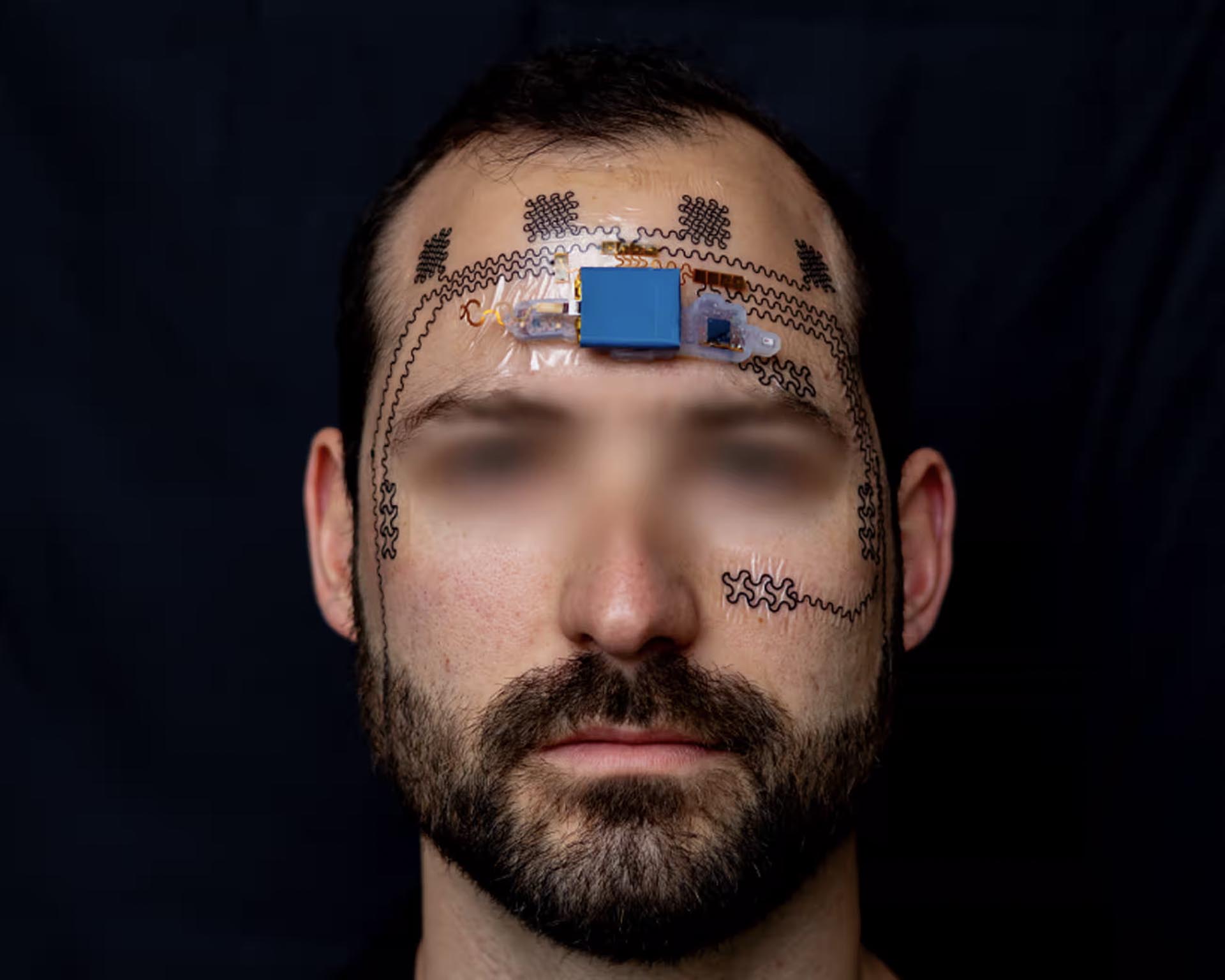
Four square EEG electrodes, positioned on the forehead, each detect a different region of brain activity – with a reference electrode behind the ear – while rectangular EOG electrodes, placed vertically and horizontally around the eyes, provide data about eye movements. Each of the stretchable electrodes is coated in an additional conductive material.
The e-tattoo is then connected to a flexible printed circuit via conductive tape, and a lightweight battery can be attached. Researchers found that the e-tattoo worked as well as traditional EEG and EOG devices.
The team found that as the task became harder, the different types of brainwave detected showed shifts in activity that corresponded to a greater mental workload.
The full system—chip and battery—is expected to cost less than $200.
The team are now developing the approach so signals can be decoded by the device’s microprocessor and sent to an app to alert the user if their mental workload is too high.
AI-Yi-Yi, Part the Infinity: Young Turks
You may recall not long ago (and we probably cited it here in Around the Web) that the Amazon Go stores’ Just Walk Out “AI-based” cashierless technology was largely 1,000 people in India visually reviewing customer transactions.
Now, via Business Today, a Microsoft-backed “no code” AI startup turns out to be humans based in India.
Builder.ai, once touted as a revolutionary AI startup backed by Microsoft, has collapsed into insolvency after revelations that its flagship no-code development platform was powered not by artificial intelligence—but by 700 human engineers in India.
The company marketed its platform as being driven by an AI assistant named “Natasha,” which could supposedly assemble software applications like Lego bricks. But recent reports and commentary have revealed that behind the scenes, customer requests were manually fulfilled by developers, not machines.
These sorts of things remind us of a 19th-century technological phenomenon called “the Mechanical Turk.”
It was invented in 1770 by Hungarian author and inventor Wolfgang von Kempelen (1734–1804) and was a mechanical chess-playing machine, sort of the Deep Blue of its day. It had a chessboard atop a large wooden cabinet — which was filled with gears and other mechanical contrivances — and seated behind the chessboard was an intimidating, be-turbaned, Turkish-looking mannequin which had working arms that moved the chess pieces. Invented to “impress the Empress Maria Theresa of Austria” (says Wikipedia, with a little bit of what I imagine is inadvertent wordplay), the Turk was toured around Europe and the Americas for 80-plus years, beating nearly all of its challengers, including a 1783 Paris match with Benjamin Franklin, who had been serving as U.S. Minister to France. Franklin lost.
The chess-playing “robot” was unbeatable for years—until it turned out that it was not a machine at all: the cabinet concealed a human chessmaster.
Plus ça change, plus c’est la même chose.
Doorknobs of Perception
Consider the doorknob. One of the essential items of modern (or even pre-modern) life. Beautiful in its simplicity. So why not make it more complicated than it needs to be. Via Core77, the Spoke knob is a solid brass doorknob designed by L.A.-based industrial designer Will Zhang.
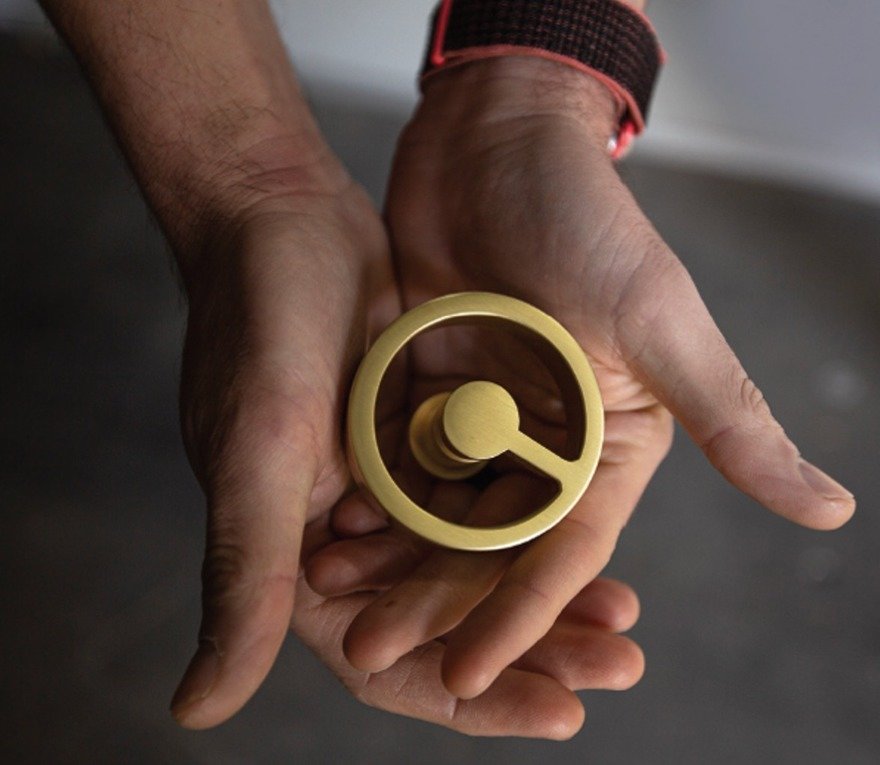
"The Spoke knob requires handing to ensure that the spoke itself is directed towards the bottom right when at rest, as intended in the design."
Handing?
“Handing” means you've got to pay attention to whether the door you're spec'ing this for is right- or left-handed, in order to get the knobs oriented the way the designer wanted it. I guess the idea is that if you've got a room where multiple Spoke knobs are visible at once on differently-handed doors, you want visual consistency. The installer had better be on their toes.
Sure, why not make doorknobs as annoying as possible?
Getting a Charge
Now this is a great idea we’ll probably never see in the US. In Europe, electric vehicles (EVs) make up about 25%, projected to grow to 60% by 2030, in China, they comprise 60%. In the US, it’s only 7.5%. So in Europe, Germany specifically, the infrastructure is being updated accordingly. Via Core77:
Rheinmetall, a German defense and automotive technology company, has developed this Rheinmetall Curb Charger. In Germany, as in many European countries, they have standards for curb stones. These transition points between the sidewalk and street can be made of natural stone or cast concrete, but have consistent dimensions within municipalities. Rheinmetall's design follows these standards, fitting precisely within the space for a single curb stone.

The charger is housed in concrete, stainless steel, and aluminum, and is completely resistant to the elements and extreme changes in temperature. Users do need to provide their own charging cables (which in Europe EV owners generally do) and delivers Level 2 charging, which can add 20 to 60 miles of range per hour, or top off a 60 kWh battery in four to eight hours.
Last year Rheinmetall rolled out four of these for a pilot project in Cologne. After a year of real-world testing, they found the units performed with 99% reliability and were positively reviewed by users.
One potential drawback is that disabled or elderly users may find them difficult to access, as it requires a fair amount of bending over to plug in.
Another potential drawback, if you can call it that, is that the design is so invisible that users may not know it's there. Your standard charging station announces itself by virtue of its freestanding design. Rheinmetall's design, at least for now, is more of an IYKYK kind of thing. But perhaps one day, at least in Europe, people will look down at curbs in parking areas and expect to see these.
E Waste
One author you have probably not heard of is Ernest Vincent Wright, whose only real claim to fame is a remarkable 1939 novel called Gadsby. Why is it remarkable? Because it was written without using the letter “e.” Why? Says Boing Boing:
“This story was written, not through any attempt to attain literary merit, but due to a somewhat balky nature, caused by hearing it so constantly claimed that ‘it can’t be done,’” Wright wrote in his introduction, allowing himself the luxury of using the banned vowel.
Not that it was easy—“e” is the most commonly used letter in the English language.
Wright had to perform linguistic gymnastics to write the novel without using the most common letter in English. He couldn’t use simple words like “the,” “he,” or “she.” Numbers one, three, five and everything between six and thirty were off-limits. To write in past tense without “-ed” endings, he relied on creative constructions like “did walk” instead of “walked.” He transformed famous quotes — Keats’ “a thing of beauty is a joy forever” became “a charming thing is a joy always.”
He even had a mechanical failsafe to prevent errant “e”s: he tied down the “E” key on his typewriter.
Despite this precaution, four forbidden “e”s slipped into the published version — the word “the” appears three times and “officers” once. Fortunately, this was before characters would have routinely used e-mail.
Gadsby was self-published, but alas most of the copies were lost in a warehouse fire. You can get an original edition for up to $7,500 from collectors, if you were so inclined.
If there is one legacy, Georges Perec, inspired by Wright’s feat, wrote his own “e”-less French novel La Disparition in 1969.
Bloody Vikings
What is your favorite Spam flavor? Surely, it must be— Wait…Spam has different flavors?! Apparently it does, 13 of them. How unlucky. And (who else?) Food & Wine rates them, so you don’t have to.
Produced by Hormel Foods, Spam is a highly processed, canned luncheon meat, typically made from a combination of pre-ground pork shoulder and ham. Plain versions are firm and chewy in texture, with a salty, cured pork flavor similar to bologna. A can of Spam can last up to five years. Once it’s opened, it’s typically sliced lengthwise and sautéed until crispy.
There is Spam Teriyaki, Spam Over-Roasted Turkey, Spam Korean BBQ, egg and spam, egg bacon and spam, egg bacon sausage and spam, spam bacon sausage and spam, spam egg spam spam bacon and spam, spam sausage spam spam bacon spam tomato and spam, and of course Lobster Thermidor a Crevette with a mornay sauce served in a Provencale manner with shallots and aubergines garnished with truffle pate, brandy and with a fried egg on top and spam.
Anyway. The first three above are real and Food & Wine ranks Spam Hot & Spicy as the #1 Spam ( “This has everything I love about summer sausage in the sharpness and heat, but with a more pleasing texture,” said Kinsman. “I’d absolutely buy this and am dreaming of having some with cheese.” Some people have very simple dreams…) followed by Spam Lite.
Of course, you may not like Spam. (What do you mean “Blehhh?!”)
(The nerds out there—and in here—know that the Monty Python “Spam” sketch is why we refer to unwanted e-mail as spam.)
This Week in Printing, Publishing, and Media History
June 2
1840: English novelist and poet Thomas Hardy born.
1896: Guglielmo Marconi applies for a patent for his wireless telegraph.
June 3
1140: The French scholar Peter Abelard is found guilty of heresy.
1889: The first long-distance electric power transmission line in the United States is completed, running 14 miles (23 km) between a generator at Willamette Falls and downtown Portland, Ore.
1924: Czech-Austrian lawyer and author Franz Kafka dies (b. 1883).
1929: American game show host and producer Chuck Barris born.
1961: American lawyer, academic, author, and founder of the Creative Commons Lawrence Lessig born.
1965: The launch of Gemini 4, the first multi-day space mission by a NASA crew. Ed White, a crew member, performs the first American spacewalk.
June 4
1783: The Montgolfier brothers publicly demonstrate their montgolfière (hot air balloon).
1876: An express train called the Transcontinental Express arrives in San Francisco, via the First Transcontinental Railroad only 83 hours and 39 minutes after leaving New York City. (Insert your own Amtrak joke here.)
1907: American actress Rosalind Russell born. Russell starred with Cary Grant in His Girl Friday, one of the best—and funniest—newspaper movies ever made.
1917: The first Pulitzer Prizes are awarded. Laura E. Richards, Maude H. Elliott, and Florence Hall win the first Pulitzer for biography (for Julia Ward Howe), Jean Jules Jusserand wins the first Pulitzer for history for his work With Americans of Past and Present Days, and Herbert B. Swope receives the first Pulitzer for journalism for his work for the New York World.
June 5
1851: Harriet Beecher Stowe's anti-slavery serial, Uncle Tom's Cabin, or Life Among the Lowly, starts a ten-month run in the National Era abolitionist newspaper.
1910: American short story writer O. Henry dies (b. 1862).
1919: American-Swiss author and illustrator Richard Scarry born.
1947: American singer-songwriter and violinist Laurie Anderson born.
1956: Elvis Presley introduces his new single, “Hound Dog,” on The Milton Berle Show, scandalizing the audience with his suggestive hip movements.
2012: American science fiction writer and screenwriter Ray Bradbury dies (b. 1920).
June 6
1756: American soldier and painter John Trumbull born.
1799: Russian author and poet Alexander Pushkin born.
1875: German author, critic, and Nobel Prize laureate Thomas Mann born.
1892: The Chicago “L” elevated rail system begins operation.
1933: The first drive-in theater opens in Camden, N.J.
1946: American bass player and songwriter Tony Levin born.
2016: English playwright and screenwriter, works included Equus and Amadeus Peter Shaffer dies (b. 1926).
June 7
1810: The newspaper Gazeta de Buenos Ayres is first published in Argentina.
1848: French painter and sculptor Paul Gauguin born.
1911: American engineer and designer Brooks Stevens born, most famous for designing the Wienermobile. (As we saw last week, a replica is for sale.)
1955: Lux Radio Theatre signs off the air permanently. The show launched in New York in 1934, and featured radio adaptations of Broadway shows and popular films.
1958: American singer-songwriter, multi-instrumentalist, producer, and actor Prince (né Prince Rogers Nelson) born.
1970: English novelist, short story writer, essayist E. M. Forster dies (b. 1879).
1971: The United States Supreme Court overturns the conviction of Paul Cohen for disturbing the peace, setting the precedent that vulgar writing is protected under the First Amendment to the United States Constitution.
1975: Sony introduces the Betamax videocassette recorder. Alas, the “videotape war” of the late 70s and early 80s would result in VHS becoming the dominant format...for a while.
June 8
1809: English-American theorist and author Thomas Paine dies (b. 1737).
1867: American architect Frank Lloyd Wright born.
1887: Herman Hollerith applies for US patent #395,781 for the “Art of Compiling Statistics,” which was his punched card calculator.
1912: Carl Laemmle incorporates Universal Pictures.
1949: George Orwell's Nineteen Eighty-Four is published, initially as fiction...for a while
1916: English biologist, biophysicist, neuroscientist, and Nobel Prize laureate Francis Crick is born.