Background
At drupa 2012, I was introduced to IMPIKA, a French company that had been fully investigating and exploiting the manufacturing and marketing of printing and material jetting solutions since 1990, prior to the founding of IMPIKA in 2003, and this unique company caught my attention. So it was not a surprise when they were subsequently acquired by Xerox in 2013 to help fast track Xerox into the production inkjet press race which was already heating up. Xerox walked away from the IMPIKA acquisition in 2019. As a result, they also walked away from an impressive inkjet development team led by Paul Morgavi, the founder of IMPIKA. Considering the 30-year history and high level of expertise of the team, it wasn’t long before the word got out, interest rose, and in October 2020 NIXKA was founded.
Kyocera had their eye on NIXKA, and had already done some project work. They invested and took a 30% share in 2022, and has since completed a full acquisition. The result is the foundation of the Kyocera industrial print unit led by Paul Morgavi. NIXKA already has a number of projects in textile, flexible packaging, and very high-quality printing, along with a few more in the pipeline. To date, the founders of NIXKA have a background of more than 500 inkjet systems installed printing over 20 billion pages per year in more than 40 countries.
Industrial Print
Kyocera, very much like Fujifilm, Epson, and others, have been developing and supplying system components to print solution providers for years. Those developments have been at the cornerstone of many products in the market today. Whether it is ink, printheads, print engines, etc., they are all in the market, but at least a step away from the end customer. Many of these big players now want to be closer to the market and not completely dependent on an integrator. Some integrator partners are good, some have some difficulties, etc. What we are seeing here, and what Kyocera is focusing on, is getting closer to the market and to the customer in order to understand very well what they’re looking for.
The first products in the new Kyocera NIXKA organization, which will be available to see and order at drupa 2024, are complete OEM inkjet systems with flow data management, data pass, a cabinet, and the print engine. These include the GENIX (Graphic Engine NIXKA) full color print 1200 dpi grayscale press engine, with everything embedded in a complete unit plus a cabinet. They will also have the larger LENIX (Large Engine NIXKA) system available and on display. This one is based on a 866mm (34 in.) print bar with the same 1200 dpi grayscale resolution. This print bar system is targeted at flexible packaging and other industrial applications.
Initially, they were using a precoat on the non-permeable substrates with water-based inks, but they have been developing a new generation of ink without the need for any primer. They are currently running at up to 100 mpm, with or without primer, and a new generation drying system. Their previous experience with food and pharma product production will ensure that they meet all the necessary ink regulation requirements. Initial developments have now emerged into a new application-specific product: Photo Printing.
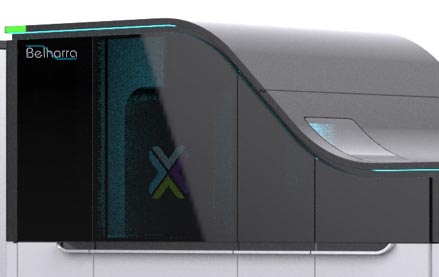
Photo Printing
Kyocera (NIXKA) has been working on an inkjet photo printer for a while and this full-color 1200 dpi grayscale system press is ready for its introduction during drupa 2024. There is a lot of interest in this product, since it will replace the existing silver halide chemical process with digital inkjet technology while maintaining the same image quality. According to Morgavi, “It was a big challenge, but we will have the quality, and productivity, and green aspect to make it attractive.”
The printer gets its name from a wave in the south of France, off the magnificent outer reef break, that surfers flock to called Belharra. The photo printer is a simplex roll-to-roll application, operating at up to 50 meters per minute with constant printing quality while ramp-up/down at 1200 dpi. Photo labs are finding silver halide paper availability is constrained, with only one global manufacturer, Fujifilm. Kyocera today also sources this application paper with one manufacturer in Japan and one in Europe, and is in discussions for some manufacturing in US in order to cover roughly 80% of the globe.
It uses a photo paper and ink combination dedicated specifically for this type of application. Importantly, they are designed to address the very key aspects and parameters for the photo industry: lightfastness, vibrancy of color, different surface finishes including coated, uncoated, special inkjet photo paper, glossy, lustre, matte, etc. The paper range is between 150 to 300 GSM, and it is able to be recycled. That means you have the feeling of classic silver halide photo paper. It is designed for industrial inkjet photo printing for retail and merchandise photo formats: 10x15, 10x12, 10x10, 9x9 cm (4x6, 4x5.5, 5x3.75 in). The single-pass YMCK GENIX 1200 dpi grayscale engine prints a variable drop size with a two bits per pixel. There’s no post coating, nor is one needed. It has image control quality with missing jet detection and correction. The inks are water-based, which is really important because this printer is designed to be ecologically sound. It has an infra-red and hot air dryer with temperature/speed automated adjustments. They have spent a lot of time working on the specific ink design for this application, and it has very good lightfastness, water resistance, and scratch resistance, since this is a primary concern of the photo industry. The machine duty cycle is 10 to 40 million 10x15cm photos per year.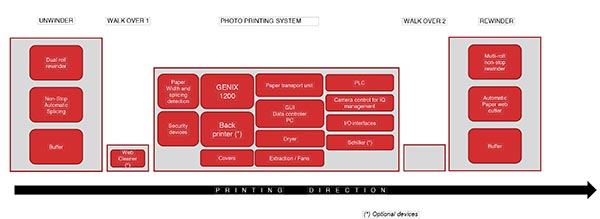
They offer an optional duplex printing by side with monochrome to print date or reference information. They also offer external air conditioning and a web cleaner if necessary, depending on the environment, country, etc. They also offer optional pre- and post- equipment, including an unwinder with multi-rolls and automatic splicing, and an unwinder with multi-rolls and automatic cutter.
The TCO is projected to be very close to silver halide, and the existing digital printing competition. Replacing silver halide printing contributes to reducing the environmental impact by 2.6 times in terms of CO2. The value proposition of the system is to replace the existing technology and contribute to reduce environment impact by 2.6 times. The flexibility, scalability and modularity of the system, including the ease of integrations with pre- and post- finishing equipment; no need to change existing workflows, web portals, or finishing devices. They expect that planned future technology enhancements, such as new generation of inks compatible with lower cost substrates, will further affect the value proposition.According to Morgavi, “People like to surf this very powerful wave, and we have used this shape of wave to reflect that it’s a new wave of inkjet.” The Belharra will be shown live and running at drupa 2024, and will be installed in a European beta customer Q3, with commercial launch Q1 2025.
Please feel free to contact me at [email protected] with any questions, suggestions, or examples of interesting applications.