Inkjet took many printing markets by storm. The success has not always been immediate, but with increasing capabilities, inkjet has expanded into many production printing and packaging markets so far. The drivers, although in varying importance, are the same in all printing markets:
- Shorter runs
- Just-in-time production
- More designs, more changes, more testing
- Personalisation, customisation
One of the last glaring voids seems to be folding carton printing. It appears that inkjet technology is still struggling to fulfil the requirements of the market, of which the most important are print quality, substrate support, sheet size, and productivity. Today most folding carton is produced by sheetfed offset presses and the latest steps in automation additionally raised the bar for inkjet to compete.
Digital press vendors have eyed the folding carton market for quite some time. At drupa 2016 there was a flurry of announcements of folding carton inkjet presses, but few made it to the market yet. Some vendors even decided to withdraw, while others kept working on their press designs and are slowly moving to commercialisation.
Dedicated inkjet presses available for folding carton
Landa S10
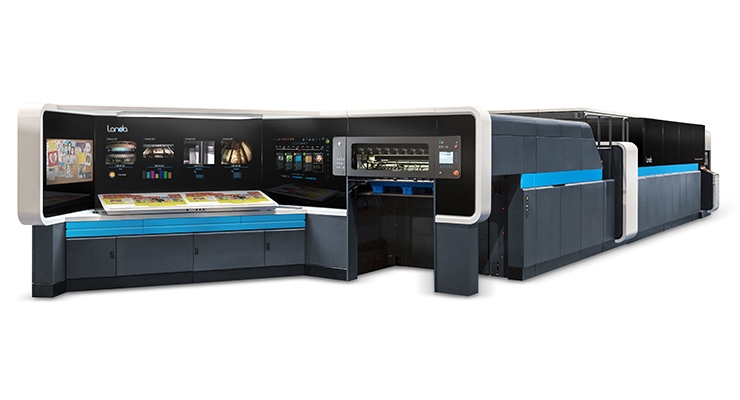
The first vendor to launch a B1 inkjet press for folding carton was Landa Digital Printing with the S10 previewed at drupa 2012. The press is based on a Komori sheet-fed transport and uses Landa’s proprietary imaging technology. Since the first installs, many improvements have been implemented and the press is fully available now. There are about 20 installations of the S10 in folding carton print currently. The S10 has a B1 format and prints up to 6,500 sheets/hour. Originally the press was planned to print at 13,000 sheets per hour but there is no indication when and if that speed is going to be realised. The press is available in process colour and seven-colour extended gamut versions and has a conventional varnishing unit.
Currently the Landa S10 is the only available B1 inkjet press for folding carton applications. The Komori Impremia NS40 is based on the S10 and is offered by development partner Komori, however, this model is still in beta testing.
Koenig & Bauer Durst VariJET 106
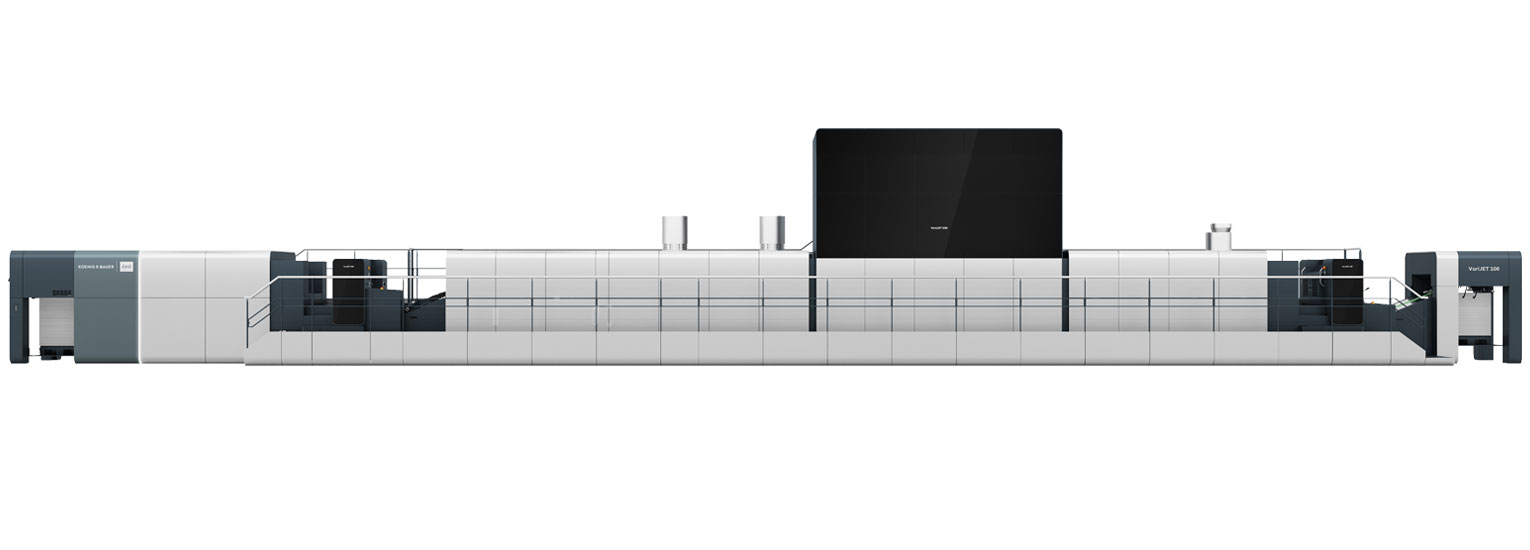
In October 2021 Koenig & Bauer presented the much-anticipated VariJET106, the results of a joint development between Durst and Koenig & Bauer. Koenig & Bauer with its strong heritage in folding carton offset presses supplies the press base, while Durst contributes the inkjet unit and imaging software. Feeder, stacker, and sheet transport are based on the market proven Rapida 106 design. The press includes priming and varnishing units, both based on Rapida 106 design as well. The imaging unit utilises Fujifilm Samba imaging heads and aqueous inks. The press is available as seven colour version for extended gamut, although a four-colour version will be available as well. The waterbased inks are suitable for food packaging. 1,200 x 1,200 dpi
Currently, there are two presses installed at beta sites in Germany and are producing customer jobs already.
Agfa Speedset 1060
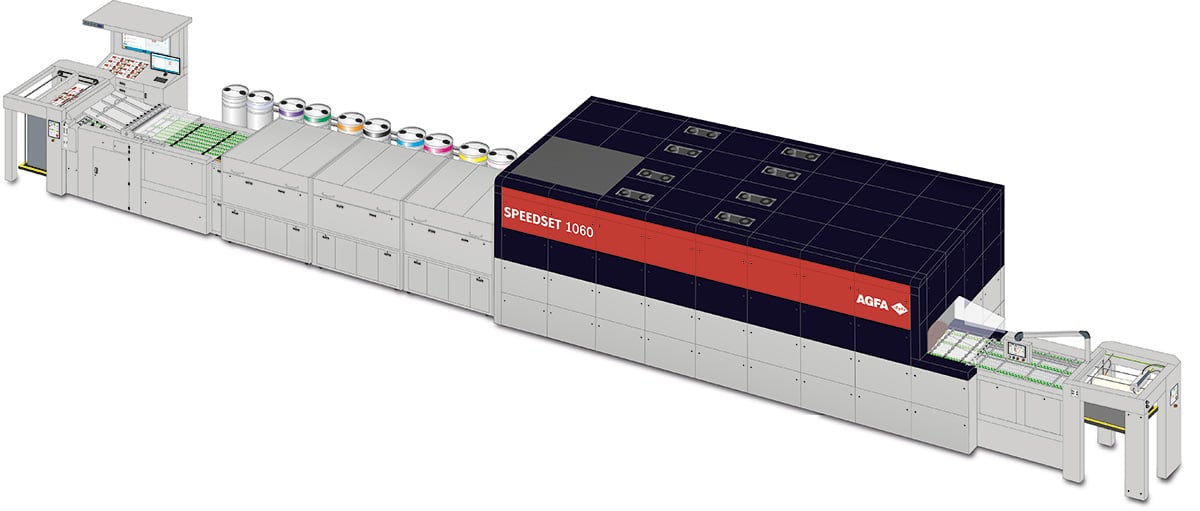
The most recent addition to the dedicated inkjet folding carton presses is the Agfa Speedset 1060. Agfa acquired Inca from Screen in 2022, shortly after Inca previewed the Speedset 1060 in late 2021. The press is nearing market introduction now.
The most interesting feature is a proposed speed of 11,000 sheets/hour, making the Speedset considerably faster than the other devices, although at a reduced resolution of 800 x 600 dpi. The press can print on substrates up to 2 mm thickness, including micro-flute corrugated. According to Agfa, this is enabled by a patent-pending steel-backed vacuum conveyor to transport the sheets through the press. Finally, primer and overcoat are jetted and are not applied as flood coat as in the other presses. This would allow for spot coating and selective priming, although the coating might not get to the high gloss levels a conventional UV flexo coating unit might achieve. Like on the other devices Fujifilm Samba heads are used for a resolution up to 1,200 x 1,200 dpi. Agfa added its ink since the acquisition, which is designed to be safe for food packaging.
The Speedset 1060 is intended to be the first product of a larger family of presses, serving other packaging markets as well. The first two beta sites are targeted for 2024 and limited availability is planned for 2025.
Table 1: Dedicated Inkjet Folding Carton Presses
|
Max Sheet format |
Speed |
Colour system |
Resolution |
Substrate thickness |
Varnishing |
|
|
Agfa Speedset 1060 |
B1 |
11,000 at 800 x 600 dpi |
CMYK |
Up to 1,200 x 1,200 dpi |
200 to 2000µ |
Jetted aqueous |
|
Koenig & Bauer Durst VariJET 106 |
740 x 1060 mm 29.1” x 41.7” |
5,500 sheets/hr |
CMYK – OGV option |
1,200 x 1,200 dpi |
200 to 800µ |
Conventional aqueous or UV |
|
Landa S10 |
750 x 1,050 mm 29.5” x 41.3” |
6,500 sheets/hr |
CMYK – OGV option |
1,200 x 1,200 dpi |
40 to 800µ |
Conventional aqueous or UV |
Commercial – folding carton overlap
In B2 inkjet presses there are some solutions available for a lower investment and easy start in folding carton inkjet print. Products available are the Fujifilm JetPress, the Konica Minolta KM-1, the Komori Impremia IS-29, and Ricoh’s Z75. Those presses are suitable for commercial printers moving into folding carton or for specialty applications. Start-ups or more bespoke folding carton printers are using these presses as well. Inkjet Insight recently published an article on the use of these presses in folding carton
For mainstream appeal the presses would need to support heavier substrates and they don’t have an inline varnishing option or specialty inks or extended gamut colours. B2 presses have a relatively low productivity as well, making them less attractive for large folding carton producers. Most crucially the B2 format is too small for full scale folding carton production and most finishing equipment is set up for the B1 format.
Web-fed folding carton print
Folding carton printing with inkjet is not a pure sheetfed affair. Continuous feed solutions can provide a high productivity although they are somewhat hampered by the maximum weight that can be fed and a more complicated change-over process when changing substrates. Still, Kodak has successful installations of the Prosper 6000S press for folding carton at Zumbiel. The 6000S is a purpose-built single sided press for folding carton that can be operated as a stand-alone press or integrated into a narrow-web conventional press line. With a web speed of 200 m/min (656 ft/min) the press is quite productive. Even more productive is the Rotajet 168 and 225 from Koenig & Bauer. There is one unit in production at Tetra Pak in the US and another one in Germany at SIG Digital for aseptic packaging print.
Finding the right solution
There is certainly a big market opportunity in short run folding carton printing, which is barely being addressed so far. It is a demanding market however and only presses capable of fulfilling the high expectations customers have in terms of productivity, substrates, and quality find acceptance.
These challenges are behind the long-delayed attempts to provide inkjet presses to this market rather than a lack of interest from printers or press manufacturers. There is no “low-end” of folding carton presses, that offer easy entry in many other markets- not even with B2 presses. Accordingly presses need to perform to a high standard to make the investment worthwhile. This also requires a constant stream of short run jobs. The market opportunity exists, exploiting it takes the right technology and business approach.
This Shopping Guide is intended to give a high-level overview of the single pass, folding carton inkjet devices currently available. More details on the products can be found in the Inkjet Insight Device Finder and in previous coverage of some models. Also check out the replay of our March 12 webinar on Inkjet Innovations in the Packaging Industry.
See also 2024 Inkjet Shopping Guide for Flexible Packaging, and 2024 Inkjet Shopping Guide for Corrugated Post-Print.