Printing the minuscule
Electrohydrodynamic (EHD) inkjet printing is not the inkjet process you might be familiar with. It is a high-resolution inkjet technology where the printed liquid is jetted using an electric field instead of a mechanic actuator. Exposure to an electric field causes mobile ions in a polarisable liquid to accumulate at the liquid surface. The coulombic repulsion of the ions causes the meniscus at the nozzle end to deform into a conical shape. When the electric field exceeds a critical limit, the stress from the surface charge repulsion at the cone apex exceeds the surface tension, and a droplet of fluid is emitted. The drops are accelerated toward a grounded substrate or grounded substrate carrier.
There are two fundamental differences to inkjet as most of us know it. There is no nozzle needed to form the droplet, it can be pulled out of a meniscus, although there might be cones or needles utilised to guide the ink (still the term “nozzle” is used in this text to signify the drop formation point). Secondly, the ink is not pushed but is pulled towards the substrate. This allows for high-precision imaging and minute droplet sizes. Also, viscous liquids are possible that are difficult to push through small nozzles.
EHD technology has been known for years and it is already used commercially for deposition processes. However, so far only single ejectors or small arrays with a few nozzles were available. This limited the throughput considerably.
Scrona upping the speed
Scrona is a spin-off of the renowned ETH (University) of Zurich, founded in 2014. Currently, the team has 20 members. The company has its own clean room for MEMS production of inkjet heads and an application lab for feasibility studies.
Scrona aims at fundamentally changing two things: introducing MEMS-produced EHD heads, to lower manufacturing costs and easier customise heads if required. Secondly to form nozzle arrays to multiply the print speed.
In Scrona’s EHD-heads, depending on the viscosity, fluids form a meniscus or are pushed through a larger orifice. The field from a ring electrode pulls the droplets out of the meniscus. A shield electrode prevents cross-talk between nozzles and allows for densely packed arrays. Through an electric field between this shield electrode and a counter-electrode underneath the substrate, the droplets are propelled toward the substrate.
[caption id="attachment_6929" align="aligncenter" width="734"]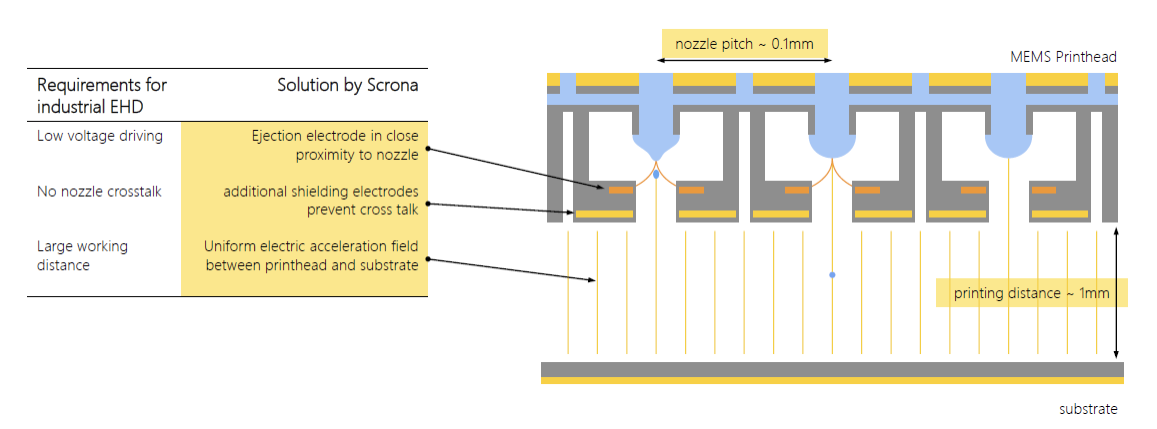 Schematics of Scrona printhead[/caption]
The differences between common piezo inkjet heads are staggering. While conventional piezo inkjet reaches a resolution down to 50 µm, EHD inkjet with Scrona can reach a printing resolution down to 0.5 µm. The size of the droplets in EHD can be varied depending on the charges used. The throwing distance can be up to 1 mm, with electrostatic support. As firing frequency, 10 kHz has been achieved, although 100 kHz is possible. At high frequency also a fine, continuous stream of liquid can be created.
The viscosity of liquids used in piezo heads is normally in the range of up to 20 cP – although plans for lifting this up to 100 cP or even 400 cP exist. Scrona heads still can jet fluids with viscosities magnitudes higher– reaching more than 10.000 cP. Accordingly, the jetted substances can vary dramatically. It is possible to jet nanoparticle inks, polymer solutions, metal salts, polar, and nonpolar solvents.
Scrona is in the process of scaling up the technology for full productivity. From single nozzles, Scrona moved to small arrays of up to 20 nozzles in the Gen 2 heads, which are available today. These heads already include ink recirculation. Gen 3 heads are now in preparation and should be launched mid of 2024. Those will have from 128 to 256 nozzles and an integrated driver. On the roadmap is a GEN 4 head with 1,000 nozzles in about two years’ time.
[caption id="attachment_6931" align="aligncenter" width="593"]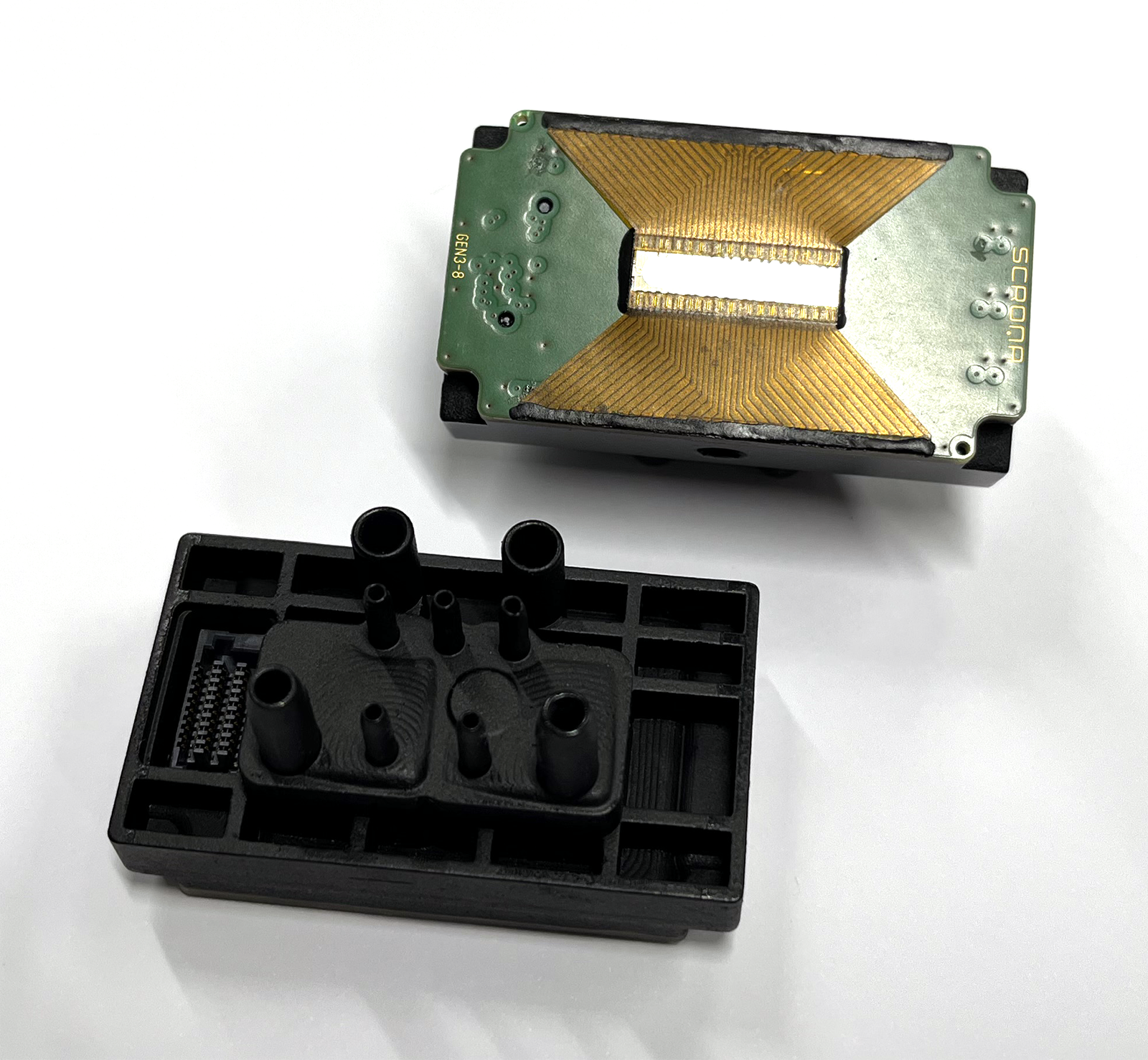 Image of soon-to-be-released Gen3 head[/caption]
German functional print equipment supplier Notion Systems already offers lab and test equipment using the Gen 2 heads. Since the Gen 3 heads will have the same form factor, existing devices can be upgraded. This will multiply the speed and allow for functional print applications.
Applications
To demonstrate the capabilities of the technology Scrona produced in 2015 the smallest print in the world. Invisible to the naked eye it even does not look anything special when blown up, although the stats are staggering. Measuring 0.08mm by 0.115mm, the photo is as big as the cross-sectional area of a human hair or (in other terms) as wide as a piece of paper is thick. Printed by ETH Zurich in Switzerland, the image was created using quantum dot technology. To see it a special microscope has to be used. To achieve the colour image quantum dots were printed at a resolution of 25.000 DPI, i.e. at an inter-pixel distance of 500 nanometers.
[caption id="attachment_6930" align="aligncenter" width="590"]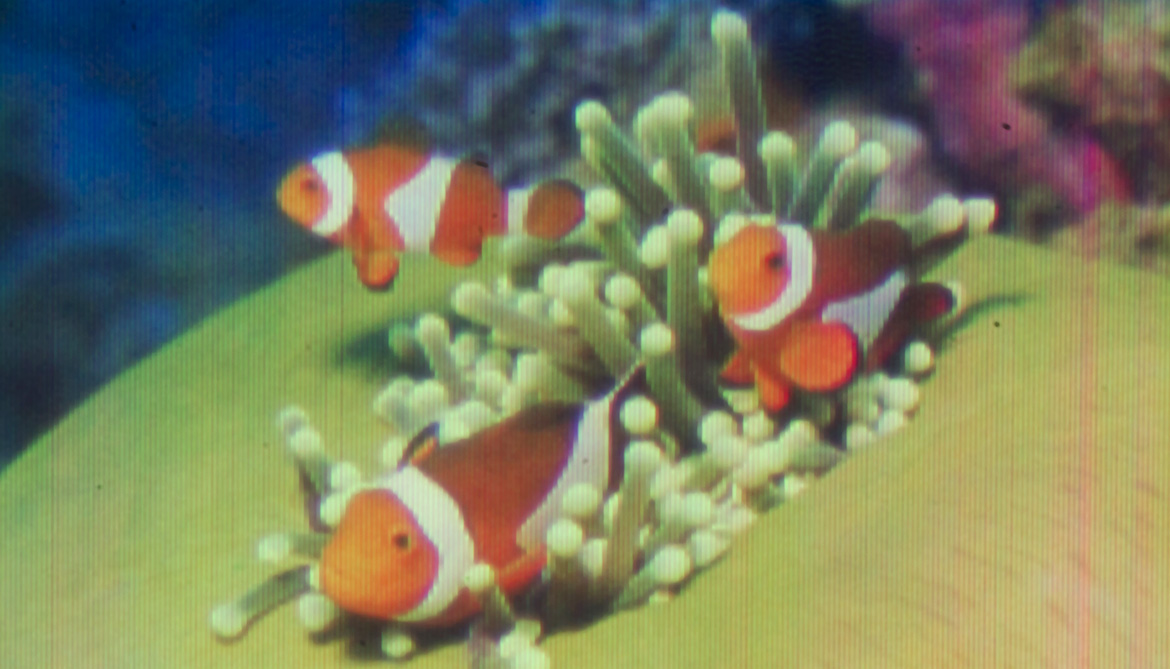 Smallest image in the world printed with Scrona technology[/caption]
Nevertheless, the EHD heads are not intended for graphic imaging, but rather for functional print applications. One targeted application is micro-LEDs by printing quantum dots of defined size to create micron-sized colour-conversion filters. Another use case is printing conducting paths on the edge of glass panes, to connect front and back. Printed circuit boards are a further application pursued.
Another potential application area is additive manufacturing. The technology does not lend itself to larger parts but to applications where complex, high-precision parts are required, e.g. in micro-optics. It allows for precise layer thickness control down to a single nanometer and even multi-material gradients.
Moving forward
Inkjet is still only scratching the surface of functional print. Despite its many advantages, several drawbacks for print in functional applications exist (see my recent article on functional print https://inkjetinsight.com/inkjet-knowledge-base/lets-get-functional-functional-print-and-inkjet/). What we see currently is a steady crawling into single applications and complementing other manufacturing processes with print. There is no doubt, however, that with increasing research and capabilities of print, more applications will be addressed.
A prime example is the Scrona technology that aims for the deposition of materials in resolutions and with fluids at a productivity level not seen before. The technology itself will not solve all problems of functional print but it opens opportunities in applications inkjet was not able to reach before.
Through the partnership with Notion Systems complete printing systems are on offer already. With the slower Gen2 heads they are mostly used for research and testing but with the faster Gen3 heads industrial applications are within reach. While the printer has an (almost) ready-to-use setup, use cases will come up that will require more bespoke approaches and integration into full production lines. In those cases, Scona can work on custom integration or supply imaging setups for interested parties.