Ricoh launched its latest continuous feed inkjet platform, the Pro VC80000 two weeks ago. The new press builds on many components that Ricoh developed and honed over the years but uses a completely new hardware base – the first since the launch of the Pro VC60000 in 2014.
Via the acquisition of IBM InfoPrint, Ricoh is one of the longest-standing suppliers of continuous feed inkjet equipment. The most recent line-up stretches from ultra-compact, lower-volume models to devices serving the mainstream transaction and direct mailing markets and finally to models serving high-quality, demanding graphic arts applications requiring a wide range of papers.
Introducing the Pro VC80000
The Pro VC80000 is targeting the latter market: high-quality printing on a wide range of papers for commercial, high-quality mailings, and high-colour publishing like catalogues, colour books, or magazines. The first impression is that the press is a lot more compact than the Pro VC60000/70000. A full duplex line measures less than ten metres (32.8 feet). In turn, the press is now slightly taller as the position of the drier was moved underneath the printing unit.
Under the hood, there are many improvements for improved automation and higher productivity. The Ricoh Pro Scanner, an option on the Pro VC70000, is now standard and has been updated and more closely integrated. The scanner monitors nozzle health down to a single nozzle and ensures colour-to-colour and front-to-back registration. An inline spectrophotometer is used for colour control. This all allows for simplified profiling media profiling.
The press can now print during speed ramps as well, allowing for crawl speed when setting up finishing or inspection and allowing a gentler start and stop. The VC80000 has better support for auto-splicing as well. Almost needless to say data communication, software, and maintenance have been improved to increase uptime and ease of use.
Drying and inkjet units are an evolution of the existing Pro VC70000 technology. The drier has been redesigned to heat up quicker, to be more compact, and use less energy. This is helped by a new ink formulation with a higher density (presumably with less liquid). As it is mostly the drier that sets the Pro VC70000 apart from the Pro VC60000, it is again a core component of the press design. Ricoh did not share details except that it consists of a series of small heated drums and hot air without using NIR.
The top speed of 150 m/min (492 ft./min) remains unchanged. There is a crucial difference, however. On the Pro VC70000 this speed was only achieved by dropping the resolution to 600 x 600 dpi, which was not always good enough for the applications intended for this press. Hence, the most frequently used speed setting was at 100 m/min (328 ft/min) at a 600 x 1,200 dpi resolution. The Pro VC80000 can achieve the top speed now at the 600 x 1,200 dpi resolution, due to a higher firing frequency of the Gen5 Ricoh heads. Liquid cooling of the heads has been introduced, which helps as well. Accordingly, Ricoh states a 50% expected increase in productivity. The Pro VC80000 has a 1,200 x 1,200 setting as well at a lower speed of 93 m/min (305 ft/min).
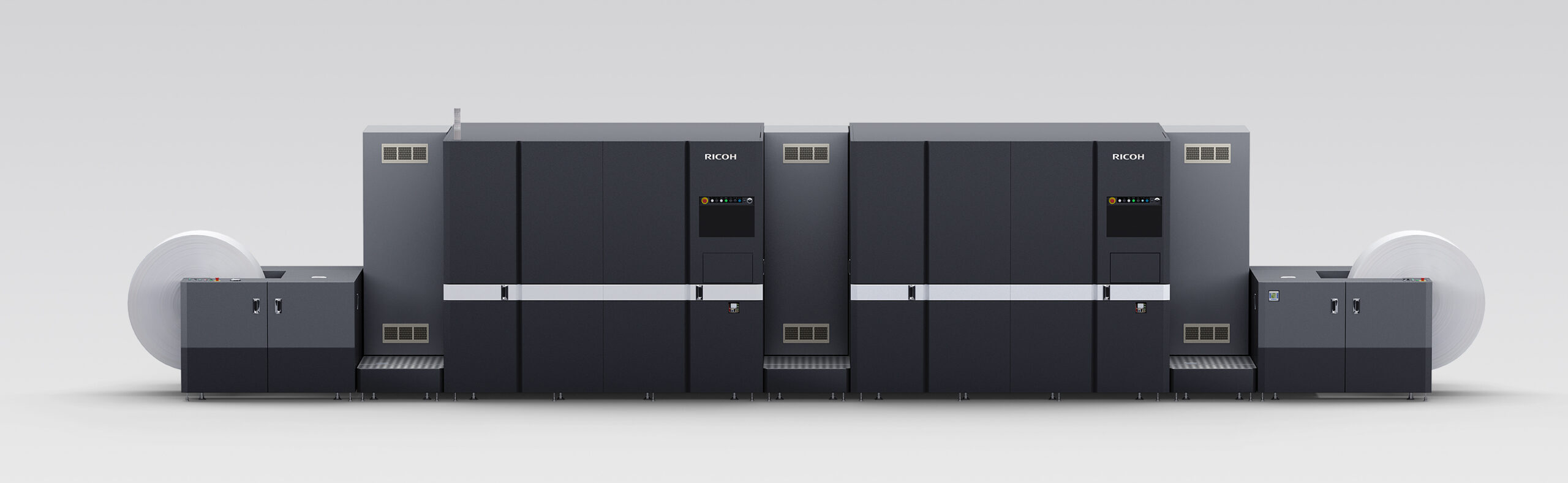
Furthermore, the paper range has been extended, lifting the maximum weight from 250 gsm (on the Pro VC70000) to 300 gsm. As direct mail postcards are gaining in popularity, this should be welcome. Coated and uncoated paper is supported and an option exists for an undercoat unit, a feature which is already available on the 70000, if especially challenging media will be used. The imaging width has been extended slightly to 571 mm (22.5 in.). The wider paper width could give Ricoh more traction in the book market, where other vendors had more sales previously, as the added width increases the impositioning opportunities.
Beta at Sattler Media Group
There is currently one beta site for the Pro VC80000 at Sattler Media Group in Germany. Sattler installed a Ricoh Pro VC70000 in June 2021 to move from imprinting on offset to a white paper solution for mailings. Further pushing the possibilities, Sattler is now a prominent player in programmatic printing in Germany. In addition, magazines, loose leaf sets and catalogues in short runs are produced on the inkjet press. Ricoh stated that Sattler was an ideal customer to test the Pro VC80000 due to the high-quality standard held up in the company and in the German market in general. In addition, a good variety of applications, including a wide range of papers, the strong focus on automation at Sattler, and the ability to compare the output against a raft of state-of-the-art offset presses at the site in Bad Oeynhausen should have been additional drivers.
The Pro VC80000 was installed in summer 2023 and by the time of the launch announcement, the press was in full operation. The Pro VC80000 will primarily be used for high-quality direct mail but other applications like magazines and catalogues will be printed as well.
Christian Haneke, Innovation and Solutions Manager confirms that the press is living up to the promised automation and ease of use - important in times of scarce staff. Maintenance processes have been improved, and especially the ability for maintenance by Sattler staff. He finds that the improved printheads and close, inline scanner integration lift the quality potential as well, even at a similar resolution compared to the VC70000.
Haneke also confirms the 50% rise in productivity, as for quality reasons the Pro VC70000 normally runs at 100 m/min, while the Pro VC80000 is running at full rated speed almost exclusively. Haneke adds that he is happy and proud that Sattler has been selected as beta site and that there has been great teamwork with Ricoh in getting the press up and running – not an easy task during the peak season for Sattler Media.
For now, the Pro VC80000 is running in a roll-to-roll configuration with the optional undercoat unit included. Sattler Media plans to add a Contiweb auto-splicer and remoistening unit as well as an inline Hunkeler Gen8 cutter including dynamic perforation to further increase the level of automation.
Looking Forward: Availability
The Pro VC80000 is targeted to ship in Q1 2024. The Pro VC60000 and the Pro VC70000 remain available. However, I would expect the Pro VC70000 to be phased out, as the targeted markets overlap considerably and the VC80000 is the more advanced product.
Historically, Screen and Ricoh cross-OEMed their printer hardware but added their own inks, driers, and DFEs respectively. This might change now as it was stated that: “the Pro VC80000 is a Ricoh product and it will be sold by Ricoh,” indicating that there is no hardware or development partnership with Screen on this product. So far, no announcement has been made by Screen (which just took on the new Kyocera B3 inkjet printer as OEM product).
Announcing the Pro VC80000 about half a year before drupa (and not previewing it at Hunkeler innovationdays) came a bit as a surprise. A planned availability within four months of the announcement is also unusual, given that the Pro VC80000 is a new engine design and not just an upgrade. A fast and successful beta trial certainly helped to make the press available so quickly. Drupa 2024 will be the first opportunity to see the printer publicly, although several sites should have the press running by then.
Even if the specs at first glance do not suggest this, the Pro VC80000 should have a noticeably higher productivity through a higher speed in a high-quality resolution mode and several productivity-enhancing features. An inline scanner as standard should help a lot in automation. Shrinking the engine can be helpful as well to address printers that did not invest in CF inkjet due to limited space. It seems that the Pro VC80000 is well positioned to fulfil Ricoh’s objective of bringing production inkjet into more companies.