What is functional print
There is no unambiguous definition of functional print. Functional print is based on creating a patterned functional layer (without specific visual properties) in contrast to a visual effect - which is the basis of commercial print.
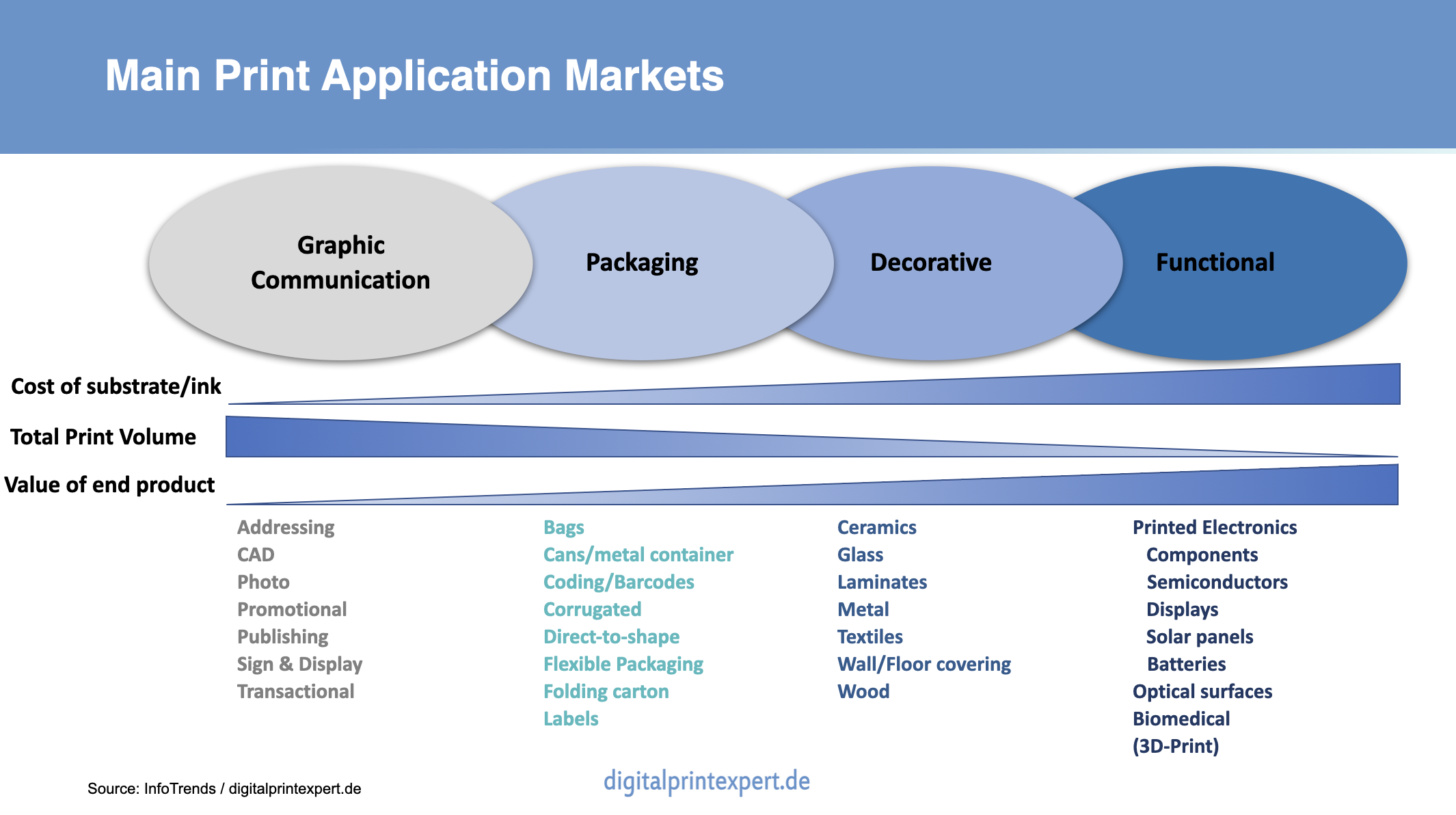
Functional properties of printed layers can be surprisingly basic, for example a protective varnish to protect a mailing or a barrier layer in a packaging. Usually, when referring to functional print a more complex functionality is assumed. Yet application areas overlap and so do the technologies used. It is interesting to remark that substrates and inks tend to get more expensive when moving towards functional print, while total global print volume per application tends to get smaller. Fortunately, the achievable price per printed surface area increases drastically.
Major Print Application Areas
Print is seen as a low-cost production alternative to traditional processes like etching, deposition, casting, or milling in the production of components. Often multiple layers of different materials are applied in functional print, although in some cases one is sufficient. Below are some examples of what functional print can include, although this is not an exhaustive list.
• Electrical components and conductive or insulating layers
• Solar cells
• LEDs and OLEDs
• Heating structures
• Optically active surfaces (mirrors, optical filters, lenses)
• Micropumps
• Various sensors
• Energy storage and fuel cells
• Circuit boards
3-D print, also known as additive manufacturing, is a special case as the final “printed” piece does have a function, although, this is not determined by the single layers. Instead, the function depends on the full object produced. Accordingly, 3-D print is not included in the discussion here.
Considerations for functional print and presses
Creating functional print almost always requires special inks and substrates. Therefore the presses need to be adapted, including substrate transport and drying. The extremely diverse nature of functional print implementations makes any standard press configuration impossible. Often components (ink transport, drier, ink transfer,…) need to be tweaked or assembled differently.
Typically developing a functional print product includes a number of steps, each with its own quality and economic feasibility gates. What works well on a sheetfed lab machine might be difficult in a continuous roll-to-roll process, needed for high yield. Automation and quality control can require new sensors, inspection, and documentation systems – which can easily double the price of a press. Steps towards commercialisation are:
- Product idea: including feasibility study
- Prototyping: proof of concept and single unit production on lab print devices
- Pilot production: transfer production to planned mass production set-up, certification and field test
- Integration: transfer from lab to plant and scaling to industrial production, including QC, documentation and workflow integration
- Industrial production
All printing technologies can be and are being used for functional print. Some have features that can be beneficial for certain types of functional print. For example, layers with a very high thickness can be easily achieved in screen printing.
There are several challenges when designing a press or production line for functional print:
- Functional prints can often only be inspected or tested when completely assembled, which takes additional time and process steps. Accordingly, it is difficult to compensate for defects in print or the waste rate is high.
- When installed in an end-user factory, specific norms, certification, documentation, operational or security demands apply – which a printing press usually does not fulfil
- Requirements on availability or yield can be very high
- Ensuring tight quality control and trackability of processes and failures
- Most applications require clean room processes and since usually solvents are involved an explosion prevention setup is obligatory
An important challenge is the extremely high productivity of print compared to the demand for functional print products. You did read correctly: print is too productive for most applications. The University of Chemnitz calculated that a single narrow web press or a B1 sheet-fed press could print all solar panels needed worldwide – even as solar panels are a widely used product. This clashes with the requests of goods producers, as they rather would like to have multiple print lines for better redundancy and geographic distribution.
A solution to this conundrum could be independent functional print service providers, which are able to switch between different products to give the press line a sufficient utilisation rate (provided the print line is flexible enough). This is already offered for example by InnovationLab, a joint venture of several companies, with Heidelberger Druck as print technology supplier. Here a Gallus web press is used on Heidelberg’s premises. The company provides R&D, product piloting and industrial production. While several applications are already commercialised, it remains challenging to fill the capacity and bring projects to the industrial production stage.
The Inkjet Opportunity
Functional print is printing technology-agnostic, but inkjet can have some advantages. As a digital process, no plate or form is required. Start-up waste can be lower and materials can be used more sparingly – a big advantage when using high-priced fluids. As a digital process, it also allows for rapid prototyping and shortest runs – even to customised products.
The inkjet process itself is contactless and has a simple setup. Usually, it is performed in a normal atmosphere and at low process temperatures, which makes the process relatively cost-effective.
However, inkjet does have some challenges in functional print. Most inkjet heads have a limited range of viscosity regarding the fluids they can support. Functional fluids can have a very wide range of viscosity and since they typically need to carry a functional material, they tend to be quite viscous. Heating the ink can lower the viscosity but this is only feasible within limits. Most manufacturers offer inkjet heads for fluids below 10 centipoise (cP). Inkjet heads up to 20 cP already count as high viscosity capable (water has a value of 1 cP, while olive oil is in the 50 cP range). Notably:
- Xaar has offered “ultra-high” high viscosity heads for up to 100 cP since 2021.
- Quantica, a new head provider that recently teamed up with Xaar, promises heads for fluids up to 400 cP.
- Scrona, using a new type of electrostatic ink ejection, aims for more than 10.000 cP – although the technology is not commercialised yet.
With these new heads pushing the boundaries, a significantly greater range of fluids and materials can be jetted.
It is not just about viscosity. Other challenges are the wettability of surfaces and drying. Also inks carrying polymers and/or microparticles with complex rheological behaviour can influence drop formation. Resolution and drop volume are other factors that need to match the application.
Accordingly, it is no surprise that inkjet in functional print is just about to start. Some companies like Notion Systems from Germany already provide full inkjet systems for functional print. With about 60 employees the company produces lab and production lines for display, soldering or semiconductor applications.
[caption id="attachment_6885" align="aligncenter" width="581"]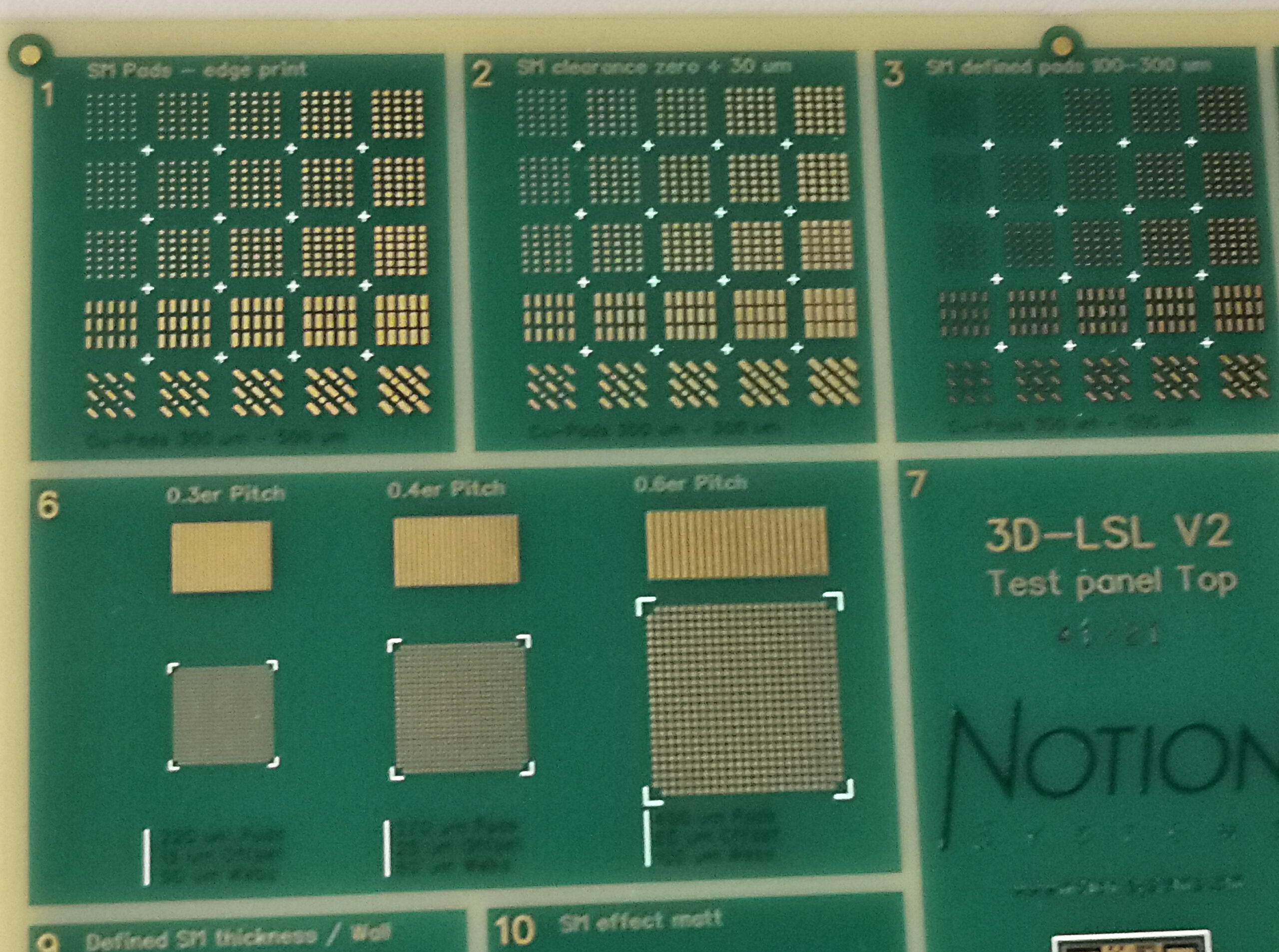 Test sample of inkjet printed soldering mask produced by Notion Systems printer[/caption]
Given the high productivity of printing processes for most functional print applications, scanning head inkjet solutions can be a good alternative to page-wide arrays. They can also smooth out nozzle defects.
The outlook for functional print
Functional print is not a new idea, although there are many new approaches and technologies constantly being developed for specific solutions. Each application is essentially its own project requiring research and customisation. Most of the work is still taking place in the labs and at best in pilot installations. The hurdle for full industrial-scale production is especially high. Already for 10 to 15 years, the technology has been tipped to make its big, widespread breakthrough. However, there are only a few areas, like displays or some electrical components, where functional print is already used widely.
The outlook is bright nevertheless. The digitisation of all processes (Industry 4.0) does require ever more inexpensive, mass-produced components. At the same time, digitisation and AI make it easier to design components. As print can also cut down waste and process steps, production becomes more efficient and environmentally friendly. Functional print will also benefit from the progress made in inkjet technology in general. There might not be a single breakthrough moment but many more applications for functional print will pop up in the near future.