In the previous article, we looked at the growing demand for quick-to-shelf packaging driven by e-commerce and the corresponding need for advanced web-to-pack solutions. In this article, we break down web-to-pack and examples of commercialized and “build-your-own” approaches.
See also “It’s Time for Web-to-Pack Enabled by Inkjet”
Background
While the B2C and B2B models of implementation and constraints on variability still exist with packaging, converters are finding levels of complexity not seen in commercial print.
First, there is no single packaging application or type. Packaging types can include primary, which has direct contact with the product; secondary, which can group primary package components; and even tertiary, which is usually used for protection and transit of the secondary packaging.
Second, there is no single packaging format, as packaging can include labels, flexible packaging, paperboard boxes, corrugated boxes, as well as bottles and cans. Granted, with each of these, there could be web-to-pack software available, provided there is an understanding of the rules of limited variability.
Since the shift from large global brands to smaller local/regional brands is increasing, so is the amount of disparate packaging required. Think more targeted and shorter packaging production runs similar to what has happened in direct mail and marketing.
Smaller local/regional brands are usually more likely to engage local resources for their design and packaging needs. Global brands competing against smaller local brands will undoubtedly also have to adjust their current relationships with their global packaging resources to align with the supply chain management responsibilities at the local/regional level.
Web-to-Pack Solutions
Web-to-pack or webshops are a growing part of the offering expansion for some commercial print PSPs. However, it is also growing in existing packaging converters.
Web-to-pack shops, both connected to converters or standalone, are acting as transaction engines for a wide range of digital and flexo printed products. They include solutions for labels, folding cartons and corrugated packaging, and are continuing to expand.
Unlike most web-to-print applications and print providers, ordering a box online can be a complex process. After all, a box can take many shapes and sizes, and if you are not a packaging engineer, how do you create the template, die outline and ultimately the graphics to fit?
Almost all web-to-pack solution providers have pattern templates for the outside of the box. Here is how one particular platform works.
To get started, you select a pattern for the outside of your box from the “Pattern Templates” menu. If you have your own design that you want to use on a product, you can download the layout template for your choice of design product.
Create your design, then upload it using the “Image” tab. You can then review the mockup with an interactive 3D visual of the package. If it’s a box, you can open and close the lid with a click, and rotate the box to see it from every angle.
Choose from different fonts and colors to add a text layer, and place the text anywhere you want. You can even design the interior if you want to provide an opening experience.
Once you’re finished, go to design review, grab the preview, and move it around to see how your box looks. If there’s anything you want to change, you can return to the design studio. They are preparing contextual how-to videos to help the customer. Ultimately, what they want to provide is a frictionless site experience.
Vistaprint
Vistaprint, one of the early web-to-print providers, now has a line of product packaging offerings comprising everything you need to package your product. This includes labels, flexible packaging, folding cartons and shipping packaging, which are basically corrugated boxes that you can customize. They also have gifting and accessories.
Vistaprint has found that customers will probably buy multiple products, so that company makes sure that they are sending or showing the relevant products for customers’ needs.
This includes the upsell. Customers may need other printed materials to support product packaging and sale. Since they are usually serving small- to medium-size businesses, they are building a “good, better, best” strategy.
So if the customer has a limited budget, and knows exactly what they need, they can select a particular price point, and the right products for them would be shown.
“Better” could include a finishing option or a little bit more premium quality substrate. The “best” option includes all the foil and the raised print and everything else that a customer would need to showcase their brand.
ePAC Flexible Packaging
ePAC has led the way with on-demand flexible packaging, and their growth has been explosive. Since their first plant opening in 2016, they have expanded across North America and into Europe, Asia and Africa. They currently have 26 manufacturing facilities and are still growing.
They are an all-digital on-demand flexible packaging company that could not find any off-the-shelf webshop solution to satisfy their requirements.
“We have not found a web storefront software that fits the needs of the digital flexible packaging market,” said Carl Joachim, ePAC co-founder. “The goal is to have a UI that is superior and also addresses the needs of the flexible packaging marketplace. We don’t believe there is anything out in the market that could satisfy our needs, due to the changing nature of print procurement and production automation.”
As a result, the company is in the process of developing their own front-end web storefront. In addition, the company is laying the groundwork for integration into PrintVIS, the company’s MIS solution.
One of the new value-added services they offer is Connected Packaging, where they can apply an individual QR code to a package, which can be used to engage the end consumer and provide other valuable market information to the product manufacturer.
Build Your Own
Giuseppe Priorie is the founder of Pakly, a unique web-to-pack company located in the province of Campobasso, Italy, near Naples. He decided to build his own web-to-pack business and systems.
Since carton manufacturing was new to him, like many commercial print service providers that take that first leap into packaging, he reached out to Aviv Ratzman, the founder of Highcon, for some initial guidance. He started to develop his online transaction software in 2014 and launched the initial build in 2015.
[caption id="attachment_6882" align="aligncenter" width="600"]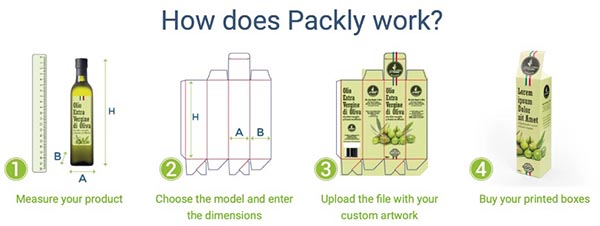 © Pakly[/caption]
The software walks the customer through box creation based on size requirements and then produces a die outline and a 2D and 3D preview of the box. He approached HP in 2018 after seeing the HP 20000, and asked if they could build one he could use for folding carton work. That became Pakly’s first Indigo 90K. They also have three Highcon laser die cutters.
They turn around their boxes in 48 hours from order. Today, he also licenses the software to converters around the globe, who want to enter the web-to-pack market.
Can Any PSP Set Up a Web-to-Pack Service?
The prospects of web-to-pack viability vary by market and application, just as they do with web-to-print. Constrained design packaging products that include a library of label or package types are the way most of the successful solutions are developed.
[caption id="attachment_6881" align="aligncenter" width="600"]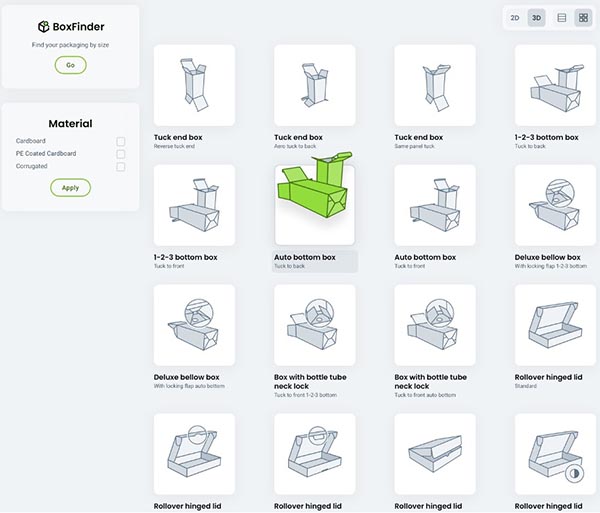 © Pakly[/caption]
Each of these solutions provide display templates. They are on-demand, web-to-pack converters that developed their own software. Basically, customers fill out the order form, upload imagery, and visualize the finished product with a 3D viewer.
Ultimately, the success of these implementations, as it is in web-to-print, is by limiting the variability of the design and production offerings. Of course, having the production plant automated in order to integrate these solutions is really the first step. Also important is understanding that B2B will offer fewer challenges than B2C.
More Solutions
Box It Now developed an online custom box creation software tool, but unlike Pakly, isn’t a converter. Kerry Drake, VP of sales and marketing for PXI Digital solutions, the creator of Box It Now, came from the packaging industry. He describes the software as a “collaborative web application, primarily used for new packaging development in the consumer product development cycle.”
It is available to consumer product companies as well as printers and converters through a monthly subscription model. It is available as an e-commerce widget for easy integration into a website.
Most of the packaged web-to-pack software solutions on the market today operate in a similar fashion and include standard templates. While some solutions are licensed, some are subscription-based.
PrintNow’s solution supports over 300 parametric standards for both paperboard and corrugated boxes. They also offer many configurable controls over the way the application works, and have an enterprise API for integration with existing business and production systems.
Infigo software provides a toolkit to build a web-to-pack solution for labels, flexible packaging and folding cartons.
Having an MIS system that supports all of these web-to-pack product distinctions is also a good idea. Tharstern, now a part of ePS, has been developed to support those needs.
ePS Packaging software is built to enable customers to design and order folding carton products online. With stunningly realistic 3D renderings, customers can create and design 3D packages—applying their own graphics and artwork while previewing and approving the job. The production files can be supplied as ready-to-produce files containing all the necessary high-resolution artwork and die files required.
Design ’N’ Buy offers a web-to-print and web-to-pack solution that can integrate and automate the online experience. It is offered as a lifetime license or as a monthly subscription.
Challenges in Web-to-Pack
Packaging design will always play a critical role in engaging the consumer and establishing and reinforcing brand recognition and loyalty. However, the amount and—more importantly—the accuracy and consistency of the content is becoming more critical.
One of the biggest challenges is maintaining identical content across the product and marketing applications. If you are an independent product manufacturer or a converter that supplies them with packaging, there are potential pitfalls that need to be monitored and resolved. As design and production workflows continue to expand beyond a single controlled process to more disparate and distributed processes, and as global packaging regulations increase, they demand a better solution.
Impact of US FDA Food Safety Modernization Act
Depending on the product, it is important to comply with regulatory provisions. The Drug Supply Chain Security Act (DSCSA) was enacted by the U.S. Congress on Nov. 27, 2013. It requires the ability to track and trace all products in the pharmaceutical distribution supply chain.
Similarly, the Food Safety Modernization Act (FSMA) has been proposed as a requirement for those who manufacture, process, pack or hold foods on the Food Traceability List (FTL).
Each of these add not just a need to ensure accurate and consistent packaging and marketing content, but also a potential liability. With brand identity, regulations and need for further integration into the value chain, it is critical that a solution supports compliances. Those could include the maintenance of consistent information across all uses, but it could extend to other areas as well.
ManageArtworks has taken on that challenge with an end-to-end packaging artwork management system. It is a cloud-based collaboration platform that was designed to address the specific requirements of packaging and brand content management.
By capturing, managing and distributing the brand content for all its intended needs, it ensures accurate and consistent content use. For design, there is a plugin that talks directly to the system providing you with the latest version. If there is a change in the system, you see it in the plugin, click a button, and it updates the content.
Ultimately, the real goal is the time it takes to get the product “shelf ready.”
Awareness of Complexities
While most of these solutions have templates and guided workflows, structural packaging design complexities can be challenging for even the more experienced designer, according to Ed Zumbiel of Zumbiel Packaging.
Zumbiel created a web-to-box solution to streamline their craft beer client growth. Between the structural complexities of design against the template, to more mundane problems with fonts and file formats, they found that the prepress department had to spend more time on these web-to-box jobs than their regular client jobs. Ultimately, they took the site down, and are onboarding jobs through CSRs, at least for now.
Other awareness complexities include those around safety, product ingredient labeling, track and tracing regulations, as well as anti-counterfeit measures, depending on the product and markets. Converters have expertise in these areas and can guide these small producers, according to Carl Joachim from ePAC, the largest on-demand global flexible packaging producer.
These are just a sampling of huge growth opportunities for web-to-pack and short-run, on-demand packaging. However, while there are opportunities, there are many complexities not seen in commercial print, that require a level of expertise not necessarily found in the producer’s kitchen, basement, or garage. In fact, many of these complexities require an experienced converter or designer to navigate.