Orders are increasing for short-run, on-demand packaging to satisfy shifting consumer purchasing requirements. While converters and web-to-pack systems are being developed to operate at the “speed of retail,” there are many opportunities, complexities and value- added offerings not seen in commercial print.
See also: E-Commerce Opens High-Revenue Opportunities for Inkjet
Background
According to U.S. Census Bureau data, in the second quarter of 2022, e-commerce comprised 14.8% of total sales.
The “Global E-Commerce Packaging Market—Forecasts from 2022 to 2027” report further stated that “the global e-commerce packaging market is anticipated to develop at a CAGR of 15.87%, reaching a total market value of $98.856 billion by 2027, from $35.244 billion in 2020.”
While the pandemic had some “forced effect” on purchasing for many reasons, according to a recent McKinsey & Company study, “The crisis has prompted a surge of new activities, with an astonishing 75% of U.S. consumers trying a new shopping behavior in response to economic pressures, store closings and changing priorities.”
Online purchasing frequency is influenced by age, with the younger generations providing the largest share.
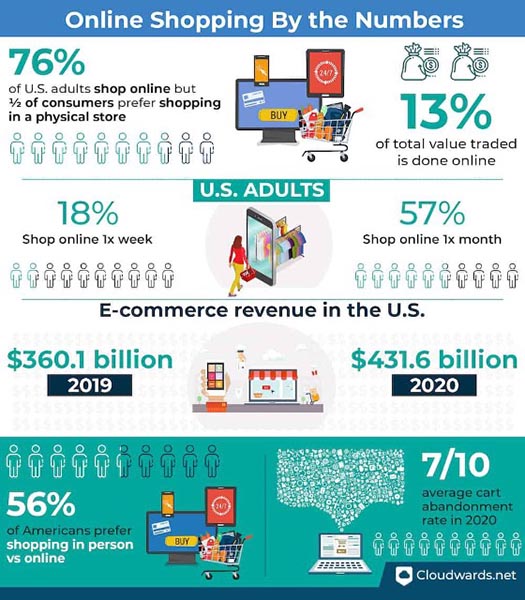
According to Internet Retailer, approximately 35% of consumers aged 18–39 shop online at least once per week. Compare that with about 45% of infrequent online shoppers (ages 40-64) who shop online at least once per year. More importantly, “global” digital sales are growing faster than the more saturated U.S. e-commerce market. See additional online shopping statistics from Cloudsward.net. in the infographic below.
Ready-to-eat foods are projected to grow at a CAGR of 7.7% to $3.8 billion by 2032. These include the products you might see in a farmers’ market that were produced by an entrepreneur in their kitchen. It’s a perfect candidate for a nice package to replace a cellophane or paper bag and label in short runs, especially if the producer is looking to expand to more competitive online sales.
Another growth area is craft beer, which is projected to grow at a CAGR of 6.9% to $174.68 billion by 2032. Cannabis is projected to grow at a CAGR of 15.3% to $72 billion by 2030.
Web-to-pack offers a great solution to take advantage of all of these new demands in quick-to-shelf packaging.
[caption id="attachment_6868" align="aligncenter" width="600"]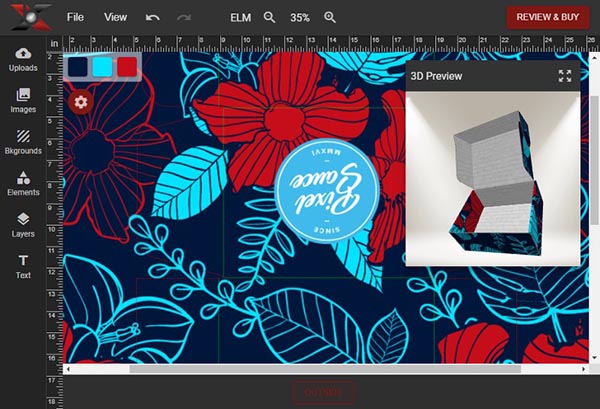 Example of a web-to-pack design template. Source: PrintNow [/caption]
Perfect Storm for Web-to-Pack and Digital Printing
Many B2C (business to consumer) print service providers using web-to-print have found their product niche and try to stay out of the race to the bottom on pricing. However, an increasing percentage of printers—who have a structured and constrained print product need with limited variability—have found that B2B web-to-print implementations can provide a better way to engage and serve their customers. So to what extent can it work for packaging?
Some of the earliest entries into the web-to-print marketing category were “constrained design” template-based solutions that offered a print service provider a way to streamline the ordering of personalized business cards. These solutions grew from offering a variety of business cards to offering larger catalogs of products, which could include brochures and mailers. Vistaprint/Cimpress was and still is the poster child in this space.
Web-to-pack solutions have been following a similar trajectory in that they are usually, but not always, a constrained design solution, or a catalog of customized product offerings.
Many Types of Packaging Are Candidates
Chances are you have one or more cartons currently stacked outside your front door. It is a growing global phenomenon.
Corrugated, solid-fiber packaging and flexible packaging use are each projected to grow by about 13% between 2022 and 2027. Considering that the global population growth rate has declined from approximately 2% in the 1960s to 1.05% today, that means we are purchasing and consuming a lot more products. In fact, global retail sales are expected to increase at a CAGR of 7.7% through 2025 as a result of the growing middle-class consumer population.
There are many forms of packaging available today, and boxes play a role in almost all of them, whether directly for the product, product aggregation or transport.
That growth also includes all sizes and shapes of flexible packaging, both preprint and postprint corrugated and carton production, an important distinction. That short-run growth will come from flexo, offset and digital, an important distinction to note, since many believe that only digital print is designed for short runs or on-demand applications.
As the generational purchasing shifts take hold, the quest for more product variations, sizes, tailored messaging and promotions will continue to be key drivers behind SKU proliferation and more packaging. Much of that growth will be in the form of shorter runs and quicker turnaround.
The next installment of this series will look at approaches to web-to-pack solutions by leading suppliers and challenges for different types of packaging segments and implementations.