Once the printing is done, whether it is a label, flexible package or folding carton process, it needs to be integrated with some finishing and converting, then delivered to the application for which it was designed. Each of those applications requires different types of equipment. That means that the print and the converting processes need to align.
While there aren’t a lot of all-in-one application-specific solutions that can address all of them yet, with drupa coming up, there is a lot of development going on with packaging press and converting machine manufacturers to address the new, shifting market requirements. Ultimately, application requirements can be fairly disparate, so a modular hybrid solution will undoubtedly provide widest range of process adaptability.
All-in-One vs. Hybrid: What’s the Difference?
Analog press and finishing equipment provided us with the one-solution-fits-all design, where production is primarily confined to disconnected processing steps, except for some flexo applications. It continues to serve the printing industry well. However, as the market demands change, there is a need to think differently about print and packaging production.
Historically, most packaging production print has been fairly static, driven predominantly by flexography and offset, with gravure picking up some of the longer runs. The introduction of inkjet enables the imaging engine to decouple from the “standard” transport, and in its place become part of a custom or bespoke transport solution. As a result, we are just beginning to see the creative opportunities that can be achieved. However, as previously mentioned, packaging is a lot more than printing.
We have seen the development of many inline modular solutions that go from white or brown paper (either cutsheet or roll) to finished product, including embellishment. These connected hybrid solutions have streamlined print production and enabled a whole new generation of digital printers to enter the industry.
Flexography continues to reinvent itself, resulting in extremely high-quality print while still providing high productivity and low cost, which creates a significant defense against electrophotographic and production inkjet solutions.
While the basic concepts of flexography have not changed, digital enhancements are affecting everything, from transport to imaging, and providing significantly enhanced automation and control.
In the area of transport, the use of visual and other sensing technologies, combined with digital servo controls, enable less operator involvement and better control. This provides an advantage for flexo in that it can also be configured to address a full production line from precoat (if needed) through printing, embellishment and finishing.
That being said, all-in-one flexo solutions have been evolving as well. Expanding from the initial roll-to-roll design to more complete solutions, they can now include inkjet printing, die cutting and embellishment. Two good examples of that are the Bobst Digital Master Series and the Gallus One.
In the case of the Bobst Digital Master Series, they are built on Bobst’s modular and upgradable M5 flexo platform in combination with the Bobst Mouvent Cluster inkjet technology. These presses are designed to produce label, shrink sleeve, flexible packaging and in more narrow- and mid-width applications.
[caption id="attachment_6855" align="aligncenter" width="600"]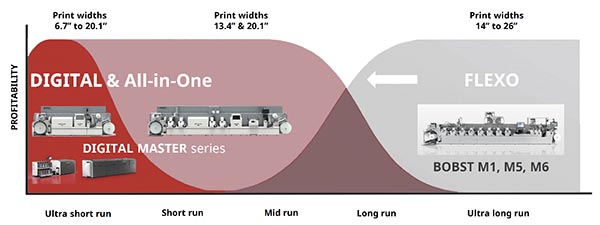 © Bobst[/caption]
The Gallus One digital label press, covered previously by Ralf Schlözer, is more than just an all-in-one label press, similar to the Bobst solution. It is also designed as the base for an expandable solution, not just a standalone print engine. One could say this is only the beginning as this new modular platform can spawn several variations in the future.
[caption id="attachment_6857" align="aligncenter" width="600"]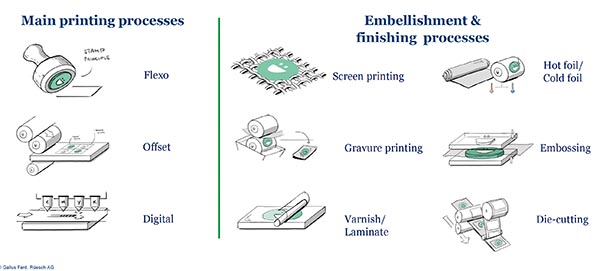 © Gallus[/caption]
Initially, Heidelberg’s new Gallus One was promoted as an all-in-one press. However, the Gallus One DPU (Digital Print Unit) can also be used as a base for growth and/or an option to existing Gallus ECS flexo presses.
This solution can bring everything inline and features a digital printer with an inline flexo station, a semi-rotary die cutter that can change a job within one minute and process up to 70 m/min., and vision inspection systems to ensure the highest level of quality and to minimize waste. There are many options that can be added, as the requirements may vary for each converter. The units can be reconfigured on-site as the need arises, as a result of the flexibility of the Gallus rail system made popular on the Labelfire.
All-in-one presses are not exclusive to Bobst; others, like the Canon LabelStream 4000, OMET XJet platform integrating Durst’s Tau 330 digital inkjet system with OMET X6, Mark Andy Digital Series iQ, and many others have similar specifications.
Coexistence
Many of the earlier EP digital label presses are printing at 25–30 m/min., but now, with the increased speeds of the HP Indigo V12, we are seeing 120 m/min. and up for a digital EP label press. However, even operating at 120 m/min., many flexo presses can run at 300 m/min. and up, and adding the increased costs associated with running digital vs. pure flexo still presents issues for large volume runs.
So the reality for quite a while will be the coexistence of digital and inkjet with flexo based on volumes and cost. In the short- to mid-term, the battle lines are being drawn between EP and inkjet for capturing the shorter-run, on-demand label production along with inline finishing and embellishment.
This hybrid approach is not only for labels; we are seeing it now in folding carton, corrugated ad flexible packaging.
For example, the Heidelberg Boardmaster was designed for increased productivity and zero changeover downtime, with the Non-Stop Print Deck technology in conjunction with the Intellimatch scanning system.
The Boardmaster is highly flexible as a result of its modular design. Folding carton production varies based on the type of carton and the required finishing. Consequently, the Boardmaster is designed to be a part of the larger Heidelberg ecosystem.
Currently, the press can run roll-to-roll, roll-to-sheet or roll-to-blank, and future plans call for the integration of various inline finishing features, such as lamination, hot- and cold-foil stamping and rotary screen printing. The Boardmaster can also be installed along with the Heidelberg FCL series flatbed die cutter. This machine can combine cutting, creasing, embossing and window and outer contour punching.
The Dantex Pico range of products have been designed on a modular platform, offering a wide range of inline finishing options: die-cutting, lamination, backlit/edge trim, slitting and rewinding. Their DecoTactile module is used to create a range of high-quality embellishments to give enhanced detail and vibrancy, such as raised tactile finishes and textures. High-build capabilities provide a digitally embossed luxury finish at low cost.
Inline flexo options offer a multitude of embellishments from spot- and flood-coat varnishing to spot colors and cold foiling. Self-wound and pre-wound laminates can be applied, as well as a full rotary die station, along with edge trim and slit modules.
[caption id="attachment_6856" align="aligncenter" width="600"]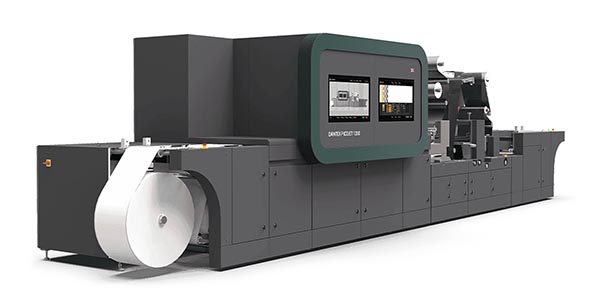 Dantex PicoJet 1200 Hybrid[/caption]
Kento Hybrid, covered previously, is specifically designed for corrugated packaging, utilizing a modular Celmacch HQ flexo press and an inline inkjet station. The feeder, flexo, primer and varnish modules are placed on rails for configuration flexibility.
Integrated with this flexo press is a single-pass solution that brings together in a single line the advantages of inkjet digital printing and high-quality flexographic printing, specially designed for corrugated cardboard.
As an enhancement to its printing capabilities, Kento offers the world’s first inline rotary die cutter on a digital printing machine, adding several advantages in terms of efficiency, speed and cost-effectiveness. It’s a true end-to-end print and die-cut solution.
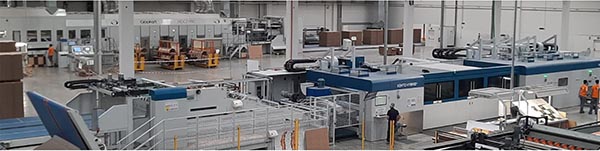
As the market requirements evolve, many digital and inkjet equipment manufacturers are developing more flexible configurations to better address those requirements. A good example of that is the newly released HP Indigo V12 label press, which provides flexo performance in an all-digital press.
If we look at the MGI AlphaJET, also known as their “printing factory,” we can see modularity and flexibility that can be tailored to many packaging and commercial applications.
Equipment on the Horizon
HP, EFI, Barbarán, Fujifilm, Xeikon, Domino, Hanaway and now Agfa—coming off the acquisition of Inca and their UK-based joint venture with BHS—are all competing in this market, and we can expect new developments from each of them to address the value vs. volume challenge of digital transition.
Some will say that, with skilled labor shortages, digital is still the way to go. However, if you look at the amount of digitalization and automation now available in these flexo hybrid presses, it begins to level the operational skill requirements. Inline automatic registration and pressure adjustments, automated maintenance and integrated semi- or full-rotary die options mitigate a lot of the legacy skill requirements.
Exciting Times Ahead
As digital technologies continue to advance and market requirements continue to shift, there will be continued growth in hybrid print solutions and most likely an explosion in bespoke machine development. I can’t wait to see what ingenuity exists out there, and what will turn up at drupa next year.