2023 marked the 100-year anniversary of Gallus, now part of Heidelberger Druckmaschinen AG. It coincided with the opening of a new experience centre at the company’s headquarter in St. Gallen, Switzerland.
100 years ago, company founder Ferdinand II. Rüesch was approached to develop a tag printer for local merchants. This led to Gallus rising to one of the leading label press manufacturers. After acquiring a 30% stake in Gallus in 1999, Gallus became a fully owned subsidy of Heidelberger Druckmaschinen in 2014. In return for bringing in his 70% of Gallus shares, Ferdinand IV Rüesch became an anchor shareholder of Heidelberger.
[caption id="attachment_6834" align="aligncenter" width="520"]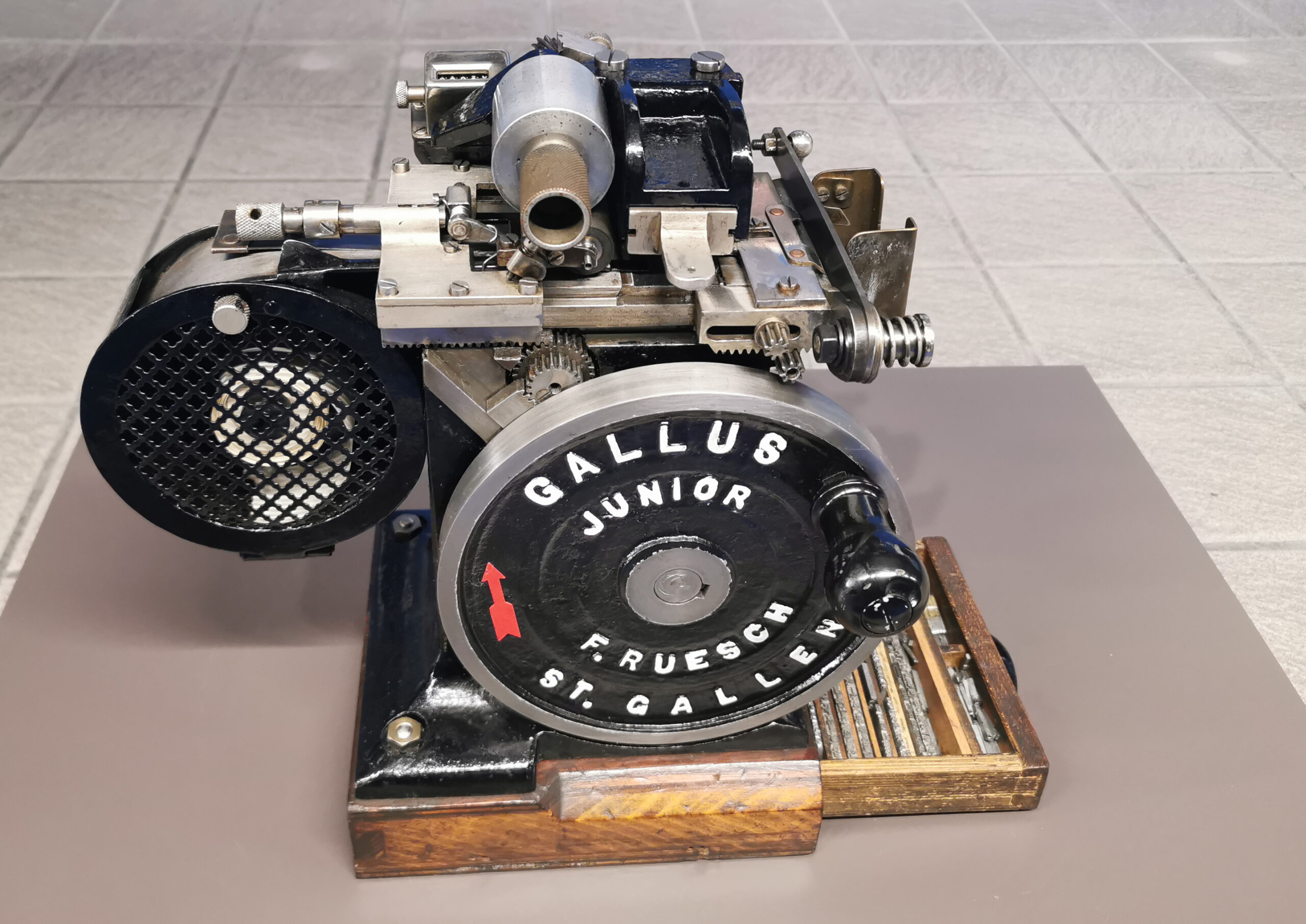 Early Gallus Tag Press[/caption]
Inkjet early on
Despite a long history in analog presses, Gallus turned into an early user of inkjet technology. In 2014 the company announced the DCS 340, a hybrid press including an inkjet unit developed by Heidelberg. The press was pioneering 1,200 dpi resolution in label printing.
Like the ECS 340, as original press base, the DCS 340 has a highly modular approach. Different flexo, screen, and foiling units can be added, together with several embellishment or finishing modules. At site, the modules can be easily interchanged. The inkjet module is noticeably larger than the standard modules and cannot be exchanged, however.
At drupa 2016 the press was renamed Labelfire 340, as part of Heidelberg’s new digital print portfolio. The hybrid presses are still sold under the same name today but include a large number of improvements based on all the customer experience gained since. Also, the speed has been upped from originally 50 m/min to 70 m/min.
Already with the DCS340 the responsibility for the different components of a Gallus inkjet press has been established. Gallus provides the press base and overarching control of the print system. Today all new Gallus presses are manufactured at the Langgöns site in Germany (the former Arsoma factory and part of Gallus since 1990). Heidelberg contributes the inkjet unit including digital DFE, colour management, and workflow. Heidelberg also develops and specifies the inks, which are produced by a 3rd party manufacturer. Finally, Fujifilm supplies the inkjet heads.
Gallus One and more
Innovation did not stop however and in August 2022 the Gallus One was announced, as a stand-alone roll-to-roll inkjet label press and new inkjet platform. Again, Gallus is using a Heidelberg inkjet unit with Fujifilm Dimatix inkjet heads. Base specs are not too different from the Labelfire with 340 mm print width and 1,200 dpi imaging at 70 m/min. The Gallus One has been developed on the experience Gallus gained in inkjet label print and has several improvements in workflow, automation, user interface, imaging control, and uptime. It also features a full Prinect workflow integration.
[caption id="attachment_6835" align="aligncenter" width="627"]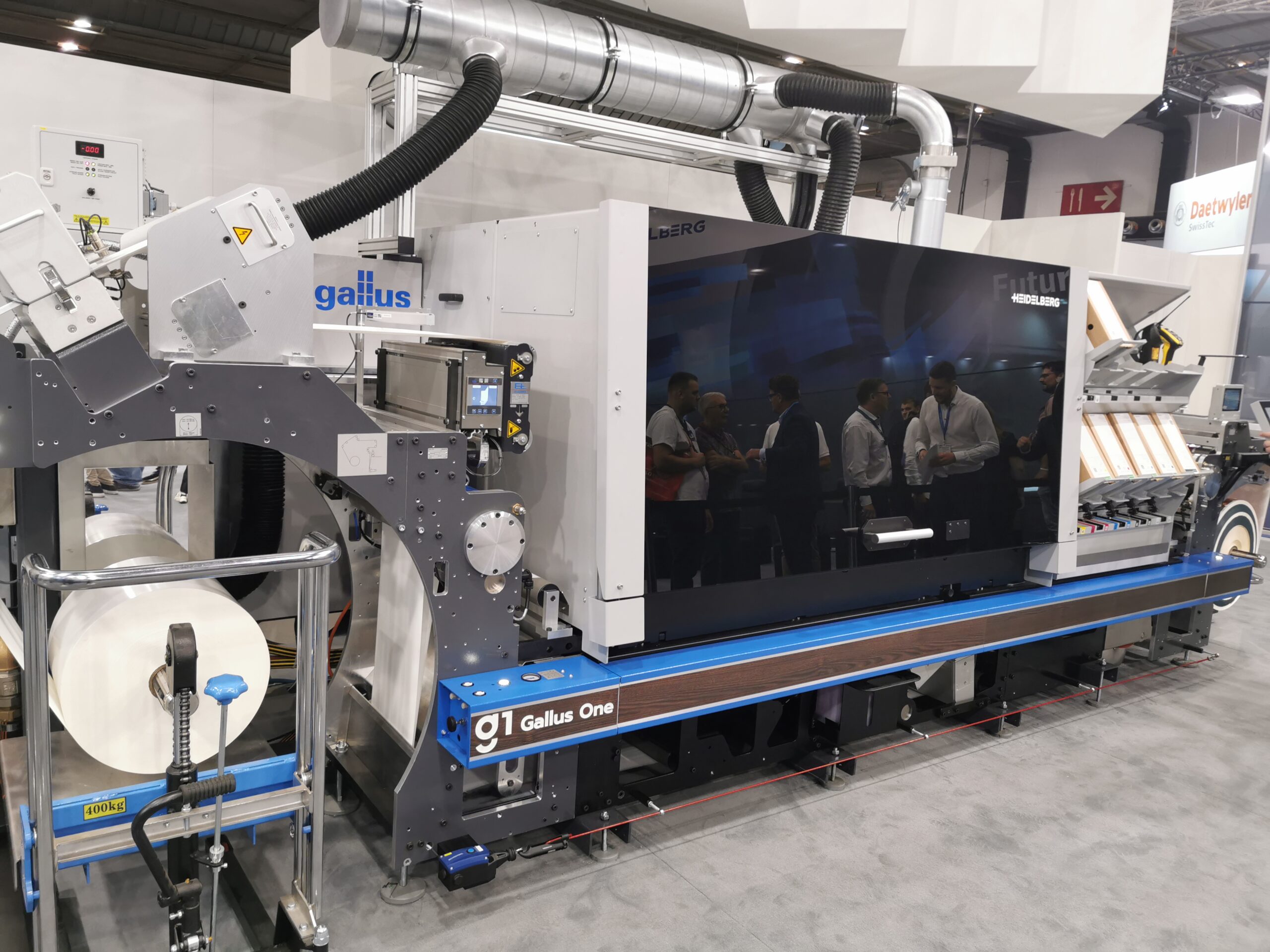 Gallus One at Labelexpo 2023[/caption]
The Gallus One is available only in a standalone configuration, with four-colour imaging, and 340 mm print width for now, which keeps manufacturing cost down. The Gallus One has been designed as a highly modular product and is intended to be extendable, however. It is based on the latest generation of conventional label presses, the Labelmaster, which was launched in 2016, at a time the Labelfire was already announced. It is likely that hybrid options will emerge at some point.
The Gallus One is now entering full sales with a limited number of installs at user sites today and more shipments scheduled for the remainder of 2023. For 2024 it is planned to ship 30 units.
There is more inkjet available from Gallus. Already in 2019, Gallus added a Digital Printbar for digitally printed white on their analog press range. Also, a Digital Embellishment Unit is available, for UV spot coating or haptic effects. It can be added to the Labelfire 340 and the Labelmaster.
Not just an experience centre
For Gallus moving into inkjet is a bare consequence of the continuing market shifts. Obviously short runs, just-in-time production, and lower stock-keeping drive digital printing for labels - as in many markets. The drivers for adopting digital print run deeper, however. Demographic changes are leading to a shrinking working population and an increasing competition for talent. Accordingly making presses easier and more attractive to use and to maintain is a main target.
Another driver is the ever-closer integration and optimisation of all processes in the supply chain, as automation islands do not yield an optimised process. The new experience centre is not only designed to be a showroom for process integration, it is pegged to drive the integration processes as well. The idea is to develop a touchpoint for the whole industry, where companies can test automation across full product lines. Also, printing companies can get familiar with full process optimisation, although still too few printing companies are driving this development. Exceptions exist, however, among printing companies with a young, IT-savvy leadership team.
[caption id="attachment_6833" align="aligncenter" width="548"]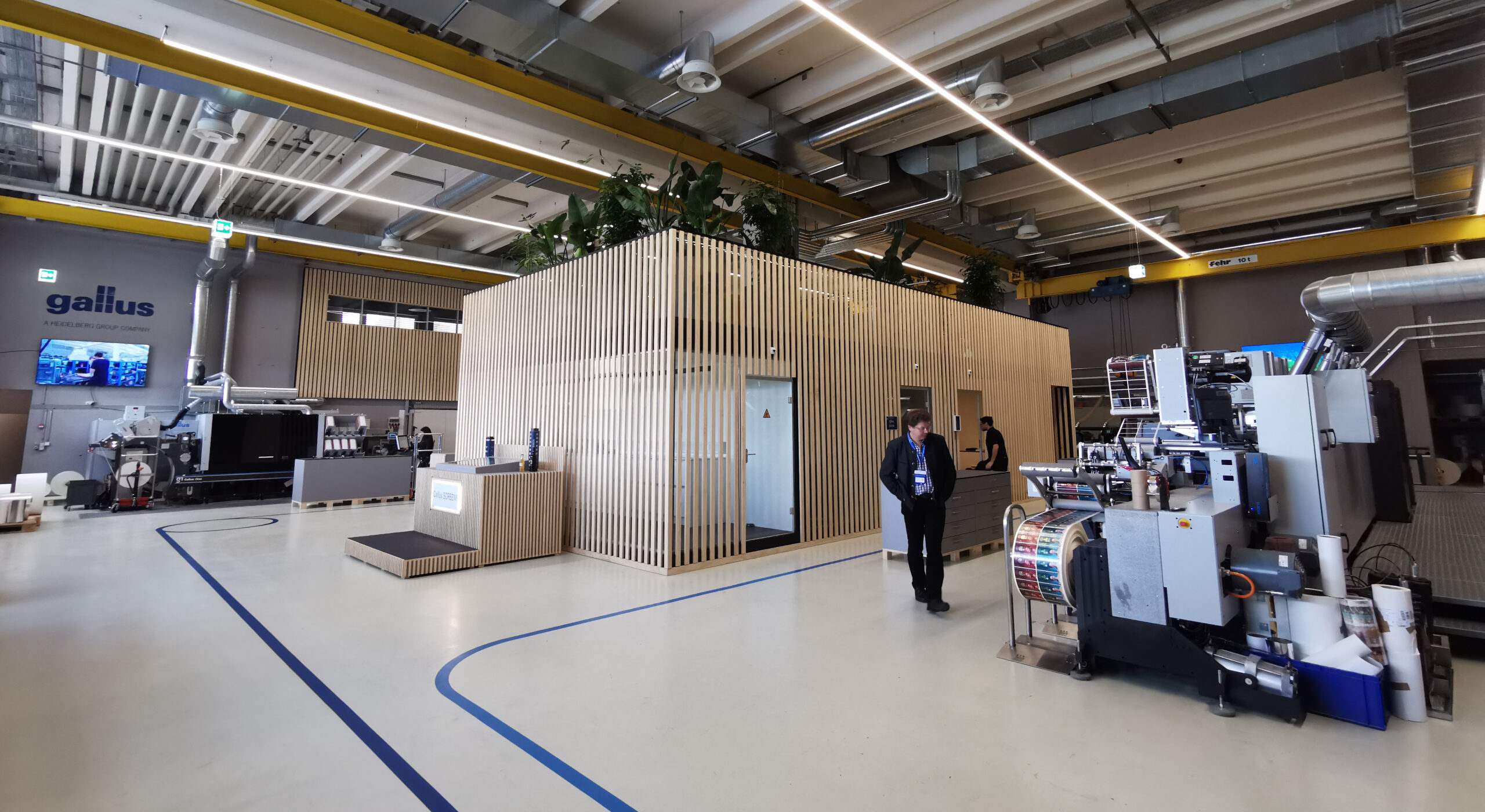 Gallus Experience Centre with Gallus One and Labelfire 340 (right)[/caption]
Today more than 20 partners are involved in the experience centre, according to Gallus, and more are in talks to join. It is an important concept to bring suppliers of the whole production chain together, not only to demonstrate complete workflows but also to optimise and automate the whole flow. Interesting will be to fill the idea with life and bring together a critical mass to start innovating. Especially small and mid-size label printers would be set to gain from that automation expertise.
Developing Inkjet
Today a significant share of Gallus’ press sales are inkjet presses. It is likely that the share will increase, although the portfolio of stand-alone inkjet, inkjet-flexo hybrid, and pure analog presses will continue. Gallus developed an advanced TCO calculator to counsel customers on what system and configuration is most beneficial.
The integration with Heidelberg seems to be fruitful as a large team is able to take care of inkjet head integration, workflow and inks – something that is difficult to achieve for a company the size of Gallus with 300 employees. Gallus can also link into Heidelberg’s well-established Prinect architecture. It was certainly a blessing for all parties that the proposed sale of Gallus to benpac in 2020 fell through.
What is taking a back seat now, is the cooperation with Fujifilm. Fujifilm still supplies its Dimatix printheads, but this falls far behind on what has been publicised as “strategic partnership” with Heidelberg in 2013 in the area of inkjet. The launch of the Gallus DCS 340, was still announced as Heidelberg/Gallus and Fujifilm joint development. Today, Fujifilm has been relegated to a mere inkjet head supplier.
As Heidelberg’s inkjet products and concepts in folding carton and industrial print faltered, it is good to see that Gallus is establishing a continuity in inkjet. The long-standing customer experience is invaluable for improving products and developing new technology. By looking at the next steps in optimising the whole production chain, Gallus is laying the basis for future, competitive products.