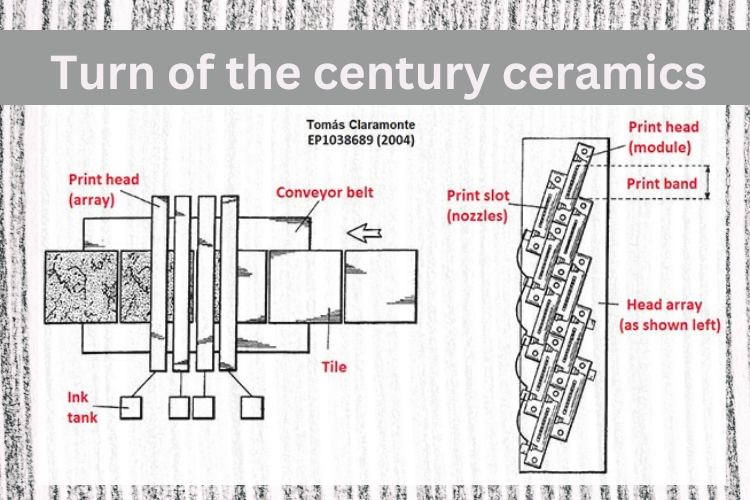
This year we have had a bit of a hardware focus when it comes to our technical oriented articles and this theme was mirrored in our Webinar on Custom Inkjet. To continue the crossover, this article picks up the theme of our most recent webinar event regarding industrial applications and innovations. In particular, we draw links between the ink and hardware solutions when inkjet has to get tough because the end-use application gets quite “hard core”.
Now, being a music fan, I am intentionally making a pun, since “industrial hardcore” is a type of music characterised by its atonal rhythms and harsh sounds. Even though I am not a fan, that is what the term evokes for me. However, the “hard core” we are really referring to here is the construction type, also called aggregates here is the UK – and I am a fan of that. This article considers the challenges when using inkjet to print building materials, and specifically when those material benefit from the use of inorganic pigments.
Inorganic Materials
One of the most talked about applications in training and foundation example for industrial inkjet is ceramic tiles. We have written previously on this topic both in 2021 and 2022. What distinguishes ceramics is that the materials are primarily inorganic, i.e. not carbon-based, since they are designed to go through a kiln at highly elevated temperatures. Therefore, the organic parts of the ink formulation (e.g. solvents) are literally the carrier of the bits that do the job and are burnt off when the deposited powders are converted to their glass-like form (vitrified.)
[caption id="attachment_6752" align="aligncenter" width="487"]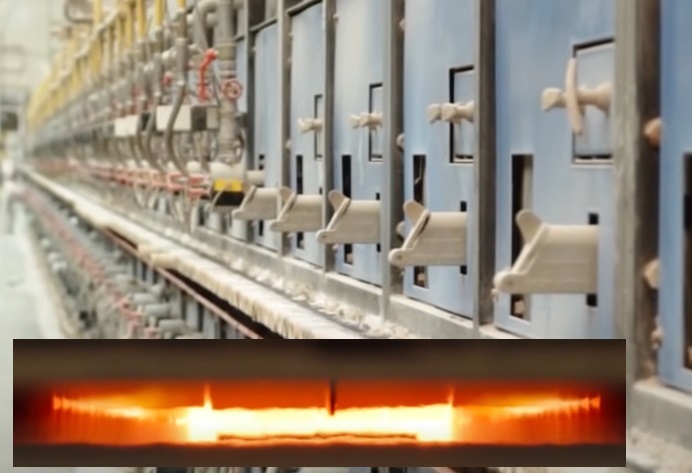 A single-layer roller kiln at ~ 100°C[/caption]
Printing concrete and other related outdoor stone materials have similar demands. When I worked in ceramic ink development years ago, it was the first time I saw Italian OEMs like Projecta Engineering looking to diversify by putting the same inks on concrete slabs and even bricks. They even invented a printer where the heads could be moved vertically to print the sides of the bricks as well as the tops, something they call the “MOVING” series. A requirement specific to architectural applications is that the decoration has to have a minimum performance in terms of outdoor resistance, especially weathering and fading.
In one of the first articles I ever wrote for Inkjet Insight, we demonstrated the UV fade resistance of typical aftermarket dye-based inks versus OEM pigment and showed how the comparison is weeks of performance versus months. The analogous comparison between the everyday organic pigments used to print paper and the inorganic metal salt pigments used in ceramics and the other applications would also show dramatic performance differences. There are high-performance organic pigments, for example those used used in automotive paint applications, as well as your typical wide-format printing inks and we’ll mention these again shortly.
Inorganic Colorants
The origin of the inorganic materials used as inkjet colorants echoes some of the earliest human uses of coloured material like iron oxide and manganese oxide for decorating cave walls 1 and subsequently early pottery. The reasons such archaeological artefacts retain their color is also why they work so well for printing on outdoor materials.
The metal compounds used in modern inks can be made in a number of ways2. Like organic pigments, the achievable color of inorganic pigments depends on the particle size. Unfortunately for inkjet, the key difference to organic materials is that the final color tends to increase in chromaticity (b* coordinate) with particle size. A yellow pigment example is shown below where the color depicted by the pink line in the left-hand-side is obtained by milling the Pr-ZrSiO4 of the crystal type shown in the scanning electron micrograph on the right. The b* color value drops significantly with particle sizes below 5 microns. The color reduction comes from the increased polycrystallinity and other defects caused by mechanical grinding.
[caption id="attachment_6751" align="aligncenter" width="463"]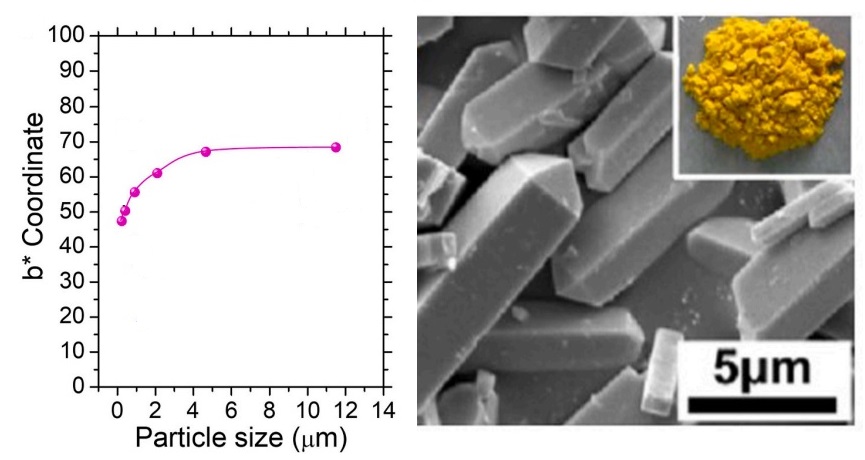 Inorganic yellow pigment color example (adapted from Fig5/6 in ref [2])[/caption]
Glass printing can use very similar chemistry, but then the ink tends also to be combined with glass particles themselves. The glass and pigment react together in a similar way to the pigment and glaze on a tile.
The target substrate does not always have to be inorganic itself to reap the benefits of using this class of pigment chemistry. EFI has demonstrated the staining of wood using ceramic-style inks based on mineral oil with their Cubic printer.
Metal Coatings
When it comes to printing metal, Ralf Schlözer recently summarized the packaging machines from different suppliers being spoken about at MetPack. Many of the solutiond use a hybrid approach, combining coatings under and over the inkjet, which are typically organic high-performance pigments we mentioned above. We have described before some of the benefits of hybrid in different situations from a technical standpoint. In metal printing using top-coat especially can help with the fading issues, allowing exposure up to 10 years outdoors.
Tiger Coatings in Austria, whose traditional business is powder coatings, came up with an intriguing solution to the weathering problems for metals by dispersing inorganic pigments into a UV base to make fade-resistant colors. I have helped folks who are printing these formulations onto metal architectural surfaces but Tiger have also applied this technology to aggregate building materials.
[caption id="attachment_6750" align="aligncenter" width="493"]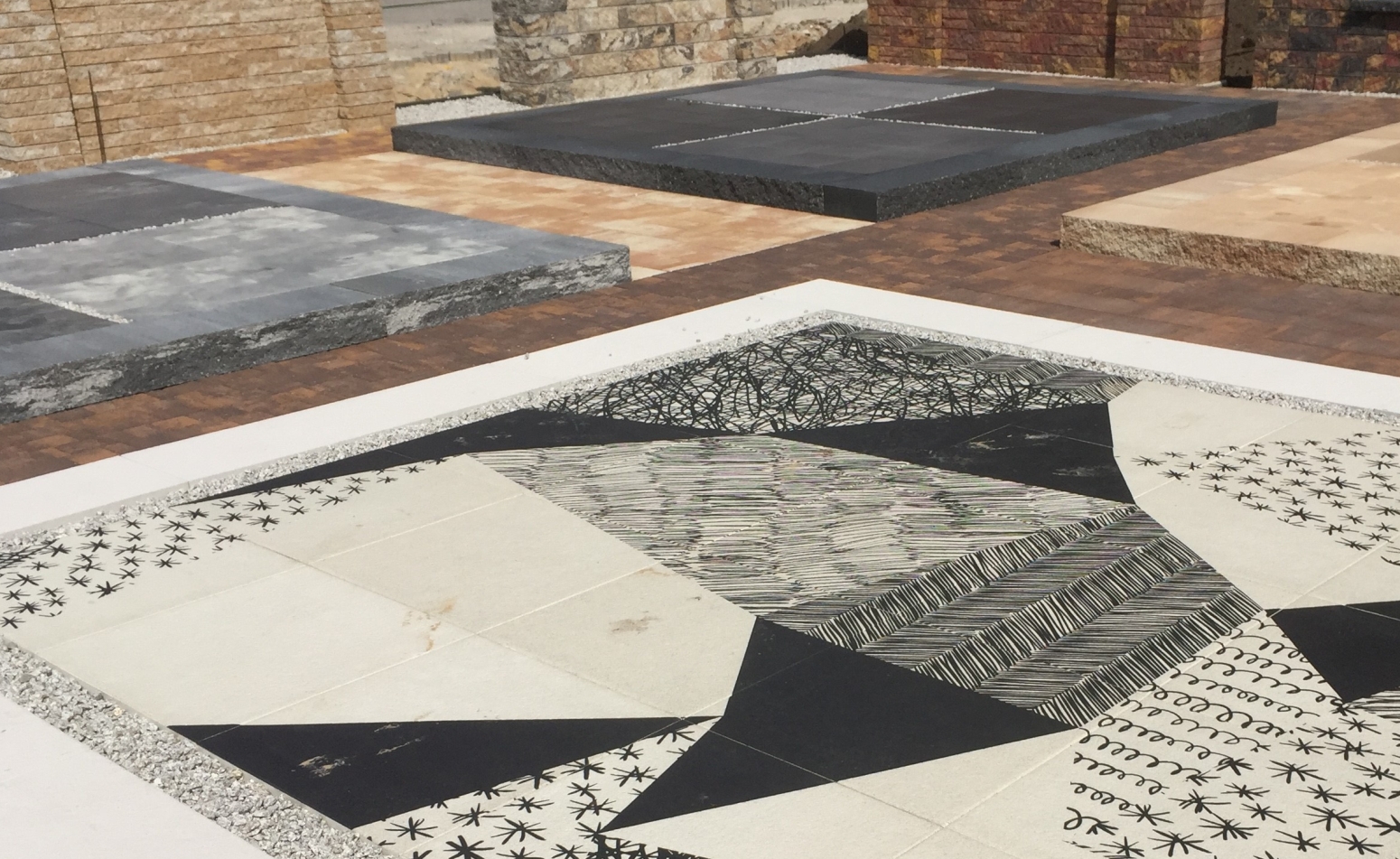 Printing stone and concrete slabs (source Tiger Coatings)[/caption]
Of course, this is not an entirely new principle. The white Titanium Dioxide (TiO2) used as a pigment for white UV inks for graphics and labels is also inorganic. Regular readers hopefully know that this means that greater care is needed to keep the system running, like recirculation in the print head.
What also makes these applications “hard core” is not just the materials but the machines themselves, which are designed to handle the heavy (concrete) or stiff (metal) materials that can cause wear and tear on equipment. Just look at the rollers on the Globus coil printing machine and you get some idea of the challenges.
[caption id="attachment_6749" align="aligncenter" width="574"]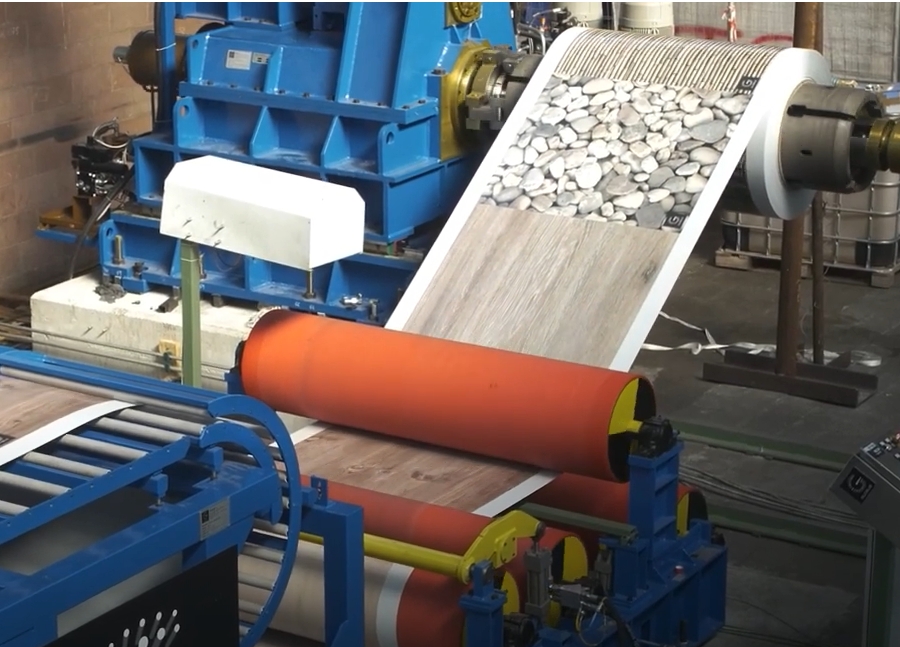 Handling coils of sheet metal is pretty hardcore inkjet as on this Globus printer.[/caption]
Hopefull we’ve been able to give a bit of our trademark technical insight into those applications that are really pushing the boundaries of inkjet. Of course there are even more in the world of 3D printing, where sand is bound together by ink-jetted binders, but that’s a topic for another day.
Academic References:
[1] https://edu.rsc.org/resources/prehistoric-pigments/1540.article
[2] https://www.sciencedirect.com/science/article/pii/S0272884222025457