The latest in the series on inkjet OEMs journeys look at Xeikon in the context of their parent organization, Flint Group. See previous coverage of Canon, HP Corrugated, Kodak and Ricoh.
Yesterday
Xeikon B.V. was founded in 1988. In the beginning, their focus was on high-resolution digital (EP) presses with their “liquid toner,” of which they own the IP. In the early 2000s, Flint Ink made a conscious decision to expand beyond ink into other business areas. One of those was the creation of a digital label press. That press was Jetrion, introduced at Labelexpo 2006, and it was one of the first narrow-web inkjet label presses on the market, and very much ahead of its time. After Labelexpo, Flint made a decision to return its focus to ink production and sales and sold the Jetrion business to EFI. It was a significant move for EFI, since it gave the company another foothold in the inkjet space beyond its VUTEk acquisition.
Fast forward to 2014, when Flint Group was acquired by Koch Equity and Goldman Sachs. After the acquisition, Flint Group started making acquisitions beyond ink companies, acquiring Xeikon in 2015. In 2017, EFI ultimately decided to get out of the label business, specifically the Jetrion business, and it is now back in the hands of the Flint Group. Xeikon is currently the #2 digital label printer manufacturer in the world.
Our perspective was that Xeikon was looking for ways to quickly grow market share in UV inkjet label production, and acquisitions are the fastest way to do that. They developed a strategic partnership where, EFI retained the Jetrion IP and the ink sales and manufacturing, resulting in a win/win/win for EFI and Xeikon and for Jetrion customers. At the time of the re-acquisition/partnership, Xeikon was #2 in the digital label press market, with EFI Jetrion being #3. This arrangement expanded Xeikon’s presence, especially in the North American market, and provided the company with a captive installed base that over time might be upgraded to their Xeikon in-house-developed UV inkjet technology, Panther.
Xeikon Panther was introduced at Xeikon Café 2017 at their headquarters in Lier, Belgium, as a natural complement to their very successful digital (EP) line of commercial and packaging presses. The PX3000 was roll-to-roll with a 13-in. print width. It was configured with either four or five print stations and printed their UV ink at a resolution of 600 dpi. Xeikon as a division of the Flint Group, has continued to grow and innovate and have expanded their product and service offerings.
Today
While COVID kept most of the globe in-house, 2020 was a big year for digital press introductions and Xeikon introduced an expanded line of Panther presses including the newer Panther 2.0 series. The line includes the PX 2200, PX3300, and PX3300 color UV label presses which are based on their Panther inkjet technology and can run on a wide variety of media at up to 164 ft./min. The newly introduced, higher-speed, PX30000 runs at speeds up to 229 ft./min.
[caption id="attachment_6708" align="aligncenter" width="432"]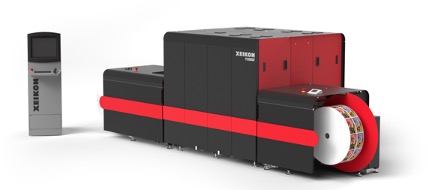 ©Xeikon[/caption]
The Panther press imaging technology prints CMYK with an optional one-pass opaque white. It uses PantherCure UV inks which support self-adhesive media, coated paper, vinyl, PP, PE, PET, metalized, and clear-on-clear making it perfect for labels and flexible packaging applications. The PX30000 can be configured to support up to eight print stations which can run CMYK, O, V and double white, with PantherCure high-durability (XT-D) or reduced-migration (XT-E) inks. The presses support media weights of 60–350 gsm.
Panther can support inline embellishment with haptic white. The inkjet heads have an automatic cleaning system built in. To monitor print quality, it features a digital microscope. It can be configured with an optional pre-printed stock sensor, which is standard on the PX30000.
Corrugated Postprint—IDERA
As a division of Flint, the second largest global ink supplier, and the #2 digital label equipment manufacturer, Xeikon has good inside information on the corrugated market, consumable use, and, most importantly, the needs of corrugated converters. Flint also understands the running costs through their existing relationships with flexo corrugated converters. None of the other inkjet postprint equipment manufacturers have this intimate perspective.
In defining the requirements, they wanted a single-pass machine that would print high-quality graphics on coated and uncoated substrates and be productive enough to support their target market. It had to use food-safe aqueous inks and have a competitive cost.
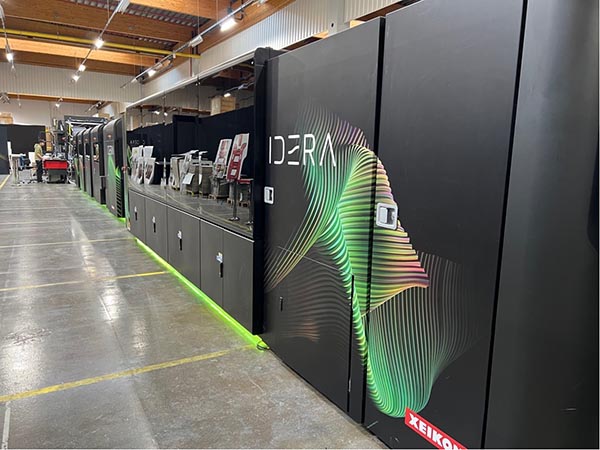
In an effort to shortcut the five-year R&D time and cost, they decided to partner with an existing manufacturer of postprint production inkjet solutions, Shenzhen Hanway Industrial Digital Equipment. The IDERA imaging includes the use of Kyocera KJ4B piezo printheads. The press can print a maximum board size of 1.6 x 2.8 m, one of the more important productivity factors. It can support a thickness of up to 11mm at a range of speeds and resolutions from 150 m/min. at 600x400 dpi to 600 x 1200 at 50 m/min., bringing a great degree of flexibility.
Importantly, Xeikon understands where their internal strengths are, and where they are better off utilizing the expertise of partners. That having been said, for the IDERA, Xeikon has implemented over 40 different enhancements for safety, connectivity, quality and productivity on top of the engine. They created an open ecosystem that allows third-party integration of peripheral equipment (pre-feeding, stacking, camera inspection, etc.). Utilizing material handling partner AEC, they are enabling further automation and productivity to that engine to enhance pre-feeding and stacking. The current RIP is from Caldera, but they will integrate their X-800 DFE in the future, as they do with all of their presses. They expect to continue to develop IDERA in this first generation and use it as a jumping point for the next generation.
With the capability to run at speeds of 150 m/min., 100 m/min., 66m/min., and 50m/min., with corresponding resolutions from 600x400 down to 600x1200 dpi, the IDERA will be able to support a wide variety of packaging and sign and display, at “acceptable quality that’s sellable” to compete with flexo in the short- to medium-run range. There are currently two IDERA presses installed in the US.
Front End
Xeikon has been developing and upgrading their X-800 DFE for many years with quality and automation functionality. It is currently available on all the Xeikon presses except the IDERA, which will probably come soon.
A Xeikon Customer’s Inkjet Journey
Label Source has its headquarters in Norcross, Ga. Incorporated in 1991 by Michael Wrigley and Chris Gland in the basement of Michael’s house, they have grown into quite a powerhouse of label and decal production. They have grown both organically and through the acquisition of ITW Labels. According to Michael Wrigley, the COO, they started as a screen printing decal company. Additionally, “we were brokering some roll label business out and some screen print business, and we decided we needed to start manufacturing it because there just wasn’t a great presence out there in the screen print world.” A few years ago, they purchased a couple of Mark Andy flexo presses to handle the increased volume and growth. As the demand for smaller runs increased, which weren’t practical for the screen printing or flexo due to makeready costs and time, they purchased a few roll-to-roll digital presses.
They acquired two Jetrion presses as a part of the ITW acquisition, which helped a lot with the shorter runs. The Jetrion presses were getting “long in the tooth” and Xeikon was going to stop supporting them sometime in the future, so they decided to purchase a new Xeikon Panther 2200. With the increased speeds, they can migrate all of the Jetrion work and be able to take advantage of the latest Xeikon ink, automation and performance technologies. If it all goes as planned, they expect to purchase another one or two Panthers in the next 12 months.
Xeikon’s Production Inkjet Journey
Xeikon started their production inkjet journey in about 2014/2015. According to Johan Van de Velde, “we were checking the market to see what’s really needed. And the more we understood that there was no one size fits all we would look further.” For example, the needs for health and beauty are going to be different than those for food and beverage. “So in 2017, we acquired the Jetrion business from EFI, giving us a very nice inkjet part in the field with the focus eventually to turn these around over the next decades.”
“In parallel, we launched, in 2018, our first Panther series, which we called the Panther PX 2000, 3000 series. For us, that was a very important step because it was the first time that we brought in the market an internally developed inkjet machine next to our dry toner machines. For us, the focus was to use the same DFE, so that it would be very easy for people who have a toner machine to use the new inkjet machine. So that’s how we entered into the market.” And of course, this was only the beginning—and it didn’t stop there.
I recently had an opportunity to speak with Rob Welford, the newly appointed President of Xeikon. Rob has an impressive background in R&D with Xeikon and others, including XAAR where he was Director of Engineering. His roots are in inkjet and, as you can see in the interview, he has jumped right in to lead Xeikon in that development. Xeikon is also focusing on sustainability in their development thinking and process. As Welford said, “The aspiration of the R&D department is to develop consumable products which require no further removal of carbon from the earth.”