This article continues the series on the evolution of production inkjet from 2011 through today. Previous articles covered Canon and HP Preprint Corrugated, and Kodak. In this article I look at Ricoh Production Inkjet.
Yesterday
Ricoh was founded in 1936 in Tokyo as Riken Sensitized Paper, a company that manufactured photographic papers. While Ricoh has a significant printing systems product line, in this article we will only be focusing on the Ricoh production inkjet printers and associated technologies.
I wrote about the InfoPrint 5000 in my 2011 pre-drupa production inkjet series for WhatTheyThink. This platform was originally marketed by the IBM Printing Systems Division prior to its staged acquisition by Ricoh starting in 2007 and has been marketed by Ricoh since. The InfoPrint platform was one of the earlier entrants into the production inkjet space, and has been very successful for IBM, Ricoh, and Screen, who was the manufacturer and a partner in the machine’s development.
Today
Since then, for Ricoh and the other production inkjet press manufacturers in the production inkjet market, the underlying technology, in print heads, ink, and media, have moved production inkjet capabilities to new levels. This has been driving users in using the technology for higher coverage applications beyond the transactional applications for which it was initially designed.
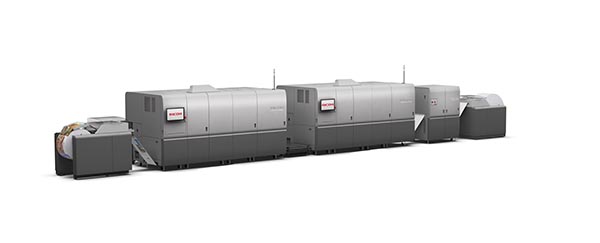
Today, Ricoh offers three continuous-feed production printers: the Pro VC60000, introduced in late 2014, the Pro VC40000, introduced in early 2017, and the Pro VC70000 and VC7000e, initially introduced in 2018. They also introduced a monochrome VC20000. in 2019. However, this is primarily for the European market. Additionally, they announced their first cut-sheet B2+ inkjet press the Pro Z75 in 2020, and have since installed first one at Heeter, based in Canonsburg, Pa. These new production inkjet presses really exemplify the evolution of production inkjet and Ricoh as well.
Imaging
The imaging unit on the older InfoPrint platform used Seiko Epson inkjet heads and inks; however, these new platforms use Ricoh’s own print head technology. Many may not realize that Ricoh has been an inkjet printhead manufacturer for about 30 years, with more than 20 years of developing and manufacturing piezo heads. However, most of those heads have found their way into other manufacturers’ products in industrial and specialty printing applications, including wide format, textiles, 3D modeling, and laminate printing applications.
The implementation of the Ricoh print heads on the Pro VC60000 and VC70000 are similar. All production inkjet manufacturers have had to balance resolution and speed with cost, Ricoh has approached this implementation in a fairly unique way.
The aqueous-based pigment heads are rated at native 1200 dpi, which is more than sufficient to address the quality needs of commercial print applications. However, the way they achieve this is by creating a printhead module comprised of a matched array of Ricoh 600 dpi heads slightly offset. This allows the press to achieve the currently rated 500 ft./min. and a maximum of 1200 x 1200 dpi resolution, while maintaining the ability to increase the speed in the future and keep costs down.
The VC60000 and VC70000 series presses use Ricoh’s own printhead technology. Theses printhead are capable of dynamically generating variable drop sizes from 2pl to 23pl. The presses can run up to 1200 dpi, with a paper thickness supporting 12-pt. stock and can be operated at up to 150 m/min. (493 ft./min.).
With the introduction of the VC70000, Ricoh is also introducing a new larger color gamut aqueous ink. Many of the existing aqueous inks use about 80% water to 20% pigments, polymers, humectants, and other ingredients. This allows for the ink to repeatedly jet through the nozzles, adhere to the media, dry, and offer a degree of light and rub resistance. This new Ricoh ink is a “hybrid” ink that only uses 50% water and a proprietary mix of the other 50% of ingredients. This enables them to increase the density and better control the viscosity of the ink for better appearance and performance on a wide variety of media.
Ricoh’s ink cartridge system consists of two 10-liter disposable containers per color and sits independently from the engine. Inks can be changed on the fly, without stopping the press, and the machine automatically switches to the new cartridge when the other one is empty.
The Press Transport
All of the Ricoh Pro VC presses except the V20000 are manufactured in conjunction with Screen, while the V20000 is manufactured in conjunction with Domino. The transports of the Pro VC60000 and VC70000 is modular, making it flexible for many applications and installation requirements. It is designed to produce ~40 million duplex impressions per month. With the introduction of the VC70000, the Pro VC family is fairly comprehensive. However, there are still some InfoPrint 5000 inkjet series still being sold and used primarily in data center types of installations.
The Pro VC60000, like most of the new generation of production inkjet presses, can run a wide variety of conventional offset and inkjet treated papers. Ricoh has chosen to include an undercoat unit that currently supports a flood coat on one or two sides of the media. Additionally, there is an optional Protector-Coat unit, which can be activated on the available fifth cartridge station to improve smear resistance. It is currently applied to the whole page at a lower coverage, but I wouldn’t be surprised if they may allow spot coating and perhaps gloss at some point in the future. This combination of pre- and post-print units allows the press to support wide range of media from uncoated to offset glossy, at paper weights from 40–250 gsm at widths of 165–520 mm.
Unlike the VC60000, the first thing you notice about the VC70000 is that there is no precoat station in the base configuration, yet it runs high ink density and coverage on many standard offset gloss coated stocks. This development is extending the reach of production inkjet into higher quality applications, furthering the migration of volume from toner and liquid ink to inkjet, but also from offset to inkjet as well.
Ricoh Front End
Ricoh designed a completely new digital front end (DFE) for the Pro VC60000 and VC 70000 series. The open standards architecture supports multiple print streams, including PS, PDF, PDF/VT, AFP/IPDS, and JDF/JMF. It uses the Adobe PDF Print Engine (APPE) in addition to some of its own core technology to support legacy AFP/IPDS formats.
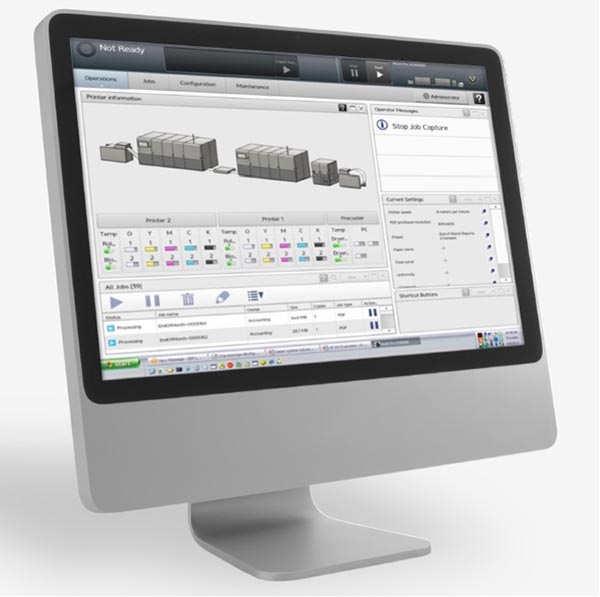
This has a new, user-friendly, browser-based interface to control the press, which can even be accessed remotely. In addition to all of the press control and status information, it also includes an enhanced job preview that shows the RIPed file and its individual color separations. It supports new color management functions that can address differences in media side and file object type as well as spot color dictionaries. It also h imposition capabilities, including saddle stitch, cut-and-stack, and trim marks.
Of course, in addition to the new DFE, Ricoh has an extensive line of TotalFlow workflow solutions in its portfolio which integrates nicely. We will be covering the new TotalFlow announcements, including enhancements to Process Director and Process Director Express, as well as the new TotalFlow Batch Builder and TotalFlow Path solutions in a future article.
Introducing Cut-Sheet—Ricoh Pro Z75
Ricoh knew that this press had to be a game changer. So as a late comer, how do you compete with both the existing B2+ and A3 presses in the market at the same time? Ideally, you need to create a lower cost B2+ press, that will deliver the productivity and print quality that Ricoh is known for, at a price that will compete with the A3 presses in the market. That way, as a print service provider you get the best of both worlds.
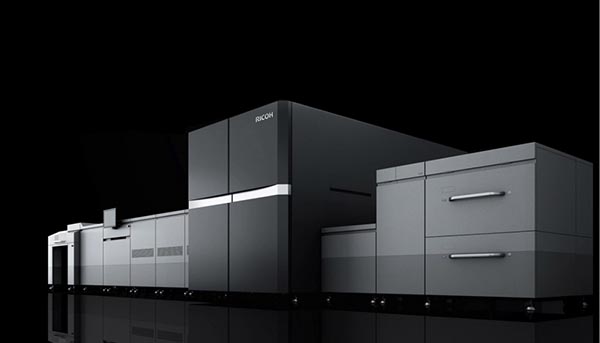
The RICOH Pro Z75 was developed from the ground up and is manufactured in-house by Ricoh in Japan. The press quality is achieved through the use of Ricoh Gen5 printhead with dynamic drop sizes and supports a resolution of 1200 x 1200 dpi. It uses 11 printheads per color, to achieve that resolution similar to the arrangement in the VC60000 and VC70000. It currently prints CMYK—but there is space to add a fifth color. It uses their aqueous pigment ink and depending on the media may not need undercoating (primer) since the press uses two drying systems, NIR plus Ricoh’s in-house developed drying technology.
To meet both commercial print and packaging requirements the press supports both input drawers and pallets. The auto-duplexing press supports offset coated, uncoated and inkjet treated media. To compete with the existing presses in the market, the press runs at a speed of 4500 simplex B2+ sheets per hour and 2250 sheets per hour in auto duplex mode. It will print to offset coated plus plain and inkjet coated paper from 60 to 400 gsm without using any kind of primer. It takes B2 sheets up to 585 x 750mm. This is suitable for printing 6-up letter size pages, which will be fine for the US market, but not for 6-up A4 pages, which is likely to be less attractive for any potential European customers.
A Ricoh Customer’s Inkjet Journey
Tri-Win Direct is a 28-year-old direct mail and marketing company in Dallas, Tex., that has an auspicious history and journey into production inkjet. As Scott Fish, President of Tri-Win related, “28 years ago we started it up and my wife, who is a physical therapist, provided the money. With that I could run with the crazy idea of starting a mailing printing company. That was just out of my apartment, and we just started putting labels on by hand as our initial start.”
“I love direct mail,” he continued. “It could have been any business, but one of the dads of one of the volunteers at my inner city ministry program that I was running, owned a printing company and he owned an ad agency. One of his first customers was Apple Computer and he was sending it to a big mailing shop here, and it’s just about 5,000 pieces a week that they were doing. They kept messing it up and losing pieces and things like that. Anyway, he suggested I start a mailing company.”
They started with five HP industrial home laser printers, “and at one point we had 10 of them strung together to handle the increased volume.” Fast forward to 2016, when they purchased their first Ricoh Pro VC60000, followed by their second Pro VC60000 in 2017. In the period between the office laser printers and the production inkjet machines, they gradually added some cut-sheet toner machines to pick up the load and expanded their product offerings.
Today, Tri-Win has lots of “big jobs from finance companies, debt companies, banks, statements, auto industry mailings, etc.” These jobs have a couple of million pieces. They couldn’t even imagine doing these with those initial laser printers!
Ricoh’s Production Inkjet Journey
Mike Herold, Director of Ricoh Global Marketing has been working on production inkjet for about 23 years, initially with in R&D in the IBM Printing Systems Division, which was ultimately acquired by Ricoh. They launched their first production inkjet press in early 2007, after an initial technology demonstration at Graph Expo 2006.
According to Mike, their inkjet journey has really been focused on “continuing to expand speed of the systems, quality of the system, media flexibility of the system, and of course all the things that go along with that, like the latest printhead technology, ink formulations, the ability to dry the printed applications—ultimately doing this in a manageable footprint, with a manageable platform that’s accessible by as many people as possible. That’s really always been a big part of our strategy, to be as innovative as possible, while also maintaining a lot of approachability for as wide a market as you possibly could.”
In discussing challenges, he says, “when you're innovating, you can essentially solve any problem, it’s just really a matter of time and money. So it doesn’t matter what problem and put that in front of our engineers, no matter what it is, they’ll say ‘we can absolutely solve that.’ But you do have to operate in the confines of reality, you don’t have unlimited time and you don’t have unlimited money. Operating within the bounds of those constraints, you have to innovate within this space, since we don't have unlimited resources and either do our customers.
“We need combine the enhancements around automation, and work with the finishing providers from a workflow and software perspective as well. You sort of bring all that together and suddenly you’ve got an operation environment where our customers can leverage their human resource in a much more value driving way. Because that's what we want them to do, create more value. And if they can use our people to do that, that would be better. So for us, it’s really heavy investments on automation and operational efficiency going forward.”
More to Come…
I would like to address your interests and concerns in future articles as it relates to production inkjet and the manufacturing of Print, Packaging, and Labels, and how, if at all, it drives future workflows including “Industry 4.0.” If you have any interesting examples of hybrid and bespoke manufacturing, I am very anxious to hear about them. Please feel free to contact me at [email protected] with any questions, suggestions, or examples of interesting applications.