(Watch David Zwang’s video interviews with HP’s Trevor Schroeder and THIMM’s Michael Weber.)
Yesterday
HP is a rather large company with a variety of consumer and production inkjet equipment. In the last article on Kodak, I referred to them as a pioneer in production inkjet, but HP was also a pioneer in inkjet, with their first commercial ThinkJet introduced in 1984. However, they didn’t enter the production inkjet market until they introduced the PageWide T300 at drupa 2008. That was targeted at commercial print, and we will cover that in a future article.
HP entered the preprint corrugated market with their PageWide T400S press, a 45-in. wide press that printed at up to 600 fpm in mono and color with their HDNA imaging technology. At the same time they introduced the PageWide T1100S with a printing width of 110 in., printing at 600 fpm mono and color. They created the T1100S along with Koenig & Bauer, who has a history of producing high-speed offset press transports.
Today
The latest generation of the T400s can run up to 1000 fpm in mono and performance mode, and 500 fpm in quality mode. The new T1195i can also run up to 1000 fpm, and supports six-color printing.
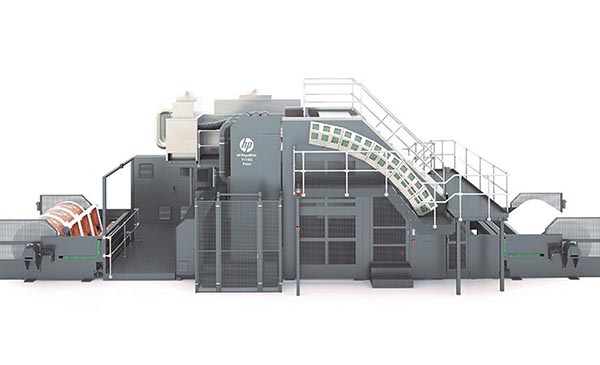
Recently, HP introduced their T700i press that fits the width requirement between the 42-in. and the 110’in., with a 67-in. print width which was also developed in conjunction with Koenig & Bauer. Like the T1100 series, it is fitted with HP PageWide printheads which enable a native resolution of 1,200 nozzles per inch, maintaining high print quality and text readability down to four-point type. The T700i is not just a press for digital preprint corrugated production, it is also designed for narrow corrugation applications and folding cartons. To ensure the output quality, there is an inline process control (IPC) unit that monitors output and alerts the operator if there are issues. It prints with the same six HP A30 aqueous ink colors (C,M,Y,K,O,V) that are used on the T1100 series and T400 series packaging presses, which should provide a wide color space and vibrant brand colors.
The high quality output of these presses can be attributed to HP’s HDNA technology. We covered the HDNA technology in detail a while ago, but, as a refresher, the unique HDNA printheads provide a density of 2,400 nozzles per inch per color on a single-color printhead producing dual drop weights. Each print head contains 21,120 nozzles that are divided between two separate chambers, with each chamber supplying the ink to 10,560 nozzles. These heads can be used for two colors, or a single color with even more nozzle redundancy.
The nozzles are divided into two sizes: a high drop weight nozzle and a lower drop weight nozzle, which is actually a tiny low drop weight (LDW) nozzle placed in between the high drop weight (HDW) nozzles. This interesting new head configuration brings with it support for 6 levels of grey per pixel, affording better color addressability throughout the color gamut while using the same HP A50 process inks currently in use today. The HD presses can run in Performance mode for jobs that need high throughput, or Quality mode for jobs that need higher reproduction quality. From the samples I have seen, the blends and flesh tones are exceptional when printed in “Quality” mode.
In order to support that wide range of packaging media the press includes a priming unit which applies a flood coat before the print engine using an analog roll. This also provides excellent durability and gamut extension. Like all of the other T presses, you can use a bonding agent that is just printed underneath wherever a color drop will be printed, as well as ColorPRO media where the chemistry is applied at the mill to enhance the printing. Of course, since some of the media can be rough and ‘dirty’ there is an integrated web cleaner to prepare the media for printing. Additionally since the introduction of this series of presses, HP introduced their One Package Workflow Suite is an end-to-end solution that helps integrate your current corrugated environment.
An HP Preprint Customer’s Inkjet Journey
 THIMM is a family owned company that has been providing consumer goods packaging for more than 70 years. It is now the largest packaging provider in Europe currently with more than 2,500 employees at 13 locations in Germany, the Czech Republic, France, Poland, and Romania. I had a great discussion with Michael Weber, the Director of Corporate Strategy, for THIMM and you can view the entire interview via the link at the top of the article and on WhatTheyThink. Here a couple of facts and insights from the interview.
“So the first real production machine, not the small toys we had for prototyping which we started in 2014. We bought and installed our first HP T1100 in 2017, this was the first HP digital preprint machine. And now currently we are just installing our second machine. We are using most of the production for our own corrugated plants. However the rest of the machine capacity we are using to supply the whole European corrugated market. So we are also selling to competitors. We are sharing the capacity of the machine. We are also looking into other applications like paper bags and also other applications which are currently being done more in analog than in digital.”
HP’s Journey
According to Trevor Schroeder, Director of Products and Solutions for HP PageWide Industrial Inkjet Division for Webfed Packaging Presses, “We started with a 30-in. printing press. We had some test beds that were a little bit narrower, different sizes, and at the time we were figuring out how to stitch together stationary print heads across the width of a web. And that technology is what we call PageWide, where you have print heads that are not moving, single-pass inkjet as an array across a variety of widths. Starting at about 30 inches, we then went down to about 20 inches and up to 42. And we really got a solid understanding of how to stitch those print heads in different widths for different form factors, formats, and markets. Based on that, we went way up to 110 inches wide on the world’s largest inkjet press, the T1100. That product is specifically for corrugated packaging. And the reason we need that width is because it matches up with a corrugator for preprint applications.
“The T400 started actually as a duplex product for commercial printing applications. And I think there was a head scratch at drupa in the 2016 timeframe, maybe even before where we thought, what about half of that? We only need one-sided printing for packaging applications. Can we chop it in half and call it a packaging press? And that’s where we began and we called it Simplex at the time. So T400S— that ‘S’ stands for Simplex—to be used for preprint applications where that paper is going to be on the corrugated board. So certainly don’t need printing in a preprint application. All of our packaging presses since then have been one-sided or simplex applications.
“The Koenig and Bauer relationship started with the T1100. Due to the sheer size of the machine, we reached out to them since we knew they were the absolute professional when it comes to paper handling and transport systems. And at that scale we needed the, the knowledge and knowhow to handle paper in that width and size as well as the speed.
The entire interview with Trevor can be viewed with the link at the top of this article and on WhatTheyThink.
Just the Beginning
Both HP and THIMM have found that the benefits of Production Inkjet in Corrugated Preprint have been more than they expected. Yes there have been some challenges, but there are also lots of future opportunities for development and application.
More to Come…
I would like to address your interests and concerns in future articles as it relates to production inkjet and the manufacturing of Print, Packaging, and Labels, and how, if at all, it drives future workflows including “Industry 4.0.” If you have any interesting examples of hybrid and bespoke manufacturing, I am very anxious to hear about them. Please feel free to contact me at [email protected] with any questions, suggestions, or examples of interesting applications.