Inkjet printing is firmly established as a mainstream method of printing. Most printed products are now using inkjet for some volume, at varying stages of adoption, with the mature display sector now joined by many products previously only produced by offset or toner printing.
Smithers tracks all print markets and has reported great prospects for continuing inkjet adoption in the years ahead. In 2022 they published a new report: The Future of Inkjet Printing to 2027, that quantified the value and print volume of the global inkjet production market (i.e. excluding home/office/workgroup printing).
In 2022 the global inkjet print and packaging market volume reached the equivalent of just over a trillion A4 prints, and is forecast to continue growing by an average compound annual growth rate of just under 10.0% between 2022 and 2027. This is a little lower than the growth rates over the past five years, reflecting the impact of the pandemic and the maturity of several sectors, where inkjet already accounts for much volume.
The figure below details the ten-year growth prospects for the major inkjet products. Even newspaper printing will grow, which is a term rarely heard these days.
[caption id="attachment_6211" align="aligncenter" width="967"]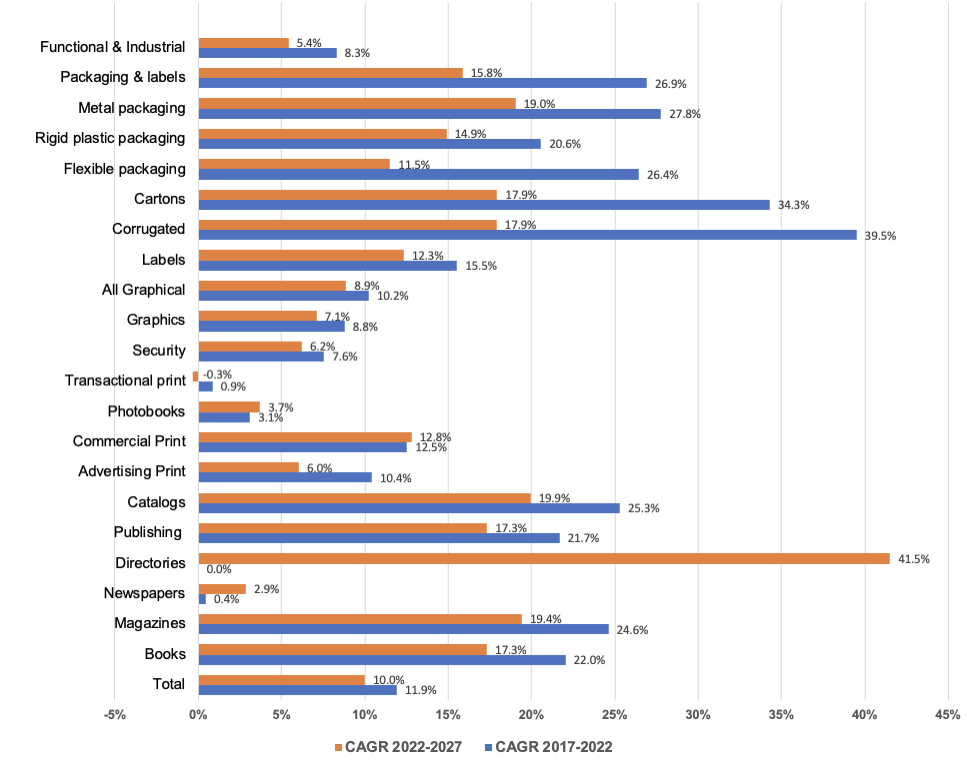 Figure 1 Global inkjet print volume growth, 2017-22 and 2022-27 (source: Smithers – Future of Inkjet Printing to 2027)[/caption]
Beyond graphical print and packaging, inkjet is used in a range of functional and industrial applications. Inkjet prints and decorates ceramic tiles, décor, glass, bio-medical materials, electronics/photovoltaics, automotive components, textiles, and a range of miscellaneous objects from fridges to footballs to funeral caskets. Varieties of inkjet also account for a significant proportion of the 3D, additive manufacturing sector. There are reports of esoteric developments from research labs or startups. Artificial meat may be on the menu. Also on the horizon is the ability to growing human organs and skin for transplanting. There may also be new ways of targeted drug delivery through inkjet printing. When, or whether, these future visions are commercialised is debatable.
Inkjet Today
Today there are thousands of inkjet presses in operation, hundreds of thousands of wide-format machines and various bespoke systems. The supply of equipment and inks is a multi-billion dollar market. The market is growing overall, but there are particular hotspots – and conversely stagnant and even declining sectors.
In the graphical side, print volume growth will average 8.9% from 2022 to 2027, while labels and packaging will see 15.8% CAGR. This is the key driver for many suppliers focusing on labels and packaging. The physical nature of a package intended to contain and protect the contents means there will be no replacement by a virtual electronic version as the overall volumes increase. Over the last five years, inkjet grew at an average 39.5% annually as single pass pre- and post-print presses were adopted to replace slower, higher cost wide-format and flatbed inkjet printers that transformed display printing where corrugate remains a key substrate.
Perhaps surprisingly, it is directories that are forecast for the overall highest growth. This is from a very low start point (no measurable volume in 2017 to 2022) and will remain a very small niche. However, directories are symptomatic of a major trend that is changing traditional print markets. As the print quality of inkjet has improved across many paper stocks it gathered market share. And this now includes coated papers typically used in offset presses which inkjet has found to be difficult. Many of the new inkjet presses claim to use standard offset coated papers successfully, eliminating cost premiums of speciality inkjet grades.
The 2023 Hunkeler Innovationdays event in Switzerland amply demonstrated the ever-improving capabilities of the latest generation of inkjet presses, both sheetfed along with web machines. The output quality from the newest generation of web presses from Canon, HP, Kodak, Screen and Ricoh (alphabetically!) was extremely good, with a broad range of applications being showcased. Many samples were varnished, with in-line coating becoming a popular option. Most were finished with Hunkeler paper handling and systems together with other suppliers of embellishment and postpress systems that simplify and automate many bindery operations. This is making it easy for commercial print companies to invest in inkjet web, which is happening. These companies are opening new market opportunities, and converting volume from offset and less productive digital printers and presses. Canon highlighted that many of their inkjet customers were making their first purchase from Canon, many are traditional sheetfed offset houses making their first foray into web printing. This is a trend that the other inkjet vendors agreed with.
So, looking at the list of growth rates, the important new ones are magazines, catalogs and commercial print, ahead of advertising print that includes display and POS which was the first application to embrace inkjet and now dominates. Here growth opportunities are limited as inkjet already has the majority of the market and cannot grow at the expense of analog methods. It also includes direct mail where the overall market growth is limited as postal services hike letter rates, but inkjet is gaining share. It is a similar pattern in transactional where the continuing adoption of electronic bill presentation and payment methods sees significant declines in the overall volumes and, even though inkjet is still gaining share, transactional is the only sector where overall volume falls over the next five years.
Not every application demands the new quality levels, one such area is books where mono inkjet is still growing. Book volumes received a boost during the lockdown periods, for trade fiction, home-schooling education titles, cookbooks, gardening and various hobby/DIY titles helping readers escape from the tyranny of another electronic screen. Volumes held up in 2022 and there will be more inkjet adoption going forward at 17.3% CAGR. Partly this is due to the lack of new offset book presses being available, but it is helped by the sophisticated automated book finishing lines now on the market. Hunkeler showed its Starbook solution with a new book sorting module that automatically places individual, or groups of books into trays that move on conveyors to packing and delivered to a courier for distribution to the buyer directly. The whole line is automated to create a book block of whatever size and pagination, then marrying with a cover to bind and trim the book. All with no operator intervention. It is great for short runs, but the book sorting module removes the complexity of manual end-of -line sorting making a batch of single copy production more practical.
One of the first users is an Amazon facility in France, where the line runs alongside a Canon ColorStream 6180 press. According to Pascal Bourlon, who is the Global Engineering Manager at Amazon Print-on-Demand, “The ColorStream 6180 and the Hunkeler solution support our vision for innovation and operational efficiency perfectly. The whole solution is specifically tailored to our need and helps us to process customer orders quickly.”
This is an example of a print site re-engineering a traditional print workflow through the adoption of high performance inkjet printing with new finishing equipment. For the print provider it simplifies production methods which is critical as availability of skilled labour is being squeezed while at the same time greatly improving turnaround times and levels of service. This is happening in other applications which makes inkjet increasingly competitive against offset. Hence the growth in cards, booklets, magazines, calendars and the myriad of other applications.
Inkjet has grown up as a technology and more print sites are mastering the changes it is enabling to improve business processes. It is certainly true that inkjet is attacking other printing methods, but it is really the advantages in print product manufacturing that is accelerating inkjet into more graphical applications.
[caption id="attachment_6210" align="aligncenter" width="609"]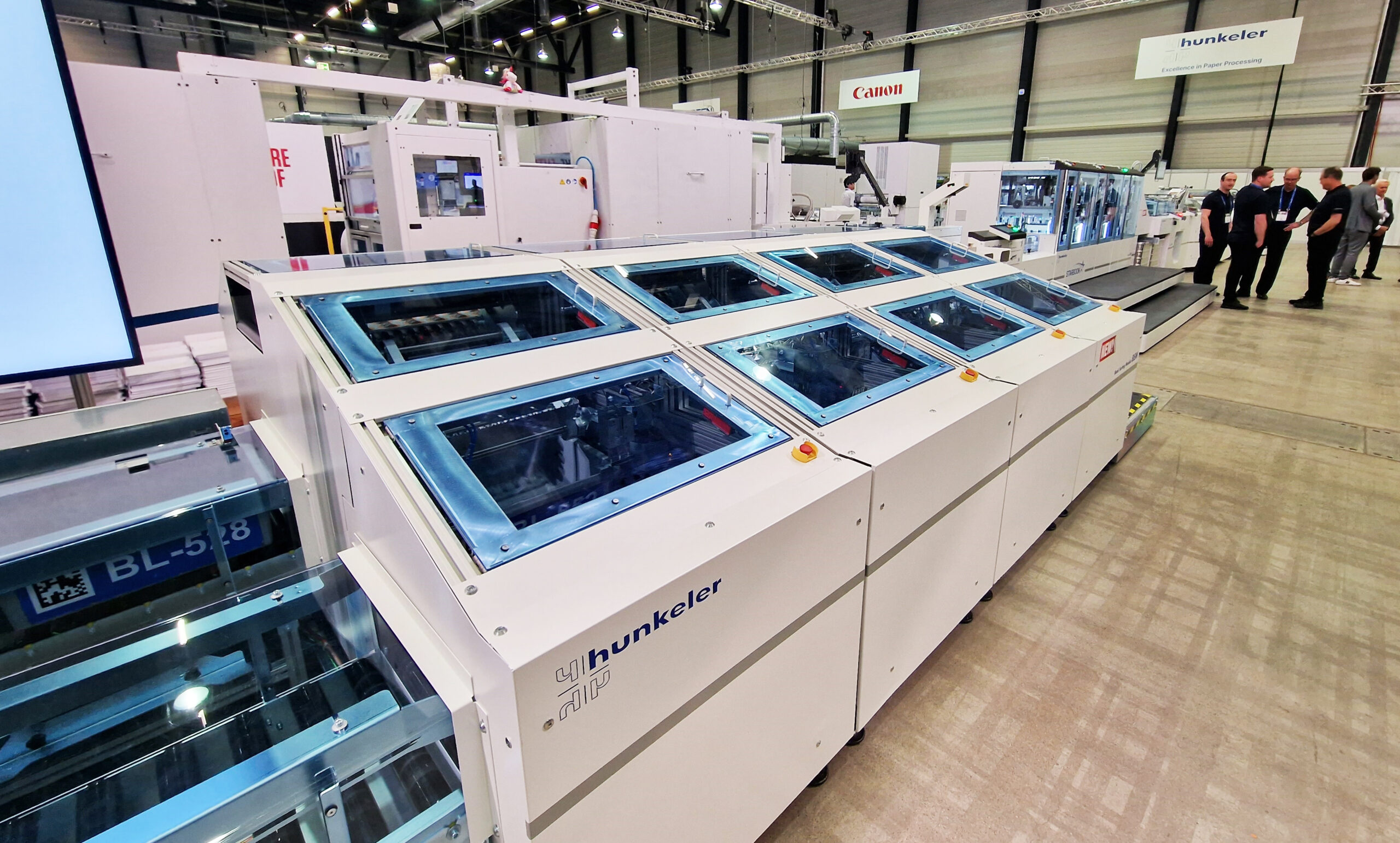 Figure 2: New book sorting module from Hunkeler that automatically organises individual copies for packing and despatch as part of a Starbook automated book finishing line[/caption]