The Hunkeler Innovationdays event evolved from an open house for web finishing into what is arguably the most important event for high volume digital printing. Over the years the focus of the print systems technologies shifted from monochrome to colour, from toner to inkjet and from business-quality transaction print to high-quality commercial and publishing print, with the whole event becoming ever more diverse.
Originally scheduled as a biannual event, the 2021 and (the rescheduled) 2022 events had to be cancelled due to the pandemic. Finally the HID returned in 2023 after a four year break. Accordingly, vendor and customer interest was anxiously awaited after years of having to rely on digital alternatives to live events.
The return of the live trade show
The show floor selling out again in 2023 was probably to be expected, as suppliers always scrambled for the limited space in the one main exhibition hall and the second hall reserved for smaller booths and catering. About 100 exhibitors showcased 50 production lines in 2023.
Visitor pre-registrations remained at about the same level as in 2019 with 6,500. According to Hunkeler, a higher number registered on-site as compared to previous years. Tuesday, the second day of the show and traditionally the busiest, had more than 4,000 visitors, setting a new daily record for Innovationdays.
The high visitor turnout confirmed a lively interest from printing companies to invest in technology.
News in inkjet technology
While the attendance showed a positive surprise, there were less new hardware announcements than at previous events. Understandably, vendors launched products at their own company events during the pandemic phase as trade shows were routinely cancelled. However, HID did have notable firsts.
Canon used the 2023 Innovationdays to launch a new generation of their top-quality ProStream press line: the ProStream 3000. Since its launch in 2017 more than 160 ProStream print towers have been sold, with a strong focus on commercial print, even including photo printing. The 3000 now marks a comprehensive revamp of the product, although base specs remained unchanged.
There are some design improvements intended to reduce set-up & service times and energy consumption, including the addition of an automated splice handling. A “smart ColorGrip” feature (jetted primer) and media specific uniformity control are set to improve quality.
The most visible change is an asymmetric drier design. By using a new type of higher capacity hot air blower, the drier in the front-side printing unit has been shortened, while the reverse printing drier achieves a higher drier capacity now. This results in an extended substrate range up to 300 gsm and being able to run 200 gsm/7pt stocks at full speed of 133 m/min.
Like the ProStream 1000 Series, two speed versions of 80 and 133 m/min are offered. Only the higher speed version can take advantage of the increased speed for heavier substrates. Inks, paper profiles and finishing connectivity remain unchanged.
Two user sites have been announced already and the press is available now.
[caption id="attachment_6204" align="aligncenter" width="416"]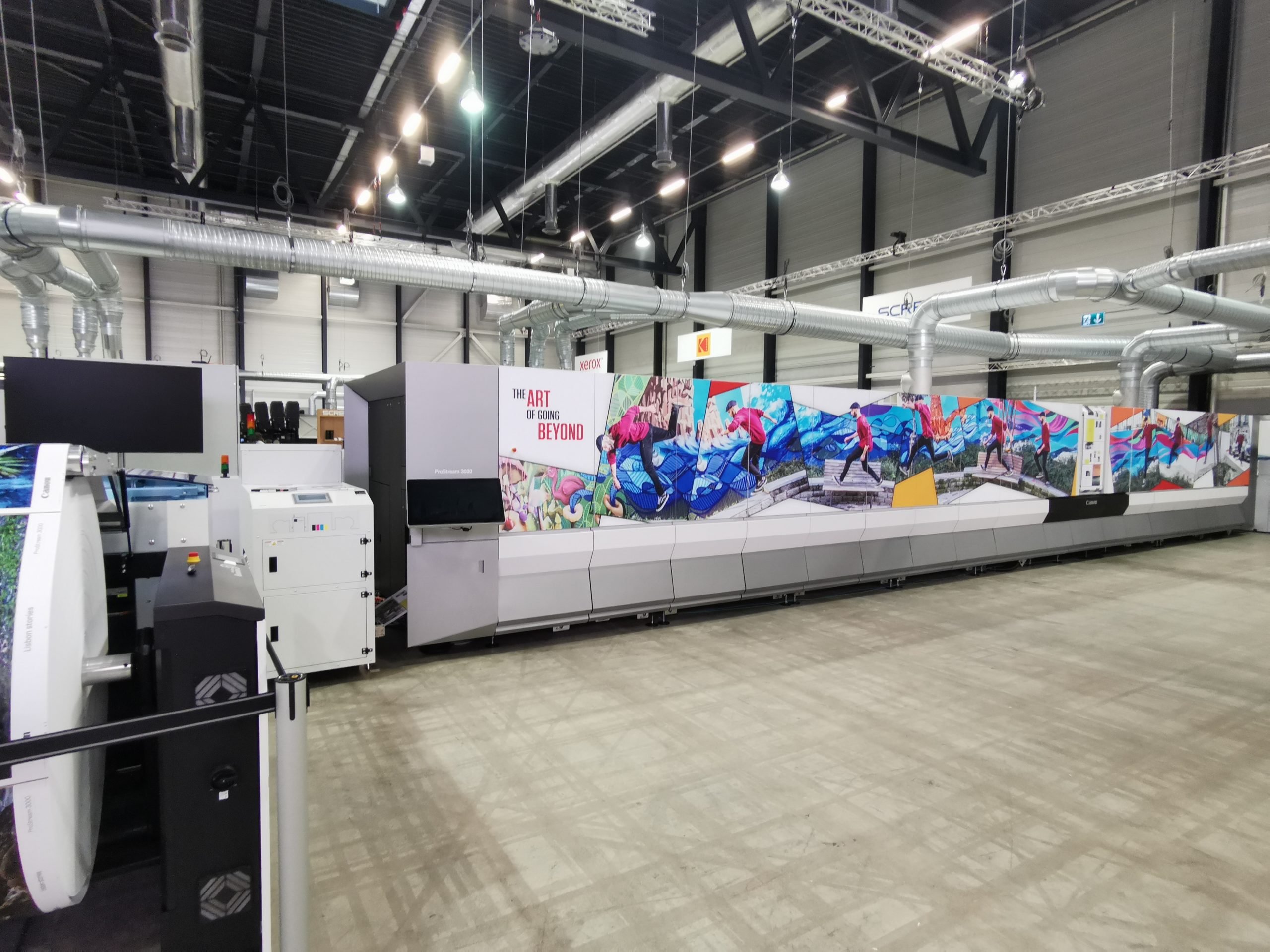 Canon ProStream3000[/caption]
Canon also introduced some productivity improvements for the VarioPrint iX, including an image quality verification system, capable of scanning every sheet. With more than 275 installations since its launch in 2020 and average print volumes of 2.5 million A4/letter size prints the uptake has been quite good so far for this press.
HP used the Innovationdays to show the HP Advantage 2200 for the first time outside the US. As an added bonus, the speed for printing in the highest quality mode was lifted to 152 m/min (500 fpm), up from 101 m/min. Speed for the “performance mode” settings remains at 152 m/min and so does the monochrome speed of 244 m/min. The added speed in quality mode brings the Advantage 2200 to twice the speed of the HP T250 HD quality mode.
Exhibited was the “medium” version with two dryers, which HP believes will appeal to the energy conscious European market. Operators can also choose from a wide range of drying temperatures to fit the application needs. The number of dryer modules, the print speed, drying temperature and energy consumption are all interdependent and should allow for a wide range of settings.
While the improvements in the speed of the top quality mode are significant, they bring the base specs into the same range as other 2-up high productivity graphic arts presses, such as the Kodak Prosper Ultra 520 HD. However, the Advantage 2200 brought notable improvements in accessibility, simplified engine design and modularity. The common print arch for both front and backside printing (half of the previous HP T-400 Series arch) is unique and exemplifies the straightforward design. Opening up the press showed how easy components can be accessed or cleaned. – which is a necessity as the thermal printheads can be considered consumables.
Surprising is the small footprint for a duplex press, which also includes a reduced height compared to the T 200 Series. This can be very beneficial for space constrained sites found in many regions globally.
[caption id="attachment_6203" align="aligncenter" width="405"]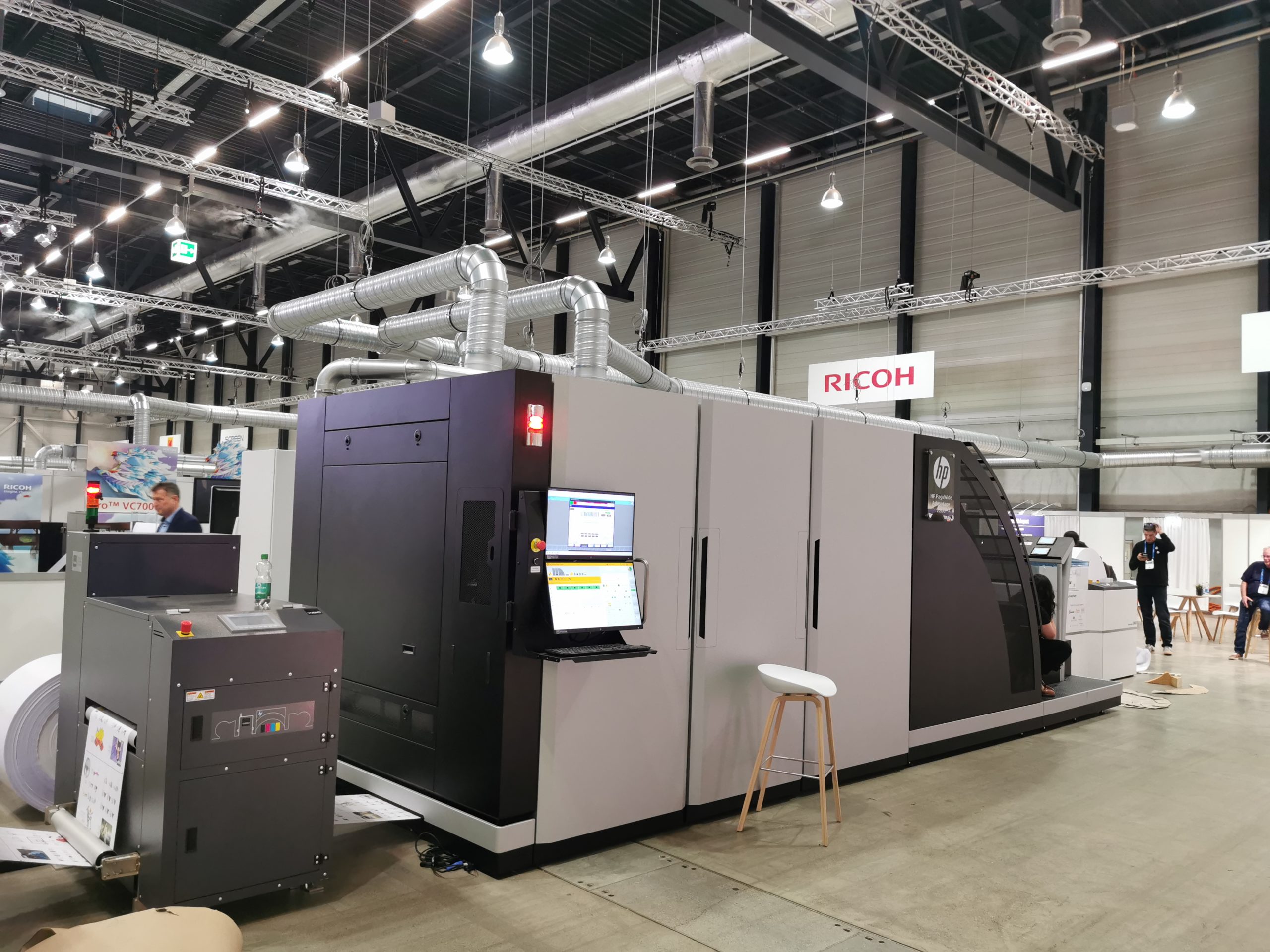 HP Pagewide Advantage 2200 with 2 dryers[/caption]
As part of their partnership, Bluecrest is selling the press as IntelliJet Advantage 2200 as well, with their own controller. As the focus is on transaction print, Bluecrest will offer mainly the single-dryer version.
Another noteworthy HP development was featured at the side: the Smart Workcell controller, an extension to the SmartStream Elite Print Server. The tool allows for intelligent batching and imposition of jobs, which makes a lot of sense when trying to run a highly productive inkjet press efficiently on short runs. The batching aims at minimising disruptions due to changes in paper, colour settings, finishing properties and the like. This is especially critical when working with roll paper. HP’s Siteflow workflow software offers batching capabilities as well and it will be interesting to see how the functionalities compare and are used at production sites.
The halls sported more noteworthy equipment, although not launched at the show.
Kodak showed the Prosper Ultra 520 HD for the first time following the announcement at virtual drupa 2021 at its Dayton Ohio customer center in June of 2022. This press delivers its top speed of 152 m/min (500 fpm), consistently for all paper weights and supported grades making it the fastest in the graphic arts sector on coated stocks. Driven by Kodak UltraStream Inkjet Technology, it is the only graphic arts press using Continuous Inkjet (CIJ) printheads as opposed to the more common piezoelectric heads, or thermal inkjet used by HP. It is also leverages hardware-based Kodak screening technology to drive speed, performance and image clarity and Kodak’s own inks.
Ricoh showed the Pro VC 70000e publicly for the first time, although the device was already launched in August 2022. The “e” version lifts the quality potential again for most demanding customers in commercial and high-quality commercial print. Unfortunately the eagerly awaited Z75 B2 sheetfed inkjet press was not on display and was only represented by some print samples.
Other vendors of digital print equipment showed their flagship products as well, some for the first time publicly: RISO the Valezus 2200 and Xeikon the Sirius SX30000. Additionally Kyocera showed the TASKalfa Pro 15000c and Xerox the Baltoro HF inkjet press.
Besides the production printer announcements, several new postpress equipment pieces were launched at the show. Those will be covered in a separate article on WhatTheyThink.com.
A maturing market
Hunkeler Innovationdays 2023 had the reassuring feeling that the majority of printing companies still like live trade shows, including the opportunity to see equipment in operation at first hand and be able to ask questions to real humans on the spot. The show also demonstrated that inkjet technology has reached a maturity level where high print quality is a given (at least on the top models) and print technology improvements are more incremental. The focus in document printing is switching now towards uptime, reliability and workflow. The latter, especially, has a lot of potential to improve efficiency and quality when delivering the ability to connect all process steps.
There was also the sense that that drupa 2024 looms large and some vendors were holding back their more outlandish technology developments for that occasion. Hunkeler innovationdays is after all a show to demonstrate equipment in complete, real-world production lines while drupa has the prerogative of showcasing technologies we can spend the following years waiting to become a practical reality.
Hunkeler Innovationdays will be back in 2025 and is scheduled to take place from February 24th to 27that the usual location in Lucerne.