I recently went to the Bobst US open house in Alpharetta, Ga., where I got to catch up on some of their latest short- and long-term developments. The Bobst Group is one of the world’s leading suppliers of equipment for substrate processing, printing and converting equipment, and services for the label, flexible packaging, folding carton, and corrugated industries, with over 30,000 machines installed globally.
Historically, they have been using flexography and gravure imaging technologies, and while the company has been mulling the digital approach since 2008, Bobst has taken a measured approach to entering the digital print fray. Mr. Bobst often states that he prefers to wait for market entry until he has products that are deserving of the Bobst name and will deliver against the high expectations customers have about the company. Their early attempt at digital, using Kodak Prosper inkjet technology, was a good learning exercise, but didn’t meet the expectations laid out by Mr. Bobst and was ultimately abandoned. In June of 2017, Bobst created Mouvent, a joint venture with Radex, a company with a long track record in the field of DOD inkjet digital printing. At the end of 2020, Bobst took full control of Mouvent.
The foundation of this new digital technology was centered around the “Mouvent Cluster,” a unique modular printhead system that uses a 1200-dpi Fuji Samba head plate. However, the rest of the system, including the electronics and ink delivery, are designed by Mouvent and utilizes advancements of 3D printing technology to develop a compact and effective printing device. The Mouvent Cluster is a unit comprising inkjet heads and their ink control system, encapsulated in one very compact design. As a result, there are a minimum of moving parts, well-positioned internal elements, and precisely organized cables and connections. The cluster can print at up to 100 m/min., and they estimate the lifespan of the refurbishable Cluster to be approximately 10,000 hours.
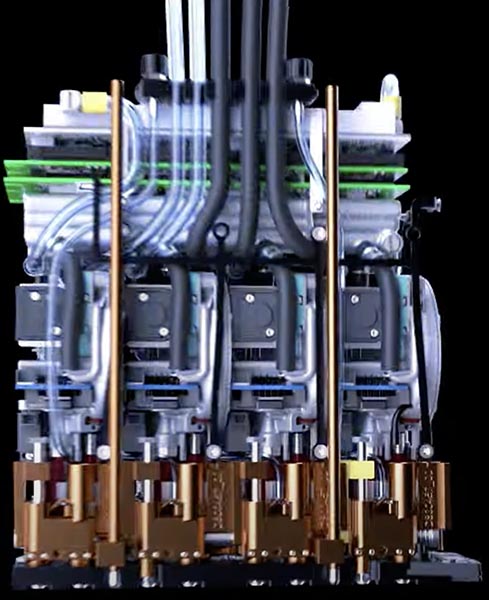
The first implementations of the cluster were with the TX801 and TX802, 8-color, 1.8m print width textile printer, as well as two label printers, the LB701 with a 170mm print width, and the LB702 which has 340mm print width. Since those successful initial introductions, Bobst has been working on integrating the digital cluster technology into its existing analog product lines to address the changing market requirements.
Integrating Across the Product Line
The design of these inkjet clusters could allow Bobst to integrate inkjet print technology across much of their expansive product line, ultimately even to folding carton and corrugated since the clusters can be configured currently to an estimated 130-in. print width. The first of those integrations was shown at Labelexpo in 2019 with the Master DM5 label press. Since then, they have enhanced the design and interface based on early customer feedback, and the result is the updated Digital Master 340 and Digital Master 510. The Digital Master 340 is a narrow web 340mm (13.5-in.), and the 510 is a mid-web 510mm (20-in.) print width. They are built on Bobst’s modular and upgradable M5 flexo platform in combination with their Mouvent Cluster inkjet technology. These presses are designed to produce label, shrink sleeve, flexible packaging, and other in narrow- and mid-width applications.
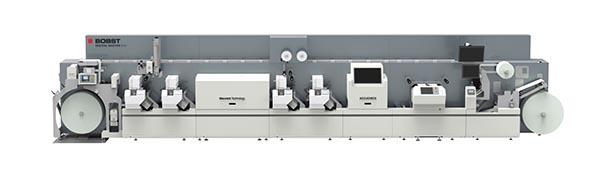
While the M5 platform can run at speeds up to about 300 m/min. in flexo mode, adding inkjet into the production, the Digital Master series constrains it to 100 m/min. limited by the maximum speed of the Mouvent Clusters. This is equal to or better than the rest of the market competition for an All in One press. The digital unit can be configured to run six UV colors plus digital white. As is the case with all of the inkjet presses on the market, in order to achieve 75–80% opacity of the digital white, the speed would need to be reduced to about 50 m/min., which still offers higher productivity than most digital only presses. The digital white is not really designed for a flood coat, but the integrated flexo configuration could be adapted to handle that.
Coexistence
Many of the earlier EP digital label presses are printing at 25–30 m/min. but now with the increased speeds of the HP Indigo V12, we are seeing 120 m/min. for a digital EP label press. However, even operating at 120 m/min., many flexo presses can run at 300 m/min. and up, and adding the increased costs associated with running digital vs. pure flexo still presents issues for large volume runs.
Some will say that with skilled labor shortages, digital is still the way to go. However, if you look at the amount of digitalization and automation now available in these flexo presses, like the Digital Master series from Bobst, it begins to level the operational skill requirements. Inline automatic registration and pressure adjustments, automated maintenance and integrated semi or full rotary die options mitigate a lot of the legacy skill requirements.
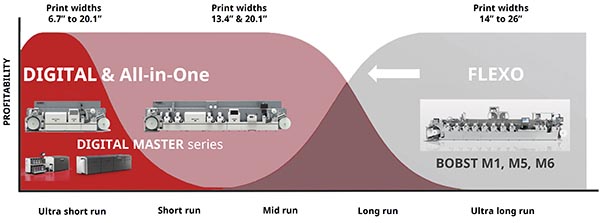
So the reality for quite a while will be the coexistence of digital and inkjet with flexo based on volumes and cost. In the short to mid-term, the battle lines are being drawn between EP and inkjet for capturing the shorter-run on-demand label production. Many large label converters were at the open house to shop for their next digital investment, and discussions around their expectations proved this out. Interestingly, many of these Digital Master series presses are being ordered with six or more flexo stations to accommodate ECG and other finishing and embellishment.
About WhatTheyThink
WhatTheyThink is the global printing industry's go-to information source with both print and digital offerings, including WhatTheyThink.com, WhatTheyThink Email Newsletters, and the WhatTheyThink magazine. Our mission is to inform, educate, and inspire the industry. We provide cogent news and analysis about trends, technologies, operations, and events in all the markets that comprise today's printing and sign industries including commercial, in-plant, mailing, finishing, sign, display, textile, industrial, finishing, labels, packaging, marketing technology, software and workflow.