Background
Production inkjet has been around since at least 1972 when Mead Digital Systems started to develop their first press, which was released in 1976. Since then, many other manufacturers joined the fray with newer, faster, and higher-quality presses. However, until the introduction of the B2+ cutsheet Fujifilm J Press in 2012, most of the production inkjet presses were rollfed. This is an important distinction because in all of the research I have done over the years, many, if not most, PSPs favor cutsheet presses since they offer more media flexibility. Even with the introduction of the B2+ KM-1, the widely successful B3 Canon i300/ix, and the B1 Landa S(P), there hasn’t been a lot of competition or availability in the cutsheet production inkjet market that many of the PSPs have been waiting for. The projections show that as the availability of competitive cutsheet B2+ inkjet presses increase, so will the page production volumes.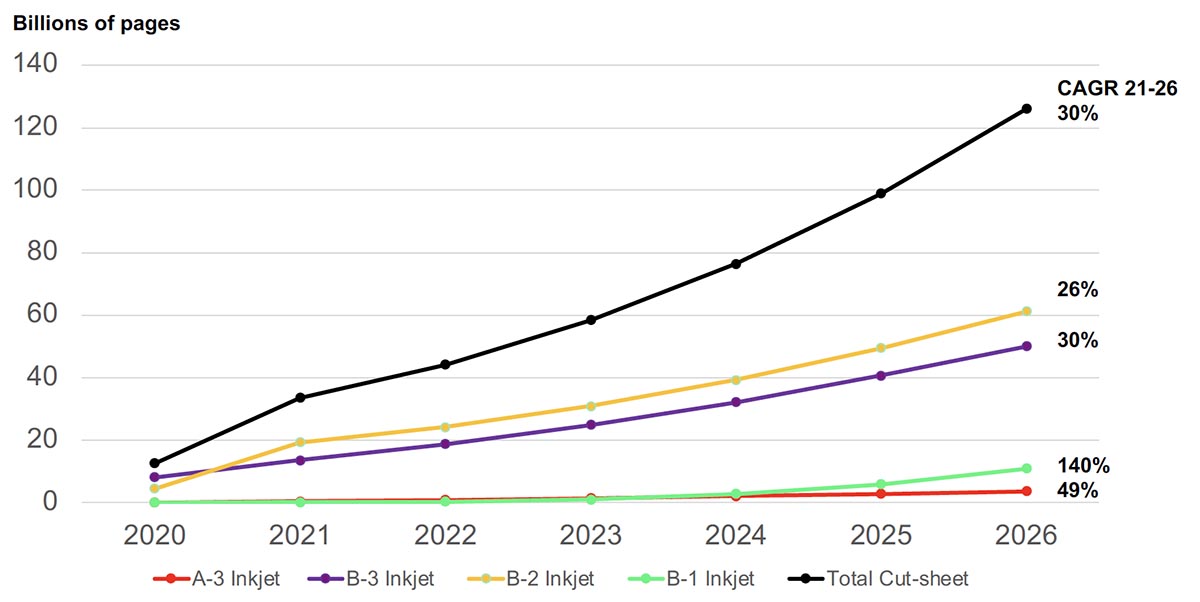
Source: IT Strategies, Inc.
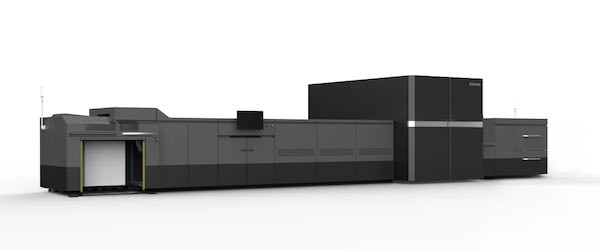
The good news is that 2023 should bring new options and, adding to those options, Ricoh has finally released the Dragon!
Delivering a New Platform
I first heard rumblings about a Ricoh B2+ press in 2018 and it caught my attention, since I knew a cutsheet production inkjet press is what the commercial print and carton industry has been waiting for. Even with Ricoh’s background in inkjet and cutsheet digital toner press manufacturing, developing a reliable larger-format cutsheet industrial press takes a lot of research, testing, and time, according to a discussion I had with Ricoh global director of inkjet marketing, Mike Herold.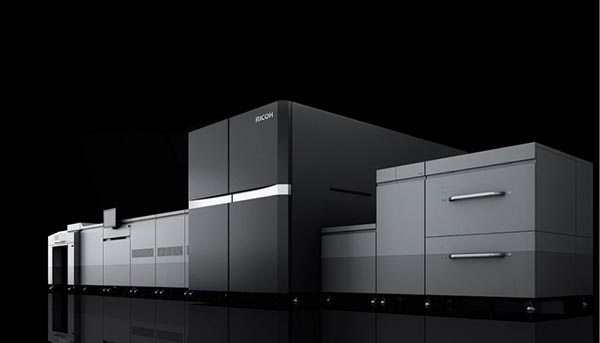
 “The first phase was really about us making sure some final engineering changes that we couldn’t do before we put the machine on a boat,” Herold said. “We also needed the machine here in the US to do some additional training for our own team as well. Typically we would do that in Japan, but because of the travel restrictions of COVID getting in and out of Japan made that complicated. Heeter was really flexible about how we did this, knowing that the machine would come here and we have kind of a small army of Ricoh people leveraging this like our own lab for a while. The second phase was really about handing off production to Heeter. And then ultimately the third phase would be very typical of a normal beta, where they ramp up for a few weeks until they're really running production.”
The machine was finally off the boat and delivered in early June to a newly built-out “next-generation digital print center” at the Heeter facility, according to President Kirk Schlecker. Both he and EVP of Sales and Marketing Tom Boyle were excited to finally get the press on the floor after hearing about it in 2019 and seeing it in Japan in 2020 just days before the world shut down from COVID. After a relatively smooth, yet unique beta cycle, they are ready to use it for production. According to Schlecker, they have found that “the print looks very compatible to the high-quality print we are getting from the VC70000, making it easier to leverage work between the two.” They also expect this to replace some of their cutsheet toner devices, as well as offer more flexibility for using heavier stocks than they could with their rollfed presses. Boyle added, “We see some extra opportunities in some of the verticals that we live in, and will help us get more dialed into customer needs.”
Importantly, this will allow them to further build on their use of digital technologies that help them get jobs through the shop with without adding more people. “Like many other PSPs we can’t find skilled people and can’t add equipment where you need a dedicated person for that machine,” said Boyle. “Our current concept is you can have one operator running multiple toner devices, but our goal is to have one operator running multiple inkjet devices at one time.” Embracing digital and personalization has resulted in a 25% overall growth in business, including a 65% increase in capacity, 35% reduction in turnaround times, over 80 new customers in the last four years, and they are 25% more energy efficient! This recent acquisition of the Ricoh Pro Z75 fits right in to their new model and will undoubtedly help them increase their performance and profits.
“The first phase was really about us making sure some final engineering changes that we couldn’t do before we put the machine on a boat,” Herold said. “We also needed the machine here in the US to do some additional training for our own team as well. Typically we would do that in Japan, but because of the travel restrictions of COVID getting in and out of Japan made that complicated. Heeter was really flexible about how we did this, knowing that the machine would come here and we have kind of a small army of Ricoh people leveraging this like our own lab for a while. The second phase was really about handing off production to Heeter. And then ultimately the third phase would be very typical of a normal beta, where they ramp up for a few weeks until they're really running production.”
The machine was finally off the boat and delivered in early June to a newly built-out “next-generation digital print center” at the Heeter facility, according to President Kirk Schlecker. Both he and EVP of Sales and Marketing Tom Boyle were excited to finally get the press on the floor after hearing about it in 2019 and seeing it in Japan in 2020 just days before the world shut down from COVID. After a relatively smooth, yet unique beta cycle, they are ready to use it for production. According to Schlecker, they have found that “the print looks very compatible to the high-quality print we are getting from the VC70000, making it easier to leverage work between the two.” They also expect this to replace some of their cutsheet toner devices, as well as offer more flexibility for using heavier stocks than they could with their rollfed presses. Boyle added, “We see some extra opportunities in some of the verticals that we live in, and will help us get more dialed into customer needs.”
Importantly, this will allow them to further build on their use of digital technologies that help them get jobs through the shop with without adding more people. “Like many other PSPs we can’t find skilled people and can’t add equipment where you need a dedicated person for that machine,” said Boyle. “Our current concept is you can have one operator running multiple toner devices, but our goal is to have one operator running multiple inkjet devices at one time.” Embracing digital and personalization has resulted in a 25% overall growth in business, including a 65% increase in capacity, 35% reduction in turnaround times, over 80 new customers in the last four years, and they are 25% more energy efficient! This recent acquisition of the Ricoh Pro Z75 fits right in to their new model and will undoubtedly help them increase their performance and profits.
Ricoh Pro Z75
The RICOH Pro Z75 was developed from the ground up and is manufactured in-house by Ricoh in Japan. The press quality is achieved through the use of Ricoh printheads with dynamic drop sizes that support a resolution of 1200 x 1200 dpi. It uses their higher gamut aqueous pigment ink to better match offset along with Ricoh’s in-house developed proven very efficient drying technology. The auto-duplexing press supports readily available offset coated, uncoated, and inkjet treated media and delivers excellent quality on thin paper without cockling. To support both commercial print and packaging requirements the press support both input drawers and pallets. The Pro Z75 runs 23 x 29 inch B2+ at speeds up 4500 sheets per hour (sph) simplex and 2250 sph duplex. It has the ability to run a mix of uncoated 60–400 gsm and offset coated 73–400 gsm to support the migration of short-run jobs to digital.