A frequent topic on Inkjet Insight has been the trend toward diversification seen in many sectors of the printing industry. This is particularly true in the transaction printing, or customer communications, segment as I detailed in a recent whitepaper: “Where Transaction Printers Can Find Growth.” However, there are also many direct mail, in-plant operations and even some book printers seeking greener pastures.
As far back as 2019, our "Lane Changer" research (with 218 companies) indicated that 70% of direct mailers, 58% of transaction printers and 53% of in-plant operations derived less than half of their annual revenue from their self-identified segment focus. While some companies actively looked to inkjet to help them diversify, others expanded their reach into new application segments to deliver the volume levels necessary to achieve optimal running costs on a new high-speed inkjet press.
For those shopping for a new press, or considering an upgrade, an understanding of your target markets is a key factor. Think about where you are now, and where else you may want to go. For example, companies who are committed to the high end of the graphic arts market are not going to cost-effectively compete in the transaction printing market using the same equipment. Likewise, those in the transaction printing market can’t price their offer competitively on a press that is intended to serve the needs of the commercial sector. However, there is a lot of middle ground between those extremes, and that’s where our selection of “crossover presses” shine.
How we define a Crossover Press
There are many continuous, web-fed presses that fit in the category analysts often describe as “mid-range” inkjet. These are presses that are mid-volume, mid-price and, sometimes, mid-color relative to the overall market. To break into more color-sensitive markets, business color or “good enough color” won’t cut it. Most of the presses on this list have color capabilities that would have been considered leading edge only a couple of years ago.
Image quality also needs to be very strong. While top graphic arts presses are now in the 2,400 dpi range, presses on our crossover list are in the 1200 dpi range (some with lower resolution in the web direction.) Note that resolution does not tell the whole story on print quality, but it’s a place to start. To “crossover” presses also need to be cost-efficient to use in price sensitive customer communications or direct letter mail production, while offering a foothold into some higher end commercial applications. This typically requires a speed upwards of 1,000 IPM and a duty cycle of 25 to 50 million monthly images. We are looking at presses, where the economies of scale at the higher end of the duty cycle make it very attractive to support different application types to keep the press running, and where the capabilities of the press easily enable application diversity.
Media compatibility, and the impact on running cost, is where the category gets a bit confusing. Our initial plan was to include only presses that do not print on offset coated stocks because, in many cases, the ink or primer needed for compatibility was an “always on” function that drove running costs out of the economic range for transaction print and direct letter mail. However, there are some presses that can be configured to support a range of offset coated stocks (at low to medium ink densities) and with primer as an option rather than a requirement. In cases where we have included a press that supports some level of offset coated media, the OEM producing it also offers another press, or press configuration, that supports an even wider range of media with a wider color gamut.
One might ask why only web-fed presses are reviewed here. Arguably there is a tremendous amount of versatility to be had with some of the sheet fed options. As noted, we are looking at a level of volume and economic scale that sheet fed presses (to date) can’t achieve. However, as noted in our previous discussion of “Big Rigs” some companies may find that their mix of business is better suited to multiple, less expensive, presses that allow different types of jobs to be run in parallel. Another factor is that we cover many of the most versatile sheet fed offerings in the graphic arts edition of our shopping guide.
The quality bar is moving ever upward as OEMs pursue the dream of replacing offset volumes with cost-effective inkjet. As OEMs continue nibbling at the corners of that volume, the previous generations of presses become more capable of handling pretty much everything else. Take a look at the current generation of crossover presses on the market.
|
Press |
Snapshot |
Overview |
|
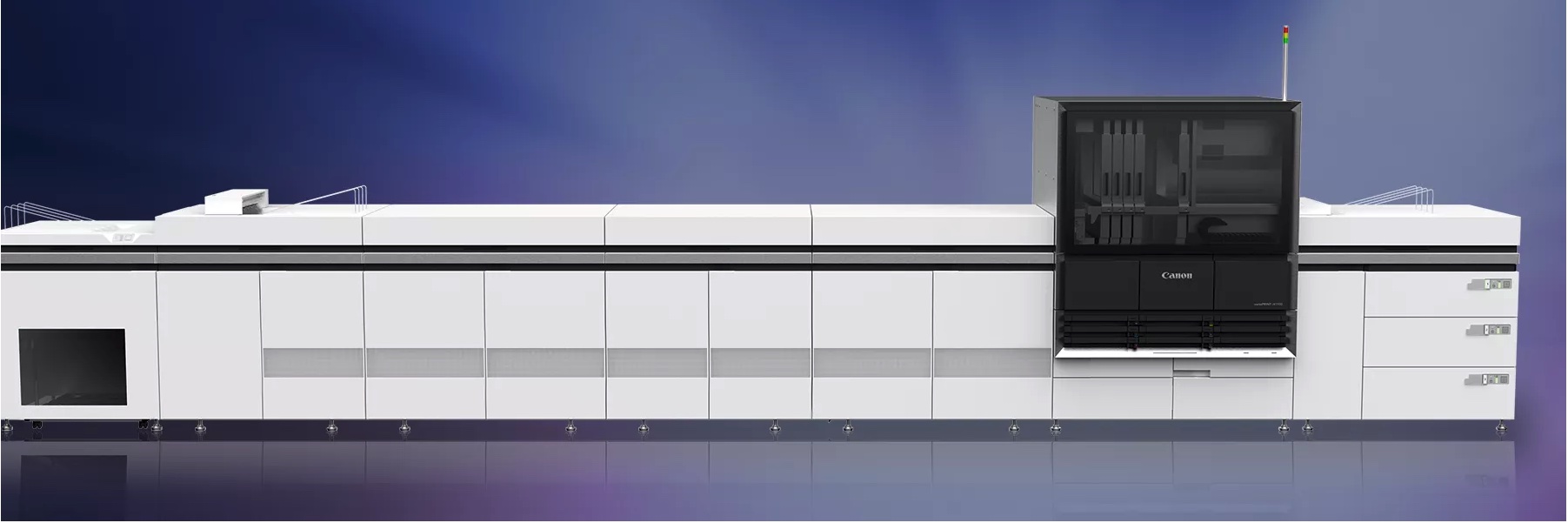
Canon ColorStream 8000 |
Launched in 2021 1790 to 2152 ipm (A4) Up to 1,200 x 720 dpi Duty Cycle of up to 28 to 59 million images per month Paper weight of 40 to 160 gsm MICR option |
There are two models in the 8000 series, the 8133 and the 8160 that deliver speeds of 133 m/min and 160 m/min respectively. This results in 1,790 or 2,152 A4 images per minute. Customers can upgrade from the 8133 to the 8160 without a hardware change. The speed improvement comes with a corresponding drop in web-direction resolution (1,200 x 600 dpi) which is almost indistinguishable, particularly since the press uses small, multilevel drop sizes ranging from 2 to 5 picoliters. The ColorStream 8000 offers CMYK plus two custom color stations. The 5th and 6th stations can support security inks or MICR. When using both stations, MICR can be printed at full speed of 160 m/min, or with one station at half that speed. The 8000 does not use primer and does not print on offset coated stock. It does deliver strong color and the flexibility of a 22 inch print width which can enable 4-up print of typical trade book formats or 2-up US letter pages in landscape mode. Additional specifications include:
|
[caption id="attachment_5853" align="aligncenter" width="393"]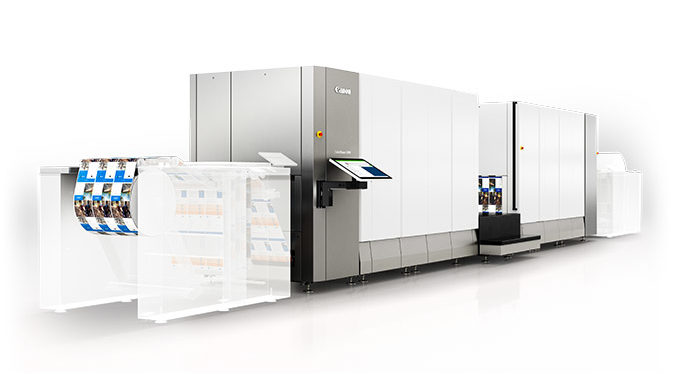 Canon ColorStream 8000[/caption] Canon ColorStream 8000[/caption] |
||
|
HP Industrial PageWide Advantage 2200 with single dryer, passive cooling |
Launched in 2022 Up to 1,600 mono IPM or 1,000 color Up to 2,400 dpi Duty Cycle up to 62M U.S. letter images per month, or 90M mono. Paper Weight of 40 gsm to 160 gsm |
The PageWide Advantage 2200 with Brilliant Ink was launched this year as HP’s color and quality flagship press, surpassing the HP T250 HD launched in 2020. However, it was also designed with a highly modular architecture and a high-speed mono mode that makes the lower-end configuration (single dryer and passive cooling) cost effective for even transaction printing applications. Although more economical solutions are available for dedicated transaction printing. The 2200 is 33% faster than the T250 HD in quality mode and 60% faster in mono performance mode (800 fpm mono / 500 fpm color performance mode / 300 fpm color – quality mode) which helps drive the economics as a crossover press. Keep in mind that when configured with less drying capacity, the press will not support offset coated media. However, if coated stock, or media up to 300 gsm, is a focus in the future, the additional drying modules and active cooling can be added. Offset uncoated stocks popular for customer communications and direct letter mail are supported. The press offers a native resolution of 2400 nozzles per inch using the HP B62 HDNA thermal drop on demand printheads and HP Brilliant Ink enhanced with HP Optimizer. The maximum printable width is 20.5 inches (521 mm) and the maximum printable frame length is 72 inches (1829 mm) enabling great flexibility for complex direct mail, posters, or banners. Additional specs:
Note that BlueCrest, a strategic partner of HP since 2009, will offer the IntelliJet Advantage 2200 with Brilliant Ink to enable clients to “consolidate their transactional and color critical applications on a single platform.” |
[caption id="attachment_5854" align="aligncenter" width="550"]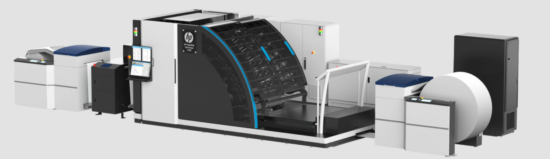 HP PageWide Advantage 2200[/caption] HP PageWide Advantage 2200[/caption] |
||
|
Kodak Prosper UltraStream C520 with 2 NIR Units and passive cooling |
Launched in 2022 Up to 2,148 IPM (US letter) 1,800 x 600 dpi Duty Cycle up to 60M U.S. letter images per month Paper Weight of 40 gsm to 160 gsm |
The KODAK PROSPER ULTRA 520 Press is offered in two CMYK models (with very similar names). The PROSPER ULTRA C520 is covered as a graphic arts press The PROSPER ULTRA P520 fits the models as a cross-over press as it optimized for use with uncoated and inkjet treated papers and the ink coverage suitable to those substrates. The P520 will support a limited number of coated papers at a reduced print speed. As with some other modular presses covered here, one of the big configuration differences relates to drying. Both the C and P models use near infrared (NIR) drying, however, the C model uses two, instead of four NIR units, and does not have additional web cooling. The press uses Kodak Ultrastream continuous inkjet heads to deliver a print resolution of 1,800 x 600 dpi consistently at all speeds and on all stocks. The print heads don’t require ink spit bars or head capping which eliminates associated ink waste. Kodak touts a number of other cost saving features that help align the press with the economics of direct mail, books and transaction printing:
|
[caption id="attachment_5875" align="aligncenter" width="500"]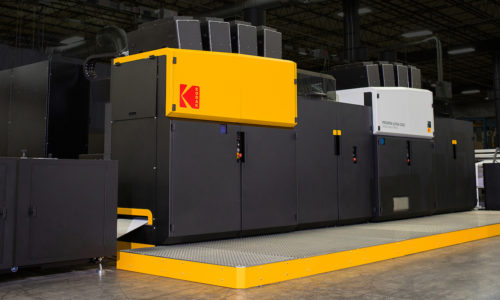 Kodak ULTRASTREAM C520[/caption] Kodak ULTRASTREAM C520[/caption] |
||
|
Ricoh Pro VC60000 |
Launched in 2014 Up to 2145 IPM Up to 1200 dpi Duty Cycle of 40 million images per month Paper weight of 40 to 250 gsm MICR option |
The middle child of the Ricoh Pro VC family, the VC 60000 can run at up to 492 feet per minute (150 meters per minute) to produce 2,145 letter images per hour at 600 × 600 dpi with color suitable for transaction printing and some direct mail. For more demanding graphic applications, 1200 dpi is available at lower speeds (164 fpm/ 50 mpm). The standard drying configuration is forced air with heated drum, but multiple drying options are available that can expand the range of media compatibility and coverage levels. The VC60000 can print on offset uncoated, IJ coated, IJ treated, and recycled stocks as well as some offset coated stocks (depending on the drying configuration.) It uses high-density aqueous pigment ink with Ricoh piezo drop on demand print heads. The 4 gray levels and a minimum drop size of under 2 picoliters contribute to the color and image quality needed to move into more demanding applications. In addition to transaction print, books, direct mail and medium coverage commercial applications, the maximum repeatable printing image area of 20.5 x 54 inches puts poster printing and other large format applications in its wheelhouse. It also has an option for MICR inks as well as what Ricoh calls extended gamut inks. Additional specifications include:
|
[caption id="attachment_5856" align="aligncenter" width="504"]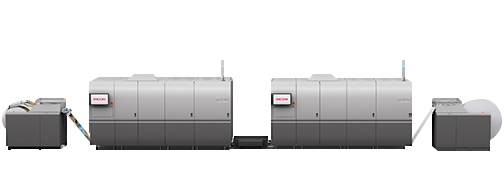 Ricoh Pro VC6000[/caption] Ricoh Pro VC6000[/caption] |
||
|
Screen Truepress Jet520HD |
Launched in 2015 Up to 1,968 IPM Up to 1,200 dpi (at lower speed) Duty Cycle: 50 million letter images Paper Weight: 40 – 250gsm 2 custom color stations |
The Truepress Jet 520HD line can be configured in many ways. Like the HP Advantage series, the configuration of drying has a big impact on the level of coverage and range of media supported and how fast it can deliver its top quality. It also provides customers a strong upgrade path to pursue even more challenging applications over time. This press has been a great success for Screen which announced the 100th installation back in 2019. The Jet520HD has an air heating and heat drum system while its more expensive siblings either add an NIR unit or use a more advanced drying unit. The standard press configuration offers a top speed of (120 m/min) 394 fpm standard, but can be upgraded to 492 ft/min (150 m/min). The resolution also varies with speed:
The press will run offset coated stocks, but only at the lowest speed (which is just fine for a crossover press). As the HD implies, this is a high-definition inkjet web press that delivers realistic images at its top resolution. Hitachi Piezo drop on demand heads offer 4 gray levels with drops ranging from 2 to 12 picoliters. In addition to CMYK there are 2 ink stations for custom color, but MICR is not an option. Other specifications include
|
[caption id="attachment_5852" align="aligncenter" width="550"]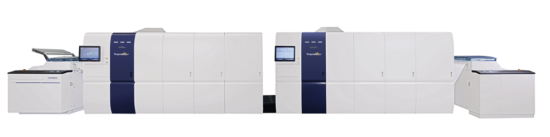 Screen Truepress Jet 520 HD[/caption] Screen Truepress Jet 520 HD[/caption] |
||
|
Superweb WEBJet 2100 P |
Launched in 2021 Up to @1,000 IPM Up to 1600 x 1585dpi Duty Cycle: 49 million duplex letter images Paper Weight: 16 lb. bond to 7 pt. (~ 40gsm to 200 gsm) |
The WebJet 2100 P may be the least expensive press on our crossover list, but it’s certainly not “less than” the others. It is highly configurable with a scalable web width of up to 20.5” (520.7mm). It uses Memjet Duralink Piezo drop on demand print heads and aqueous pigment ink. It can print on a range of uncoated offset media, inkjet treated/primed, and inkjet coated media without the use of a primer or undercoat. An enhanced drying package is available to extend the range of media compatibility and associated coverage levels. Like many of the other presses, it delivers a range of speeds and resolutions but it’s highest speed of 490 fpm still delivers 1,600 x 790 dpi. In High Quality mode it produces 1,600 x 1,260 dpi images at up to 300 fpm and in Standard mode, 1,600 x 925 dpi images at up to 410 fpm. The maximum print width is 17.5” (444.5mm) which is narrower than the others on the list, but still enables 2-up US letter printing. The WebJet is the most compact presses on the list with a standard footprint of just 41x10x 6 feet. Other specifications include:
|
[caption id="attachment_5855" align="aligncenter" width="550"] Superweb WEBJet 2100 P[/caption] Superweb WEBJet 2100 P[/caption] |
||
Use this list as a thought starter - not an end point
In addition to the presses on the list above, we did contact some other OEMs to ask if presses the we would categorize in the graphic arts segment were available in a more minimal configuration that would meet the productivity and running cost threshold to serve crossover customers in the transaction printing, book and direct mail categories. We did not get any additions in time for the publication of this article, but if new information comes in, we will update the list accordingly.
From this list it should be apparent that the presses included have as many differentiators as they have characteristics in common. While all use aqueous pigment inks, they all use different types and brands of printheads. Some offer MICR or security inks as an option, other offer additional color stations for custom colors. Some have features that make them very economical for books or transaction printing, and some have a wider printable web width or maximum print frame that opens up possibilities for posters or other creative uses of the larger printable area. What they all have in common is that they can do more than one thing very well and very cost effectively. That is something that a growing number of printing companies need.
It is also notable that these presses have a range of configurations that impact the economics and the range of application compatibility that they will support. While we may have narrowed the list of presses to consider, there is still a lot of work to do to compare configurations to fit your business. Stay tuned for our next shopping guide that looks at the top of the line graphic arts presses.
Inkjet Shopping Guide 1: Entry Level Presses Inkjet Shopping Guide 2: The Big Rigs