Historically, label production has been driven predominantly by flexography and offset, with gravure picking up some of the longer runs. In the mid 1990s, we started to see the early use of the digital electrophotographic process for label production, with the Xeikon DCP/32S followed by HP Indigo WS4000 in 2002. After that, we saw an increase of electrophotographic and inkjet technologies, from historically flexo press manufacturers like Mark Andy, Gallus, Durst, and others targeting short-run label and, ultimately, flexible packaging print production. The advantage of flexo is that it can be configured to address a full production line from precoat (if needed) through printing, embellishment, finishing, etc. Flexo label converters needed a way to maintain the advantage of cost and speed, and address some of the variability or mass customization requirements by initially turning to adding “after-market”’ digital printing units, like those from Colordyne to their existing flexo presses.
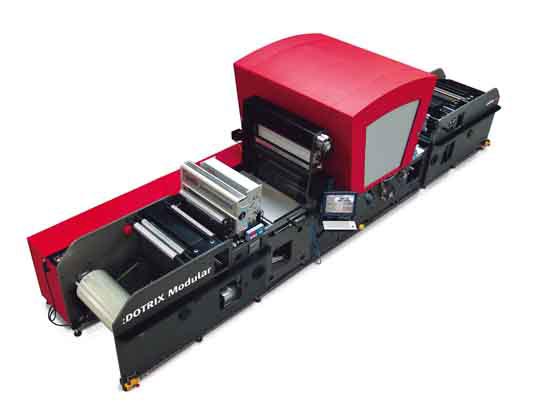
The earliest flexo/digital hybrid press dates back to 2002 when the Dotrix Modular hybrid single-pass UV inkjet system was developed by Edale and Agfa, and while it was a unique design, it was too early for the market. In 2012, FFEI and Edale developed the Graphium modular digital UV inkjet label press, which was launched in 2013 by FFEI. The flexo press manufacturers began to recognize that the shifts in consumer purchasing would continue to have an impact on packaging segmentation and growth providing a perfect storm for a hybrid press requirement, and they weren’t going to sit back and watch digital solutions grow at their expense. That was the beginning of the first wave of hybrid flexo presses from Mark Andy, Gallus, Durst, and others.
Bobst Digital Master—The Next Wave
At Labelexpo in 2019, there was a smattering of hybrid presses and Bobst showed the Master DM5, their first take at a digital/flexo hybrid, which they identified as an “All in One” press. Since then, they have enhanced the design and interface based on early customer feedback. The result is the just released updated Digital Master 340 and Digital Master 510. The Digital Master 340 is a narrow-web 340mm (13.5-in.), and the 510 is a mid-web 510mm (20-in.) print width. They are built on Bobst’s modular and upgradable M5 flexo platform in combination with their Mouvent Cluster inkjet technology. These presses are designed to produce labels, shrink sleeves, flexible packaging, and other applications. According to Bobst Strategic Marketing Manager Patrick Graber, they are designed to produce “short runs to long runs, which we consider to be about 8,000 to 10,000 meters.” Unlike many of the digital presses which print at 25 meters per minute, if you can print at 85 meters to a hundred meters per minute you can easily print 20,000 meters although it may be a bit more expensive than pure flexo.
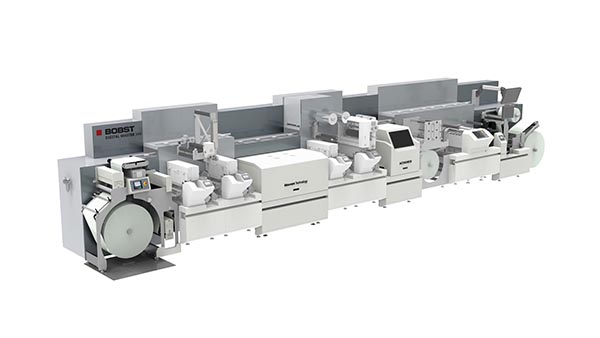
While the M5 platform can run at speeds up to about 200 m/min., the Digital Master series can run up to 100 m/min., constrained by the maximum speed of the Mouvent Clusters. Although this is equal to or better than the rest of the market competition for an All in One press. The native resolution of the Fuji Dimatix Samba heads is 1200 x 1200 dpi, and the digital unit can be configured to run six UV colors plus digital white. As is the case with all of the inkjet presses on the market, in order to achieve 75–80% opacity of the digital white, the speed would need to be reduced to about 50 m/min., which still offers higher productivity than most digital-only presses. The digital white is not really designed for a flood coat, but the flexo configuration could be adapted to handle that.
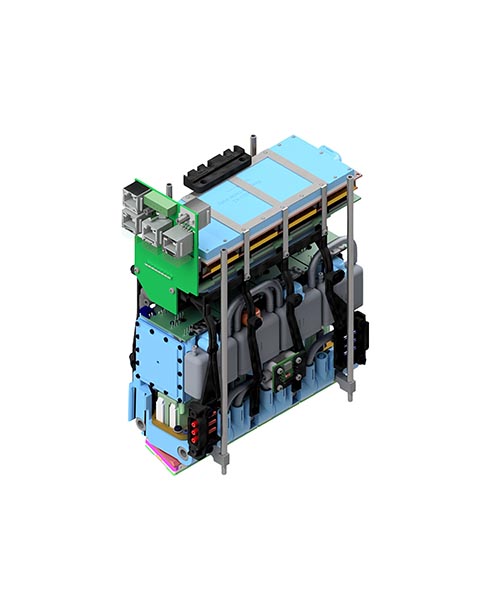
When Mouvent initially introduced their Cluster technology in 2017, they projected that they would initially introduce a UV solution, but had a goal to also provide an aqueous-based ink solution as well. As we have seen with others, aqueous ink for packaging is not impossible, but is challenging due to the variability in media and finishing requirements. There is no doubt in my mind that Bobst will be able to introduce an aqueous ink solution in the future, which will open the door to more indirect and direct food contact applications.
Since it is built on the M5 platform, it can be configured with finishing and converting units like cold foil, hot foil, lamination, varnishing, die-cutting, and slitting in one pass for more application-specific production. While the flexibility of run length is a huge benefit, configuring the press to application-based production is one of the real benefits of having a digital/flexo hybrid press. This allows you to create focused and optimized production processes based on specific requirements instead of trying to fit work with different requirements into the same production processes. That could provide more cost effective and timely solutions with less setups and handling.
All in One presses are not exclusive to Bobst; others like the Canon LabelStream 4000, OMET XJet platform integrating Durst’s Tau 330 digital inkjet system with OMET X6, Mark Andy Digital Series iQ, and many others have similar specifications. However, each of them is developed using digital units that are all manufactured by someone other than the flexo manufacturer, while the Digital Master presses are all developed and manufactured by Bobst.
Bobst has long been one of the global leaders in packaging print and converting equipment, and this new All in One solution will help continue that leadership and growth. In the last six months, they have already sold 12 Digital Master presses, and expect that growth to continue.