The amazing thing about inkjet is the number of applications inkjet has managed to penetrate by offering short runs that generate freedom of design. In my last application post we took an introductory look at the ceramic tile market and how print head technology made such an impact on the specific materials needed. This time we build on the architectural design theme and widen our analysis and discuss the many things we take for granted in our living and working spaces that have been created for us by printing, from furniture to flooring and the latest kid on the block: wallpaper.
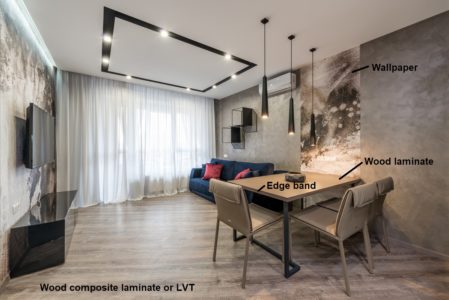
After inkjet labels, this was one of the earliest crossover applications since it exploited closely related head technology to print narrow width product like edge bands & skirting boards. In more recent time the cross-fertilisation of different uses continues with OEMs with a previous focus on wide-format graphics now producing machines for wallpaper and those having developed tile printers now turning their attention to wooden sheets. So, let’s take a look at what printing corrugated board has in common with printing wood.
Size Matters
As we have seen throughout our posts in the last two years, almost every potential industrial market has required some time to get understand the true value of an investment in inkjet technology, with the possible exception of the afore-mentioned ceramic tiles. This has meant that machines offered to the market have started at narrow widths with just a few heads, and then grown in-line with investment confidence level to meet the true production needs. Décor is a good example of this. I first saw a prototype single-pass edge-band printing system quite soon after starting work on labels, back in 2009. In fact, it was possible to use much the same UV ink, since the plastic ABS substrate was relatively known material from graphics printing. What was different about these machines was the engineering required to get a 2mm thick roll of thermoplastic under a print head!
As confidence built, so did the size of machines to meet the standard factory sizes of furniture & flooring factories, reaching 6ft (1.8m) or more. This is where the overlap with corrugated printing arises since, the cost of developing technology to print such large sheets justified looking to expansion in sales. Spanish décor experts Barberan famously took their JetMaster 1260 into the corrugated market, starting with local converter Hinohosa, who have since invested in several of EFI’s Nozumi press. To get market acceptability in décor, however, there was a crucial difference that proved a little harder to meet.
Color Matters
A lot of decorative printing seeks to emulate natural materials, especially wood. This involves quite a few tones of brown. The magenta pigment normally used in CMYK colour systems do not combine well with the traditional inks for gravure, for example, which tend to utilise spot browns made with red pigments. This created an issue for combinations of analog and digital print under different light conditions due to an effect known as metamerism. As a result, some of the early market success was made with novelty web-to-print using graphics images printed onto skirting. With a bit of extra formulating effort however, bespoke colours were produced that could meet this need using PR186 and PR176 and PR254 instead of the typical quinacridone magentas.
Another common requirement of décor applications seeking to emulate natural materials is the need for lighter color options. The typical Lc, Lm you might find in the graphics application is often augmented by light black or even light yellow (yes, really). This enables a finer reproduction of the delicate shade variations often found in nature without compromising quality. This is quite useful considering the trend for more grey stone-like flooring colours. Lightfastness is also a critical property of the resulting product and so pigment selection for yellow is important.
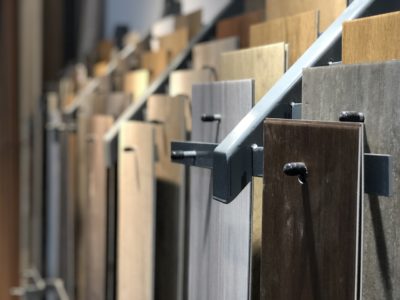
Color accuracy is important to simulating natural effects for inkjet printed decor
Success from Hybrid Printing
Decorative applications can be quite challenging for the end-use resistance. Unlike many other forms of print which have a limited end-use lifetime, furniture and flooring are expected to last for years with obvious fade or wear and tear. Therefore, applications like edge bands and flooring have been made successful by combining inkjet with traditional analog methods of finishing, like roller coating, or curtain coating. Applying primer is commonly used in order to improve interlayer adhesion and can also be tinted to reduce inkjet ink consumption.
The hybrid nature goes far beyond just printing methods. One of the most successful décor applications in terms of volume has been printing for high pressure lamination of flooring. In this process a décor paper is printed and pressed onto boards using melamine sheets, a method that has been in used for many years. Some digital printers have been developed is a direct replacement for the traditional water-based gravure printers, such as RotaJET from the likes of Koenig and Bauer and Palis are designed to be fast and enable roll-to-roll printing at converters. Interprint have bought several RotaJet™ printers now, with the latest able to print 225cm.
Others, like Saturn from Hymmen/Ricoh have sought to disrupt the existing supply chain by allowing for print and lamination in the same factories. Classen Group started printing flooring for lamination in the same factory using UV inks back in 2013 using a Hymmen printer. Such hybrid applications processes are also used for producing print on otherwise difficult to print objects, especially wrapping PVC profiles with printed foils.
Beyond 2D
Just like the ceramics industry, inkjet for décor has enabled printing beyond two dimensions by introducing topographic reproduction into the mix. The height can be obtained in single-pass using very large droplet sizes achieved by greyscale or head technology approaches like Xaar’s High Laydown™ or it can be realised by cleverly combining materials of different chemistry. Leading OEMs Hymmen and Barberan both offer such texturing technology, although there has been an unfortunate dispute in the German courts about patents, which only goes to prove how desirable the technology is.
The advantage presented by creating texture is to mimic natural materials much more convincingly than previous possible, allowing continuous variation that is just not possible with analog methods like embossing. In the example of wood, this can enable reproduction of grain, saw marks and knots in the wood where the variation in texture is aligned to the variation in color.
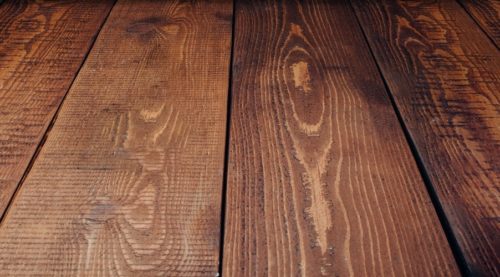
Texture adds realism to inkjet printed flooring
Beyond Rigid Materials
Although a large part of the established market has been built around the success of laminate flooring and other rigid panels, the last few years has seen a growth in both wallpaper and laminated vinyl tiles. For wallpaper Ricoh have even invented a new ink to put into their development partnership with European giant Olbrich in which the ink becomes and inherent component of the PVC coating. Also in Europe, Integrator IIJ have announced a high-speed printer for wallpaper printing that uses indoor-friendly, water-based inks.
Where I live, vinyl floors have a poor history, overused as they were as a chap alternative in the past. However, luxury vinyl tiles (LVT) have undergone a resurgence of popularity and just like the wood-based laminated solution, it requires a special ink in order to achieve the required adhesion between the layers in the printed sandwich. In Europe, Forbo is a well known supplier of digitally printed products and offer customized design from you own photos. Web-to-print is now commonplace in textiles but recent advance in ink has also made it possible for leather, as promoted by Agfa, which could extend to home furnishing in future, although seating is a particularly challenging application in terms of wear.
So that’s our introduction to some of the things we call Décor. Of course there is massive overlap with ceramics, textiles and glass printing for both indoor and outdoor surface decoration so we’ll look to add some further detail on some of those processes later. In the meanwhile we’d love to have your feedback.