©Enhance a Colour
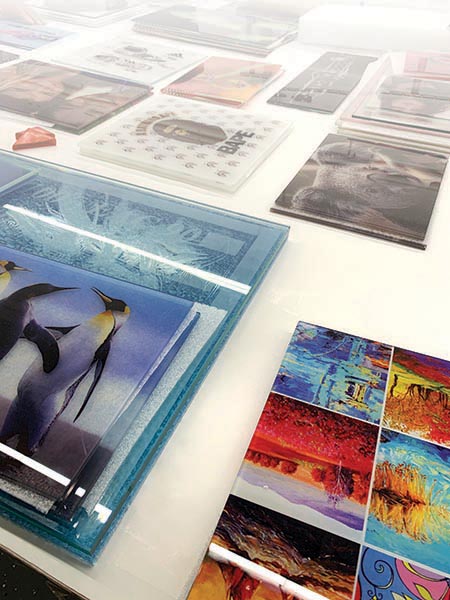
Glass is fairly ubiquitous in our lives, and historically people have been looking for ways to bring functional and artistic decoration to this interesting medium—think stained glass, for example. Some of my earliest memories of decorating glass were of the guy hand lettering someone’s name on the glass of an office door. It was simple but useful. Today, decorating glass can be used to control levels of transparency and opacity or graphic decoration and signage. Over the years, many different methods have been used to decorate glass including painting, silk screen, sandblasting, etching, decal and cling films, and of late the increasing use of inkjet technology. Using ceramic frit-based inks in a flatbed inkjet printer, you can print directly on to the glass. To create permanence, you fire or temper the printed glass to fuse the ceramic inks to the glass in a fairly quick and repeatable way. To achieve color matching as well as variable levels of translucency and transparency, specially designed inks and image processing software have been developed. Enhance a Colour, a visual and graphics solution company in Danbury, Conn., has perfected this process. “You can print full-color vibrant images and designs onto glass measuring up to 120 in. x 60 in,” said Owner Jim O’Connor. You can use printed glass for light-enhancing printed windows, privacy panels, facility décor, and more. You can also add an interlayer of custom printed fabric or paper positioned and sealed between two layers of glass. Unlike decals, these can be permanent decorations and be used in any glass application. Enhance a Colour has created glass walls and even glass floors for Broadway shows, automotive trade shows, and business decoration.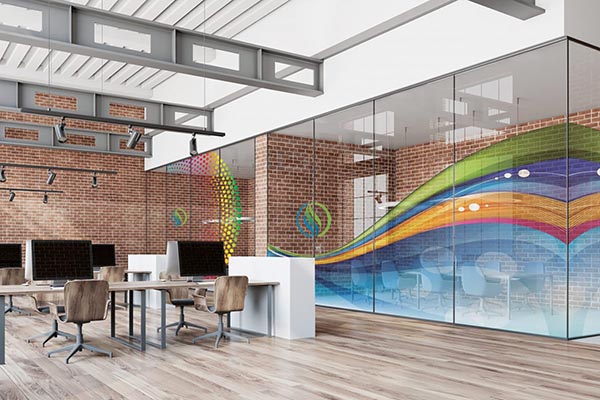
©Enhance a Colour
In automotive applications, laminated safety glass has been used to provide protection from harmful UV radiation. This has been done through the use of film laminates either tempered between the glass or as film decals on the interior surface of the vehicle glass. With single-pass 2880-dpi ceramic inkjet printers, like the Evolution press manufactured by TECGLASS of Lalín, near Pontevedra, Spain, car and window manufacturers can now print that protection in custom formats directly on the automotive glass.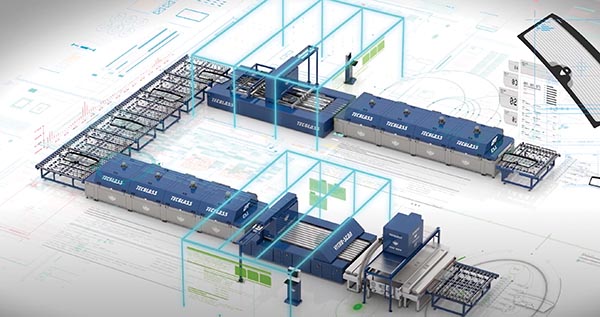
©TECGLASS
Obviously, printed decoration on automotive glass is limited based on regulations and safety, however there are specific applications like border frames, identification logos, and detail and even some tints for decoration and gradients to address glare at the top of the windshield. Their solution comes with the Vitro Scan tool standard to ensure perfect print results. This automatically reads and records the dimensions and position of the glass prior to printing, reducing the possibility of error and providing more reliable results. This is especially valuable when working with irregularly-shaped sheets of glass, as it automatically resizes the file to be printed, based on the data gathered by the Vitro Scan. TECGLASS printers can be configured with up to 12 color channels, including the six base colors: cyan, red, yellow, green, black, and white. Alternatively, UV printers, like the VR5D-E from Vanguard, recently acquired by Durst, can also be used to print on glass as well as other unique substrates. Moon Shadow Glass of Sandy, Ore. used their EFI H1625 UV LED printer to print on glass for displays like one created in the Oregon Zoo’s Elephant Land exhibit. While these solution offer great color stability, depending on the curing and fusion into the glass, the applications can be a bit more limited.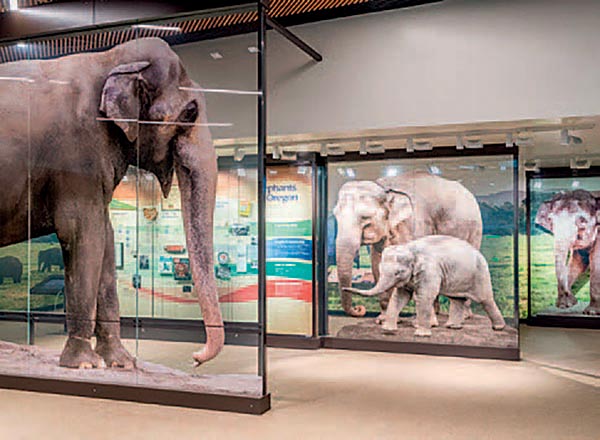
©Moon Shadow Glass
Glass has many uses and benefits in our lives. The ability to decorate it graphically and functionally increases its value and use. With the proliferation of inkjet technologies we can expect to see even more applications on the horizon.