Continuing in our 2021 technical theme of applications and the way inks and heads are combined to make them work, we take a few moments to look at the crucial industrial inkjet market of ceramic tile decoration. Like our other introductory applications discussions, we will start by looking retrospectively at the market and use that to describe the technology that created the successful solutions, with a focus on nozzle-based recirculation in print heads.
To understand the ceramic tile production and the reason inkjet proved so successful, you need to look at the way things were done before digital. Print was done by a combination of flat screen printing or a rotary blanket printer such as the System Rotocolor machine. Both techniques involve the contact to the un-fired (green) tile, thus requiring a certain thickness to give the required strength to withstand the contact force. The printing also involves set-up related to patterning of the screens or the blankets and the changeover of these meant stopping the lines.
The Defining Single-Pass Industrial Case Study
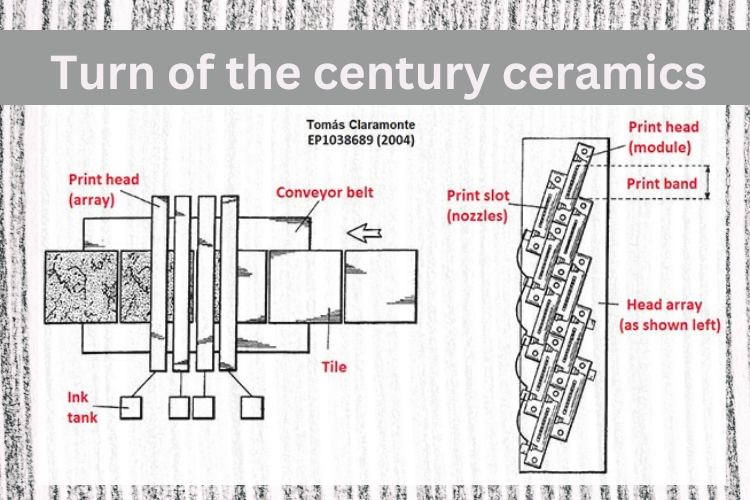
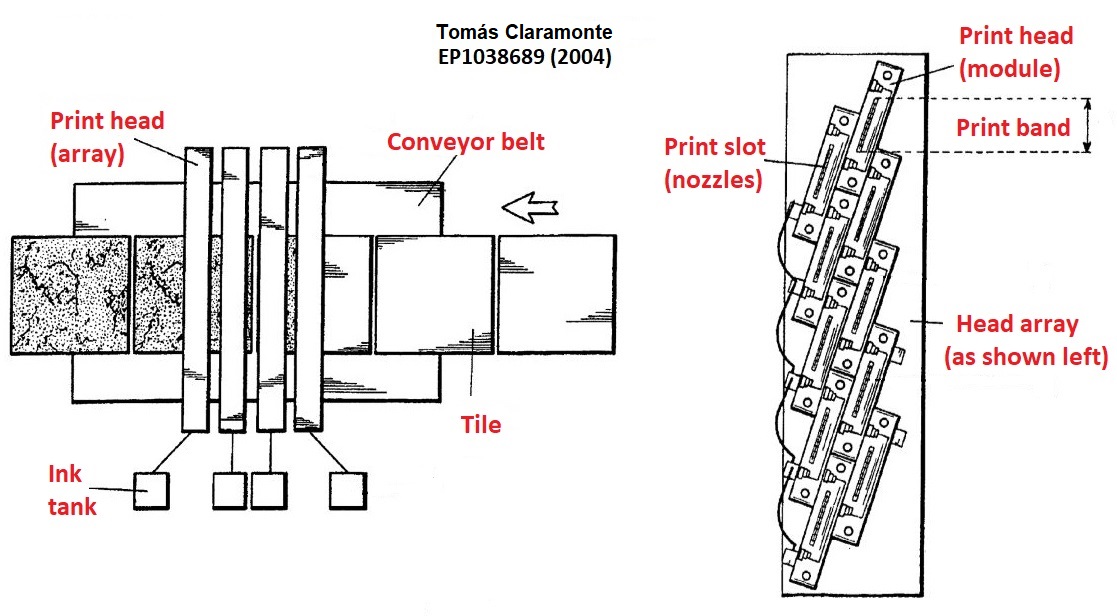
Digital printing address many of these challenges, but especially the number of tiles of a certain design that are needed to be kept in stock. Ceramics has become the go-to inkjet case study demonstrating the benefits of minimizing inventory where design versions exist and can be re-printed when needed. To enable the digital printers to match the existing production style, single-pass printing was necessary: the tiles would pass under a print head one time each in order for the ink to be deposited. This is shown in the early patent image from early machine innovators Kerajet, shown below, fined in 1999. The print head is shown below with the heads rotated to make the head stitch, a process common with earlier print heads including the Dimatix S-class range. Although this patent disclosed The Xaar XJ500, the Kerajet printer would adopt the Seiko 510 version of the Xaar technology.
The main difference between ceramic tile printing and many other inkjet applications is that the green tile “body” is not a solid surface. It is made from pressed powder and is coated in a base glaze that has been dried, but it is still wet and often warm when it enters the printer. This means the materials are very specific to the market. In their early patent on ceramic inks (US6402823), Ferro describe the printing of inks based on oils that are printed onto a glaze, also from Ferro. By combining digital and conventional materials ceramics suppliers have created solution for manufacturing, a bit like an optimised primer-ink combination in paper printing.
The Recirculation Revolution
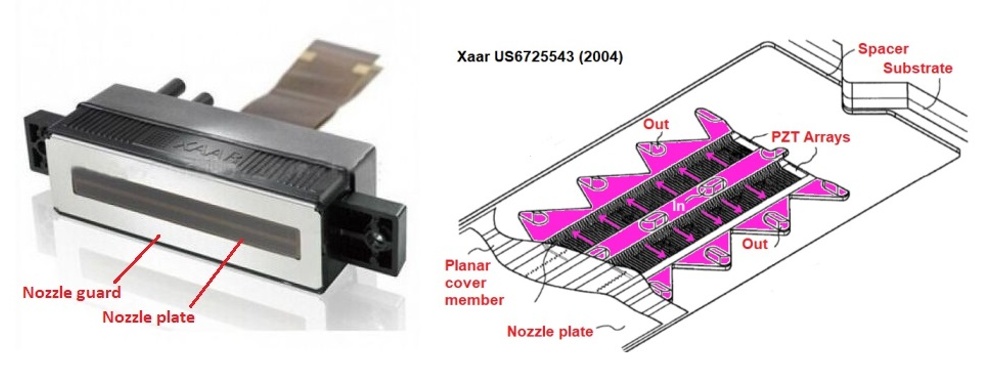
With the introduction of the Xaar XJ1001 in 2007, printer builders could improve the reliability of the system by using the ThroughFlow® (TF) feature of the printhead and achieve a 360DPI resolution. The patented TF Technology® allowed the ink to be constantly agitated throughout the ink system, reducing the chance of pigment settling. The design concept is captured below. The photo shows the finished head, whilst the patent image reveals the ink flow path when the silver nozzle guard and plastic nozzle plate is removed.
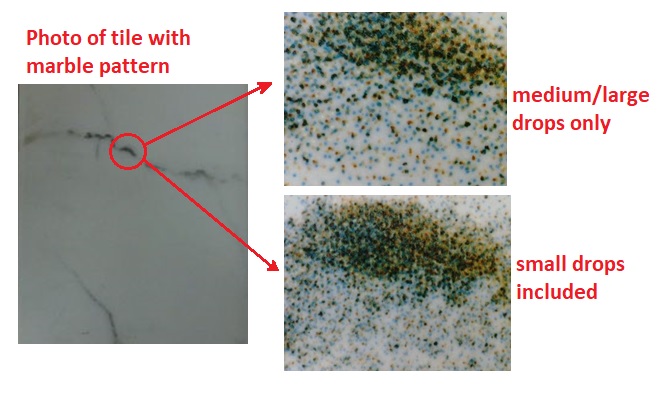
The images below demonstrate the differences seen when printing a tile with a Xaar head when different drop sizes are used. It shows how the smaller grayscale dots fill the space more evenly so that when viewed up close they are not so easily visible. This reveals one of the reasons that tile printing was so successful early on – that some of the images can be more tolerant of defects than some other applications.
As time went on throughout the 2010s, the head designs began to respond to the needs. Xaar produced a larger drop size head in 2012 in the form of the GS12. In the same year, Fujifilm Dimatix launched their competing 27pL SG1026MC “Starfire” heads. Seiko, Kyocera released their RC1536 and KJ-4C alternatives in 2015 and Konica Minolta followed up soon after with most offering the same 360DPI.
Hint: Which head to choose for any application comes down to finding the right DPI / frequency combination that matches the customer needs of print speed versus drop size/coverage and getting the widest fluid compatibility, including compatibility with water-based inks, for example. Sign up to our upcoming webinar on printhead resolution and speed.
Ceramic Materials – Aqueous Inks and Beyond
The majority of conventional fluids used in ceramic lines are essentially water-based and this lead early innovators to experiment with aqueous inks long before the printhead technology was ready (see EP0573476). In their early inkjet ink patent (US6402823), Ferro describes how it is useful to ensure the ink carriers were not miscible with water. They point out that this reduces the migration of the ink when glazed. In that patent they also use soluble colorants to avoid settlement.
The market was quickly driven by increasing cost competition toward solid pigments & lower cost carrier materials, the latter based largely on the price competition. Because the glazes contained water, often additives were required to prevent repulsion between the oil and water. It was therefore logical to look again at water as the carrier, which became a hot topic in 2013. This gave suppliers like Dimatix a competitive advantage with their Starfire “SG1024..A” heads for Aq/UV/Solvent complementing the “SG1024..C” for non-polar oil inks.
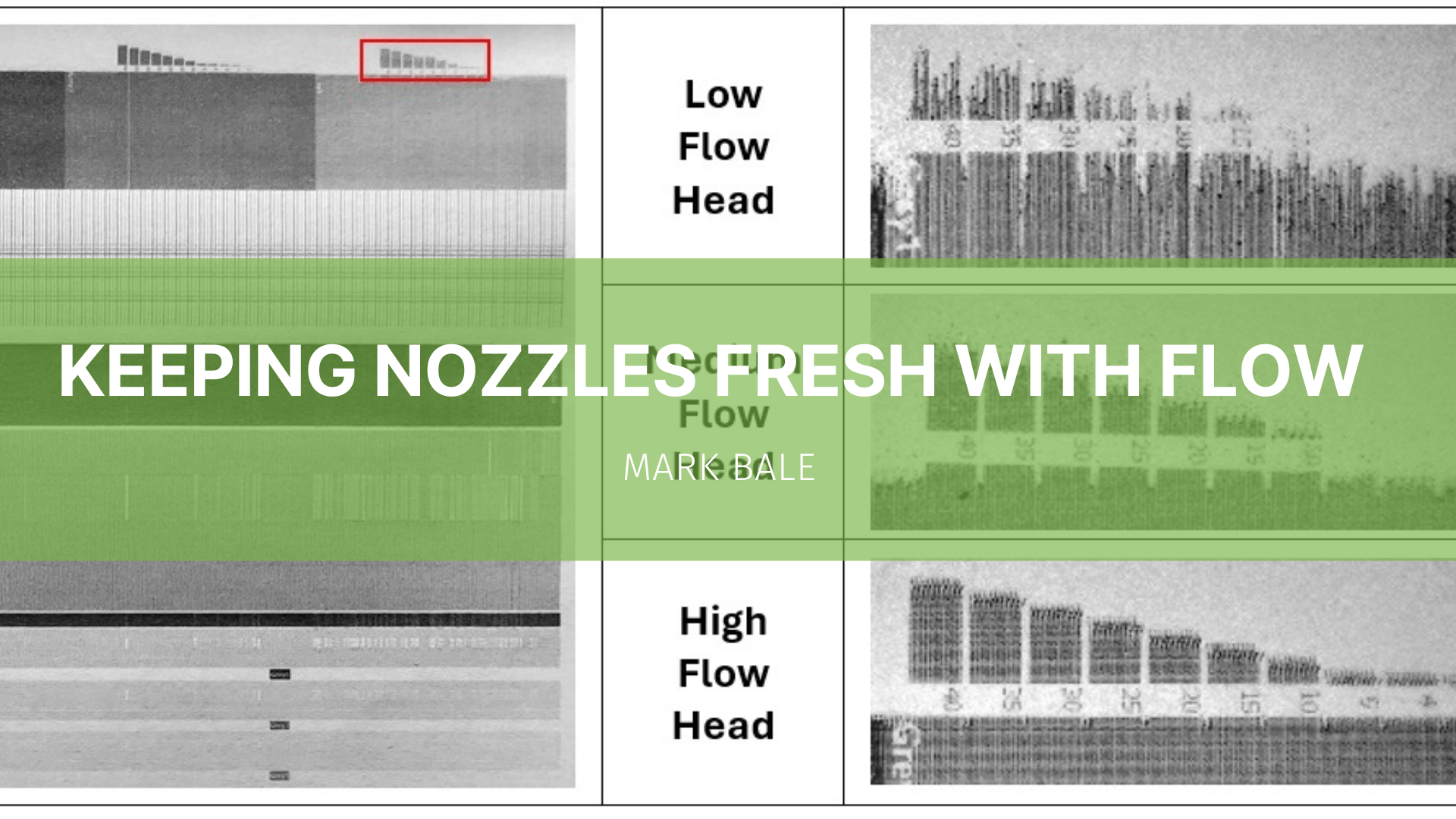
While the traditional inkjet market drive to ever smaller nozzles, ceramics has pushed the other way, demanding larger drop sizes driven by the desire to print effects. This relies on printing glass fits themselves, not just the pigment. Tiles with matte, gloss and satin detail could be produced by adding extra heads into the printer layout. Such finishes allow for some convincing reproductions of wood grain, for example. This means the designer can mimic the look and feel of wood without the maintenance, especially when combined with underfloor heating. The challenges of such materials have again pushed printhead development, with Dimatix now producing a higher flow variant of their Starfire head that is used in printers from System SpA.
Ceramics as Additive Manufacturing
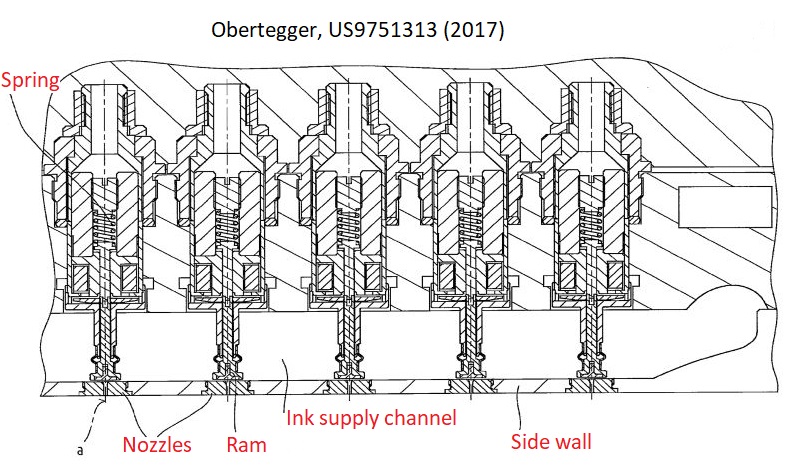
Despite the piezo head advancements to provide 100-200pL at 360DPI there is still a desire to increase the volume even further with the aim of achieving a complete digital production line involving deposition of glazes to allow for structured prints. The machine manufacturers therefore turned initially toward valve-jet type designs that are common in large character coding and certain textile applications. In valve-jet, the ink is generally pressurized behind an actuated valve seal which opens to let some of the fluid out. Back in 2014, Sacmi and Colorrobia both show the capability at the Tecnargilla using the prototype Xaar 001 head. Since then, Durst commercialized their RockJet® (see picture) and other OEMs, like Kerajet, have also made their own solutions. Although generally lower in nozzle density, these large nozzle technologies more than make up for this with volume to achieve glaze coverages ~ kg per m2.
Since it too much detail for this introductory post to look at this any further we will postpone any further discussion on very large drop size and powder printhead technologies until a future article!
The thing to remember is that suppliers are not making the printing line digital just for the sake of it. The new technology allows new designs to be taken one step further in term of deposition. Of different materials with endless design options for combining topography, colour and effects, including sticking powders or “grits” by the use of inkjet deposited glues. Production lines are becoming fully digital.
All about Design
We like to use as an example the picture below we found in a photo archive. Wood is a common example that we already mentioned, but older ceramic surfaces and chipped items can also be re-created with near-infinite variation in texture and color to create interior designs mimicking real dereliction.
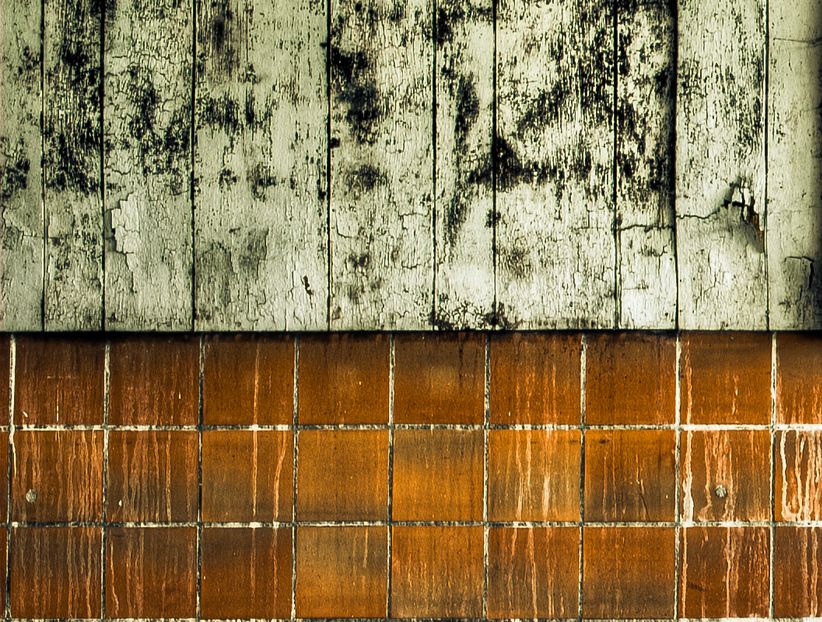
Of course, the ceramic market has also adopted standard wide-format printer and inks (like UV-cured) in some niche applications. Mohawk tiles, for example, print a sandwich of ink and a primer/overcoat to decorate the edges of already-fired tile whilst Italian finishing experts Cefla have decorating lines for ceramics using UV inks post firing.
The 3D scanning of real surfaces to re-create such materials is a whole complementary industry for decorative surfaces as a whole. We will pick up the wider topic of decorative/topological surface printing another time. In the meantime, let us know what you think of this post by leaving a comment.