The dynamics in packaging print are obvious, there is a trend towards shorter runs and more just in time production. The reasons are numerous:
- More fragmented markets
- More brands
- Taking out inventory in the supply chain
- Reacting quickly on market demand
- Promotions
- Test marketing
For folding cartons the changes might be even more pressing, as folding cartons are the most varied type of packaging material and extremely present on the retail shelves. The more striking is the lack of printing solutions today.
Drupa 2016 felt like it was the packaging inkjet drupa with a range of solutions previewed and presented. A lot happened since, or in cases did not happen. While Heidelberg pulled out of the Primefire business in 2020, other vendors did not even bring out their presses previewed 5 years ago. It has been a bumpy ride for Koenig & Bauer as well. With Durst the company found a new partner for the inkjet imaging unit, which even resulted in the Koenig & Bauer – Durst joint venture, not only covering the VariJET, but also the single-pass inkjet corrugated presses and possible future inkjet products.
Unveiling the Press
On the 14th of October 2021 the wait finally had an end, with the official launch of the VariJET 106. As in the first announcement the VariJET 106 is a B1 format folding carton press. Dimensions are impressive with a 28m length and 4.1 m height. The press is built on the Rapida 106X basis. The imaging unit is designed by Durst, and inks, workflow and RIP are provided by Durst as well. Feeder, delivery, printer, coating unit use the Rapida technology from Koenig & Bauer. Like the latest Rapida presses the VariJET can be operated from a mobile device, like a tablet. The press also fits Koenig & Bauer’s infrastructure for remote service, data analytics and factory workflow. Remarkably Koenig & Bauer also provides the priming fluid, based on experience gained with their corrugated inkjet press.
[caption id="attachment_4998" align="aligncenter" width="1854"]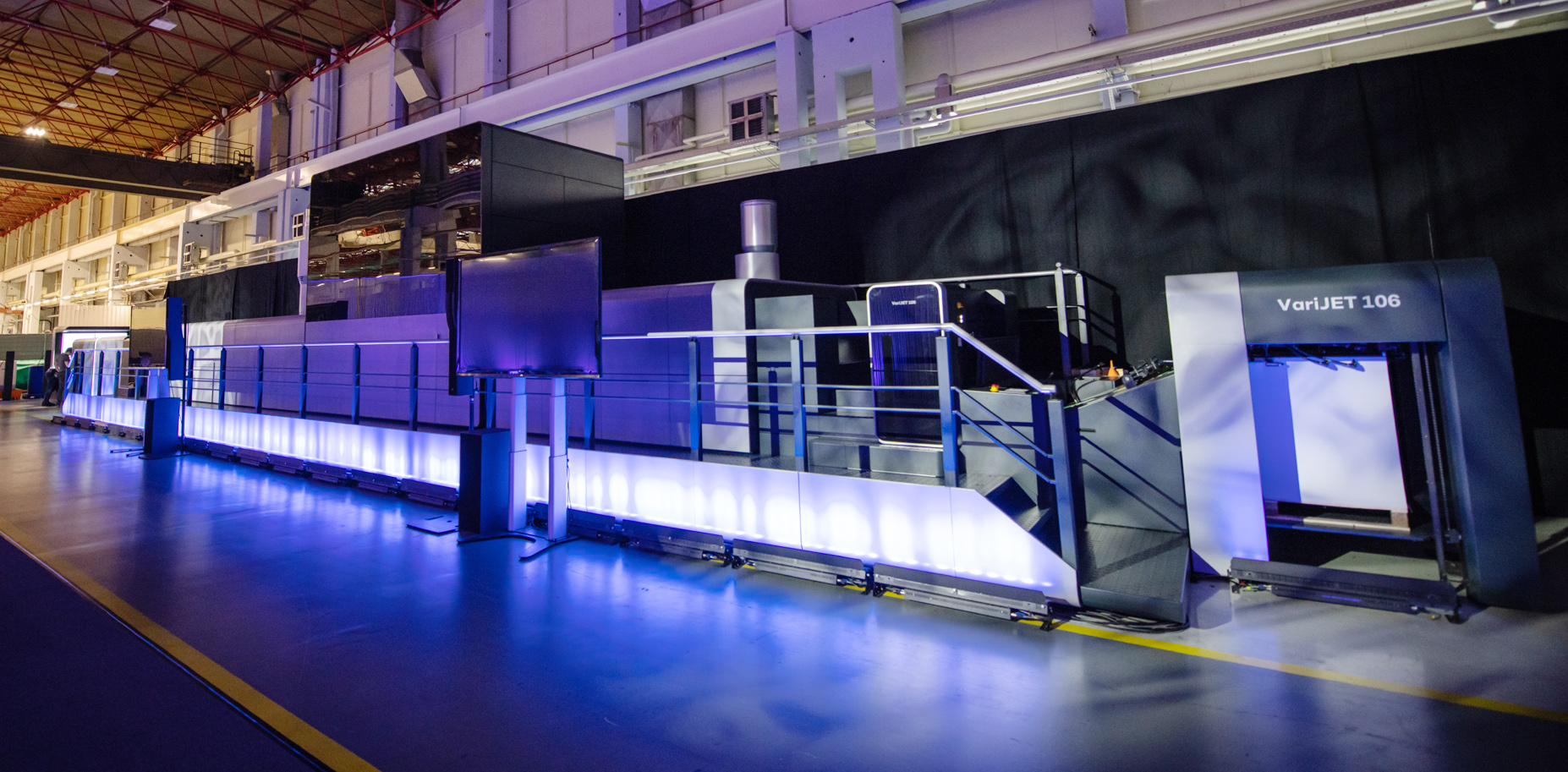 VariJET 106 demo[/caption]
The inkjet heads are sourced from Fujifilm Dimatix – interestingly the same supplier to all B1 folding carton presses. Durst provides the cleaning and capping technology. Lifting the heads vertically for cleaning and capping results in the considerable height of the inkjet tower. In turn this reduces the depth of the press compared to other concepts. A high-resolution inline scanner is standard and checks every sheet to compensate for any nozzle problems.
The drier for the inkjet unit uses a combination of IR and hot air. The primer and coater have separate driers.
B1 Inkjet folding carton presses
|
Heidelberg Primefire 106 |
Koenig & Bauer VariJET 106 |
Landa S10 / Komori NS 40 |
|
|
Format |
B1 |
B1 |
B1 |
|
No of Colours |
7 |
7 |
7 |
|
Imaging resolution |
1,200 x 1,200 |
1,200 x 1,200 |
1,200 x 1,200 |
|
Coating unit |
1 |
1 – potentially additional units in future |
1 |
|
Substrate range |
170 – 450 gsm 0.2 to 0.6 mm |
0.2 to 0.8 mm |
0.06 to 0.8 mm |
|
B1 sheets / hour |
2,500 or 4,500 at lower resolution |
5,500 |
6,500 (13,000 planned) |
Print quality
With a 1,200 by 1,200 resolution and a 7 colour ink set the VariJET has all prerequisites to provide a very high image quality. Samples provided show good colour saturation and Pantone matching without noticeably inkjet artefacts. The company was even confident in handing out samples right from the back of the press during the live demo. 5 different jobs with change on-the-fly were printed, only briefly interrupted by a semi-automatic change of the spot-varnishing plate. All sample sets in runs from 50 to 500 sheets were printed at full press speed.
[caption id="attachment_4999" align="aligncenter" width="2560"]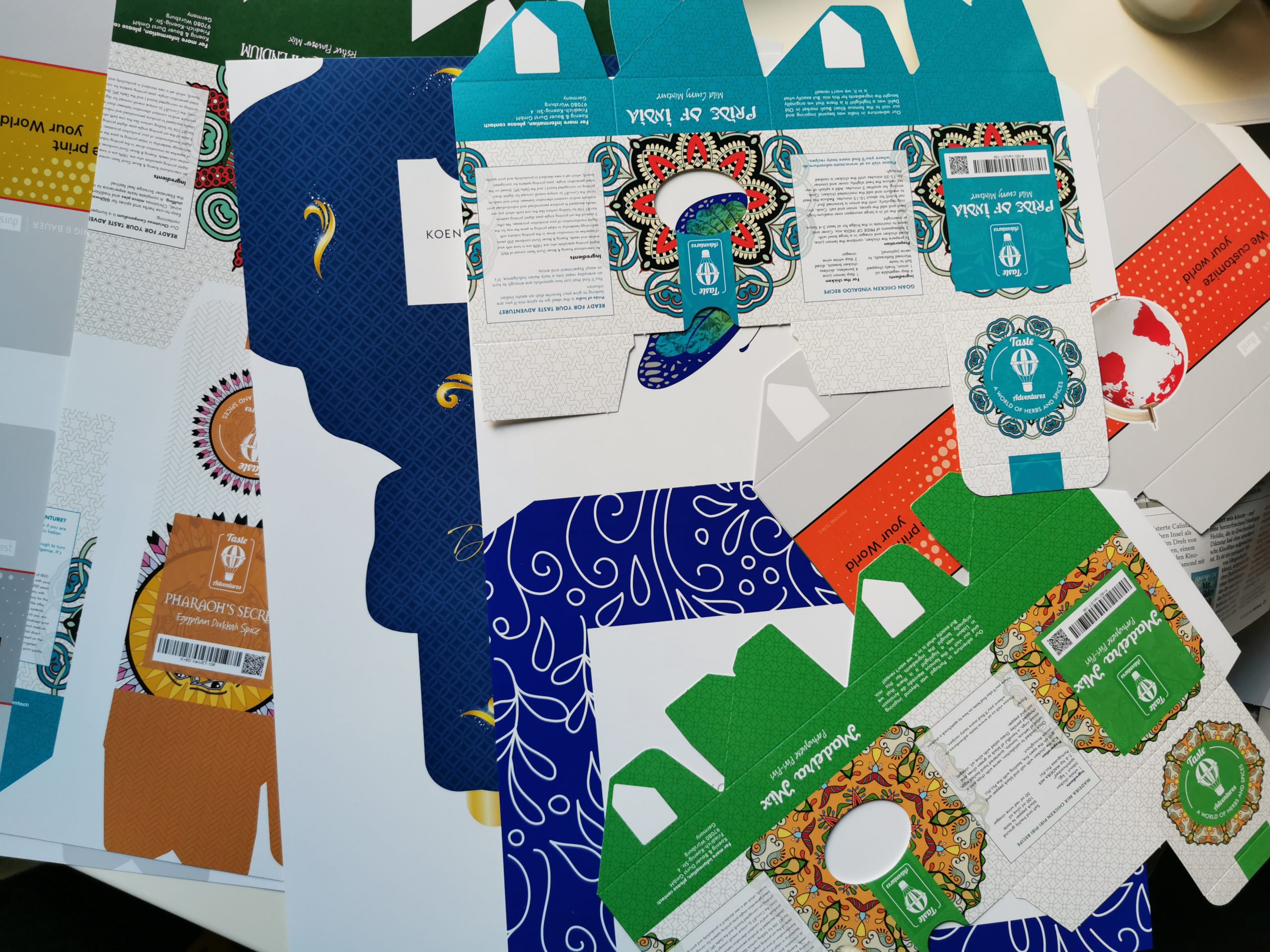 Print samples[/caption]
Koenig & Bauer pointed out the very good colour to colour register of the inkjet print, allowing even fine negative print. A suction metal belt is holding the sheet in place during inkjet printing and drying.
The press is equipped with seven colours, however there is space for an 8th imaging unit. Depending on customer feedback Koenig & Bauer will look into options, e.g. adding white ink.
The press is currently targeted at fibre based substrates. The company does not anticipate speed reduction for high coverage. Yet the full range of substrates has to be determined during the planned tests.
A modular press concept
Like the presses from Landa and Heidelberg the VariJET is built on a B1 sheetfed offset press base. However, to a greater extent than the other two concepts, Koenig & Bauer is following a modular approach. Initially as a base model the press is equipped with a primer unit before the inkjet module and one coater. However, there are considerations for a lot more options. Anticipated is already offering a second coater, which is a frequent requirement in folding carton print.
Koenig & Bauer can draw from a large set of other modules in the B1 format. Possibilities are single preprint units (flexo or offset) or even a complete set of offset units. Like in the Rapida 106X cold foiling could be a possibility and surely multiple coating and driers are an option. A bit more far-fetched, but nevertheless an interesting opportunity could be integrating rotary die-cutting and creasing as used in the Koenig & Bauer’s CutPRO X. In discussions with first users and prospects Koenig & Bauer Durst will decide which future options will be offered.
Next steps
The press shown at the presentation will be used for rigorous testing in the upcoming 12 months on site in Radebeul before being shipped to the first beta site. The company receiving the press is still unnamed. In the upcoming tests substrates, quality, drying and more will be tried.
In 2022 at least one other beta press will be installed. Availability of the first series models is expected for end of 2022 or early 2023. The press will be available in Europe and the US first, with global availability at a later point of time.
The press at the demo is a pre-series model. It is likely the final product will have some tweaks and changes in the specs. It is even possible that the press will shrink somewhat, when components are getting optimised.
The VariJET 106 seems like a rock-solid product. Not only the length, also the weight of 21 tons are indicators. The press is designed for 24/7 operation. This will require a constant stream of short run jobs – as personalisation in packaging will remain an exception for quite some time. A critical factor will be the break-even against offset, when considering the total process costs of a job (not just the print costs). This calculation is notoriously difficult as it depends a lot on ink coverage and on other factors like labour cost, substrate, plate cost, waste, factory overhead and more. In sample calculations Koenig & Bauer expects the VariJET to be efficient for runs of more than 5,000 sheets against a Rapida 106, which would open up quite a number of jobs. A high utilisation, the relatively high press speed and reasonably priced consumables will be prerequisites for this. With a base price of under €4 million the press is not cheap, but within the expected range and in a 24/7 operation the investment costs are a lesser factor.
Targeted are hybrid environments where the VariJET sits alongside offset presses and takes on the shorter runs, freeing the offset presses from inefficient work. Sales for the VariJET will be in the hands of Koenig & Bauer, which can consult customers whether inkjet or offset will be the right solution. Koenig & Bauer Durst developed analytics tools to guide that decision.