Digital textile printing continues to grow. Estimated at 6% of global textile printing, research firm Smithers anticipates continued growth in the sector to drive a 10% market penetration by 2026. The current low market penetration does not translate to a lack of demand. Like most new technologies, Digital Textile Printing needed time to demonstrate its reliability and value before progressing on the product technology curve. Digital textile printing will grow as it addresses consumer demand for product customization as well as production challenges around sustainability and inventory management.
In traditional printing, pigment is the predominant ink chemistry. To date, digital textile printing has been dominated by dye sublimation printing on polyester fabrics. There remains pent up demand for pigment-based digital textile printing as the process avoids downstream production steps of washing and steaming. Avoiding washing and steaming reduces production costs as well as energy and water usage. Some digital textile printers have pursued high speed pigment textile printing in the roll-to-roll format. One considerable challenge to adoption has been high levels of with printer maintenance due to a tendency for pigment inks to clog nozzles. Some companies have expressed frustration with manual processes related to nozzle and plate cleaning. Printheads are expensive and buyers want to avoid a need for early replacement so maintenance is a focus. Purging ink to clean nozzles before starting up a printer and wiping nozzle plates are typical activities along with monitoring temperature and humidity in the print room
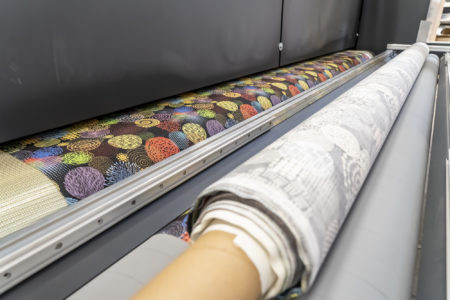 The highest speed single pass machines predominantly print reactive dye. Large home furnishing printers have been hesitant to risk the extra maintenance of trying pigment printing in single pass machines. The market has been begging for a solution that prints bright colors and jet blacks on-demand at high production speeds without manual maintenance. With the rapid growth of inkjet printing in textile home furnishings throughout the pandemic, printer operators are ready for improved printer maintenance solutions that reduce downtime.
This month, EFI Reggiani answered the market’s call with its third new digital textile printer of 2021 – the EFI™ Reggiani HYPER. Compatible with both dye and pigment ink options, the HYPER promises to deliver prints at up to 13 linear meters per minute in two-pass production mode, making it the fastest textile scanning printer on the market and significantly faster than EFI’s previous 2021 scanning and single-pass press launches (covered below). The HYPER offers speed while also minimizing manual maintenance. EFI Reggiani partnered with Kyocera to design a new print head with recirculating ink flow to ensure nozzles are always wet and never dry out. This has the potential to eliminate nozzle drying and related clogs that have been so problematic and costly in the past. The contactless wiping system prevents ink drying on nozzle plates and prevents potential nozzle damage from manual nozzle plate cleaning. Ink temperature is also controlled in the Hyper to ensure consistent quality and reliability. This has the potential to reduce operations headaches of humidity and temperature control. The new printer is now commercially available worldwide.
“We are especially excited about filling out our portfolio with a very dependable, very fast printer that delivers greater throughput than other scanning printers,” said EFI Reggiani Senior Vice President and General Manager Adele Genoni. “Thanks to a unique design for its 72 printheads – which recirculates ink up to the heads’ nozzle plate – and the legacy EFI Reggiani continuous ink recirculation system, HYPER is also a champion for uptime and reliability, maximising printer availability for production with excellent printing results.”
One of the other production challenges HYPER may resolve for some textile print houses is the challenge of having fast speeds and a price-point that enables multiple installations to ensure a production back-up. Companies seeking the fastest speeds and highest productivity in the past purchased high speed, single-pass printers often priced over $1 million. With the large footprint and high initial capital investment, most installations started with one single-pass machine. If the machine was shut down for maintenance, there was no back-up. Other print production operations chose redundancy over speed investing in multiple scanning head machines to ensure at least one was always running. While specific pricing has not yet been released, Hyper is positioned to deliver the highest speeds in its class, coming close to single-pass production speeds, with a scanning-head machine price tag.
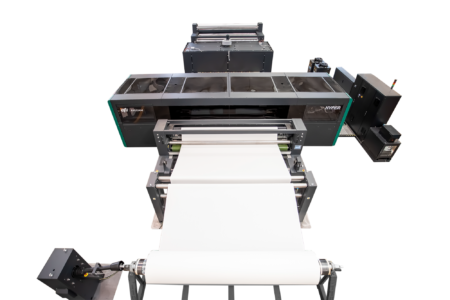 The EFI Reggiani HYPER printer highlighted features include:
• 72 recirculating print heads with 600-dots per inch (dpi) native resolution and full variable drop size.
• Recirculation of ink up to the nozzle plate along with an innovative printhead maintenance system featuring contactless wiping. The proprietary, auto-calibrating continuous ink recirculation system reduces maintenance at start up and during production.
• A double bridge that provides stability and accuracy, while ensuring easy carriage access for printhead maintenance.
• Multiple printing modes, including EFI Reggiani’s legacy high uniformity printing modes, to ensure outstanding quality and extreme design versatility.
• Proprietary EFI Reggiani electronics and software with real-time image processing. The software does not require image pre-calculation time prior to printing enabling design changes to be made on the fly with a complete WYSIWYG (what you see is what you get) experience.
• A precision Kevlar® conveyor belt with an embedded magnetic device for adhesive application, supported by EFI Reggiani’s longitudinal belt movement control to ensure optimal and accurate belt movement at high speed.
• Several fabric feed and take-up options, including an oscillating brace for folding, a small roll winder up to 400 mm, or a big roll winder up to 1,600 mm.
• An industrial dryer with symmetrical ventilation and high-efficiency exhaust capacity powered by gas, electricity, oil or steam options.
HYPER fits well in the EFI Reggiani digital printer line-up, serving as a very fast scanning head machine for those not yet ready for single-pass production, but who are well beyond initial market entry. For those print shops investing in automation, the HYPER fully integrates into industry 4.0 (Internet of Things/IoT) projects and its software uploads data to ERP systems.
For print operations seeking high speed single-pass printing, EFI Reggiani launched the Bolt in the fall of 2018 and announced significant upgrades in June 2021. The Bolt is noted for high speed production worthy of the home furnishings market. Capable of speeds up to 90 meter per minute, the Bolt is a single pass press compatible with pigment inks. EFI has launched a combination of hardware and software enhancements to minimize artifacts, compensate for missing nozzles that may occur over time and enhance uniformity. In addition to smoother solid colors, the upgrade also delivers improved quality and smoother gradients. From an operational perspective, it enables faster printhead replacement and drastically increases file processing speed by up to 200% for large, complex files. Bolt sports a maximum print width of 1950 millimeters. The Bolt is said to have five installations in place, four in Pakistan and one in Italy.
For those print houses looking to get a start in digital textile printing, EFI Reggiani announced the Blaze earlier in 2021 as an entry level scanning head, roll-to-roll printer. The Blaze is designed to print up to 185 centimeters printing width with 8 print heads in two rows for a printing resolution of 600x1200 dots per inch (dpi). It comes with a continuous ink recirculation system and a maximum print speed of 125 linear meters per hour.