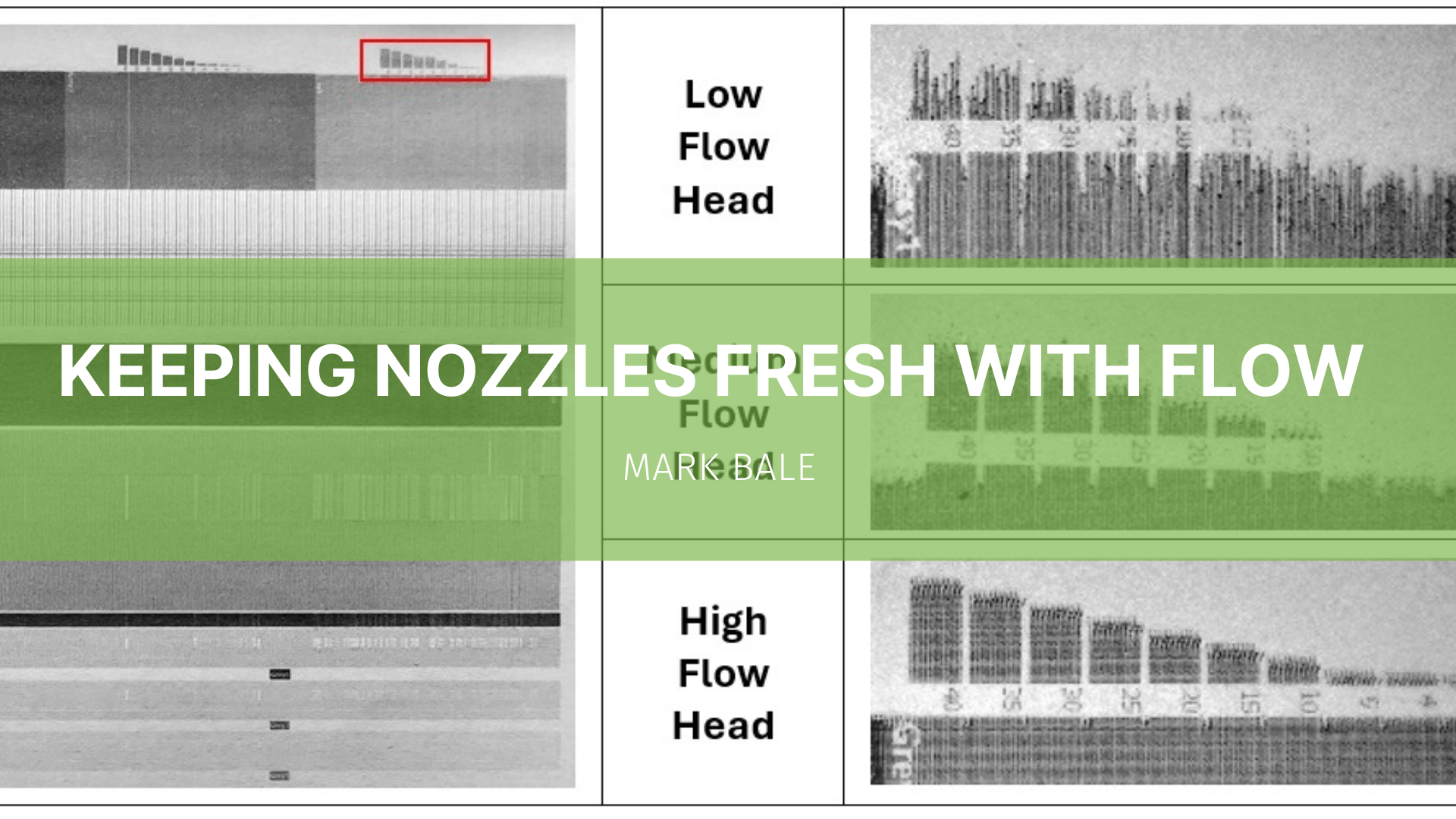
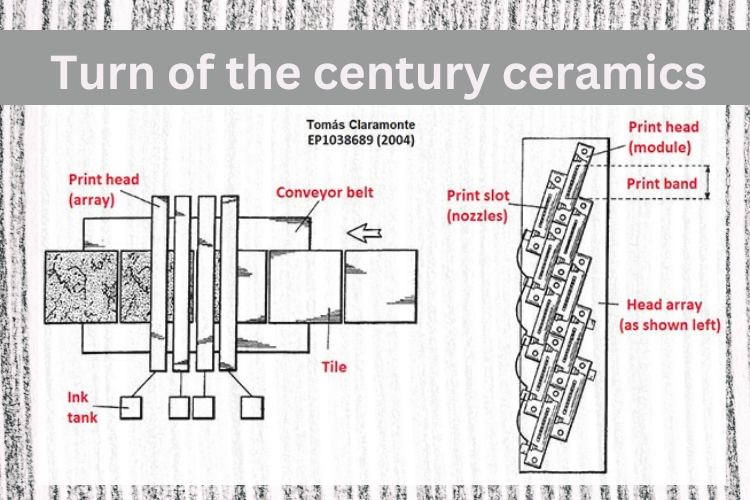
In our 2020 inkjet printing series we looked at some of the challenges of single pass printing hardware and the ink properties that underpin optimisation. In this post we will reference this subject again, by discussing how more sophisticated hardware & software can maintain image quality.
The Inkjet Paradox
Inkjet has found its way into many industrial applications because of the ever-increasing capabilities of speed and ink choice, combined with the non-contact nature of the deposition. However, since inkjet printing typically relies on arrays of nozzle to deposit ink in a controlled array of droplets, the effect of nozzles that are blocked or deviating is one of the biggest barriers to early adoption in new markets. Unfortunately, this seems to be common quite often.
Improving print head design, including recirculation, has improved the reliability of systems, especially those using faster drying water-based inks. Predicting failure and dealing with it sooner by preventative maintenance is also an important part of quality control. Even with a state-of-the art nozzle cleaning system there is still an inevitability about degradation in the print from streaks or density variation linked to specific head defects, or even heads of different age.
The role of compensation methods is to basically hide those visual errors by choosing which nozzles for which to turn off the print data and then other nozzles to turn on (or drive harder) to help hide the gaps.
Multi-Pass Example & Redundancy
This is not a new problem of course. Nozzle maintenance and compensation has been a feature of home-office printers for a long time. For almost thirty years inkjet machines have used regular capping and spitting type and wiping to keep the head working. And until recently, with the advent of pagewide printers, any nozzle failures could be hidden by the ability to make multiple passes. In the schematic below we provide a simple view of how a pixel grid can be filled by a 4pass “checkerboard” print interlace. You can image that if the print head take more passes on the substrate, like 16, then any missing nozzle gets less noticeable. The only penalty is time to make the print.
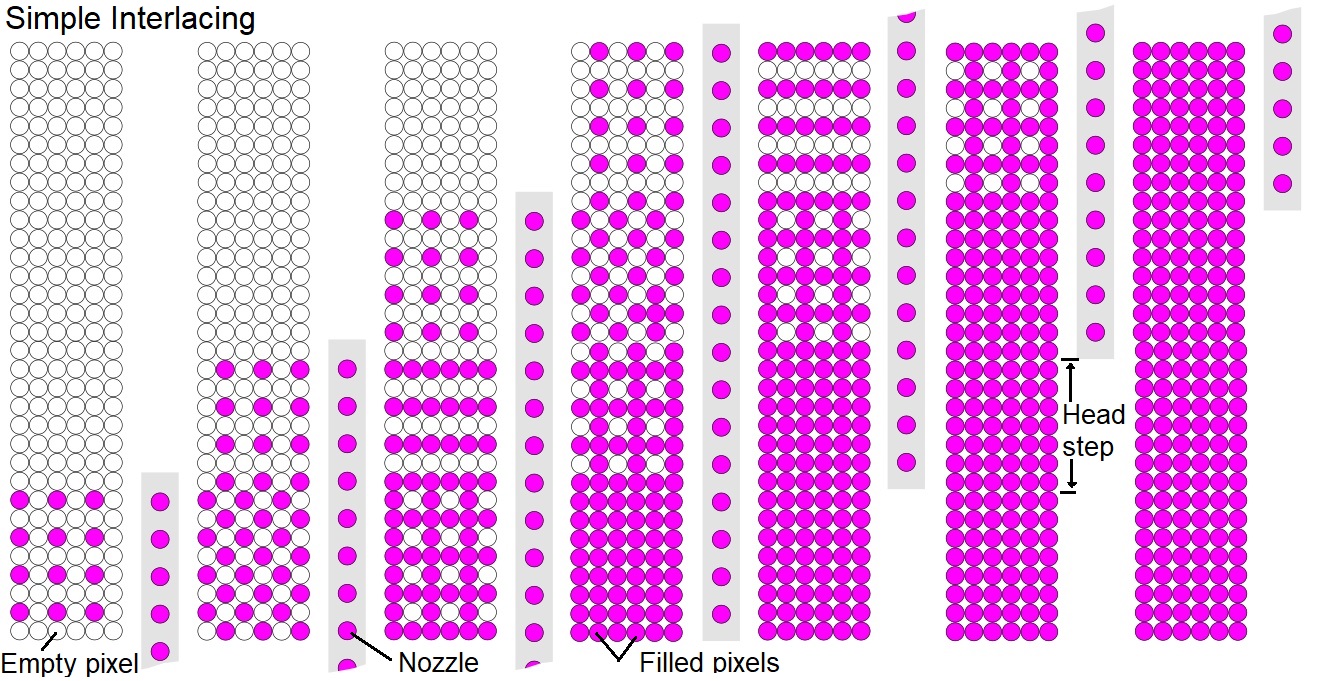
In industrial wide format, the multiple-pass approach continued to make things a little easier, but printer OEMs went one step further and introduced a “passive” compensation into the pattern generators, so that nozzles that were noted by the operator as not working, could be intentionally avoided in the interlace pattern (or print mask).
Doing this without ink voids requires applying more passes than required by the pixel resolution thus creating what we call “redundancy”. This is when more ink is applied than required by the process.
Single-Pass
In single-pass printers the issue is, there is not the same chance to print the same pixel row with a different nozzle on the next pass. The redundancy either comes from having a whole row of other nozzles available, just in case they are needed, or by having extra volume from adjacent nozzles (or sometimes even nozzles from other colors). In the image below shows examples of different types of redundancy and what compensation they make possible.
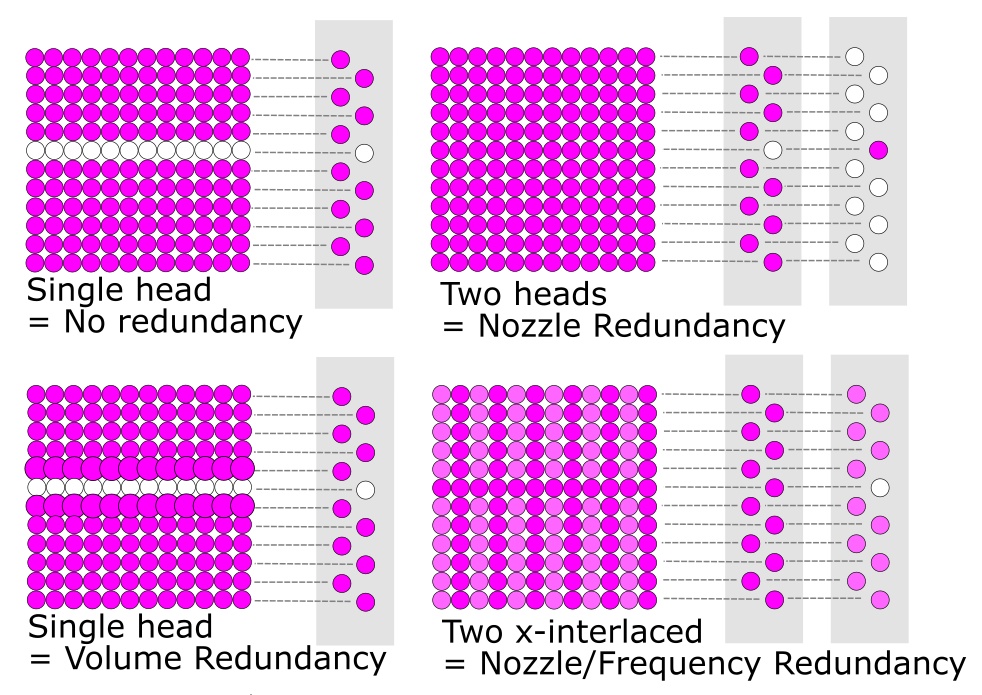
As shown in our top-right example, the simplest solution is to apply more nozzles than you need for the process in case one fails. However, this can be an unacceptable cost depending on the head technology. It is more realistic for thermal printheads and the Versapass Memjet heads, for example, the possibility of having 5x redundancy when used with a single color. The advantage of having full nozzle redundancy is that correction can be performed even when several nozzles in a row have problems.
In Piezo DoD systems, including those for commercial print and for paper packaging, it has been more common to get the redundancy from droplet volume, as shown the bottom-left example of our schematic. Printers using the Fuji Samba printhead are a good example. In these schemes, the nozzle next to the one not working are used to deposit a little extra ink of the same colour using an extra grey level. If there is enough spread in the substrate, the effect fills in the otherwise very noticeable white gap. It is also possible to tweak adjoining pixels to smooth density even further.
Not surprisingly, this type of compensation is easier when there is absorption, like on paper, than non-absorbent materials such as films. The limitation of this approach is that is difficult to correct for anything more than isolated missing jets or the ink voids become too big to fill by spread.
Our final example, on the bottom right, where print heads are normally sharing the job of printing the pixel grid. If the head is not being run at max frequency, then the remaining working nozzle in a row can be used to fire twice as often. In some printers however, the two rows of heads are used to share the resolution in the print direction with the aim of printing faster. Under these conditions the ability to fully substitute is lost, but the fact that only 50% of the ink is missing can reduce the severity of the defects.
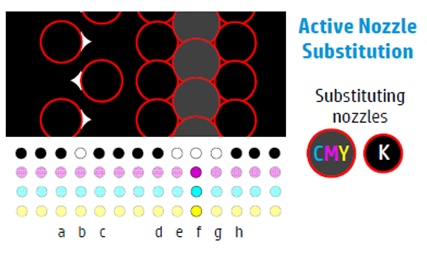
When running with a full process colour set, there are a lot more options that becomes possible depending on the colour that is missing. For example, mixtures of CMY can be used to replace a missing black nozzle in the same pixel line rather than adjacent ones, and this can help boost the effect of the neighbouring nozzle substitution. This effect as shown in the schematic below from HP’s white paper on PageWide™ printing.
Optical Feedback & Active Substitution
The discussion above considers only the origin of the drop that prints each pixel and not the process of deciding what needs fixing. We have already mentioned passive compensation for multi-pass, some single-pass printers and hardware which allow this based on known, repeatable, missing jets. What really makes nozzle compensation powerful however is the ability to make corrections on-the-fly. This involves some optics to detect the print defects, as shown in the image below of the Inca Speedset™.
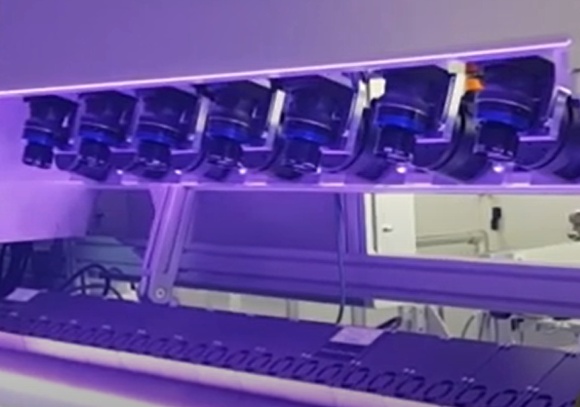
The regular printing of a nozzle check or density pattern is captured by the optics and used to determine which nozzles are not working. Highly customised software then implements the necessary adjustments to the pixel image data to make the compensation.
The advantage of these systems, whether passive or active, is that they can also correct for color banding issues related to differences between print head, both in terms of droplet volume, but also slight variations in mechanical alignment, such as rotation. Although these technologies are sophisticated and therefore often increase the cost of inkjet system development, they can substantially reduce the amount of downtime needed for operators to fine-tune settings when replacing print heads, improving the return on investment by maximising productivity.