One of the largest and oldest players in the industrial inkjet space is Xaar. I write this article as a user who has worked with Xaar technology over many years for many industrial inkjet projects.
For over 3 decades, Xaar has specialized in piezoelectric print heads. Piezo revolutionized the inkjet print industry as the only print head which could successfully jet solvent and UV-cured inks. Jetting low viscosity inks allowed inkjet to move into industrial manufacturing areas which previously had a time-consuming setup and expensive consumables such as screens and pad printing clichés.
I have used Xaar print heads with various ink chemistries for metal, glass, wood, and plastic materials throughout my consulting career. But the years working with Xaar were not always easy, so I was excited to have a candid conversation with John Mills, CEO of Xaar.
[caption id="attachment_4267" align="alignleft" width="278"] John Mills, Xaar CEO[/caption]
New Direction, New Look
I was impressed with John’s down to earth personality and genuine passion for change. We openly discussed Xaar’s history of offering limited options to integrators who needed help with connecting the puzzle pieces of ink and print engines, heads, and compatible inks. John took over as CEO from Doug Edwards in 2019 to take the company in a new direction. He is focused on applying his experience as a development scientist, director of development, COO and CEO at companies such as Domino, Inca Digital and other key inkjet providers to steer Xaar’s course. This “new direction” starts with a new, fresh, and innovative look representing movement.
Moving Beyond Evaluation Kits
Historically, Xaar provided limited assistance to customers with figuring out the complex compatibility challenges involved with inkjet development. This created some confusion on what inks and engines were compatible with Xaar print heads.
“In the past, we sold other print heads besides Xaar which created confusion on support.” Said John. “We have now eliminated this confusion by only selling Xaar’s portfolio of print heads, and have developed partnerships with ink manufacturers, as well as, providing solutions to help our customers go to market faster.”
I was curious as to what Xaar’s “new direction” would be for helping customers move forward with integration issues other than print head performance and particularly, support for customers who need to integrate inkjet in-line with product manufacturing. These customers have more challenging requirements for ink and jetting than decorative printers. John noted that Xaar’s future is dependent on ensuring support for finished applications and not just being a single part of the process.
“We have companies coming to us who have fantastic competence in what they produce, but no competency in inkjet, because they've never done it before. They've got great people, great products that they want to produce, but it's not obvious to them that there's anybody out there who's producing complete inkjet systems that meet their requirements,” says John. “Our preferences are for an OEM to supply the end-user, but often companies want to develop it themselves. They have multiple sites, multiple lines and jetting requirements so Xaar will help them develop a more in-depth, integrated solution using our technology by creating strong partnerships with our compatible partners.”
[caption id="attachment_4268" align="alignright" width="283"]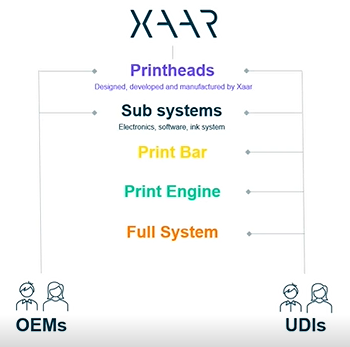 Xaar- Providing Solutions for OEM and Custom Development[/caption]
Xaar is working closely with print engine players such as Meteor and Global Inkjet Systems (GIS) and the Royals in China to ensure that RIP providers are fully up to speed with supporting their printheads. Closer relationships with software and other sub-system partners enable better support of OEMs and UDIs (User Developer Integrators) throughout the inkjet product development lifecycle.
One of the reasons consultants like myself are so busy in the industrial inkjet space is that manufacturers who are developing bespoke inkjet systems struggle with variables in a customer’s manufacturing process as well as the graphic workflow. Most integrators are not familiar with ink to substrate changes, color management, or creating the correct graphic files for the inkjet process for the RIP they may be using.
Going forward, Xaar intends to provide solutions and support the customer through final print. But it will take time. John explains, “For us to do that, we've got gaps in our organization that we need to fill. We're going to fill those gaps through a combination of organic growth and hiring people. We are looking to partner and add skills of applications, support, and integration for all those things that we do to support the customer. Internally, we are not necessarily that strong in this area today, but partnerships with the right companies and acquisitions will expand our capability to deliver that.”
Inkjet development is hard enough but having to pinpoint issues that are not related to your products can be difficult and time consuming. It is easy to immediately suspect the print head since it is responsible for the jetting and making the visual print defect. However, there are many other complex ink compatibilities for the print head and the substrate which could be causing jetting un-reliability. Working in partnership is a good step towards resolving complex problems, but a standardized, coordinated approach is also required.
Xaar’s Five Step Program
John stresses, “When OEMs or integrators are working to develop a system it is important that we are involved at the beginning of the process. We have to ensure we understand the full process and a customer’s print and process expectations in order to make it easier on the integrator.” Xaar has developed a five-step process to help customers understand and validate whether an ink is going to work. It includes:
- Fluid evaluation
- Jetting optimization
- Sample production
- Application development
- Controlled support
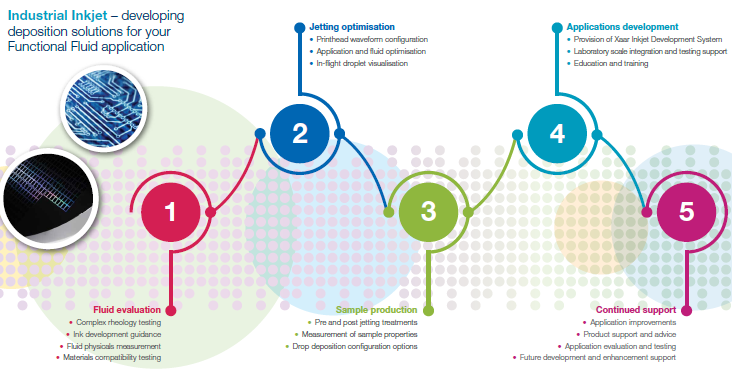 Xaar’s 5-Step Process for Ensuring Print Head Reliability throughout Product Development[/caption]
Ensuring ink compatibility with the head is a big aspect of jetting reliability, especially for the industrial inkjet markets where inks are required to do more than just jet. John mentions, “Xaar offers advanced rheological capabilities to advise people on their ink chemistry and advise when the jetting could be improved.”
Xaar measures parameters of the ink to test the incredibly high shear rates going through the nozzles. Their methods of measuring and testing in house, dynamic viscosity is to understand the elastic effects that have a big impact on the jetting. They will advise people on changes of molecular weight that may be needed in an ink to change jetting properties based on an application. At the end of this five-step process, they should have a qualified ink for their application.”
What About Wave Forms?
Being familiar with the properties of the ink is one thing, but how to achieve accurate jetting and drops by coding electricity pulses compatible with the printhead is completely different. Wave forms determine drop volume, velocity, and trajectory based on the kH firing frequency. This part of the puzzle is most often overlooked or misunderstood when developing custom inks for bespoke projects. If wave forms are not customized to the printhead requirements, drops will break and jet incorrectly leaving malformed drops, tails, and satellites.
[caption id="attachment_4270" align="aligncenter" width="750"]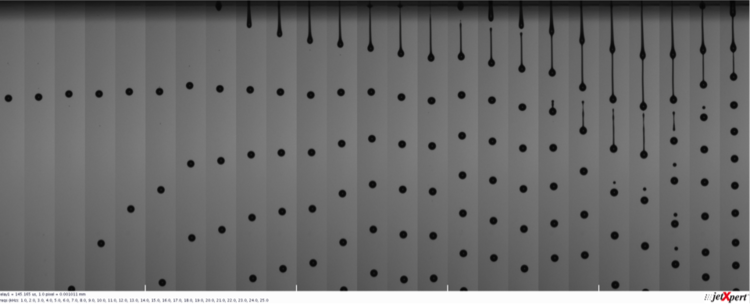 From left to right: correcting firing frequency. Last right column: correct firing drop and velocity[/caption]
In the past, when working with Xaar to develop wave forms, there were a limited number of people writing them. The lack of resources caused delays in development and product roll out. John agreed that there were problems, “Well, there's reasons for that. One is, bandwidth and one is confidentiality.”
When asked if Xaar will open up the wave form development process to developers, the short answer was no. Xaar is not ready to give away their secrets just yet. They are incredibly happy to work with an integrator or an OEM on waveform development, but Xaar wants to handle the design of complex, pulse handling, waveforms specific to their heads and compatible fluids.
“In terms of bandwidth, we have done a lot with [waveforms], because as you know it is a unique skillset and we have expanded this area” noted John. “But we want to make sure that when we develop a wave form, we have some competitive advantage.”
Integration Requires Front-to-Back Support
Inkjet integration is not an easy process and understanding all the parts are crucial to the success of the project. When developing any process which includes inkjet, remember that it is a puzzle where all parts must be compatible with the substrate, starting with the heads and ink. Integration into a manufacturing process requires accurate jetting, wet-out, drying/curing at speeds compatible with the process. Although printing is the last 90% of the process, do not forget the first 10%. The print is only as good as the data and imagery being converted into those little ink drops. Designing, color assignments, color space, profiles, and rip compatibility are just as important as the print hardware of the process. Partner with manufacturers who not only help with development but understand and can provide training on the entire process.