(Read the original press release here.)
Background
Ricoh is not a newcomer to production inkjet. Beginning with the creation of the InfoPrint Solutions Company, a joint venture between Ricoh and the IBM Printing Systems Division in 2007, they were on a path to becoming a significant player in the production inkjet press market. Beginning with InfoPrint 5000 and evolving and growing through intense efforts in plants in Japan and Boulder, Colo., they have released many new presses and innovations with the most recent being the VC70000, their premier continuous-feed press. Unlike some of their digital printing machine competitors, like Canon, Fujifilm, and Xerox, Ricoh has not had both a continuous-feed and a cut-sheet production inkjet press in the market. While continuous-feed inkjet has been growing for a while, the real future growth will be in cut-sheet presses.
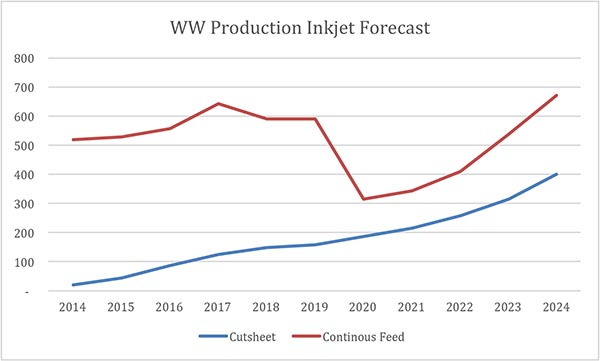
©IDC, 2020
The adoption of continuous-feed inkjet was dependent on the replacement of less efficient continuous-feed toner presses, but never really had that much of an impact on offset or even cut-sheet toner migration in commercial print. Cut-sheet inkjet brings cut-sheet offset and toner media selection variability to inkjet which will provide more impetus for migration to support the demand for short-run jobs.
Ricoh has been working on this press since before 2017, so to some, this highly anticipated news has been one of the worst-kept secrets. It wasn’t like they didn’t realize they needed a cut-sheet production inkjet press; it was that they wanted to introduce one that could stand out in a market where others were already developing an installed base. The digital B2+ market share is still led by HP with their liquid toner Indigo 12000, now updated to the 100K, while Konica Minolta and Fujifilm have been gaining traction with their inkjet presses. In the A3 inkjet space, according to IDC, for 2020 to date, Xerox holds the lead with their Brenva/Baltoro platform with Canon coming in a close second with their VarioPrint i300 and iX. So how do you create a product that can compete and even stand out in this market? In the case of Ricoh, they start with Henkaku, the company’s culture of transformational innovation. The rough translation from the Japanese is “revolutionary change.”
Ricoh Pro Z75
Ricoh knew that this press had to be a game changer. So as a late-comer, how do you compete with both the existing B2+ and A3 presses in the market at the same time? Ideally you need to create a lower cost B2+ press, that will deliver the productivity and print quality that Ricoh is known for, at a price that will compete with the A3 presses in the market. That way, as a print service provider. you get the best of both worlds.
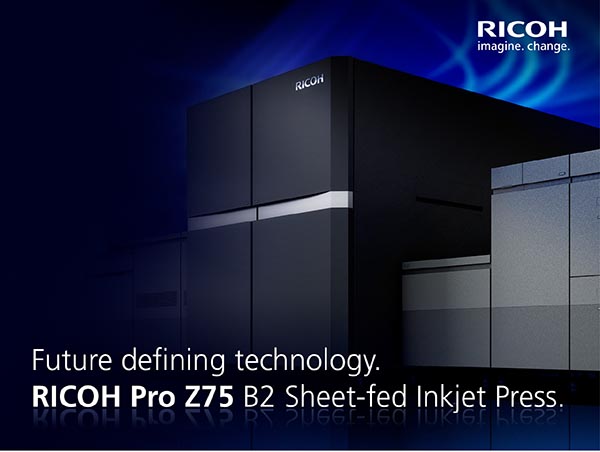
The RICOH Pro Z75 was developed from the ground up and is manufactured in-house by Ricoh in Japan. From what we know, and what we can surmise—since all of the details haven’t been revealed—the press would need to meet certain criteria to be competitive. While the press quality is achieved through the use of Ricoh printheads with dynamic drop sizes, it would need to support a resolution of at least 1200 dpi to be competitive. It uses their aqueous pigment ink and may or may not need undercoating (primer) along with Ricoh’s in-house-developed drying technology, which if similar, as evidenced in the VC70000, is one of the most efficient available today. To support both commercial print and packaging requirements, the press would need to support both input drawers and pallets. The auto-duplexing press supports offset coated, uncoated, and inkjet-treated media. To compete with the existing presses in the market, the press would need to run at a minimum of 4,000 simplex B2+ sheets per hour, making it faster than the HP 12000 (not the 100K), the KM-1, and the Fujifilm 750S. That translates into about 8,000 A3 simplex pages per hour, making it more productive than the current A3 competition.
As is the case with most of the Ricoh presses, it will probably be supported with either a Ricoh or EFI scalable DFE to support variable data requirements.
Summary
With the entry of Ricoh into the market with a cut-sheet B2+ press, the adoption of cut-sheet inkjet will undoubtedly increase. We expect that others are working hard to bring many more cut sheet production inkjet solutions to market.
More details on the Ricoh Pro Z75 press will be revealed in early 2021.
More to Come…
With 2021 on the horizon, I would like to address your interests and concerns in future articles as it relates to the manufacturing of Print, Packaging, and Labels, and how, if at all, it drives future workflows including “Industry 4.0.” If you have any interesting examples of hybrid and bespoke manufacturing, I am very anxious to hear about them. Please feel free to contact me at
[email protected] with any questions, suggestions or examples of interesting applications.
About WhatTheyThink
WhatTheyThink is the global printing industry's go-to information source with both print and digital offerings, including WhatTheyThink.com, WhatTheyThink Email Newsletters, and the WhatTheyThink magazine. Our mission is to inform, educate, and inspire the industry. We provide cogent news and analysis about trends, technologies, operations, and events in all the markets that comprise today's printing and sign industries including commercial, in-plant, mailing, finishing, sign, display, textile, industrial, finishing, labels, packaging, marketing technology, software and workflow.